
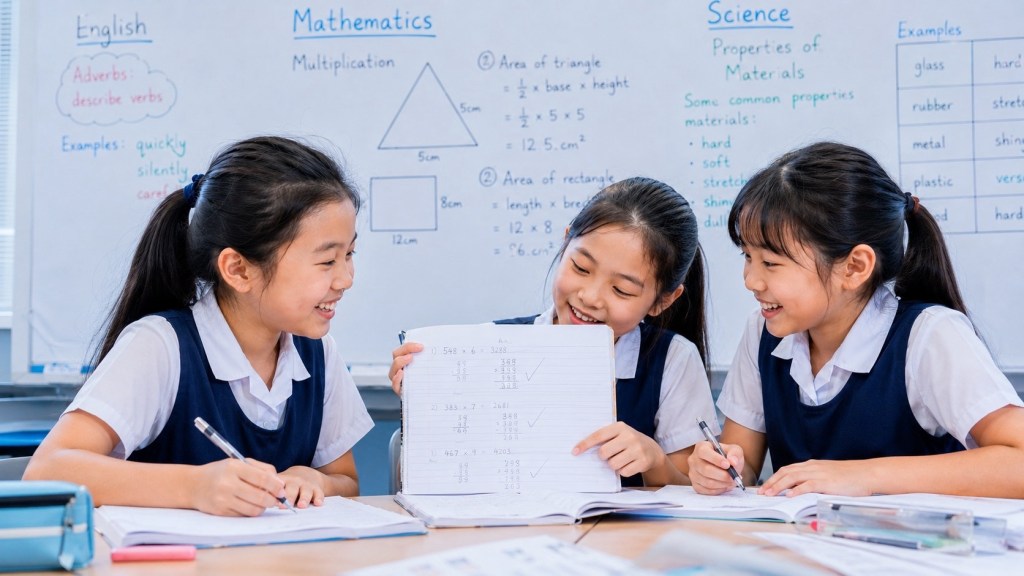
Primary 1 operations should begin with meaning, not symbols. Before a child becomes fast with +, − and ×, the learner needs to understand the situations those symbols describe. Addition can combine parts or increase a quantity. Subtraction can take away, find what remains or compare two quantities. Multiplication begins with equal groups. Division begins with sharing or grouping.
This guide is the second part of the Primary 1 Mathematics Learning Hub. It builds on number sense, counting and place value and develops the operation relationships that later support bar models, fractions, ratio, algebra and multi-step problem solving.
The operation sign should be the result of understanding the relationship, not the first thing the child chooses.
Why Operation Meaning Matters
A child can memorise 7 + 5 = 12 and still not know when addition is appropriate. Another child can subtract accurately in a number sentence but fail a story in which the difference between two quantities must be found. The weakness is not always calculation. It may be interpretation.
Primary 1 is the right place to make the distinction visible. Calculation fluency and problem interpretation should grow together. One answers “Can the child perform the operation?” The other asks “Can the child recognise when that operation represents the situation?”
Addition: Parts Becoming a Whole
The simplest addition structure combines two or more parts into one whole. Three red counters and four blue counters make seven counters altogether. The number sentence 3 + 4 = 7 records that relationship.
But addition can also describe an increase. If Amir has 5 stickers and receives 3 more, the starting quantity changes from 5 to 8. The mathematical result is still 5 + 3 = 8, but the story structure is different. Exposing both structures prevents the child from believing that every addition question must contain the word “altogether”.
Worked Example 1 | Two Addition Stories, Same Number Sentence
Story A: There are 6 apples and 2 oranges in a basket. How many fruits are there?
Story B: Lina has 6 beads. Her friend gives her 2 more. How many beads does Lina have now?
Both situations can be represented by 6 + 2 = 8. In the first, two parts combine. In the second, an initial quantity increases. The arithmetic is the same; the relationship is not identical. Ask the child to describe the difference.
Subtraction: More Than Taking Away
Subtraction is often introduced as removal: 9 birds are on a fence, 3 fly away, and 6 remain. This is useful, but incomplete. Subtraction can also find a missing part or compare two quantities.
- Take away: 9 − 3 = 6 because 3 are removed from 9.
- Missing part: 9 is the whole, one part is 3, so the other part is 6.
- Comparison: one group has 9 and another has 3; the difference is 6.
These three meanings matter later because word problems often hide subtraction inside comparison or missing-part language. A child trained only on “take away” may hesitate even when the calculation itself is easy.
Worked Example 2 | Difference Without Taking Away
Jia has 11 marbles. Ben has 7 marbles. How many more marbles does Jia have than Ben?
No marbles are removed. The problem compares two quantities. The difference is 11 − 7 = 4. Jia has 4 more marbles than Ben.
Ask the child to explain why subtraction is appropriate even though nobody gave away or lost anything. That explanation reveals whether operation meaning is secure.
The Equal Sign Means Balance, Not “Write the Answer Now”
At Primary 1, the symbol = should be taught as “has the same value as”. If children learn it only as an instruction to calculate whatever is on the left, they may later struggle with number sentences such as 7 + 3 = __ + 4.
For 7 + 3 = __ + 4, the left side has value 10. Therefore the right side must also have value 10, so the missing number is 6. This simple idea prepares the learner for equations. Equality is a relationship between two expressions, not a command to stop thinking.
Number Bonds: See the Whole and Its Parts
Number bonds help children see addition and subtraction as related. If 8 is the whole and 5 and 3 are the parts, several facts are connected:
- 5 + 3 = 8
- 3 + 5 = 8
- 8 − 5 = 3
- 8 − 3 = 5
The learner should not memorise these as four unrelated lines. They arise from one part–whole structure. This is the beginning of fact families and inverse reasoning.
Addition and Subtraction Are Inverse Relationships
Inverse operations undo one another. If 7 + 4 = 11, then 11 − 4 = 7. This relationship helps with checking, missing-number problems and mental calculation.
Worked Example 3 | Missing Number Through Inverse Thinking
Find the missing number: 8 + __ = 13.
A child may count on from 8 until reaching 13. That is acceptable. A more connected route is to ask: “13 minus 8 gives what missing part?” Since 13 − 8 = 5, the missing number is 5.
Both routes should point to the same structure. The goal is not to ban counting but to build more efficient relationships around it.
Adding More Than Two One-Digit Numbers
When three or more small numbers are added, Primary 1 learners can begin to choose useful groupings. For 4 + 6 + 3, the pair 4 + 6 makes 10, so the calculation becomes 10 + 3 = 13. This is more efficient than counting all thirteen one by one.
Teach children to look for structure before starting from the left automatically. Useful structures include making ten, doubles, near doubles and known number bonds.
Mental Calculation Within 20
Mental fluency grows from a small set of connected strategies rather than from speed pressure alone.
- Count on from the larger number: 8 + 3 becomes 9, 10, 11.
- Make ten: 8 + 5 becomes 8 + 2 + 3 = 13.
- Doubles: 6 + 6 = 12.
- Near doubles: 6 + 7 is 6 + 6 + 1 = 13.
- Use inverse facts: if 9 + 4 = 13, then 13 − 9 = 4.
- Use complements: think of how far a number is from 10 or 20.
Different children may prefer different efficient routes. The teacher’s job is to make several strategies visible, then help the learner choose rather than force one method into every problem.
Adding and Subtracting Two-Digit Numbers
Place value should remain visible when work extends within 100. For 34 + 20, the ones do not change. Three tens become five tens, giving 54. For 57 − 4, the tens remain five and the ones change from seven to three, giving 53.
When a written algorithm is introduced, it should not replace meaning. The learner should know why digits are aligned by place and why regrouping changes the representation without changing the quantity.
Worked Example 4 | Place Value Before Procedure
Calculate 42 + 5.
42 is four tens and two ones. Add five ones: two ones plus five ones gives seven ones. The four tens stay unchanged. Therefore 42 + 5 = 47.
This reasoning is short, but it protects the place-value structure. A child who understands it is less likely to misalign digits later.
Multiplication Begins With Equal Groups
Primary 1 multiplication should first answer the question: What makes repeated groups multiplicative? The groups must be equal in size. Three groups of four objects can be seen as 4 + 4 + 4 and represented as 3 groups of 4.
Do not rush immediately to tables. Let the child build equal groups, draw them, count the total and describe the relationship. The multiplication symbol becomes meaningful when it compresses a structure the learner already understands.
Worked Example 5 | Equal Groups
There are 4 plates. Each plate has 3 biscuits. How many biscuits are there?
The groups are equal: 3 + 3 + 3 + 3 = 12. The child can also describe this as four groups of three. The total is 12 biscuits.
Now change one plate to contain 2 biscuits. Ask whether the situation can still be described as four equal groups of three. The answer is no. This contrast makes the condition of equal grouping explicit.
Division Begins With Sharing and Grouping
Two foundational division structures are useful.
- Sharing: 12 objects are shared equally among 3 children. How many does each child receive?
- Grouping: 12 objects are placed into groups of 3. How many groups can be made?
Both can produce the same numerical result in suitable examples, but the unknown is different. Sharing asks for the size of each group. Grouping asks for the number of groups.
Worked Example 6 | Same 12, Different Division Question
Sharing: 12 pencils are shared equally among 4 pupils. Each pupil receives 3 pencils.
Grouping: 12 pencils are packed 4 in each packet. Three packets can be made.
The child should not only give 3. Ask what the 3 represents in each story. In one it is pencils per pupil; in the other it is number of packets.
Operation Language: Useful, but Never Sufficient Alone
| Language that may appear | Possible relationship | Warning |
|---|---|---|
| altogether, total, in all | often addition | still read the whole situation |
| left, remaining | often subtraction | may involve a missing part |
| more than, fewer than | comparison | identify which quantity is larger |
| each, every | may signal equal groups | check that group sizes are equal |
| shared equally | division | decide whether group size or number of groups is unknown |
Keywords can support reading, but they should not replace it. The learner should be able to explain the relationship in ordinary language before choosing the operation.
How to Check an Operation Answer
- Use the inverse operation where appropriate.
- Estimate whether the answer should be larger or smaller than the starting quantity.
- Return to the story and attach the correct unit or object.
- Use counters or a drawing if the symbolic answer feels uncertain.
- Ask whether the result is possible: sharing 5 sweets equally among 10 children cannot give each child 2 sweets.
Common Misconceptions to Repair Early
- “Addition always makes numbers bigger.” At this level with positive whole numbers it often does, but the deeper idea is combining or increasing; later mathematics broadens the rule.
- “Subtraction means taking away.” It can also find a missing part or a difference.
- “The equal sign means the answer comes next.” It means both sides have the same value.
- “Multiplication is repeated addition with any groups.” The groups being counted must be equal in the basic model.
- “Division always means sharing.” It can also mean forming equal groups of a given size.
- “The first operation I see in the chapter must be the one to use.” Mixed practice should force the learner to choose from meaning.
A Strong Practice Sequence
For each operation, practise in several directions rather than one.
- Story to objects: act out the situation.
- Objects to drawing: record the structure pictorially.
- Drawing to number sentence: translate the relationship into symbols.
- Number sentence to story: invent a situation that matches it.
- Missing part: remove one value and solve for it.
- Contrast: compare two similar-looking questions that require different operations.
- Transfer: revisit the idea after a delay in mixed practice.
Turning a number sentence back into a story is particularly useful. If a child can create a valid story for 12 − 5 = 7, they are showing more than computational memory. They are demonstrating operation meaning.
A Short Diagnostic Set
- Show 7 + 5 with a drawing and solve it.
- Write two subtraction facts connected to 7 + 5 = 12.
- Explain why 9 − 4 can describe a comparison.
- Solve 6 + __ = 10 and explain the missing part.
- Add 4 + 6 + 3 using an efficient grouping.
- Calculate 52 + 4 using place-value reasoning.
- Build 3 equal groups of 4 and state the total.
- Share 12 objects equally among 3 groups.
- Make groups of 3 from 12 objects and say how many groups are formed.
- Invent a story for 14 − 6 = 8.
Again, the pattern matters more than the score. A child may calculate all ten accurately but fail to explain the relationship. That learner needs conceptual linking, not more of the same drill.
What Parents Can Do at Home
- Use small real situations: sharing fruit, arranging equal groups, combining toy sets, comparing quantities.
- Ask “What does the operation mean here?”
- Practise number bonds and make-ten strategies in short bursts.
- Ask for a second way to solve a simple calculation.
- Reverse questions: give 13 and 5 and ask the child to invent both an addition and subtraction story.
- When an answer is wrong, ask for the first place the story or representation stopped matching rather than only correcting the arithmetic.
Checkpoint | Are Operations Becoming Mathematical Rather Than Mechanical?
- Can the learner explain addition as combining or increasing?
- Can the learner explain subtraction as taking away, missing part or comparison?
- Can the learner use number bonds to connect addition and subtraction facts?
- Does the learner understand = as equality?
- Can the child use make-ten, doubles or counting-on strategies within 20?
- Can the learner add or subtract simple two-digit and one-digit quantities while preserving place value?
- Can the learner recognise equal groups?
- Can the learner distinguish sharing from grouping in simple division situations?
- Can the learner choose an operation from the relationship rather than one keyword?
- Can the child check an answer by returning to the original story?
How This Connects to Measurement, Geometry and Data
Operations do not live only in number sentences. Children add and subtract money, compare lengths, reason about time, count equal groups in shapes and interpret differences in picture graphs. The next guide moves these relationships into the physical and visual world.
Continue with Primary 1 Mathematics Learning Guide | Money, Length, Time, Shapes and Picture Graphs.
Final Thought
Primary 1 operation fluency is important, but the most valuable fluency is not only speed. It is the ability to move quickly between a situation, a representation and a valid operation while preserving meaning. A child who can do that is building a foundation that later mathematics can trust.
First see the relationship. Then choose the symbol. Then calculate. Then return to the relationship and check.
Return to the Primary 1 Mathematics Learning Hub.
