
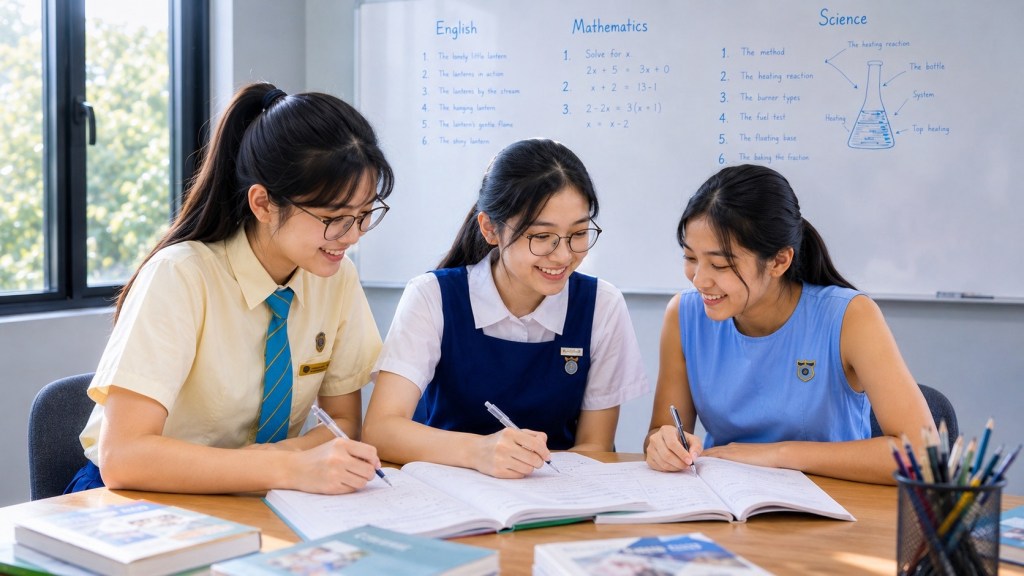
Strong foundations. Clearer thinking. Confident progress from Primary 1 to Primary 6.
A child can complete a page of Mathematics questions and still not fully understand the concept behind them.
They may remember a familiar method when the numbers and wording look the same. The difficulty begins when the question changes its presentation, combines several topics or asks the child to decide which method should be used.
This is where many Mathematics problems begin.
It is not always a lack of effort. It is often a missing connection.
At eduKate Sengkang, Primary Math tuition is designed to help students form those connections. We teach children to understand what the numbers represent, recognise the mathematical relationship within a question and select an appropriate strategy with greater confidence.
Students who need support are guided back to the earliest concept that is holding them back. Students who are already performing well are given broader and more demanding problems so that they continue developing.
A good tutor does not force every child down the same narrow path.
The lesson should meet the student where they are, establish the next secure step and gradually open a clearer route forward.
What Does It Mean to Master a Mathematics Concept?
Mastery is more than obtaining the correct answer.
A student has begun to master a concept when they can:
- explain what the concept means;
- recognise it when the question is presented differently;
- connect it to concepts learned earlier;
- choose a suitable method without excessive prompting;
- complete the working accurately;
- check whether the final answer is reasonable; and
- apply the same idea in an unfamiliar problem.
Singapore’s current Primary 1 to Primary 6 Mathematics syllabus places mathematical problem-solving at the centre of learning. It is supported by five closely connected areas: concepts, skills, processes, metacognition and attitudes. (Ministry of Education)
This matters because strong Mathematics students do not simply calculate quickly. They understand, interpret, reason and make decisions.
The current PSLE Mathematics assessment objectives reflect the same progression. Students are expected to recall mathematical knowledge, apply concepts in different contexts, analyse information, make inferences and select appropriate problem-solving strategies. (Isomer User Content)
A well-designed Primary Math tuition programme should therefore do more than provide additional worksheets. It should improve the quality of the child’s thinking.
Why Primary Students Struggle with Mathematics
Mathematics is cumulative.
New learning is usually built upon earlier learning. A child who is uncertain about number bonds may later struggle with mental calculation. A child who does not understand multiplication as equal groups may find fractions, ratio and area more difficult. A child who cannot translate a word problem into a mathematical relationship may know several formulas but remain unsure which one to use.
The visible mistake may appear in today’s topic, while the actual weakness began much earlier.
This is why repeatedly practising the latest worksheet does not always solve the problem.
The child may be working harder without repairing the part of the subject that is causing the difficulty.
The problem may be conceptual
The student can follow a demonstrated method but does not understand why it works.
The problem may be procedural
The student understands the idea but makes frequent errors while calculating, organising working or applying a formula.
The problem may be linguistic
The student can perform the Mathematics but struggles to interpret the wording of the question.
The problem may be structural
The student understands each individual topic but cannot connect several concepts within a multi-step problem.
The problem may be confidence
The child has experienced enough difficulty that they now expect Mathematics to go badly. They rush, avoid difficult questions or stop thinking as soon as the answer is not obvious.
The correct response depends on the cause.
This is why effective Mathematics tuition begins with observation and diagnosis rather than assumptions.
Different Students Need Different Routes
A Primary Mathematics class may contain three children of the same age who require very different forms of teaching.
One may be struggling with earlier concepts.
Another may understand classroom lessons but lose marks through weak application and careless working.
The third may already score highly but require greater depth and challenge.
Giving all three students exactly the same worksheet is convenient, but it is not necessarily useful.
At eduKate Sengkang, the tutor adjusts the route while keeping every student moving towards the appropriate curriculum goals.
For Students Who Need to Rebuild Their Foundation
A weaker student does not always need easier work forever.
They need the right work in the right order.
The tutor first identifies the earliest concept that is no longer secure. That concept is then retaught using clearer language, suitable examples and carefully arranged practice.
A child struggling with fractions, for example, may need to revisit equal parts, multiplication facts or the relationship between numerator and denominator before attempting more difficult word problems.
The aim is not to keep the child behind.
The aim is to create a route that allows the child to rejoin level-appropriate work with genuine understanding.
This may involve:
- breaking a complex process into smaller decisions;
- using diagrams or concrete examples;
- comparing correct and incorrect methods;
- reducing unnecessary cognitive load;
- strengthening mathematical vocabulary;
- practising one relationship before combining several; and
- returning to the same concept at planned intervals.
Once the foundation becomes more stable, the tutor gradually increases the complexity.
The student begins to experience something important: questions that once appeared impossible can become manageable when the underlying structure is understood.
That change often restores confidence more effectively than praise alone.
For Students Who Are Coping but Inconsistent
Many Primary students sit in the middle.
They are not completely lost. They may understand most school lessons and perform reasonably well in familiar exercises. However, their results fluctuate.
They lose marks because they:
- misread one condition;
- choose an inefficient method;
- omit a working step;
- confuse two similar concepts;
- calculate too quickly;
- fail to check units; or
- do not know how to begin an unfamiliar question.
These students usually need better organisation.
The tutor helps them build a repeatable approach:
What is the question asking?
What information has been given?
What relationship connects the information?
Which method is suitable?
What should be checked before the answer is finalised?
Over time, the student becomes less dependent on guessing.
They learn to pause before calculating, represent the problem clearly and make a deliberate choice.
This is often the point at which an average student begins moving towards consistently stronger results.
For Strong Students Who Need a Wider Challenge
A student who performs well should not spend every lesson repeating questions they can already complete.
Accuracy and fluency remain important, but strong students also need to develop flexibility.
They should encounter questions that ask them to:
- compare several possible methods;
- explain why a method works;
- solve non-routine problems;
- identify hidden assumptions;
- work backwards;
- generalise a pattern;
- connect different topics; and
- improve the elegance or efficiency of a solution.
The purpose is not to make every lesson unnecessarily difficult.
It is to prevent high-performing students from becoming dependent on familiar question templates.
A child who only practises known formats may appear strong until the presentation changes. A child who learns to reason across different formats has a much wider mathematical range.
At eduKate Sengkang, stronger students are moved beyond repetition into deeper application. Their corridor becomes wider: more strategies, more connections and more ways to approach a problem.
This prepares them not only for higher marks, but also for the increased abstraction and algebraic thinking they will encounter in secondary school.
Primary Math Tuition in Sengkang for Every Stage of Primary School
The character of Mathematics changes as a child moves through primary school.
The teaching approach should change with it.
Primary 1 and Primary 2 Math Tuition: Building Number Sense
The early primary years establish the language of Mathematics.
Students learn to understand quantities, number relationships, basic operations, shapes, measurements and simple data. These concepts may appear elementary to adults, but they become the foundation for almost everything that follows.
A young child may be able to recite an addition fact without having a secure understanding of the relationship between the numbers.
For example, knowing that 8 + 7 = 15 is useful. Understanding how 8 can be completed to 10 before adding the remaining 5 creates a more flexible number sense.
In Primary 1 and Primary 2 Math tuition, we focus on helping students:
- see numbers as quantities and relationships;
- build reliable addition and subtraction strategies;
- understand place value;
- interpret mathematical symbols correctly;
- explain simple reasoning;
- read questions carefully; and
- develop neat, organised working habits.
At this stage, clarity matters more than speed.
A child who understands the structure of numbers can become faster naturally. A child who is pushed to calculate quickly without understanding may develop fragile methods that become harder to repair later.
The early years should make Mathematics feel orderly, understandable and possible.
Primary 3 Math Tuition: Managing the First Major Expansion
Primary 3 introduces a noticeable increase in mathematical demand.
Students encounter more substantial work involving multiplication, division, fractions, measurement, geometry and word problems. They are expected to retain earlier knowledge while learning to apply several operations more independently.
This is often where parents first notice that a child who was previously comfortable with Mathematics has started to hesitate.
The issue may not be the new topic alone.
Primary 3 Mathematics places greater pressure on:
- multiplication and division fluency;
- reading comprehension;
- multi-step thinking;
- accurate use of units;
- visual representation; and
- the ability to decide what to do without being shown the method first.
Our Primary 3 Math tuition in Sengkang helps students organise this new learning.
The tutor does not simply demonstrate a solution and ask the child to imitate it. The student is guided to identify what each step represents and why it is necessary.
This prevents multiplication, division and fractions from becoming isolated procedures that the child cannot apply outside a familiar exercise.
Primary 4 Math Tuition: Strengthening the Middle Foundation
Primary 4 is an important consolidation year.
Students now have enough mathematical knowledge to attempt more sophisticated problems, but weaknesses from the lower primary years may also become more visible.
Fractions, decimals, factors, multiples, geometry, area, perimeter and increasingly complex word problems require students to make stronger connections between topics.
Primary 4 is therefore not merely another year of content.
It is the stage at which students should begin becoming more independent mathematical thinkers.
Our Primary 4 Math tuition in Sengkang focuses on:
- securing multiplication and division;
- strengthening fraction and decimal understanding;
- improving the translation of word problems;
- connecting models, diagrams and equations;
- developing systematic working;
- reducing avoidable errors; and
- preparing students for the sharper rise in complexity at Primary 5.
A student who enters Primary 5 with a stable Primary 4 foundation has more mental capacity available for new concepts.
A student who enters Primary 5 while still trying to repair lower-primary knowledge may find the workload much heavier.
This makes Primary 4 a valuable time to correct difficulties before they become urgent.
Primary 5 Math Tuition: The First of the Two PSLE Preparation Years
Primary 5 is where the Mathematics curriculum begins to feel significantly denser.
Students encounter concepts such as percentage, ratio, rate, volume and more demanding multi-step applications. Questions increasingly require the child to combine knowledge rather than treat each topic separately.
This is also when the difference between remembering methods and understanding relationships becomes much clearer.
A student may know how to calculate a percentage but not recognise when percentage is the appropriate tool. They may understand ratio in a direct exercise but become uncertain when ratio is combined with fractions or differences.
Primary 5 Math tuition should not be reduced to early examination drilling.
The first priority is to build a complete and connected understanding of the new upper-primary concepts.
At eduKate Sengkang, Primary 5 students are taught to:
- identify the quantities being compared;
- distinguish between part, whole and difference;
- connect fractions, decimals and percentages;
- interpret ratio accurately;
- understand rate as a relationship between quantities;
- organise multi-step information;
- use models and equations appropriately; and
- explain how each stage of the solution follows from the previous one.
Examination skills are gradually introduced, but they are built upon comprehension.
This creates a more stable runway into Primary 6.
Primary 6 and PSLE Math Tuition in Sengkang
Primary 6 Mathematics requires consolidation, application and execution.
Students must retain concepts learned across several years, recognise them in varied contexts and complete their solutions accurately within examination conditions.
For examinations from 2026, the revised PSLE Mathematics format continues to assess a range of question types across two written papers. Paper 1 is completed without a calculator, while calculators are permitted for Paper 2. Structured and long-answer questions require students to show their methods clearly. (Isomer User Content)
This means effective PSLE Math preparation must develop several abilities at the same time:
Conceptual readiness
The student understands the curriculum and can connect related topics.
Question interpretation
The student identifies what is known, what must be found and which conditions matter.
Strategy selection
The student chooses an appropriate approach rather than applying the first remembered formula.
Calculation accuracy
The student completes operations reliably, with or without a calculator.
Clear presentation
The student shows sufficient working and communicates the solution properly.
Time control
The student knows when to continue, when to check and when to move temporarily to another question.
Emotional control
The student can remain composed when a question looks unfamiliar.
At eduKate Sengkang, PSLE Math tuition is structured to move from topic repair to mixed application and then to increasingly realistic examination practice.
Students do not begin with endless timed papers before they are ready.
First, the weak areas are identified. Next, related concepts are rebuilt and connected. Only then is the student expected to execute those skills under tighter conditions.
This produces more meaningful practice because the child is not merely repeating the same misunderstandings at greater speed.
How a Structured Mathematics Tutorial Works
1. We Identify What the Student Actually Knows
A score tells us that marks were lost.
It does not always tell us why.
The tutor examines the student’s working, hesitation, choice of method and explanation. Two students may give the same wrong answer for completely different reasons.
One may misunderstand the concept.
Another may understand it but make a calculation error.
A third may misread the question.
Accurate teaching begins by distinguishing between these causes.
2. We Repair the Earliest Important Weakness
The tutor returns to the concept that will create the greatest improvement.
This is not necessarily the most recent chapter.
If the child’s difficulty with ratio is caused by weak fraction understanding, additional ratio worksheets alone will not provide a durable solution.
The earlier relationship must be secured first.
This creates a stronger route back into current schoolwork.
3. We Teach the Concept Clearly
The concept is explained through suitable examples, diagrams, comparisons and representations.
Students are encouraged to understand:
- what the quantities mean;
- how the quantities are related;
- why the method is valid;
- when the method should be used; and
- when it should not be used.
Good teaching reduces mystery.
The child begins to see Mathematics as a connected system rather than a collection of unrelated tricks.
4. We Guide the First Applications
The tutor initially provides more support.
Questions are selected so that the student can concentrate on the new relationship without being overwhelmed by unnecessary complexity.
Prompts are gradually reduced.
The student moves from following a solution to producing one.
5. We Test Independent Understanding
The student then attempts questions without step-by-step assistance.
This reveals whether the concept has genuinely transferred.
A child may appear to understand while watching a tutor. Independent work shows whether they can retrieve and apply the idea for themselves.
6. We Correct the Thinking, Not Only the Answer
Corrections are most useful when they explain the cause of the mistake.
Rather than simply replacing a wrong answer with the correct one, the tutor helps the student identify the point at which the reasoning changed direction.
The student learns to ask:
- Did I misunderstand the question?
- Did I select the wrong relationship?
- Was my method correct but my calculation inaccurate?
- Did I omit a unit?
- Does my answer make sense?
A corrected mistake becomes part of the child’s future decision-making.
7. We Revisit the Concept Later
Understanding can appear secure during one lesson and weaken after several weeks.
Important concepts are therefore revisited through mixed practice.
This helps students recognise the concept when it is no longer presented under a familiar chapter heading.
The goal is long-term access, not temporary performance.
Why Small-Group Primary Math Tuition Can Be Effective
At eduKate Sengkang, our small-group tuition model allows the tutor to remain close to each student’s work.
This matters in Mathematics because many important difficulties are visible only in the working process.
A tutor needs to notice:
- where the child pauses;
- which information they underline;
- how they organise the page;
- what method they choose;
- where the first error appears; and
- whether the student can explain the decision.
In a small group, students also benefit from hearing different approaches.
One child may solve a problem with a model. Another may use equations. A third may notice a pattern.
When these methods are discussed carefully, students learn that Mathematics is not always a single memorised route. There may be several valid approaches, each revealing a different part of the problem.
The group remains small enough for individual correction while offering the useful energy of learning alongside peers.
For many students, this creates a calm balance between attention and independence.
Tuition Should Reduce Confusion, Not Add More Work
Parents sometimes hesitate to enrol their child for tuition because the child is already busy.
That concern is reasonable.
Poorly designed tuition can become an additional pile of worksheets without resolving the original difficulty.
Effective tuition should make the child’s overall learning more manageable.
When concepts become clearer:
- homework takes less time;
- revision becomes more focused;
- mistakes become easier to diagnose;
- the child requires less repeated prompting;
- new topics connect more naturally; and
- school lessons become easier to follow.
The aim is not to occupy every available hour.
It is to improve the value of the hours the child already spends learning.
Less confusion. More structure. Better progress.
When Should Parents Consider Primary Math Tuition?
Tuition may be useful when a child repeatedly shows one or more of these patterns:
The child can calculate but cannot solve word problems
This often indicates difficulty translating language into mathematical relationships.
The child remembers methods only when the question looks familiar
This suggests that learning may be based on templates rather than transferable understanding.
Results vary widely between tests
The student may have partial understanding, weak checking habits or difficulty managing unfamiliar questions.
Homework regularly becomes a source of conflict
The child may be carrying unresolved confusion that appears as avoidance, frustration or resistance.
The child has become afraid of Mathematics
Confidence may need to be rebuilt through achievable steps and clearer explanations.
The child is doing well but no longer feels challenged
A strong student may need deeper problems, broader methods and more demanding reasoning.
Primary 5 or Primary 6 has exposed earlier gaps
Upper-primary topics often reveal weaknesses that were less visible in earlier years.
Parents do not need to wait until the child has failed badly.
Early intervention is usually calmer because there is more time to identify, repair and consolidate the necessary concepts.
What Parents Should Look for in a Sengkang Math Tuition Centre
A good tuition centre should be able to explain more than what worksheets it uses.
Parents should consider whether the programme:
- identifies individual learning gaps;
- teaches concepts before increasing question volume;
- provides close correction;
- adjusts the level of challenge;
- develops reasoning as well as calculation;
- revisits earlier learning;
- prepares students for independent work; and
- communicates progress clearly.
The most impressive-looking worksheet is not necessarily the most useful one.
What matters is whether the tutor understands why a particular question is being given to a particular child at that particular stage.
Every exercise should have a purpose.
Why Choose eduKate Sengkang for Primary Math Tuition?
Teaching That Begins with the Child
We do not assume that every student of the same level requires the same lesson.
The tutor observes the child’s understanding, working habits, confidence and present needs before deciding the next priority.
Strong Foundations Before Acceleration
When an earlier concept is weak, we repair it.
When the foundation is ready, we move forward.
This prevents students from accumulating methods they cannot use independently.
Appropriate Challenge for Stronger Students
Students who are already confident are not kept in repetitive work.
They are introduced to wider applications, non-routine questions and more sophisticated reasoning.
They continue growing rather than simply remaining comfortable.
Close Correction in Small Groups
Small-group lessons allow the tutor to follow each child’s working and intervene at the point where the misunderstanding begins.
This is more precise than correcting only the final answer.
A Calm, Structured Learning Environment
Students learn best when they can think without feeling rushed or embarrassed.
Our lessons are purposeful and demanding, but the atmosphere remains calm.
Children are expected to attempt, explain, correct and improve.
Preparation for School, PSLE and What Comes Next
Primary Mathematics should prepare a child for more than the next test.
It should build the numerical fluency, reasoning, accuracy and independence required for upper primary, the PSLE and secondary Mathematics.
A student who knows how to learn Mathematics is better prepared when the subject becomes more abstract.
From “I Don’t Know” to “I Know How to Begin”
One of the most important changes in a Mathematics student is not immediately visible in the score.
It happens when the child stops looking at a difficult question as a closed door.
Instead, they begin to inspect it.
What is given?
What is changing?
What remains the same?
What relationship might connect these quantities?
Can I draw it?
Can I work backwards?
Have I seen the same concept in another form?
The student may not know the complete solution immediately. But they know how to begin thinking.
That is the beginning of mathematical independence.
At eduKate Sengkang, this is what we work towards: students who understand their concepts, approach problems with greater composure and have a clear route for continued improvement.
For the child who is struggling, we find a more secure path.
For the child who is progressing, we strengthen consistency.
For the child who is already strong, we open a wider field of challenge.
Every student moves forward from the right starting point.
Primary Math Tuition in Sengkang: Frequently Asked Questions
Which Primary levels does eduKate Sengkang support?
Our Primary Mathematics tuition supports students from Primary 1 to Primary 6, including upper-primary and PSLE Math preparation.
The lesson emphasis changes according to the student’s level, present understanding and school requirements.
Is tuition only suitable for students who are weak in Mathematics?
No.
Students may attend tuition to repair learning gaps, improve consistency, prepare for the PSLE or develop beyond the standard questions they already manage confidently.
The level of teaching should be adjusted to the child rather than determined only by the child’s current score.
Can tuition help a child who struggles mainly with word problems?
Yes, provided the tuition addresses the actual source of the difficulty.
Word-problem weakness may come from language interpretation, weak conceptual understanding, poor visualisation or difficulty selecting a strategy.
The tutor should determine which of these is affecting the child and teach accordingly.
How early should PSLE Math preparation begin?
Primary 5 is an important foundation year for PSLE preparation because students are learning major upper-primary concepts while integrating knowledge from earlier levels.
Primary 6 then becomes the year for completing the curriculum, repairing remaining gaps, strengthening mixed application and developing examination execution.
Preparation is most effective when it develops progressively rather than beginning with intensive paper practice at the last moment.
Will a stronger student still benefit from small-group tuition?
A strong student can benefit when the programme provides sufficient depth.
They should be challenged to solve unfamiliar problems, compare strategies, explain reasoning and connect concepts across topics.
Repeatedly completing easy questions is unlikely to produce meaningful growth.
What is the main goal of Primary Math tuition?
The main goal is to help the child become a more capable and independent Mathematics learner.
Better results are important, but lasting improvement comes from understanding concepts, selecting methods carefully, presenting work accurately and learning from mistakes.
Master Mathematics with eduKate Sengkang
A child does not need more noise around Mathematics.
They need the right explanation, the right level of challenge and enough careful practice for understanding to become secure.
At eduKate Sengkang, our Primary Math tuition helps students build strong foundations, connect mathematical concepts and approach increasingly complex problems with confidence.
From Primary 1 number sense to Primary 6 PSLE preparation, every lesson is designed to move the student forward with purpose.
Small groups. Close correction. Clear progress.
Enquire about Primary Math tuition in Sengkang and find the right learning route for your child.
Building a strong foundation in mathematics is essential for a child’s academic success. At eduKate Singapore in Sengkang, our Primary Math Tuition program is designed to help students master key math concepts and develop critical problem-solving skills. Through engaging lessons, experienced tutors, and a supportive learning environment, we ensure that students gain the confidence and abilities they need to excel in math.
Primary Mathematics Tuition in Sengkang introduces foundational math concepts in a structured, supportive environment that helps young students build strong skills and confidence. Here are essential math concepts typically covered for primary students:
1. Number Sense and Place Value
- Understanding Numbers: Students learn to recognize, read, and write numbers, focusing on understanding the value of each digit in numbers up to the thousands and beyond.
- Comparing and Ordering Numbers: They practice comparing, ordering, and rounding numbers, foundational skills that help with more advanced calculations later.
2. Addition and Subtraction
- Basic Operations: Mastering addition and subtraction, both with and without regrouping, helps students build a sense of numerical relationships and patterns.
- Problem-Solving with Word Problems: Through word problems, students learn to apply addition and subtraction in real-world scenarios, enhancing their problem-solving abilities and comprehension skills.
3. Multiplication and Division
- Multiplication Tables: Memorizing multiplication tables builds a strong base for future math topics. This foundational skill helps students understand patterns and makes calculations quicker.
- Division Concepts: Students learn about division as the inverse of multiplication, focusing on simple division problems and understanding how to break numbers into equal parts.
4. Fractions and Decimals
- Introduction to Fractions: Students begin by learning about halves, quarters, and other fractions, understanding parts of a whole, and comparing fractional values.
- Basic Decimals: For upper primary, decimals are introduced to show how fractions relate to decimal values. This includes learning place values in tenths, hundredths, and beyond.
5. Measurement and Geometry
- Length, Weight, and Volume: Students learn to measure and compare lengths, weights, and volumes using standard units. This practical skill often includes hands-on activities to make learning interactive.
- Understanding Shapes and Angles: Introduction to basic shapes, symmetry, and angles helps students visualize and understand spatial relationships. They begin to identify and categorize shapes based on properties.
6. Time and Money
- Telling Time: Students learn to read both digital and analog clocks, understand hours, minutes, and seconds, and solve time-related problems.
- Money Concepts: Practical exercises in counting money, making change, and solving money-related problems help students develop skills essential for everyday life.
7. Data Interpretation and Probability
- Reading and Creating Graphs: Basic data interpretation skills, like reading bar graphs and pictograms, help students understand how to gather, organize, and interpret information.
- Simple Probability: An introduction to probability concepts, like understanding likely and unlikely events, develops students’ critical thinking and decision-making skills.
8. Patterns and Sequences
- Identifying Patterns: Recognizing and creating patterns lays the groundwork for algebraic thinking. Students learn to identify patterns in numbers, shapes, and colors.
- Simple Sequences: Basic sequences, such as counting by twos or fives, help students recognize order and develop number fluency, which is essential for more complex math.
9. Introduction to Algebraic Thinking
- Basic Equations: For upper primary students, introductory algebra focuses on understanding simple equations and concepts of equality.
- Solving for Unknowns: Basic problems with unknowns (e.g., “What is the value of x in x + 3 = 7?”) help students learn the logic of equations, preparing them for secondary-level algebra.
10. Problem-Solving and Logical Thinking
- Word Problems and Real-Life Application: Students practice applying mathematical concepts through problem-solving exercises that build critical thinking.
- Logical Reasoning: Exercises that encourage logical reasoning help students approach problems systematically, building a strong foundation for future math challenges.
Benefits of Primary Math Tuition in Sengkang
- Interactive Learning: Tutors use games, manipulatives, and interactive activities to make math fun and engaging, fostering a positive attitude toward the subject.
- Customized Support: Tuition focuses on each student’s unique needs, ensuring they progress at their own pace, whether they need extra help or more advanced challenges.
- Consistent Practice: Regular practice and revision solidify foundational skills, ensuring students feel confident and well-prepared for exams.
- Parent Feedback: Many tuition centers, including those in Sengkang, provide regular updates to parents, keeping them informed of their child’s progress and ways to support learning at home.
Primary Math Tuition in Sengkang builds a comprehensive understanding of these foundational concepts, setting students up for success in math both in school and beyond. With a strong grasp of these basics, students can approach advanced math topics with confidence as they progress through their education.
Why Mastering Math Concepts Early is Important
Primary Math introduces fundamental concepts that form the basis for more advanced topics in higher education. Our Primary Math Tuition program focuses on helping students understand and apply these concepts confidently, setting the stage for future success.
1. Comprehensive MOE-Aligned Curriculum
Our Primary Mathematics Tuition in Sengkang program follows the MOE Primary Math syllabus, ensuring students receive a well-rounded and relevant education that prepares them for exams and school assessments. Key topics include:
- Number Operations and Place Value: Building proficiency in addition, subtraction, multiplication, and division.
- Fractions and Decimals: Understanding fractions and decimals and their real-life applications.
- Geometry and Measurement: Learning about shapes, area, perimeter, and spatial reasoning.
- Data Handling: Interpreting data through charts, graphs, and tables.
By aligning our lessons with the MOE syllabus, we ensure that students receive targeted and thorough instruction that supports their academic progress.
2. Personalized Support in Small Group Classes
Our Primary Mathematics Tuition in Sengkang small group classes provide students with individualized attention, allowing tutors to adapt their teaching to each student’s unique learning needs. With small class sizes, students feel comfortable asking questions, participating actively, and working at their own pace.
This personalized support helps students grasp difficult concepts, gain confidence, and overcome any challenges they may face in their math journey.
3. Expert Tutors Dedicated to Student Success
Our Primary Mathematics tutors at eduKate Singapore have years of experience teaching Primary Math to students of all levels. They use engaging teaching techniques to make math enjoyable and accessible for young learners. With a passion for helping students succeed, our tutors provide:
- Interactive Lessons: Using visual aids, hands-on activities, and real-life examples, our tutors make math lessons engaging and effective.
- Continuous Feedback: Regular assessments and feedback help students understand their progress, focus on areas needing improvement, and celebrate their achievements.
4. Developing Problem-Solving Skills for PSLE Success
Problem-solving is an essential skill for math success, especially in preparation for the PSLE. Our program emphasizes critical thinking and logical reasoning, teaching students to approach questions methodically and find solutions effectively. We focus on:
- Breaking Down Questions: Teaching students to analyze questions, identify key elements, and plan their answers.
- Time Management: Practicing time management skills to help students complete exams within the given timeframe.
- Mock Exams and Practice Papers: Regular mock exams help students become familiar with the exam format, improve their timing, and build confidence.
5. Building Confidence Through Practice and Encouragement
Confidence is key to success in math. Our Primary Math Tuition program emphasizes consistent practice through problem-solving exercises, quizzes, and targeted assignments. By mastering each topic and celebrating their progress, students develop a positive attitude toward math and gain the confidence needed to tackle new challenges.
Tuition Rates and Packages
At eduKate Singapore, we provide competitive tuition rates, giving families options that best meet their needs.
Here’s an overview of Singapore Primary Math tuition rates by tutor category:
| Tutor Type | Primary 1 | Primary 2 | Primary 3 | Primary 4 | Primary 5 | Primary 6 |
|---|---|---|---|---|---|---|
| Part-Time Tutors | $25-$35/h | $25-$35/h | $25-$35/h | $31-$44/h | $30-$40/h | $30-$40/h |
| Full-Time Tutors | $35-$45/h | $35-$45/h | $35-$45/h | $44-$56/h | $40-$50/h | $40-$50/h |
| Ex/Current MOE Teachers | $50-$70/h | $50-$70/h | $50-$70/h | $63-$88/h | $60-$80/h | $60-$80/h |
| Professional Tutors | $80-$100/h | $80-$100/h | $90-$100/h | $92-$110/h | $100-$140/h | $100-$190/h |
Our Primary Math Tuition program combines affordability with quality instruction, ensuring students receive the support they need to achieve academic success.
Key Components of Our Primary Math Tuition Program
Our tuition program in Sengkang is designed to cover essential topics, develop problem-solving skills, and prepare students for exam success:
1. Thorough Coverage of Essential Math Topics
We cover all major topics in the MOE syllabus, ensuring students gain a strong foundation in areas such as whole numbers, fractions, geometry, and data handling. This comprehensive approach gives students the confidence to approach a wide range of math problems effectively.
2. Intensive PSLE Preparation for Primary 6 Students
Our Primary Mathematics Tuition in Sengkang program includes targeted preparation for the PSLE, with a focus on exam strategies and efficient problem-solving:
- Answering Techniques: Teaching students how to interpret questions accurately and present their solutions clearly.
- Mock Exams: Providing practice under timed conditions to improve time management and build exam confidence.
3. Real-Life Applications of Math Concepts
Our Primary Mathematics tutors use real-world examples to show how math applies in daily life, making learning more relevant and engaging. This approach helps students understand the practical uses of math, enhancing their appreciation and interest in the subject.
Conclusion
At eduKate Singapore, we believe that every student can master math concepts with the right support and guidance. Our Primary Math Tuition program in Sengkang focuses on building foundational skills, critical thinking abilities, and confidence for future success.
- Integrity: We foster a learning environment based on honesty and responsibility, encouraging students to become accountable learners.
- Empathy: Understanding that math can be challenging, we create a supportive space where students feel comfortable seeking help.
- Critical Thinking: Our lessons emphasize logical reasoning, helping students develop problem-solving skills that will benefit them academically and beyond.
- Responsibility: We guide students to take ownership of their learning, preparing them for both academic and personal success.
Our Primary Math Tuition program is designed to help students achieve their academic goals and build lifelong skills for success.
Join Our Primary Math Tuition Program in Sengkang Today
Empower your child with the skills and confidence to master Primary Math concepts. At eduKate Singapore, we are dedicated to nurturing each student’s potential through quality education and personalized support.
Contact Us to Enrol or Learn More:
Phone: +65 82226327
Email: admin@edukatesg.com
Website: eduKate Singapore Homepage
Follow us on Facebook for updates, educational tips, and more:
Useful Links
- MOE Primary Education: Learn more about primary education in Singapore at the Ministry of Education.
- MOE Syllabus Information: View the official syllabus at the MOE Curriculum Syllabus.
- SEAB PSLE Information: For details on the PSLE examinations, visit the Singapore Examinations and Assessment Board.

