
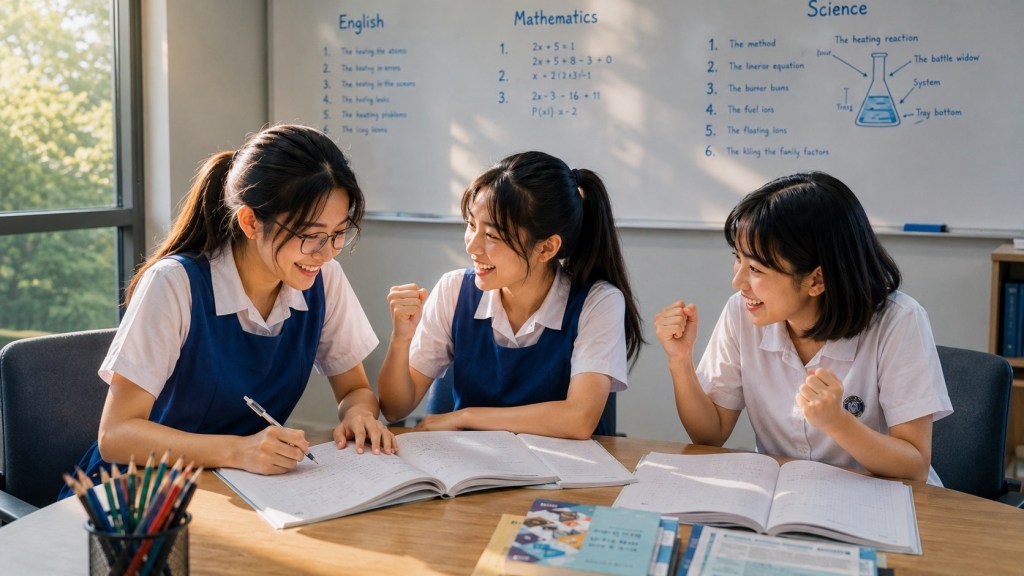
Learning Is Not Complete When the Lesson Ends
A Secondary 1 student learns how to solve an equation during tuition.
The student understands the explanation.
The guided examples are completed correctly.
The independent practice also appears successful.
But one week later, the student sees a similar equation in a school assessment and cannot begin.
What happened?
The lesson may have produced temporary access without producing learning continuity.
The student could use the knowledge while:
- the topic was announced;
- the example remained visible;
- the tutor was nearby;
- the method had just been explained;
- the questions followed a familiar sequence.
The knowledge was present inside the lesson.
It was not yet sufficiently available outside it.
This creates an important separation:
[
\text{understood during lesson}
\neq
\text{available later}
]
Secondary 1 Mathematics Tuition should therefore do more than create successful lesson performance.
It should help preserve, reconnect and reactivate learning across:
- time;
- topics;
- representations;
- contexts;
- levels of difficulty;
- assessment conditions;
- changes in support.
That is learning continuity.
What Is Learning Continuity?
eduKate defines Learning Continuity as:
The preservation, availability and productive reconnection of learning across time, topics, representations and contexts.
This is an eduKate educational model.
It is not an official MOE classification.
Learning continuity exists when a student can:
- retain an earlier concept;
- recognise when it is needed again;
- reconnect it to the present problem;
- use it in a changed form;
- recover it after a period of non-use;
- combine it with newer knowledge;
- operate it with decreasing external support.
A useful representation is:
[
\boxed{
\text{learn}
\rightarrow
\text{retain}
\rightarrow
\text{retrieve}
\rightarrow
\text{reconnect}
\rightarrow
\text{transfer}
}
]
If any part of this sequence breaks, the student may appear to have learned while remaining unable to use the knowledge independently.
The Difference Between Learning and Temporary Access
Temporary access occurs when the student succeeds because the learning environment is supplying much of the route.
The environment may provide:
- the chapter heading;
- the formula;
- a worked example;
- a tutor prompt;
- a sequence of similar questions;
- immediate confirmation;
- recent memory of the explanation.
For example, a worksheet titled Linear Equations tells the student which method to retrieve.
Every question may then follow the same structure:
[
3x+5=20
]
[
4x+7=31
]
[
5x+2=42
]
The student succeeds.
But in a mixed assessment, the learner must first determine whether the question involves:
- an equation;
- percentage;
- ratio;
- geometry;
- rate;
- a graph;
- another relationship.
The support supplied by the chapter heading has disappeared.
The student now requires independent retrieval.
Therefore:
[
\text{topic-labelled success}
\neq
\text{independent access}
]
Learning continuity becomes visible when the knowledge survives after the temporary supports are removed.
Why Secondary 1 Requires Stronger Continuity
Primary-school Mathematics already requires retention and transfer.
Secondary 1 increases the importance of continuity because the subject becomes more connected.
A later topic may depend on several earlier systems.
For example:
[
\text{linear graph}
]
may depend on:
[
\text{coordinates}
+
\text{negative numbers}
+
\text{algebra}
+
\text{ratio}
+
\text{rate of change}
]
A student who has forgotten one of these earlier components may struggle even if the graph lesson itself is explained clearly.
Similarly:
[
\text{percentage change}
]
depends on:
[
\text{fraction relationships}
+
\text{division}
+
\text{reference quantity}
+
\text{multiplicative reasoning}
]
As Mathematics becomes more interconnected, forgotten or isolated knowledge creates downstream instability.
Secondary 1 therefore does not merely add new content.
It increases the demand placed on earlier content.
The Five Dimensions of Learning Continuity
eduKate examines five major continuity dimensions:
[
\boxed{
\begin{aligned}
1.&\ \text{Temporal continuity}\
2.&\ \text{Structural continuity}\
3.&\ \text{Representational continuity}\
4.&\ \text{Contextual continuity}\
5.&\ \text{Regulatory continuity}
\end{aligned}
}
]
These dimensions overlap.
Together they explain why a student may appear capable in one situation but unable to reproduce the learning elsewhere.
Dimension 1: Temporal Continuity
Temporal continuity asks:
Does the learning remain available over time?
A student may understand an idea:
- immediately after explanation;
- later that evening;
- the following week;
- during the next school topic;
- several months later during examination revision.
These are different retention conditions.
Immediate performance
The student completes the question while the method is still active in short-term memory.
Short-delay retrieval
The student reconstructs the method after the original example is no longer visible.
Spaced retrieval
The student recalls the concept after other topics have been studied.
Cumulative retrieval
The concept is recovered inside a mixed-topic assessment.
Longitudinal retrieval
The knowledge remains usable in Secondary 2, upper-secondary Mathematics or Additional Mathematics.
A student may pass the first condition and fail the others.
Therefore:
[
\text{immediate success}
\neq
\text{temporal continuity}
]
How Tuition Builds Temporal Continuity
Retrieval at the next lesson
The tutor begins with a short question from the previous session.
No full explanation is given first.
This reveals whether the student can reconstruct the route.
Spaced return
The same concept reappears after several days or weeks.
The surface may change while the structure remains related.
Cumulative practice
Earlier topics are mixed with current work.
The student must identify which knowledge is required.
Delayed correction checks
A previously repaired error is tested again later.
The tutor asks whether the old mistake has returned.
Examination-cycle retrieval
Concepts are reviewed before assessments through mixed, increasingly independent work rather than by rereading notes alone.
The objective is not constant repetition of every topic.
It is timely reactivation before the route disappears.
The Forgetting–Retrieval Relationship
Forgetting is not always evidence that learning failed completely.
Some reduction in immediate access is normal.
The important question is whether the student can retrieve and reconstruct the learning.
Each successful retrieval can strengthen future availability.
A useful sequence is:
[
\text{initial learning}
\rightarrow
\text{partial forgetting}
\rightarrow
\text{effortful retrieval}
\rightarrow
\text{stronger future access}
]
The tutor should not always rescue the student immediately.
A short period of productive search may help the learner recover:
- the first step;
- the governing relationship;
- the notation;
- the checking method.
However, retrieval practice becomes unproductive when the student has no remaining access to the concept.
The tutor must distinguish:
[
\text{effortful retrieval}
]
from:
[
\text{complete disconnection}
]
Dimension 2: Structural Continuity
Structural continuity asks:
Can the student recognise how earlier knowledge connects to the present mathematical object?
Mathematics is cumulative, but it is not merely a staircase where every chapter sits neatly above the previous chapter.
It is a network.
For example:
[
\text{fraction}
\leftrightarrow
\text{ratio}
\leftrightarrow
\text{percentage}
\leftrightarrow
\text{rate}
]
and:
[
\text{integer}
\leftrightarrow
\text{algebra}
\leftrightarrow
\text{equation}
\leftrightarrow
\text{coordinate}
\leftrightarrow
\text{graph}
]
Structural continuity exists when the student can move through these relationships.
The student recognises that a current difficulty may use an earlier concept in a new role.
Example: Negative Numbers Become Algebraic Control
A student may complete the negative-number chapter successfully.
Later, the student sees:
[
4x-7x
]
and writes:
[
3x
]
The difficulty appears inside algebra.
But the structural route is:
[
4x-7x
(4-7)x
-3x
]
The earlier integer relationship must remain connected to the algebraic expression.
If the student stored negative numbers only as an isolated chapter, the route may not activate.
Structural continuity allows earlier knowledge to migrate into later topics.
Example: Ratio Becomes Gradient
A student learns ratio as:
[
2:3
]
Later, gradient is introduced as:
[
\frac{\text{vertical change}}{\text{horizontal change}}
]
The notation has changed.
The underlying proportional relationship remains connected.
A student with structural continuity may recognise that gradient is a comparison between two changes.
The learner without that connection may treat gradient as a completely new formula.
This creates a wider principle:
[
\text{new notation}
\neq
\text{entirely new mathematical structure}
]
How Tuition Builds Structural Continuity
The tutor can ask:
- What earlier topic is being used here?
- Which part of this question is familiar?
- How is this expression related to ordinary arithmetic?
- Where have you seen this relationship before?
- Which later topic might depend on this idea?
- Can the same structure be represented differently?
The tutor may also create explicit knowledge routes:
[
\text{fractions}
\rightarrow
\text{ratio}
\rightarrow
\text{percentage}
\rightarrow
\text{reverse percentage}
]
or:
[
\text{patterns}
\rightarrow
\text{expressions}
\rightarrow
\text{equations}
\rightarrow
\text{functions}
\rightarrow
\text{graphs}
]
These routes give the student more than one way to retrieve the knowledge.
From Chain to Web
A beginner often learns Mathematics as a chain:
[
A\rightarrow B\rightarrow C
]
This is useful because it reduces complexity.
The student follows one route in a predictable order.
As learning develops, the structure becomes a web:
[
\begin{array}{ccc}
A & \leftrightarrow & B\
\updownarrow & & \updownarrow\
C & \leftrightarrow & D
\end{array}
]
The student can now reach one concept from several directions.
For example, percentage may be reached through:
- fraction;
- decimal;
- ratio;
- multiplier;
- real-world change.
This route diversity reduces learning friction.
If one route is temporarily unavailable, another route may recover the idea.
The objective is not to force a novice into a complex web immediately.
It is to begin with a usable chain and gradually build alternative routes.
Dimension 3: Representational Continuity
Representational continuity asks:
Does the student preserve the mathematical relationship when its form changes?
Secondary Mathematics is expressed through:
[
\text{words}
\leftrightarrow
\text{numbers}
\leftrightarrow
\text{symbols}
\leftrightarrow
\text{tables}
\leftrightarrow
\text{graphs}
\leftrightarrow
\text{diagrams}
]
A student may understand one form but not another.
For example:
- understands a verbal pattern but cannot form an expression;
- understands an equation but cannot interpret its graph;
- reads a table but cannot identify the rule;
- uses a formula but cannot explain the physical quantity;
- understands a diagram but cannot construct the necessary equation.
The mathematical relationship should survive the change in representation.
Example: One Relationship, Several Forms
Consider:
[
y=2x+1
]
This can be expressed as:
Words
The output is one more than twice the input.
Table
| (x) | (y) |
|---|---|
| 0 | 1 |
| 1 | 3 |
| 2 | 5 |
| 3 | 7 |
Ordered pairs
[
(0,1),\ (1,3),\ (2,5),\ (3,7)
]
Graph
A straight line with gradient (2) and vertical intercept (1).
Representational continuity exists when the student recognises these as different surfaces of one relationship.
Translation Failure and Continuity
A student may have learned the concept but fail to access it because the representation changes.
For example:
[
3x+5=20
]
may be easy.
But:
A service charges a fixed fee of $5 and $3 per item. The total is $20.
may appear unrelated.
The continuity break occurs between:
[
\text{verbal situation}
]
and:
[
\text{algebraic model}
]
The repair must therefore target translation—not equation solving.
This is why repeated practice in only one representation can create fragile learning.
How Tuition Builds Representational Continuity
For one mathematical relationship, the tutor may ask the student to:
- explain it in words;
- produce a numerical example;
- write the algebraic form;
- draw or interpret a diagram;
- organise the information in a table;
- graph it where appropriate;
- explain what each symbol represents.
The student learns that representation changes do not automatically create a new topic.
They create another view of the same structure.
Dimension 4: Contextual Continuity
Contextual continuity asks:
Can the student use the Mathematics when the setting, wording or surface story changes?
A student may learn percentage through shopping discounts.
Later, percentage appears in:
- population change;
- examination results;
- profit and loss;
- concentration;
- statistical comparisons;
- repeated growth or reduction.
The surface context changes.
The mathematical relationship may remain related.
Contextual continuity allows the learner to see through the story to the mathematical structure.
Familiarity Is Not Contextual Continuity
A student may become highly successful with a narrow worksheet format.
For example:
Find the percentage increase from $80 to $100.
After several similar exercises, the student performs accurately.
Then the assessment asks:
A school’s enrolment rises from 640 students to 736 students. By what percentage did the enrolment increase?
The structure is equivalent:
[
\frac{\text{increase}}{\text{original}}\times100%
]
But the familiar shopping surface has disappeared.
If the student cannot transfer, the learning was attached to the context rather than the relationship.
How Tuition Builds Contextual Continuity
The tutor can vary:
- the story;
- the quantities;
- the direction of the question;
- the information order;
- the amount of irrelevant information;
- the required conclusion;
- the topic combination.
For example, ratio may appear through:
- recipes;
- maps;
- mixtures;
- geometry;
- class composition;
- exchange rates;
- speed;
- graphical relationships.
The student should eventually recognise ratio without needing the word “ratio” to appear.
The Surface–Structure Test
A useful continuity test asks:
What changed on the surface, and what remained mathematically the same?
For two questions, the student may compare:
| Surface feature | Question A | Question B |
|---|---|---|
| Context | Shopping | Population |
| Numbers | 80 to 100 | 640 to 736 |
| Mathematical structure | Percentage increase | Percentage increase |
| Reference quantity | Original price | Original population |
| Core method | Change ÷ original | Change ÷ original |
This helps the student distinguish story from structure.
Dimension 5: Regulatory Continuity
Regulatory continuity asks:
Can the student keep the learning operational when conditions become less supportive?
A learner may understand and retain a concept but lose access when:
- time is limited;
- several topics are mixed;
- the question looks unfamiliar;
- one early error creates panic;
- the assessment is longer;
- no tutor confirmation is available;
- the student is tired or distracted.
Regulation includes the ability to:
- begin;
- persist;
- monitor;
- check;
- recover;
- allocate time;
- manage uncertainty.
The knowledge may still exist.
The student may temporarily lose access to it.
Example: Knowledge Without Regulatory Access
During tuition, a student solves:
[
5-2x=17
]
correctly.
During a test, the same student sees a negative coefficient and leaves the question blank.
The mathematical knowledge has not necessarily disappeared.
The student may have developed a threat response to that visual structure.
A regulatory continuity repair may include:
- identifying the first move;
- practising short timed sets;
- normalising negative answers;
- rehearsing an error-recovery routine;
- delaying checking until the full line is written;
- building confidence through successful independent retrieval.
The objective is to keep the mathematical system online under ordinary academic pressure.
How Tuition Builds Regulatory Continuity
First-move routines
The student learns what to do before panic expands.
Examples:
- mark the unknown;
- identify the original quantity;
- write the relationship;
- label the diagram;
- estimate the answer range.
Error-recovery routines
The student learns that a wrong step does not require abandoning the entire problem.
A repair sequence may be:
[
\text{stop}
\rightarrow
\text{locate last secure line}
\rightarrow
\text{identify the changed relationship}
\rightarrow
\text{restart from that point}
]
Gradual load
Time pressure and question complexity are increased only after the structure is sufficiently stable.
Reduced confirmation
The tutor gradually stops confirming every line.
The student develops internal checking.
Mixed practice
The learner practises selecting methods without chapter labels.
Regulatory continuity allows knowledge to survive the loss of external control.
Learning Synchrony
Learning continuity is closely related to Learning Synchrony.
eduKate defines Learning Synchrony as:
The alignment of prerequisite knowledge, present instruction, cognitive readiness, practice load and the next expected step.
A student may struggle even when the present explanation is good if the required parts are out of synchrony.
For example:
- the school is teaching equations;
- negative-number control remains unstable;
- homework volume is high;
- the student is tired;
- assessment preparation has begun;
- the tutor is attempting advanced word problems.
The system is misaligned.
A synchronised sequence might be:
[
\text{repair negative numbers}
\rightarrow
\text{reconnect to equations}
\rightarrow
\text{stabilise working}
\rightarrow
\text{introduce word problems}
\rightarrow
\text{add assessment load}
]
Learning continuity preserves the knowledge across time.
Learning synchrony ensures that the components required now are available together.
The Continuity Break
A continuity break occurs when previously learned Mathematics cannot be productively reconnected.
The break may appear as:
- “I have never seen this before.”
- “I understood last week but forgot everything.”
- “I can do it only when the teacher shows me.”
- “This question looks different.”
- “I know the formula but not which one to use.”
- “I can do it at home but not in a test.”
- “I learned this chapter, but I cannot use it here.”
Each statement points to a different possible break.
| Student statement | Possible continuity break |
|---|---|
| “I forgot everything.” | Temporal |
| “I did not know ratio was needed.” | Structural or routing |
| “I cannot turn the words into an equation.” | Representational |
| “The question looks completely different.” | Contextual |
| “I froze in the test.” | Regulatory |
The tuition response should match the break.
Continuity Is Not Constant Repetition
Learning continuity does not require the student to repeat every question indefinitely.
Constant repetition can create:
- boredom;
- shallow familiarity;
- dependence on one format;
- reduced attention;
- an illusion of mastery.
Continuity requires strategically spaced and varied return.
A concept should reappear often enough to remain connected, but differently enough to require retrieval.
The objective is:
[
\text{revisit the structure}
]
not:
[
\text{repeat the identical surface}
]
The Continuity Loop
A useful eduKate continuity loop is:
[
\boxed{
\text{Install}
\rightarrow
\text{Retrieve}
\rightarrow
\text{Vary}
\rightarrow
\text{Connect}
\rightarrow
\text{Load}
\rightarrow
\text{Return}
}
]
Install
The concept is understood and initially practised.
Retrieve
The student recovers it after support has been reduced.
Vary
The surface changes while the underlying relationship remains.
Connect
The idea is linked to earlier and later Mathematics.
Load
The student uses it under more realistic complexity or time pressure.
Return
The concept reappears after a delay.
Each loop increases the number of conditions under which the knowledge remains usable.
Installing a Concept
A concept is not securely installed merely because the tutor has explained it.
Installation requires the student to:
- understand the mathematical meaning;
- recognise the notation;
- execute the basic procedure;
- explain the relationship;
- identify an initial checking method.
For example, reverse percentage is not installed when the student memorises:
Divide by 0.8.
The student should understand:
After a 20% reduction, the final amount represents 80% of the original.
Therefore:
[
0.8x=\text{final amount}
]
The procedure is attached to a relationship.
This creates a stronger basis for later retrieval.
Retrieving a Concept
Retrieval requires the student to reconstruct the concept without receiving the entire route again.
Useful retrieval prompts include:
- What does the percentage represent?
- Which quantity is the original?
- What remains equal in an equation?
- How is gradient related to rate?
- What is the first step?
- Can you draw a representation?
The tutor may give a small cue where necessary, but should record how much support was required.
Prompt level is part of continuity evidence.
Varying a Concept
Variation reveals whether the student has learned the structure or only the example.
For example, after learning:
[
3x+5=20
]
the tutor may vary:
- the sign;
- the position of the variable;
- the number of steps;
- the representation;
- the context;
- the required conclusion.
A student with continuity recognises the family resemblance.
Connecting a Concept
Connection strengthens retrieval routes.
For example:
[
\text{equation}
]
may connect to:
- balance;
- inverse operations;
- formulas;
- graphs;
- real-world models.
The student can then access the concept through several neighbouring ideas.
Loading a Concept
The student applies the learning under more realistic conditions:
- mixed topics;
- longer questions;
- reduced prompting;
- moderate time pressure;
- assessment-style language;
- several steps.
Load should be increased after understanding and basic control are present.
Otherwise, the lesson measures overload rather than learning.
Returning to a Concept
The final continuity test occurs after the learning has left immediate attention.
The tutor revisits it:
- in the next lesson;
- inside a later chapter;
- during cumulative revision;
- before an assessment;
- after the school has moved on.
The student should not be told every time:
This is the method we learned three weeks ago.
The learner must begin recognising when the earlier knowledge has returned.
The Secondary 1 Mathematics Continuity Calendar
A continuity system can operate across several time scales.
Within the lesson
The student moves from explanation to guided and independent practice.
At the end of the lesson
The student explains the key relationship and completes a release question.
Before the next lesson
A short follow-up task requires reconstruction without the original example.
At the next lesson
The concept appears in a retrieval check.
Two to four weeks later
The topic returns in changed or mixed form.
Before a weighted assessment
The concept is retrieved under cumulative and timed conditions.
During later topics
The earlier idea is explicitly connected to its new role.
At the end of the year
The student should possess a connected Secondary 1 network rather than isolated chapter memories.
The exact schedule may vary.
The continuity principle remains stable.
Mixed Practice and Continuity
Blocked practice groups questions by topic:
[
\text{all ratio}
\rightarrow
\text{all percentage}
\rightarrow
\text{all equations}
]
This can be useful during initial learning.
Mixed practice combines topics:
[
\text{ratio}
\rightarrow
\text{equation}
\rightarrow
\text{geometry}
\rightarrow
\text{percentage}
]
Now the student must select the route.
The two forms of practice perform different jobs.
Blocked practice
Useful for:
- initial understanding;
- basic fluency;
- reducing early cognitive load;
- stabilising a new procedure.
Mixed practice
Useful for:
- retrieval;
- discrimination;
- routing;
- transfer;
- assessment readiness.
A strong tuition runtime uses both.
It does not treat one as universally superior.
Cumulative Practice
Cumulative practice keeps earlier learning active while the syllabus progresses.
A cumulative set might contain:
- one recent algebra question;
- one earlier ratio question;
- one number-operation question;
- one geometry problem;
- one mixed transfer task.
The student must continually reconnect the network.
This helps prevent the pattern:
[
\text{learn}
\rightarrow
\text{test}
\rightarrow
\text{forget}
\rightarrow
\text{relearn before examination}
]
Instead:
[
\text{learn}
\rightarrow
\text{return}
\rightarrow
\text{connect}
\rightarrow
\text{strengthen}
]
The Retrieval Ladder
eduKate may organise retrieval through increasing levels of independence.
Level 1: Recognition
The student recognises the correct method when shown several options.
Level 2: Cued recall
The student retrieves the method after a small prompt.
Level 3: Independent recall
The learner retrieves the method without a prompt.
Level 4: Structural recognition
The student identifies the method in changed wording or representation.
Level 5: Connected use
The learner combines the concept with another topic.
Level 6: Delayed transfer
The student uses it correctly after time has passed and the original lesson context has disappeared.
A student may appear successful at Level 1 or Level 2 while remaining unable to operate at the later levels.
The tutor should know which level has actually been reached.
The Prompt-Fading Sequence
Prompts should be reduced deliberately.
A student may begin with:
Use the percentage-change formula.
Later:
Which quantity should be the denominator?
Later:
What relationship is present?
Later:
Begin independently.
The progression is:
[
\text{full route supplied}
\rightarrow
\text{partial cue}
\rightarrow
\text{structural question}
\rightarrow
\text{independent retrieval}
]
The tutor should not remove support before the student has a viable route.
But permanent support prevents continuity from becoming independent.
Continuity Across G1, G2 and G3 Mathematics
Learning continuity matters at all three subject levels.
The level of curriculum demand differs, but each student requires knowledge that remains available and connected.
G1 continuity may emphasise
- reliable numerical foundations;
- practical meaning;
- clear step sequences;
- familiar-to-changed contexts;
- stable retrieval;
- confidence through successful independence.
G2 continuity may emphasise
- movement between numerical and symbolic forms;
- multi-step relationships;
- topic connections;
- cumulative practice;
- transfer into less familiar questions.
G3 continuity may emphasise
- algebraic fluency;
- abstraction;
- multi-topic transfer;
- alternative representations;
- unfamiliar applications;
- readiness for later mathematical pathways.
A G3 student can possess weak continuity.
A G1 student can build strong continuity.
The subject level and the continuity condition are different objects.
Continuity and Movement Between Subject Levels
A student preparing for more demanding Mathematics does not only need exposure to harder questions.
The student needs a sufficiently stable learning system.
Readiness may require:
- secure prerequisites;
- reliable retrieval;
- clear working;
- transfer into unfamiliar questions;
- sustainable performance under load;
- ability to connect topics;
- increasing independence.
Therefore:
[
\text{harder worksheet completed}
\neq
\text{readiness for a more demanding level}
]
A more defensible sequence is:
[
\text{stability at present level}
\rightarrow
\text{strong transfer}
\rightarrow
\text{controlled exposure}
\rightarrow
\text{readiness evidence}
]
Tuition may support this development.
It cannot guarantee a school subject-level decision.
Continuity and Mathematics Confidence
Confidence is often treated as an emotion that must be produced before the student can learn.
In many cases, stronger confidence emerges from continuity.
The student becomes more confident because:
- earlier knowledge can be retrieved;
- the first move is visible;
- mistakes can be repaired;
- changed questions remain recognisable;
- assessments feel less unpredictable;
- support is no longer required at every step.
A useful sequence is:
[
\text{competence}
\rightarrow
\text{successful retrieval}
\rightarrow
\text{predictable control}
\rightarrow
\text{grounded confidence}
]
This does not mean emotion is unimportant.
It means confidence becomes more durable when attached to functioning mathematical knowledge.
Confidence Without Continuity
A student may feel confident after completing many familiar questions.
The confidence may disappear when:
- the wording changes;
- the topics are mixed;
- the tutor is absent;
- time pressure begins;
- one early error occurs.
This is confidence attached to familiarity.
It should not be mistaken for stable mastery.
Therefore:
[
\text{feeling confident}
\neq
\text{learning continuity}
]
But stable continuity can support more defensible confidence.
Continuity and Examination Performance
Examinations require several continuity systems to operate together.
The student must:
- retrieve knowledge learned across many months;
- recognise the topic without a chapter heading;
- translate varied representations;
- select a method;
- execute under time pressure;
- recover after errors;
- move between topics;
- check efficiently.
A student may understand every chapter individually and still underperform if these systems do not coordinate.
Examination preparation should therefore not begin only with more papers.
It should examine:
- what has been retained;
- what can be retrieved;
- which routes remain weak;
- which representations cause failure;
- where load breaks the system;
- whether the student can recover.
Past papers become a continuity test.
They should also become a continuity repair instrument.
The Assessment Continuity Loop
After an assessment:
[
\text{paper}
\rightarrow
\text{error classification}
\rightarrow
\text{weak-link repair}
\rightarrow
\text{parallel question}
\rightarrow
\text{delayed retest}
]
The correction should not end when the student copies the model answer.
The same mathematical structure must be tested again later.
Otherwise:
[
\text{paper corrected}
\neq
\text{continuity restored}
]
Error Memory
Students often remember that an answer was wrong but forget why.
An error record can preserve the important part.
For example:
| Visible error | Underlying break | Repair route | Future check |
|---|---|---|---|
| Divided by final amount | Reference quantity lost | Mark original value first | Ask “percentage of what?” |
| Lost negative sign | Integer control under load | Predict sign before dividing | Substitute answer |
| Could not begin word problem | Translation break | Define unknown and relationship | Write first equation only |
| Used area instead of perimeter | Measurement object confused | Label what is being measured | Check units |
Error memory creates continuity across corrections.
The student does not merely remember the answer.
The learner remembers the warning signal and repair route.
Learning Continuity Across School and Tuition
Tuition should not become a disconnected second Mathematics curriculum.
The school and tuition environments should remain connected.
Tuition may use:
- the student’s school topic sequence;
- school worksheets;
- assessment feedback;
- teacher comments;
- upcoming tests;
- known syllabus demands.
But tuition should add a different layer:
- diagnosis;
- prerequisite repair;
- alternative explanation;
- variation;
- cumulative retrieval;
- transfer testing;
- individual pacing.
The relationship is:
[
\text{school supplies the core educational environment}
]
while:
[
\text{tuition may provide additional diagnosis and continuity support}
]
Tuition should not make the student dependent on learning every topic twice.
It should help the student access school learning more independently.
Learning Continuity at Home
Parents can support continuity without teaching the entire subject.
Useful home questions include:
- What did you learn today?
- What earlier topic did it connect to?
- Can you explain one example without looking?
- What mistake are you trying not to repeat?
- What would you check first?
- Can you solve one question from last week?
- Which part still feels uncertain?
Less useful routines include:
- immediately supplying the method;
- checking only whether homework is complete;
- repeating “be careful” without identifying the error;
- requiring large amounts of extra work without diagnosis;
- comparing the child’s pace with another student.
The goal is to make learning retrievable—not to replace the learner’s thinking.
The One-Question Continuity Check
A parent or tutor can ask one question from an earlier topic without warning.
The objective is not to catch the student out.
Observe:
- Does the student recognise the topic?
- Can the learner state a first move?
- Is a small cue sufficient?
- Does the student become dependent on a full example?
- Can the answer be checked?
- Can the learner explain the relationship afterwards?
One well-chosen question may reveal more than rereading an entire chapter.
Continuity in a 3-Pax Class
A small class can support continuity in several ways.
Retrieval remains visible
The tutor can see who remembers, who reconstructs and who waits for another student’s answer.
Different routes appear
Students may retrieve the same concept through different representations.
Explanation strengthens connection
One student may explain an idea to another, revealing whether the knowledge is sufficiently organised.
Misconceptions become shared evidence
A peer’s error may activate another student’s checking process.
Prompt dependence is harder to hide
The tutor can observe whether the student begins independently or follows the group.
However, small class size alone does not create continuity.
The lesson sequence must deliberately include retrieval, variation, reconnection and delayed return.
Continuity for the Falling Student
A falling student often possesses many disconnected fragments.
The immediate objective is to restore a usable route.
A suitable sequence may be:
[
\text{identify essential prerequisite}
\rightarrow
\text{repair}
\rightarrow
\text{connect to present topic}
\rightarrow
\text{retrieve soon}
\rightarrow
\text{protect against new gaps}
]
The continuity system should remain narrow enough to avoid overwhelming the learner.
The student does not need every old topic reactivated at once.
The learner needs the critical upstream knowledge required to participate again.
Continuity for the Wobbling Student
A wobbling student often understands but cannot reproduce performance reliably.
The tuition should emphasise:
- spaced retrieval;
- reduced prompts;
- error tracking;
- mixed practice;
- moderate timed work;
- self-correction;
- changed representations.
The objective is to convert intermittent access into dependable access.
Continuity for the Maintaining Student
A maintaining student benefits from:
- regular cumulative practice;
- early correction;
- preparation before school topics;
- mixed retrieval;
- connection to later learning.
The aim is to prevent small gaps from accumulating.
Maintenance is active preservation.
Continuity for the Progressing Student
A progressing student should use earlier knowledge in:
- multi-topic questions;
- unfamiliar contexts;
- alternative representations;
- stronger reasoning;
- independent explanation.
The objective is no longer only retention.
It is flexible reconnection.
Continuity for the Stretching Student
A stretching student can deepen continuity by:
- comparing solution routes;
- generalising patterns;
- creating questions;
- analysing incorrect arguments;
- connecting current work to later Mathematics;
- explaining invariant structures across contexts.
Advanced continuity is not merely remembering more.
It is seeing the same mathematical architecture across wider fields.
The Continuity Audit
A Secondary 1 Mathematics continuity audit may ask:
Temporal
- Can the student retrieve last week’s learning?
- Does the concept remain available after several weeks?
- Is examination revision rebuilding from zero?
Structural
- Can the learner identify prerequisite knowledge?
- Are topics connected or stored as isolated chapters?
- Can an earlier concept be recognised inside a later topic?
Representational
- Can the student move between words, symbols, diagrams, tables and graphs?
- Does meaning survive the change of form?
Contextual
- Can the learner identify the same structure in a new story?
- Does a changed surface cause complete disconnection?
Regulatory
- Can the student begin without confirmation?
- Does the learning survive moderate time pressure?
- Can the learner recover after an error?
The audit does not produce a permanent label.
It identifies where continuity support should begin.
Signs That Learning Continuity Is Growing
Parents and tutors may notice:
- earlier topics are retrieved with less prompting;
- the student refers to prior knowledge spontaneously;
- fewer chapters feel completely new;
- changed wording causes less panic;
- the learner explains relationships between topics;
- corrections remain effective later;
- mixed exercises become more manageable;
- the student identifies unreasonable answers;
- test performance becomes more stable;
- less revision time is spent relearning forgotten foundations;
- the learner works with greater independence.
These are signs that knowledge is becoming connected and reusable.
Signs of a Continuity Break
Possible warning signs include:
- every revision cycle begins from the beginning;
- the student says all earlier topics have been forgotten;
- correct work depends on a visible example;
- chapter headings are needed before methods can be selected;
- the same misconception returns after correction;
- new representations feel like new topics;
- mixed assessments produce sharp performance drops;
- the student cannot explain how topics connect;
- tuition success does not appear in school work;
- strong home performance collapses under ordinary assessment conditions.
One signal alone does not establish the cause.
The pattern should be investigated.
What Learning Continuity Is Not
It is not perfect memory
Students will forget details and require reactivation.
Continuity means that the learning can be productively recovered.
It is not endless revision
The purpose is strategic return, not constant repetition.
It is not acceleration
A student may complete later chapters while earlier learning remains disconnected.
It is not examination drilling alone
Papers can test continuity but do not automatically create it.
It is not confidence alone
A student may feel confident in familiar work while lacking transfer.
It is not tutor dependence
Continuity should increase the student’s ability to operate without immediate support.
Continuity and Independence
The deepest continuity test is whether the student can keep learning after direct support is reduced.
At first:
[
\text{tutor identifies the connection}
]
Later:
[
\text{student identifies the connection}
]
At first:
[
\text{tutor supplies the retrieval cue}
]
Later:
[
\text{student generates the cue}
]
At first:
[
\text{tutor detects the continuity break}
]
Later:
[
\text{student notices, repairs and reconnects}
]
The direction is:
[
\boxed{
\text{external continuity support}
\rightarrow
\text{shared continuity control}
\rightarrow
\text{self-sustaining learning}
}
]
Tuition should not remain the only place where the student’s Mathematics works.
When Tuition Has Built Enough Continuity
Tuition support may be reduced or reviewed when the student can:
- retrieve earlier concepts;
- recognise them in changed forms;
- connect them to present topics;
- operate under ordinary assessment load;
- identify recurring mistakes;
- repair some errors independently;
- maintain a revision rhythm;
- ask precise questions when help is needed;
- continue school learning without requiring every lesson to be retaught.
This does not require perfection.
It requires a sufficiently reliable internal learning system.
Frequently Asked Questions
Why does my child forget Mathematics so quickly?
The child may have understood the lesson but received too little retrieval, variation or delayed practice.
The knowledge may also have been attached to one representation or worksheet format.
The cause should be examined before simply increasing practice volume.
Should students revise every topic every week?
Not necessarily.
Revision should be spaced and prioritised according to:
- prerequisite importance;
- current instability;
- upcoming use;
- assessment demand;
- evidence of forgetting.
Is doing more worksheets the best way to retain Mathematics?
Practice is necessary, but identical repetition may create familiarity without independent retrieval.
A stronger sequence includes spaced return, variation, mixed questions and explanation.
Why can my child do tuition work but not school tests?
The tuition environment may provide more prompts, clearer topic labels, immediate correction or familiar question sequences.
The student may require stronger transfer and regulatory continuity.
How can earlier topics be revised without slowing current progress?
The tutor can use short retrieval tasks and targeted prerequisite reconnections rather than repeating entire chapters.
Does continuity mean a student should never forget?
No.
The meaningful test is whether the knowledge can be recovered efficiently and reconnected when needed.
Can a strong student have weak continuity?
Yes.
A student may learn quickly but forget rapidly, depend on familiar formats or fail to connect topics.
How long does continuity take to build?
A narrow concept may become stable over several retrieval cycles.
A larger network of Mathematics develops across months and years.
Continuity is an operating condition rather than one final achievement.
Evidence and Interpretation Boundary
eduKate definitions
The following are eduKate educational models:
- Learning Continuity;
- Learning Synchrony;
- temporal continuity;
- structural continuity;
- representational continuity;
- contextual continuity;
- regulatory continuity;
- continuity break;
- continuity loop;
- retrieval ladder.
They are used to organise teaching, observation and curriculum connection.
They are not official MOE categories, psychological diagnoses or claims that all students learn through one identical sequence.
Individual variation
Students differ in:
- prior knowledge;
- memory;
- subject level;
- language;
- confidence;
- school sequence;
- rate of learning;
- response to practice;
- performance under load.
The continuity system should be adapted to the learner.
Educational outcomes
Learning-continuity work may support:
- stronger retention;
- better retrieval;
- improved transfer;
- greater assessment stability;
- reduced repeated errors;
- increasing independence.
It cannot guarantee:
- perfect memory;
- a specific grade;
- a fixed speed of improvement;
- subject-level movement;
- identical outcomes for every learner.
Essential Firewalls
[
\text{understood once}
\neq
\text{learned permanently}
]
[
\text{completed worksheet}
\neq
\text{retrievable knowledge}
]
[
\text{immediate success}
\neq
\text{temporal continuity}
]
[
\text{chapter knowledge}
\neq
\text{structural connection}
]
[
\text{same idea in new form}
\neq
\text{entirely new topic}
]
[
\text{familiar context success}
\neq
\text{contextual transfer}
]
[
\text{knowledge available at home}
\neq
\text{knowledge available under assessment load}
]
[
\text{confidence}
\neq
\text{continuity}
]
[
\text{repetition}
\neq
\text{retention}
]
[
\text{revision}
\neq
\text{relearning from zero}
]
[
\text{harder work completed}
\neq
\text{readiness for a higher subject level}
]
[
\text{tuition support}
\neq
\text{permanent tutor dependence}
]
[
\text{learning continuity}
\neq
\text{guaranteed academic result}
]
These separations prevent continuity from being reduced to memory, repetition or examination drilling alone.
Where This Article Sits in the Organism
This article is the learning-continuity compiler for:
Secondary 1 Mathematics Tuition
It owns the question:
How does Mathematics remain available, connected and usable after the original lesson?
The organism now contains:
- Secondary 1 Mathematics Tuition
Canonical parent object. - Why Secondary 1 Mathematics Feels Different After PSLE
Transition compiler. - G1, G2 and G3 Secondary 1 Mathematics Under Full Subject-Based Banding
Subject-level and pathway compiler. - What Students Learn in Secondary 1 Mathematics
Subject-anatomy compiler. - Does My Child Need Secondary 1 Mathematics Tuition?
Student-state and parent-decision compiler. - Finding the Earliest Weak Link in Secondary 1 Mathematics
Diagnostic compiler. - What Happens Inside Secondary 1 Mathematics Tuition?
Tuition-operation compiler. - How Secondary 1 Mathematics Tuition Builds Learning Continuity
Learning-continuity compiler.
The diagnostic article locates instability.
The tuition-runtime article explains how intervention operates.
This article determines whether the resulting learning survives, reconnects and becomes independently usable.
Conclusion: Learning Must Survive the Disappearance of the Lesson
A Mathematics lesson is temporary.
The student eventually leaves:
- the tutor;
- the worked example;
- the chapter heading;
- the familiar worksheet;
- the immediate correction;
- the protected practice environment.
The knowledge must continue without them.
Learning continuity exists when the student can later say:
I have seen this relationship before.
I know which earlier idea connects to it.
The question looks different, but the structure is related.
I made an error, but I know where to restart.
I can recover the method without waiting for someone to show me again.
The objective is not perfect memory.
It is recoverable, connected and usable Mathematics.
Secondary 1 is where this becomes especially important because the subject is changing from a collection of familiar procedures into a network of symbolic and connected ideas.
The tuition system should therefore ask more than:
Did the student understand today?
It should also ask:
Will this learning still exist next week?
Will it appear when the wording changes?
Will it connect to the next topic?
Will it survive the test?
Will the student eventually be able to recover it alone?
The deepest result of tuition is not a completed page.
It is a learner whose Mathematics remains available after the page has disappeared.
