
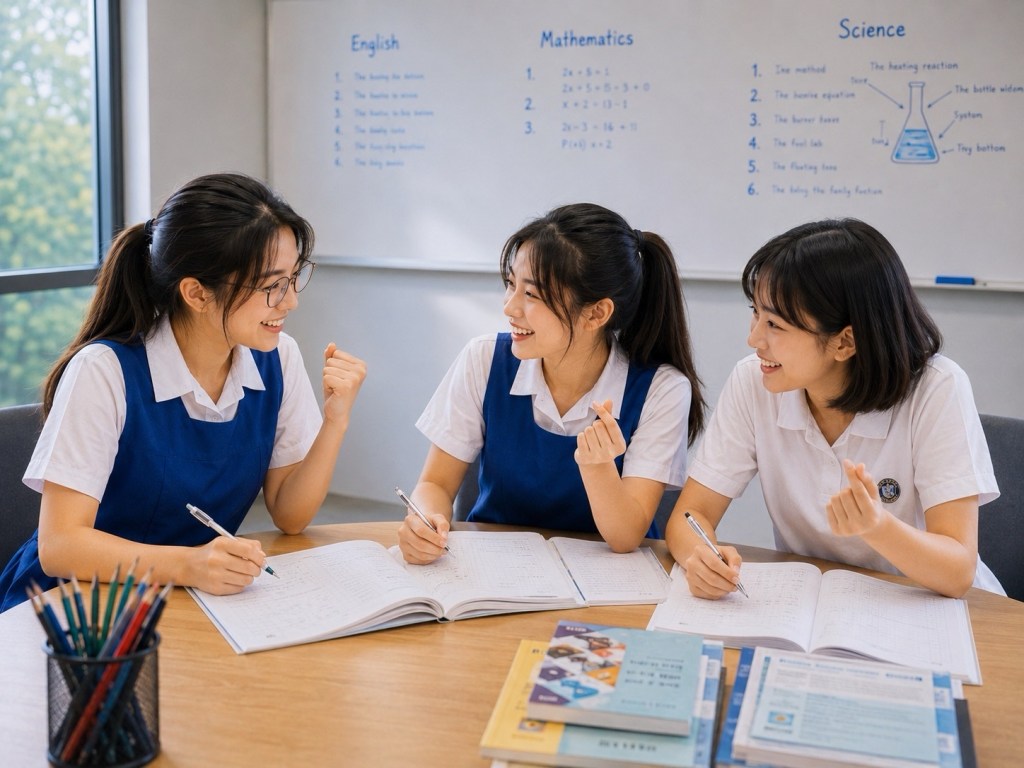
For Parents seeking structured Additional Mathematics tuition in Sengkang.
And understanding how an A-Math education should be diagnosed, organised, paced and managed over time.
Start Here: https://edukatesengkang.com/mathematics-tuition/additional-mathematics-tuition-sengkang/
Sengkang Additional Mathematics Tuition | Managing an Education
A weekly tuition class is easy to schedule.
An education is harder to manage.
A student does not arrive at Additional Mathematics as an empty page. The student arrives with previous knowledge, algebra habits, confidence levels, school demands, examination deadlines and a particular way of responding when a question becomes difficult.
Some students understand concepts but make frequent algebraic errors.
Some can complete familiar exercises but cannot recognise the method in an unfamiliar question.
Some work accurately when given unlimited time, yet lose control during tests.
Others are already doing well and need greater depth, stronger transfer and more demanding questions.
This is why effective Sengkang Additional Mathematics tuition should do more than provide another lesson each week.
It should manage the student’s education.
That means identifying the correct starting point, repairing weak foundations, organising the order of learning, controlling the amount of difficulty, observing errors, connecting topics and gradually transferring responsibility back to the student.
At eduKate Sengkang, our objective is not simply to help a student finish more A-Math questions.
It is to help the student become increasingly capable of managing the Mathematics independently.
The Short Answer
Good Additional Mathematics tuition manages five connected requirements:
Stable A-Math Performance
= Understanding × Algebraic Control × Method Selection × Working Precision × Timed Execution
This is a multiplicative relationship.
A student may understand the chapter, but weak algebra can still damage the answer.
The algebra may be accurate, but poor method selection can prevent the student from beginning.
The student may know the correct method, but unclear working can produce sign errors or lost marks.
Everything may work during practice, but unstable timed execution can cause the performance to collapse during an examination.
The purpose of tuition is therefore not to strengthen one visible part while ignoring the rest.
It is to make the complete system work together.
A second relationship governs improvement:
Progress
= Accurate Diagnosis × Correct Sequence × Deliberate Practice × Feedback × Transfer
More practice is helpful only when the student is practising the right skill, at the right level, in the right order.
Additional Mathematics Is a Connected Subject
A-Math is not merely a longer version of Elementary Mathematics.
Its ideas form a dependency system.
Algebra supports equations and functions. Functions support graphs and modelling. Trigonometry requires algebraic control. Calculus draws upon functions, algebra, graphs and interpretation. Examination questions may then combine several of these areas in a single route.
The 2027 G3 Additional Mathematics syllabus is organised into Algebra, Geometry and Trigonometry, and Calculus. It also assesses the use of standard techniques, problem-solving across different contexts, mathematical reasoning, communication and connections between topics. (Isomer User Content)
This explains why a student can know individual formulas and still struggle with the subject.
The missing factor may not be information.
It may be connection.
A student who learns every chapter as a separate collection of procedures may perform adequately on direct topical exercises. However, mixed questions remove the chapter label. The student must inspect the question, recognise its structure, choose a route and maintain accuracy through several stages.
That requires a managed education rather than disconnected tuition worksheets.
What Must Be Managed?
A strong A-Math programme manages several variables at the same time.
| What is managed | The question being answered |
|---|---|
| Starting point | What can the student genuinely do without help? |
| Dependencies | Which earlier skill is carrying or blocking the present topic? |
| Sequence | What should be repaired or taught next? |
| Difficulty | Is the current work challenging enough without becoming unproductive? |
| Feedback | What is causing each recurring error? |
| Transfer | Can the student use the method when the question changes form? |
| Time | Will the required capabilities become stable before the assessment? |
| Independence | Is the student gradually relying less on prompts and worked solutions? |
When these variables are not managed, tuition may become busy without becoming effective.
The student attends lessons, completes worksheets and receives corrections, yet the same problems return.
When they are managed properly, each lesson has a position in a longer route.
Begin With the Student’s Actual Coordinate
Students should not be grouped simply as “weak”, “average” or “strong”.
A student may be advanced in one part of Additional Mathematics and unstable in another.
For example, the same student may:
- understand differentiation conceptually;
- make frequent errors when simplifying algebraic expressions;
- perform well on direct questions;
- struggle to recognise connected-rate problems;
- become hesitant during timed papers.
A single overall grade cannot explain all of this.
The student’s written work gives a more useful map.
We look at how the student begins, where the first incorrect decision appears, whether the method is understood, how the algebra is controlled and whether the student can detect an unreasonable result.
The first repair should normally occur at the earliest broken dependency.
When algebra is unstable, accelerating into harder calculus questions may create the appearance of progress while leaving the main weakness untouched.
The student learns more advanced content, but the old errors continue multiplying underneath it.
The Algebra Floor
Algebra is the operating language of Additional Mathematics.
Students need to manipulate expressions, factorise, expand, solve equations, work with fractions, manage indices, handle surds and preserve equality across several lines of working.
A small weakness can spread widely.
A sign error may alter a quadratic equation.
Poor factorisation may block partial fractions.
Weak handling of indices may interfere with exponential and logarithmic functions.
Uncertain fractions may create errors in differentiation and integration.
This produces an important rule:
When algebraic instability is the main bottleneck, repair the algebraic floor before demanding more advanced speed.
This does not mean stopping the entire syllabus until every earlier skill is perfect.
It means identifying the exact algebraic operation causing repeated loss and repairing it deliberately while the student continues progressing.
Good tuition keeps the student moving without carrying a dangerous weakness forward.
Understanding Is Only the First Stage
Many students say:
“I understand when the teacher explains it, but I cannot do it myself.”
This is not a contradiction.
There is a difference between following a revealed route and discovering that route independently.
A student may understand each step once the tutor has:
- identified the topic;
- selected the formula;
- organised the information;
- demonstrated the first transformation; and
- shown where the answer is heading.
During an examination, those decisions belong to the student.
The learning sequence must therefore continue beyond explanation:
Tutor Demonstration
→ Guided Control
→ Shared Control
→ Independent Control
→ Mixed Application
→ Timed Execution
A well-managed programme does not leave the student permanently dependent on clear tutor demonstrations.
The tutor gradually removes support.
Separate the Problem Before Reconnecting It
When a student repeatedly loses marks, the whole performance should not be labelled “careless”.
The error must first be separated into its actual source.
| Error type | What may be happening |
|---|---|
| Concept error | The student does not understand the mathematical relationship |
| Algebra error | The route is correct but symbolic manipulation breaks down |
| Selection error | The student cannot identify the appropriate method |
| Translation error | Information is not converted correctly into Mathematics |
| Working error | Steps are compressed, disorganised or insufficiently checked |
| Timing error | Too much time is spent on one route |
| Pressure error | Familiar skills become unstable under assessment conditions |
| Review error | Corrections are read but not converted into changed behaviour |
Once the weak component is identified, it can be trained with greater precision.
The parts are then reconnected through mixed questions.
This is more efficient than repeatedly assigning complete papers and hoping the weakness disappears through volume.
More Worksheets Are Not Always the Answer
Practice matters greatly in Additional Mathematics.
However:
Practice volume × incorrect behaviour
= stronger incorrect behaviour
A student who repeatedly guesses the method may become faster at guessing.
A student who skips working may continue producing answers that cannot be checked.
A student who copies corrections without attempting the question again may recognise the answer without gaining independent control.
Purposeful practice changes according to the student’s present need.
A student repairing factorisation may need a short, concentrated set of carefully selected questions.
A student learning transfer may need variations that look different but use the same underlying relationship.
A student preparing for examinations may need mixed and timed work.
The worksheet is not the programme.
It is one instrument inside the programme.
Three Learning Routes Within the Same Subject
Students attending Sengkang A-Math tuition may be moving through different routes.
The Repair Route
This route is suitable when important foundations are unstable.
The immediate priorities are to reduce confusion, repair algebra, rebuild standard methods and help the student begin questions with less fear.
The student needs manageable success, but not artificially easy work.
The Stabilisation Route
This route is for students who generally understand the syllabus but remain inconsistent.
They may lose marks through incomplete working, weak transfer, recurring errors or slow method selection.
The objective is to make performance repeatable.
The Extension Route
This route is for students whose foundations are secure.
They require deeper variations, unfamiliar structures, more efficient solutions, stronger explanations and earlier movement into mixed examination conditions.
These are not fixed identities.
A student may require repair in trigonometry, stabilisation in logarithms and extension in differentiation.
The programme should respond to the student’s capabilities rather than attach a permanent label.
How a Managed A-Math Lesson Works
A productive lesson is not a continuous lecture followed by homework.
It moves through a controlled cycle.
1. Recalibrate
The tutor checks what has been retained from previous learning.
This may be a short retrieval exercise, a correction review or a question requiring the student to explain a method.
2. Establish the Main Idea
The new concept is taught clearly from first principles.
The student should understand what the method is doing, not merely which formula is being used.
3. Observe the Working
The tutor watches how the student handles the question.
The first hesitation or incorrect transformation often reveals more than the final answer.
4. Correct Early
A misconception is addressed before it becomes repeated practice.
The correction should explain why the route failed and what signal should be noticed next time.
5. Increase Independence
Prompts are reduced.
The student must choose more of the route, organise the working and justify important decisions.
6. Change the Question Form
The same idea appears in a different arrangement.
This checks whether the student learned the underlying structure or only remembered the previous surface pattern.
7. Reconnect the Topic
The skill is combined with earlier chapters through mixed practice.
8. Test Under Appropriate Pressure
Timed work is introduced when the underlying method is sufficiently stable.
Speed is built on control rather than used as a substitute for it.
Why Three Students Can Be a Useful Class Size
eduKate Sengkang currently structures its Mathematics classes in small groups of up to three students. (eduKate Sengkang)
This creates a useful balance.
There are enough students for explanation, comparison and mathematical discussion, while the tutor can still observe individual working closely.
The class can share a common concept without pretending that every student has the same weakness.
During a lesson, the tutor may teach one main mathematical idea to the group, then adjust the questions, prompts and correction route for each student.
One student may need the algebra unpacked.
Another may need fewer prompts.
A third may need an unfamiliar extension question.
The students are learning in the same room, but they do not have to occupy exactly the same point in the subject.
The benefit of a small class is not simply that there are fewer students.
It is that the student remains visible.
Secondary 3 and Secondary 4 Require Different Management
Secondary 3: Build the System
Secondary 3 is commonly the entry point into Additional Mathematics.
The student must adapt to deeper algebra, functions, graphs, trigonometry and increasingly connected reasoning.
The central tasks are to:
- establish the algebraic floor;
- understand the language of functions;
- build reliable standard methods;
- develop clean mathematical working;
- recognise common question routes; and
- prevent early confusion from becoming a Secondary 4 crisis.
Secondary 3 should not be treated as a long preparation period during which inconsistency is harmless.
It is where the main machinery is assembled.
Secondary 4: Integrate and Execute
Secondary 4 places greater pressure on time.
Students must complete the syllabus, revisit earlier topics, combine chapters, manage school assessments and prepare for national examinations.
The management problem changes.
The programme must now balance:
- unfinished foundations;
- current school topics;
- cumulative revision;
- mixed-question transfer;
- timed-paper performance;
- error reduction; and
- examination scheduling.
A Secondary 4 student cannot spend every week only following the school’s newest chapter.
Earlier weaknesses and examination execution must be managed concurrently.
Examination Readiness Is More Than Knowing the Syllabus
A student can possess substantial knowledge and still convert too little of it into marks.
A useful relationship is:
Marks Earned
= Knowledge Available × Conversion Accuracy
Conversion accuracy includes the ability to:
- retrieve the relevant idea;
- interpret the question;
- choose an appropriate method;
- present essential working;
- maintain algebraic accuracy;
- manage time;
- check the result; and
- recover after becoming stuck.
For the 2027 G3 syllabus, problem-solving carries substantial assessment emphasis, and candidates are expected to make connections across topics, translate information, select appropriate techniques and communicate mathematical reasoning. Essential working also matters in the examination. (Isomer User Content)
This is why examination preparation should not begin only after the student has “finished learning everything”.
Execution must be developed progressively.
Managing Difficulty and Confidence
Confidence in Additional Mathematics should not be built through praise alone.
It grows when the student repeatedly experiences a reliable sequence:
See the problem
→ Find a starting point
→ Select a route
→ Complete the working
→ Check the result
→ Recover from mistakes
A student who knows how to recover does not need every question to look familiar.
This is a more durable form of confidence.
At the same time, difficulty must be controlled carefully.
Work that is permanently easy produces little growth.
Work that is consistently overwhelming produces avoidance, guessing and dependence.
The useful zone is where the student must think, but still has enough control to learn from the attempt.
As stability improves, the difficulty rises.
How We Measure A-Math Progress
Grades matter, but they are not the only useful signal.
Before marks become consistently stronger, parents may notice that:
- the student starts questions with fewer prompts;
- algebraic working becomes cleaner;
- recurring mistakes appear less often;
- explanations become more precise;
- the student identifies methods more quickly;
- unfamiliar questions create less panic;
- corrections lead to successful reattempts;
- homework becomes more purposeful;
- timed performance becomes less erratic; and
- dependence on worked solutions decreases.
These indicators show that the student’s learning system is becoming more stable.
A sudden improvement on one test is encouraging.
Reliable capability across several conditions is more valuable.
The Current Singapore Examination Transition
For school candidates in 2026, Additional Mathematics remains part of the Singapore-Cambridge GCE O-Level examination under syllabus code 4049. (SEAB)
From the 2027 Singapore-Cambridge Secondary Education Certificate examinations, G3 Additional Mathematics uses syllabus code K341, with 4049 shown as its earlier reference code. G2 Additional Mathematics uses K232, with 4051 as its earlier reference code. (SEAB)
This transition makes accurate pathway identification important.
Parents should confirm the subject level and syllabus followed by the student’s school rather than assuming every Additional Mathematics route is identical.
The teaching pace, depth and examination requirements should match the student’s actual pathway.
Sengkang Additional Mathematics Tuition at eduKate Sengkang
Our Sengkang Additional Mathematics tuition is organised around a simple principle:
Teach what the student is ready to understand next, while protecting the route that comes afterwards.
Where necessary, we teach from the beginning.
We repair weak algebra rather than hiding it beneath advanced worksheets.
We explain standard methods clearly, then vary the question until the student can recognise the relationship independently.
We move from topical control into mixed application.
We introduce timed conditions after the required knowledge and methods are sufficiently stable.
Throughout the process, the tutor observes how the student thinks, writes, hesitates, corrects and responds to difficulty.
This makes it possible to adjust the programme before a small weakness becomes a larger failure.
Who May Benefit From This Programme?
Sengkang Additional Mathematics tuition may be useful when the student:
- has recently started A-Math and feels overwhelmed;
- did well in lower secondary Mathematics but is struggling with A-Math;
- understands explanations but cannot begin independently;
- makes repeated algebra or sign errors;
- depends heavily on worked solutions;
- performs well on topical exercises but poorly on mixed tests;
- works too slowly under examination conditions;
- is failing and requires structured recovery;
- is passing but remains inconsistent; or
- is performing strongly and needs greater depth and challenge.
The appropriate route depends on what the student can currently do—not only on the latest grade.
What Parents Should Look for in A-Math Tuition
Parents do not need to judge tuition by the amount of paper used.
More useful questions include:
Does the tutor examine the student’s working?
Are recurring mistakes classified and addressed?
Are foundations repaired when necessary?
Does the sequence make mathematical sense?
Is the student learning to select methods independently?
Are mixed questions introduced?
Does timed practice occur at the appropriate stage?
Is the child becoming clearer, steadier and less dependent?
The long-term purpose of tuition is not to make the tutor permanently essential.
It is to help the student develop greater control over the subject.
Managing an Education, Not Merely an Examination
An examination is an important deadline.
An education is the capability that remains after the examination is over.
Additional Mathematics teaches more than a list of procedures. Properly learned, it develops symbolic control, structured reasoning, method selection, precision, abstraction and the ability to carry a complex route from beginning to end.
These abilities support later learning in Mathematics, Science, computing, engineering, economics and other analytical fields, although the exact educational pathway will differ between students.
The grade is important because it records performance at a critical gate.
The deeper objective is to build the person who can produce that performance.
That is what it means to manage an education.
Frequently Asked Questions
What is different about Additional Mathematics tuition?
A-Math tuition should address the connected structure of the subject. It must strengthen algebra, concepts, method recognition, topic linkage, working accuracy and examination execution rather than teaching chapters as isolated sets of formulas.
Why is my child good at E-Math but struggling with A-Math?
A-Math requires deeper symbolic manipulation and more independent method selection. The route is often less visible, and several earlier skills may need to operate together within one question.
Should algebra be repaired before calculus?
When algebra is the main weakness, it should be repaired alongside current learning. Calculus relies heavily on accurate manipulation, so unresolved algebraic errors can continue affecting advanced topics.
Can a student improve after failing A-Math?
A failing grade does not identify the exact cause. Improvement begins by determining whether the main issue is foundation knowledge, algebra, method selection, incomplete working, transfer, timing or examination pressure. A repair route can then be built from the earliest important weakness.
Is Secondary 3 too early for A-Math tuition?
Secondary 3 is often the most useful time to build the foundation. Early repair leaves more time for topic connection, mixed practice and examination preparation in Secondary 4.
Is Secondary 4 too late to seek help?
There may still be time to improve, but the route must be prioritised carefully. The programme should identify the highest-impact weaknesses, protect current school learning and introduce examination practice without attempting to repair everything at once.
Why use a three-student class?
A class of up to three students allows shared explanation and mathematical discussion while keeping each student’s written work visible to the tutor. Questions and corrections can be adjusted without losing the benefits of a small learning group.
How do parents know whether tuition is working?
Look for earlier indicators such as cleaner working, fewer repeated errors, less prompting, better method selection, stronger reattempts and more stable performance on mixed or timed work. Grade improvement should eventually reflect these capability changes.
Does the programme guarantee an A1?
No responsible programme should guarantee a grade. Results depend on the student’s starting point, attendance, practice, school demands, time available and response to teaching. The programme’s responsibility is to provide accurate diagnosis, coherent instruction, close correction and a suitable route towards stronger performance.
Conclusion
Additional Mathematics becomes manageable when the student’s learning route is made visible.
Find the real starting point.
Repair the earliest important weakness.
Teach the concept clearly.
Build accurate working.
Train the student to recognise the route.
Reconnect the topics.
Practise under appropriate pressure.
Then gradually return control to the student.
For families considering Sengkang Additional Mathematics tuition, eduKate Sengkang provides small-group support for students who need to repair, stabilise or extend their A-Math learning.
The next step is a calm assessment of the student’s current work, present difficulties and academic timeline.
Because the objective is not simply another weekly class.
It is a better-managed education.
