
Quick Read
There is no single best way to improve Additional Mathematics.
A student who does not understand algebra needs a different solution from a student who understands the mathematics but works too slowly. A student who performs well on chapter worksheets but struggles with examination papers has a different problem again.
At eduKateSengkang, we therefore approach Additional Mathematics improvement by first asking:
Where is the student losing control?
The improvement route may involve:
| Student difficulty | Useful improvement route |
|---|---|
| Weak algebra foundation | Repair prerequisite Mathematics |
| Does not understand the concept | Rebuild conceptual understanding |
| Understands examples but cannot work independently | Retrieval and independent practice |
| Cannot decide which method to use | Method-selection training |
| Makes repeated algebra mistakes | Precision and error-correction training |
| Forgets previous chapters | Spaced retrieval |
| Strong on chapter exercises but weak on mixed questions | Interleaved practice and transfer |
| Knows the Mathematics but works too slowly | Fluency and timed execution |
| Loses marks despite knowing the answer | Mathematical communication and working |
| Results collapse during examinations | Examination conditioning |
| Already performing strongly | Extension, unfamiliar applications and deeper reasoning |
The objective is therefore not:
More A-Math questions → automatically better A-Math
It is:
Diagnose → Repair → Practise → Test → Transfer → Stabilise
That distinction matters because Singapore’s Additional Mathematics assessment is not limited to routine calculation. For the 2026 O-Level 4049 syllabus, approximately 35% of assessment is AO1 standard techniques, 50% is AO2 problem solving in different contexts, and 15% is AO3 mathematical reasoning and communication. (SEAB)
So students must eventually learn not only how to perform a method, but also when to select it, how to connect ideas and how to communicate a complete mathematical solution.
Why Are There Different Ways to Improve Additional Mathematics?
Additional Mathematics is a connected subject.
A student may appear to have a problem with differentiation when the actual weakness began much earlier:
weak algebra → difficult simplification → unstable differentiation → incorrect final answer
Another student may understand differentiation perfectly but fail because the question combines functions, graphs and calculus in an unfamiliar way.
Another may solve everything correctly at home but lose accuracy when attempting a full examination paper.
All three students may receive the same examination mark.
But they do not have the same problem.
This is one of the most important principles behind effective Additional Mathematics tuition:
The mark tells us that something went wrong. The working tells us what went wrong.
Improvement becomes much faster when teaching responds to the actual mechanism producing the error.
Additional Mathematics Is More Than Harder Mathematics
Students entering Secondary 3 sometimes expect Additional Mathematics to behave like ordinary Mathematics with more difficult numbers.
It does not.
The 2026 Singapore-Cambridge O-Level Additional Mathematics syllabus is organised around Algebra, Geometry and Trigonometry, and Calculus. It also explicitly emphasises conceptual understanding, reasoning, communication, application and mathematical connections. Knowledge of O-Level Mathematics is assumed. (SEAB)
This creates an important transition.
Earlier Mathematics may sometimes allow a student to recognise a familiar exercise and reproduce the method.
A-Math increasingly requires:
See the structure → identify the relevant mathematics → select a route → execute accurately → verify the result
That is why a student can say:
“I understand it when my teacher does it.”
and still be unable to solve the next question.
Watching a solution creates recognition.
An examination requires independent retrieval and selection.
Those are different capabilities.
Way 1: Improve the Mathematics Underneath A-Math
Sometimes the fastest way forward is backwards.
Additional Mathematics relies heavily on earlier mathematical capabilities.
A student struggling with calculus may actually need stronger:
| Foundation | Where it returns later |
|---|---|
| Fractions | algebra, equations, calculus |
| Negative numbers | almost every symbolic topic |
| Expansion and factorisation | polynomials, identities, calculus |
| Indices | exponentials, logarithms, differentiation |
| Equation solving | functions, coordinate geometry, trigonometry |
| Graph interpretation | functions and calculus |
| Algebraic manipulation | throughout A-Math |
This is why simply repeating the present chapter may produce very little improvement.
If the machinery underneath the chapter is unstable, increasing the amount of work can increase frustration without repairing the cause.
At eduKateSengkang, one useful question is therefore:
What capability does this question require before the student can solve it?
Then we repair the earliest important break.
This is not “going backwards”.
It is restoring the mathematical platform required to move forward.
Way 2: Improve Conceptual Understanding
Some students can execute a procedure without understanding the mathematical idea behind it.
That may work temporarily.
It becomes dangerous when the question changes.
For example, memorising a differentiation rule is not identical to understanding what a derivative represents. Memorising the quadratic formula is not identical to understanding the relationship between roots, graphs and discriminants.
Conceptual understanding helps students see relationships.
Instead of learning:
Question type A → Method A
the student gradually learns:
Mathematical structure → possible mathematical routes
That gives the learner much greater flexibility when examination questions are unfamiliar.
At eduKateSengkang, explanations should therefore lead toward independence rather than permanent dependence on explanations.
The tutor explains.
The student reconstructs the idea.
Then the explanation is removed.
The real test is whether the student can now operate without it.
Way 3: Improve Method Selection
This is one of the largest hidden differences between Elementary Mathematics and Additional Mathematics.
A student may know five methods but still be unable to determine which one is needed.
The difficulty is not knowledge storage.
It is selection.
Singapore’s assessment framework makes this particularly important. AO2 asks students to interpret information, identify relevant mathematical concepts or formulae, make connections across topics and select suitable techniques for solving problems. AO2 represents approximately 50% of the 2026 O-Level Additional Mathematics assessment. (SEAB)
Students therefore need practice asking:
What am I looking at?
What information matters?
What mathematical structure is hiding underneath the wording?
Which route is likely to work?
This changes practice from mechanical repetition into mathematical decision-making.
Way 4: Improve Through Worked Examples—Then Remove Them
Worked examples are useful.
Permanent dependence on worked examples is not.
A good progression is:
See → Explain → Complete → Reconstruct → Solve independently
The student might first study a carefully explained solution.
Next, some steps are removed.
Then most of the support disappears.
Finally, the question changes.
This matters because the objective is not:
“I recognise this solution.”
It is:
“I can produce a valid solution myself.”
Research in Mathematics learning continues to support the value of both worked examples and retrieval-based approaches, while also showing that the learning processes they create are different. (Springer Link)
A-Math teaching can therefore use both.
The important question is when each is useful.
Way 5: Improve Through Retrieval Practice
Students often mistake familiarity for mastery.
A formula looks familiar.
A completed worksheet looks familiar.
A tutor’s explanation sounds familiar.
But familiarity disappears very quickly when the book closes.
Retrieval practice asks the learner to produce knowledge rather than merely look at it again.
For A-Math this might mean returning to a previously learned concept and attempting it without first seeing the solution.
Recent research continues to find benefits from retrieval practice in higher Mathematics learning, particularly where students must retain and retrieve prerequisite knowledge over time. (Springer Link)
This creates a useful test:
Can the student still do it when nobody has just shown them how?
If not, the topic may have been completed in the timetable without becoming sufficiently stable in the learner.
Way 6: Improve Through Spaced Practice
Finishing a chapter is not the same as keeping a chapter.
A student may perform very well immediately after studying logarithms because everything is active in short-term memory.
Three months later, the same student may barely remember how to begin.
That is why revision should not occur only immediately before an examination.
Older material needs to return.
A useful learning sequence is:
Learn → Retrieve → Wait → Retrieve again → Mix with other topics → Retrieve again
Spacing and retrieval are among the more consistently supported strategies in the science of learning. (Nature Reviews Psychology)
For A-Math, spacing is especially valuable because later topics repeatedly depend on earlier ones.
The student is not maintaining isolated chapters.
The student is maintaining a mathematical network.
Way 7: Improve Through Interleaved Practice
Chapter worksheets provide an important first stage.
But they contain a hidden clue.
If every question sits underneath a heading called Differentiation, the student has already been told which mathematical tool to use.
The examination often removes that clue.
Mixed practice changes the task.
The student must first identify the type of problem before solving it.
That extra decision is valuable.
Classroom research has found substantial advantages for interleaved Mathematics practice over blocked practice in some settings, and later research suggests part of the advantage comes from forcing learners to discriminate between different problem types and retrieve the appropriate strategy. (PubMed)
Interestingly, students often perceive interleaving as harder and may underestimate how useful it is. Recent research published in 2025 again found that many students judged interleaving less favourably despite evidence supporting the strategy. (PubMed)
That apparent difficulty can be productive.
During early learning:
Blocked practice helps build the method.
Later:
Interleaved practice helps train method selection.
Both have a role.
Way 8: Improve Mathematical Accuracy
“Careless mistakes” should not automatically be treated as random.
Suppose a student repeatedly loses marks because:
a negative sign disappears after expanding brackets;
a denominator is copied incorrectly;
a constant is omitted during integration;
an equation becomes mathematically unequal between two lines.
After ten occurrences, this is no longer useful to describe merely as “careless”.
There is a pattern.
The tutor should locate exactly where control breaks.
This creates a better correction cycle:
Error → Locate → Explain → Correct → Repeat differently → Retest
The aim is not merely to correct today’s answer.
It is to prevent the mechanism from producing tomorrow’s error.
Way 9: Improve Mathematical Communication
A student can understand the Mathematics and still lose marks through poor presentation.
The 2026 examination instructions explicitly state that omission of essential working can result in loss of marks.
In addition, AO3 assesses mathematical reasoning and communication, including justification, explanation and mathematical arguments. (SEAB)
Students therefore need to learn to make their reasoning visible.
Good working helps the examiner.
It also helps the student.
When every mathematical move is visible, errors can be located more easily.
The paper becomes a record of reasoning rather than a trail of calculator answers.
Way 10: Improve Speed Only After the Route Is Stable
Speed matters.
But forcing speed too early can automate mistakes.
A better progression is:
Correct slowly → correct consistently → correct efficiently → correct under time
Fluency develops when repeated processes become sufficiently stable that they consume less attention.
This leaves more mental capacity available for difficult decisions later in the problem.
Students who repeatedly restart questions, hesitate between methods or perform basic algebra slowly may run out of time even when their conceptual understanding is good.
For these students, the intervention is not necessarily another conceptual lecture.
It may be execution training.
Way 11: Improve Transfer
Transfer is one of the strongest tests of genuine learning.
Can the student use the same idea when:
the numbers change;
the graph replaces the equation;
the wording changes;
two chapters appear together;
the familiar cue disappears;
or the question is presented in an unfamiliar context?
If not, the learner may have learned the worksheet rather than learned the Mathematics.
This is why we increasingly treat A-Math capability as having several dimensions:
| Capability | Key question |
|---|---|
| Understanding | Do I know why this works? |
| Selection | Do I know when to use it? |
| Execution | Can I perform it accurately? |
| Communication | Can I show the solution properly? |
| Retrieval | Can I remember it later? |
| Transfer | Can I use it when the question changes? |
| Examination control | Can I still do all of this under pressure? |
A strong A-Math student gradually gains control across all seven.
Way 12: Improve Through Examination Training
Learning Mathematics and converting Mathematics into examination marks overlap.
They are not identical.
The 2026 O-Level Additional Mathematics examination consists of two papers, each lasting 2 hours 15 minutes and worth 90 marks, with each contributing 50% of the overall assessment. Candidates answer all questions.
That means the student must maintain mathematical control for a long period.
Examination preparation therefore eventually needs to test:
knowledge + selection + execution + timing + checking + recovery
The last one is important.
What happens after a student encounters a question they cannot immediately solve?
Do they freeze?
Spend twelve minutes on three marks?
Abandon the paper mentally?
Or move, recover and return?
Examination performance requires control of the entire paper, not merely mastery of individual chapters.
Different Students Therefore Need Different A-Math Routes
This gives us a much more useful model than simply dividing students into “strong” and “weak”.
Student A: The Foundation Repair Student
The student is struggling across many chapters because algebra underneath them is unstable.
The priority is repair.
Student B: The Recognition Student
The student follows every lesson but cannot reproduce methods independently.
The priority is retrieval and fading support.
Student C: The Chapter Student
The student scores well on individual-topic worksheets but struggles in examinations.
The priority is interleaving, selection and transfer.
Student D: The Accuracy Student
The Mathematics is understood, but repeated execution errors destroy marks.
The priority is precision and error control.
Student E: The Slow Student
Solutions are generally correct but take too long.
The priority is fluency and route efficiency.
Student F: The Examination Student
Homework is strong but assessment results fluctuate sharply.
The priority is performance under load and examination conditioning.
Student G: The Advanced Student
The syllabus is secure and routine work provides little additional growth.
The priority is deeper reasoning, unfamiliar applications and extension.
Same subject.
Different student state.
Different intervention.
Why eduKateSengkang Uses Small Groups
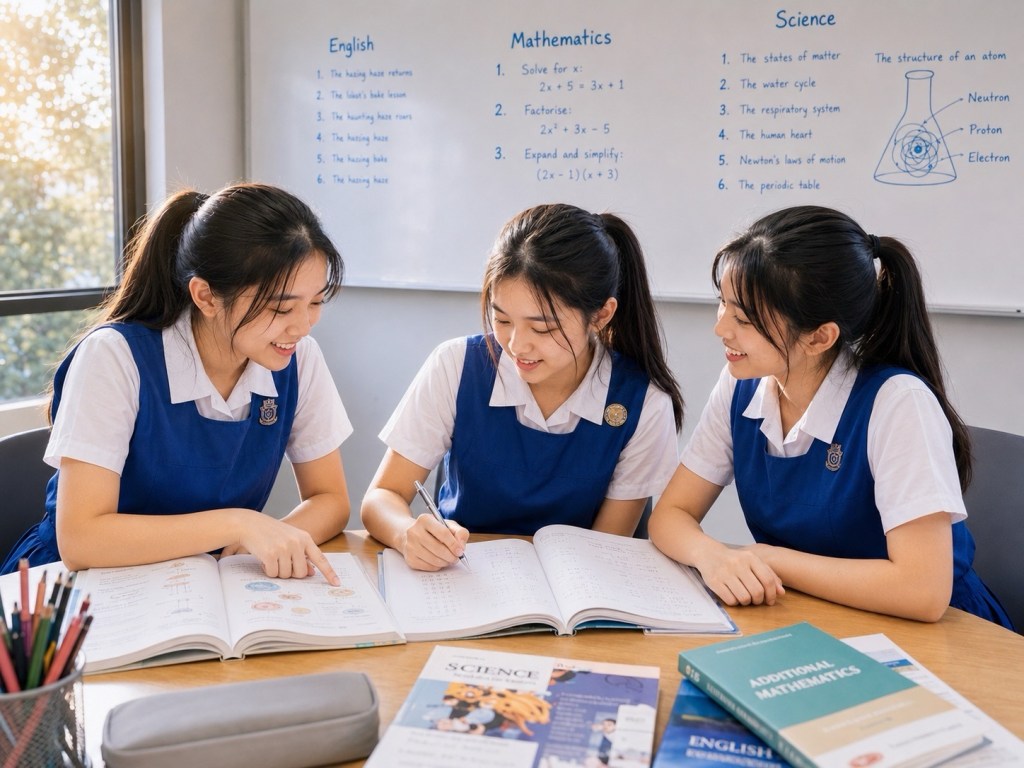
eduKateSengkang currently describes its Mathematics classes as small three-student groups, with 1.5-hour lessons and Additional Mathematics support among its Secondary offerings. (eduKate Sengkang)
But the educational value of three students is not simply that “smaller is better”.
The important advantage is visibility.
A tutor can see more of each student’s mathematical process:
How did the student begin?
Why was that method selected?
Where did the first error occur?
Was the student guessing or reasoning?
Did the correction survive the next question?
Two students can obtain exactly the same wrong answer for completely different reasons.
One may misunderstand the concept.
One may understand it perfectly but lose a negative sign.
The correction should not be identical.
That is where small-group tuition becomes a diagnostic tool rather than merely a smaller classroom.
The eduKateSengkang Additional Mathematics Improvement Cycle
The newest version of our approach can be reduced to six movements:
1. Diagnose
Find the learner’s actual mathematical state rather than assuming it from the school level or latest test score.
2. Repair
Restore the earliest important missing capability.
3. Strengthen
Build the current concept until the student can execute it accurately.
4. Verify
Remove help and test independent retrieval.
5. Transfer
Change the problem and see whether the student can still recognise the mathematics.
6. Stabilise
Return to the concept later, mix it with other topics and eventually test it under examination conditions.
This is a major difference between finishing work and building capability.
The worksheet tells us what the student completed.
Transfer tells us what the student can now do.
Secondary 3 and Secondary 4 Need Different Emphases
Secondary 3 Additional Mathematics
Secondary 3 is the construction year.
There is a strong argument for prioritising:
algebra → functions → mathematical representation → route recognition → disciplined working
Students should build the engine before the examination year becomes crowded.
A weak Secondary 3 foundation often turns Secondary 4 into continuous repair.
A strong one creates room for deeper practice.
Secondary 4 Additional Mathematics
Secondary 4 increasingly becomes an integration year.
Earlier topics must remain available while new work is completed.
Practice should gradually move from:
chapter mastery
towards:
mixed Mathematics → complete questions → timed sections → complete papers → examination control
The goal changes from learning each component to coordinating the entire system.
Additional Mathematics in 2026 and the SEC Transition
For students sitting the Singapore-Cambridge GCE O-Level examination in 2026, G3-equivalent Additional Mathematics remains syllabus 4049. (SEAB)
From 2027, Singapore moves to the Singapore-Cambridge Secondary Education Certificate (SEC). SEAB lists Additional Mathematics at G3 as K341 and at G2 as K232. The SEC will record subjects at their respective G1, G2 or G3 levels. (SEAB)
The naming and examination architecture are changing.
The fundamental learning requirement remains familiar:
students need increasingly reliable mathematical understanding, reasoning, application, communication and independence.
How Parents Can Tell Whether A-Math Tuition Is Working
Do not look only at whether the latest test mark increased.
Marks matter, but they are a delayed measurement.
Earlier signs of real improvement include:
The student starts questions more independently.
The student can explain why a method works.
Fewer repeated errors appear.
Old chapters remain retrievable.
The student can handle mixed questions.
Working becomes cleaner.
Unfamiliar questions create less panic.
Corrections survive when the numbers or wording change.
Those changes indicate that underlying capability is improving.
When capability becomes sufficiently stable, examination results have a much stronger foundation from which to improve.
Frequently Asked Questions
What is the fastest way to improve Additional Mathematics?
It depends on what is limiting the student. For a learner with severe algebra gaps, foundation repair may produce the largest improvement. For someone who knows the content but struggles in examinations, mixed and timed practice may have higher value. Diagnosis should come before prescription.
Should my child simply do more A-Math questions?
Practice matters, but volume alone is not enough. The questions should serve a purpose: learning a method, retrieving it, correcting an error, discriminating between methods, transferring knowledge or preparing for examinations.
Why can my child understand tuition but still fail tests?
Understanding an explanation is easier than independently retrieving, selecting and executing a method. Support needs to be gradually removed so that independent performance is tested.
Is algebra really that important for Additional Mathematics?
Yes. Algebraic manipulation supports much of the subject and is specifically identified by SEAB as an important foundation for further Mathematics. (SEAB)
Should students start examination papers immediately?
Not necessarily. A student who has not yet built the required concepts can practise entire papers inefficiently. Paper practice becomes increasingly valuable once enough of the mathematical machinery is available to make the exercise meaningful.
Can a strong A-Math student still benefit from tuition?
Potentially, but the purpose should change. The student may benefit more from difficult transfer questions, alternative solution routes, deeper reasoning and examination refinement than from repeating routine exercises.
Different Ways, One Final Destination
There are many ways to improve Additional Mathematics because there are many reasons why Additional Mathematics performance can become unstable.
A student may need to go backwards and repair.
Another needs practice.
Another needs less guidance.
Another needs more difficult questions.
Another needs more time.
Another needs less time.
Another needs examination conditioning.
Effective tuition should be able to tell the difference.
At eduKateSengkang, the aim is therefore not to put every student through the same sequence of worksheets.
It is to identify what the learner needs next and use the appropriate route to build stronger mathematical control.
Understand the student.
Find the constraint.
Repair the correct capability.
Build independence.
Test transfer.
Prepare for performance.
Because improving Additional Mathematics is ultimately not about becoming good at repeating solutions.
It is about becoming increasingly capable of producing the correct mathematical solution when the route is no longer given.
