
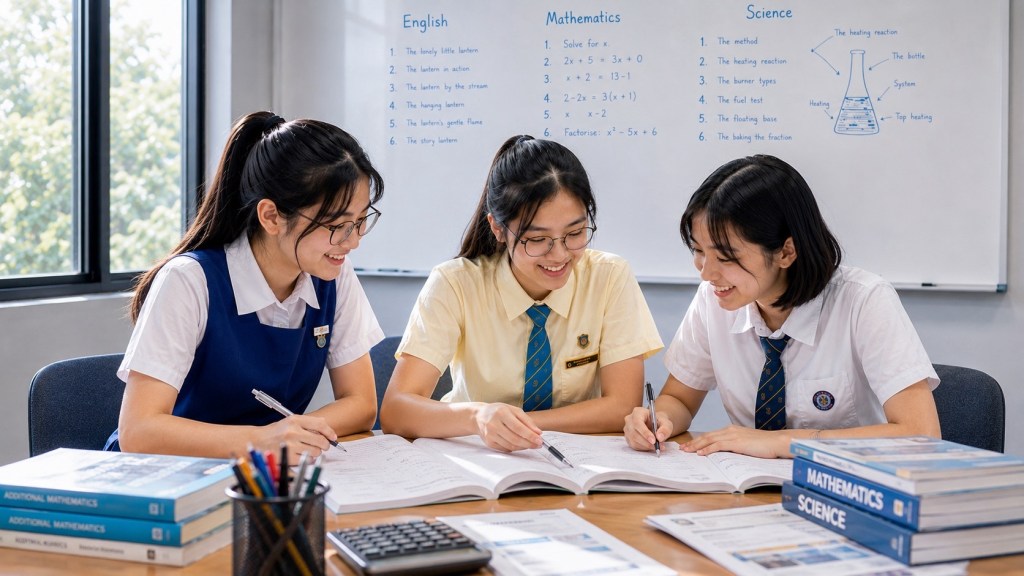
The teacher begins explaining a new idea. One student is still trying to find the right page. Another recognises every word but does not know which relationship the explanation is building. A third has already copied the model answer and is waiting for the teacher to say something different.
None of these situations is solved simply by saying that students should prepare more. The preparation needs a purpose. Finding the material, recognising the starting concepts and identifying a useful question are different jobs from completing the whole lesson in advance.
Studying before a lesson means preparing to use the lesson well: establish what it concerns, make essential background available and bring an honest account of what is still uncertain. The goal is not to arrive pretending that instruction is unnecessary. It is to arrive with a clearer place for instruction to begin.
This is an applied guide in the How Studying Works series. It covers the period before a school lesson, tuition class or other guided learning encounter. The examples are original illustrations; suggested routines are adaptable planning choices, not a tested programme that guarantees results.
Preparation is a bridge, not a second full lesson
A lesson has work to do. The teacher may introduce a concept, demonstrate a method, organise a discussion or examine an unresolved problem. Preparation should make that work more accessible rather than assume it must already have been completed independently.
Imagine an upcoming lesson on equations. A reasonable preparation task might check whether the learner understands equality and can calculate with the numbers involved. It need not demand independent mastery of every equation type that the teacher intends to introduce. Requiring the final performance before the initial explanation confuses readiness with achievement.
This distinction also protects the learner’s time. If preparation routinely becomes a long private lesson, followed by a school lesson and then another complete lesson at home, inspect whether the encounters serve different purposes. More encounters are not automatically duplication, but each should contribute something identifiable.
A useful bridge leaves a modest output: the correct material located, one relevant idea checked and a question that the learner can recognise when the lesson addresses it. Its usefulness should be judged by what it enables, not by the size of the preparatory notebook.
Begin with the teacher’s actual instruction
Read what has genuinely been assigned. Preparing a passage for discussion, completing prerequisite questions and watching an instructional video are different requirements. Do not replace an explicit assignment with a favourite study technique just because that technique is usually helpful.
Check the extent of the task. Which pages, question numbers or sections are included? Is a written response expected, or is the learner asked to arrive ready to discuss? Is the task an initial exploration in which uncertainty is expected? These distinctions change what completion should mean.
If the instruction is unclear, record the point that needs clarification. A responsible question is, “Should we attempt these questions before reading the example, or are they practice after the video?” That is more useful than guessing and then interpreting a mismatch as evidence that the learner failed to prepare.
Where no preparation is assigned, keep any self-chosen preview proportionate. A learner is not automatically obliged to create an additional homework programme for every lesson. The proposed preview should have a clear reason and fit the time actually available.
Identify the kind of lesson you are approaching
Preparation for first instruction differs from preparation for a discussion, a correction lesson or a practical demonstration. Ask what contribution the learner will be expected to make. The most useful starting material is whatever supports that contribution.
Before a correction lesson, bring the original attempt and locate the unresolved step. Before a text discussion, read the assigned material and preserve questions about its meaning. Before a demonstration, read the stated instructions and know which observations the teacher asks students to attend to. Practical activities must still follow the teacher’s safety and supervision requirements.
Before an introductory lesson, a light orientation may be sufficient. Before a lesson that assumes prior reading, more substantial preparation may be necessary. The same ten-minute ritual should not be imposed on both situations as though the instructional design were identical.
Use the topic title as a question, not proof of understanding
A familiar topic label can conceal an unfamiliar demand. A student may have encountered graphs before without understanding why a graph’s slope represents a rate. Another may know the word inference without being able to justify one from a passage.
Turn the title into a question. “What relationship are we trying to see in these graphs?” “How will this lesson distinguish a reasonable inference from an unsupported guess?” This gives the learner something to listen for without supplying an answer that has not been checked.
Keep the question broad enough to allow the lesson to develop. Preparation should not train the learner to ignore everything except a predicted examination answer. The teacher may introduce a distinction that the learner did not yet know was important.
Check background knowledge selectively
Choose a small prerequisite that the next lesson is likely to use. Before working with unit rates, for example, the learner could check what a quantity per one unit means. Before comparing arguments, they could practise locating a claim and a supporting reason in a short paragraph.
Do not turn this into an exhaustive test of every earlier chapter. A prerequisite check is useful when it answers a specific readiness question. If it reveals a gap, note whether the gap can be clarified briefly or needs the teacher’s attention.
The existing How Prior Knowledge Works in Learning explains the wider mechanism. The practical responsibility here is narrower: make a relevant starting point visible before the teacher builds on it.
A learner who cannot perform the prerequisite should not invent a confident answer. Bringing that uncertainty to class can be the most important result of preparation. The lesson can then address the real starting state instead of an appearance of readiness.
Preview vocabulary without turning the glossary into the lesson
Some words act as entrances to an explanation. If a learner does not know what a quantity, comparison or condition refers to, the first part of the lesson may be difficult to follow. Identify a few indispensable terms in the assigned material rather than copying every bold word.
Record a provisional meaning, its source and a question about use. For rate, the question might be, “Which quantity is measured for each unit of the other quantity?” That directs attention towards the relationship rather than only a dictionary sentence.
Keep everyday and subject meanings separate. A familiar word such as product or argument can do specialised work in a lesson. The learner should be ready to revise an everyday interpretation when the teacher introduces the disciplinary meaning.
Vocabulary preview is complete when it removes a useful barrier or identifies one. It is not complete merely because a list has been copied neatly, nor does it require the learner to master every future application before class.
Make one genuine prediction, then keep it correctable
A prediction can give the lesson a question to resolve. Before a comparison of two methods, ask which might be more suitable and why. Before reading an explanation, attempt a brief answer to its organising question. Write uncertainty honestly rather than making the prediction sound authoritative.
In Richland, Kornell and Kao’s 2009 pretesting experiments, attempting questions before studying an essay improved later performance on the tested material, including items initially answered incorrectly. The finding concerned a particular experimental procedure, not every form of advance preparation.
The application proposed here is to preserve a tentative answer and revisit it when a dependable explanation becomes available. Do not rehearse an unchecked guess repeatedly. A prediction has a different status from a fact learned from instruction.
It is also acceptable to write, “I do not yet have a plausible explanation.” The preparatory task has identified a question. It need not reward imaginative certainty over an honest account of current knowledge.
Prequestions are an option, not a universal advantage
Evidence about questioning before instruction does not justify a claim that more pretesting must improve every lesson. In Geller and colleagues’ 2017 undergraduate chemical-engineering study, prequestions did not add a detectable benefit to questions asked at the end of class. End-of-class retrieval with feedback did benefit later performance relative to material not tested.
This matters when time is limited. A short preview may still serve an organisational purpose, but it should not consume the opportunities for explanation, feedback or later practice on the assumption that advance questions are always superior.
Choose a prequestion when it clarifies an important relationship and the learner will encounter a suitable answer. Leave it out when it becomes a prolonged guessing exercise or when the teacher has deliberately designed a different starting experience.
Bring a question that identifies a boundary
The most useful classroom question often sits between something the learner can explain and something they cannot. “I understand how to divide the total cost by the number of items, but I do not know when that comparison is fair” provides a clear boundary.
Another example is, “I can identify the character’s action, but I cannot tell whether the action supports this emotion or another one.” The teacher can now address the connection rather than repeat every definition in the topic.
Keep the question in a form the learner can actually ask. It does not need expert terminology. A page reference, a short example and the phrase “I am unsure about this step” can be sufficient. The guide to study questions develops this skill further.
Know when the preview should stop
A self-chosen preview needs an ending. One reasonable finish condition is that the assigned material is located, the topic’s main question is identified and any essential uncertainty is recorded. More work is justified only when it has a separate purpose.
If the preview exposes a large missing prerequisite, do not quietly turn a brief preparation into an unplanned night of catch-up. Inform the appropriate adult or teacher and make a feasible plan. If the learner is already secure, stop rather than assigning more work to make the preparation look substantial.
This boundary is especially important for conscientious students. There is always another explanation to watch or example to solve. Preparedness should mean readiness to engage with instruction, not the impossible condition of having removed every possible uncertainty in advance.
Worked case: preparing for a lesson on unit rates
Suppose an upcoming lesson concerns comparisons using unit rates. Use this original preparatory example: one packet contains three identical notebooks for $6; another contains five of the same notebooks for $9. The learner is asked what a fair price comparison might require.
A first response might compare only total prices and call the $6 packet cheaper. Ask what differs between the packets. The number of notebooks differs, so comparing cost for one notebook is one possible approach when the notebooks really are equivalent.
The calculations are $6 ÷ 3 = $2 per notebook and $9 ÷ 5 = $1.80 per notebook. These figures make the unit-price comparison explicit. They do not automatically decide a real purchase: needing only three notebooks or having a limited total budget introduces additional considerations.
The preparation should finish with a question such as, “When does a per-item comparison answer the question, and when do other conditions matter?” The learner now has a concrete relationship to follow in the lesson, without having completed every application of rate in advance.
If division itself is uncertain, preserve that finding. The teacher may need to clarify the prerequisite before asking the learner to interpret more complicated comparisons. The example has revealed a starting point, not delivered a judgement about mathematical ability.
Worked case: preparing for an English discussion
Consider an assigned discussion of the original sentence, “After the invitation arrived, Hana moved the unopened envelope from the table to a drawer.” A light preparation asks the learner to distinguish what is stated from what might be inferred.
The sentence states that the envelope arrived, remained unopened and was moved into a drawer. It may suggest avoidance or a wish to put it aside. It does not establish whether Hana is frightened, busy, angry or simply storing the letter safely.
The learner can bring two possible interpretations and ask what additional context would distinguish them. That prepares a contribution to discussion without memorising an alleged model emotion that the sentence does not establish.
Do not search for a polished answer to the exact passage merely to arrive with something impressive to say. The preparatory value lies in having noticed the evidence and the uncertainty. During the lesson, new context may reasonably change the interpretation.
For a longer assigned text, retain the same discipline at a larger scale: identify the main situation, one important detail and a question that remains open. Complete the actual reading required, but do not confuse internet commentary with the learner’s encounter with the text.
Worked case: preparing to interpret a data display
Suppose a teacher will discuss a supplied table of measurements. Preparation can begin with the headings, units and the distinction between the quantity changed and the quantity recorded. The learner does not need to invent the experiment’s conclusion before seeing the lesson.
As a numerical illustration, imagine a table listing elapsed times of 0, 5 and 10 minutes alongside recorded masses of 100, 98 and 96 grams. The recorded mass decreases by two grams in each displayed five-minute interval. That is a description of these invented entries.
The numbers alone do not explain why the mass changed, establish what was measured or show that the same rate continues indefinitely. A useful preparatory question is, “What extra information is needed before explaining this pattern?”
Bring that question to the lesson and inspect how the teacher uses the stated conditions. This is preparation for interpreting evidence, not an instruction to conduct an unsupervised experiment or a claim that the illustrative measurements were observed in the real world.
Preparing for a flipped or video-supported lesson
When initial instruction is explicitly assigned before class, preparation has a larger instructional role. Follow the assigned sequence and record where the explanation stops making sense. A video completion indicator alone does not show what the learner understood.
After a meaningful segment, attempt the action it was teaching when appropriate. That could be explaining a transition, completing a missing step or identifying how a diagram connects to the spoken account. Keep the prompt small enough to reveal a specific uncertainty.
If the video, transcript or connection is inaccessible, report the access problem rather than describing the learner as unprepared without qualification. Preparation cannot reasonably depend on materials the learner cannot use. Ask the school or teacher about an appropriate alternative.
Bring an honest distinction into class: “I watched it but need this step explained,” or “I could complete the first example; I do not understand the changed condition.” That gives the in-person lesson a clearer job than a simple declaration that the video was finished.
Do not let previewing narrow attention to predicted answers
A learner who arrives searching only for the answer to one preview question may overlook another important distinction. Keep a second place in the note for something unexpected: an example, condition or question introduced by the teacher that changes the initial picture.
This is a practical safeguard, not a claim that previewing necessarily creates tunnel vision. The point is to preserve openness. A preparation question directs attention; it should not define the only information worth noticing.
At the end of the lesson, ask what mattered that the learner did not anticipate. That question allows the lesson to revise the preview instead of turning the lesson into a search for confirmation of the learner’s first guess.
Preparation when the topic is already familiar
A learner who already knows the introductory material may need a different preparation task. Instead of copying definitions again, attempt a changed example, compare two methods or identify a boundary where a familiar rule does not apply.
Keep the claim of familiarity testable. Recognising the chapter title is not the same as explaining the central relationship. A small attempt can establish whether the learner needs extension, maintenance or clarification.
During class, familiarity does not remove the responsibility to attend respectfully. The teacher may develop a condition or application that the learner has not considered. A useful contribution asks a substantive question rather than treating speed of recognition as a reason to disengage.
Preparation when essential background is missing
When the preview reveals that a prerequisite is missing, separate the discovery from the remedy. First make the gap specific: a word, operation, representation or earlier concept. Then decide who or what can explain it appropriately.
A brief clarification may be enough. A larger gap may need planned teaching. Do not assume the learner must independently reconstruct several years of material before being entitled to take part in the next lesson.
Bring evidence rather than a broad label: “I can compare whole-number prices but cannot interpret dollars per kilogram,” for example. This helps the teacher choose a useful starting point. The guide to study recovery is the better route when preparation exposes a substantial backlog.
Use digital help without arriving with borrowed understanding
A search result or AI explanation may help locate a definition or suggest a question. It may also supply an answer that the learner cannot explain. Keep those outcomes distinct.
Ask the tool a bounded question and check important information against the assigned source or another dependable reference. A generated account should remain a candidate explanation until its relevant claims are checked. Follow the school’s rules about assistance and avoid unnecessary sharing of personal information.
Before class, ask the learner to state what they now understand in plain language and what still needs the teacher. If the only available response is to repeat the generated wording, further interpretation may be needed. The dedicated digital studying guide explains this division of work.
The parent’s role is to support entry, not rehearse a performance
A parent can help locate the instruction, make the resource accessible and ask what the learner intends to find out. These actions support preparation without requiring the parent to become a second subject teacher.
Avoid rehearsing the child to deliver a sophisticated answer whose meaning they cannot defend. It is more useful for the teacher to receive an ordinary, accurate account of uncertainty than an impressive response assembled by an adult.
For younger learners, offer a choice between two useful questions or help them mark the confusing line. Older learners can increasingly select their own preparation task. The amount of support should follow the actual need, not a rigid rule that all preparation must be completed alone.
If preparation repeatedly consumes the evening, discuss the combined workload and the purpose of the assignments. The solution may be a clearer scope or better access to explanation, not an assumption that the family must keep expanding study hours.
The teacher can make preparation more usable
A preparation instruction becomes easier to act on when it names the resource, the expected action and how the result will be used. “Read these two pages and bring one question about the comparison” makes a different demand from “understand the chapter before class”.
Clarify whether incorrect initial answers are expected and where the correct account will be established. That protects the distinction between an exploratory attempt and work the student should already know how to complete.
Provide a route for learners whose access or prerequisites differ. An assignment can be common while its support varies. The purpose is to prepare students for the shared lesson, not to make prior access to private help an invisible entry requirement.
A small preparation record that can travel into class
A practical record can contain four short statements: the lesson’s likely question; one relevant idea already checked; one uncertainty; and the source or example to which that uncertainty belongs. It should fit comfortably beside the assigned work.
For the notebook example, the record could read: “We are comparing quantities fairly. I can calculate cost per notebook. I want to know when unit price is insufficient for a decision. My example compares three notebooks for $6 with five for $9.”
After the lesson, add what changed. The record now connects preparation to instruction instead of becoming a separate artefact that is filed away and never used. There is no need to duplicate every classroom note inside it.
Evaluate preparation by the question it resolves
Ask whether the learner could find the task, follow the relevant starting terms, recognise an answer to their question or explain what changed during the lesson. These are local observations of usefulness, not proof of a guaranteed grade improvement.
If the preview did not help, inspect why. It may have concerned the wrong section, been too broad, supplied unchecked answers or displaced needed rest and required work. Revise the preparation task rather than defend a routine simply because it sounds educational.
Keep one lesson’s result in proportion. A difficult class can still be valuable, and a smooth class can still leave important gaps. Preparation should make the learner’s participation more informed while leaving the larger learning judgement to suitable later evidence.
The next useful step is still inside the lesson
Preparation should end with room for teaching. The learner arrives ready to hear a correction, examine a new example, ask for a missing link and change an initial interpretation. This is different from arriving with the answer already copied and the intellectual task apparently complete.
The purpose of studying before a lesson is not to remove every reason for having the lesson. It is to make the reasons clearer. Find the material, establish a manageable starting point and bring a question worth resolving. Then let the lesson do work that preparation could not do alone.
Continue the studying route
Use How Study Goals Work when the purpose remains vague, How Study Questions Work when uncertainty needs a usable form and How a Study Week Works when preparation must fit alongside other obligations. Return to How Studying Works for the full series.
The research cited here supports particular findings about pretesting and classroom questioning. The preparation records, stopping rules and worked scenarios are original practical applications. They should be adapted to the teacher’s actual instructions, the learner’s starting knowledge and the time and support genuinely available.
