
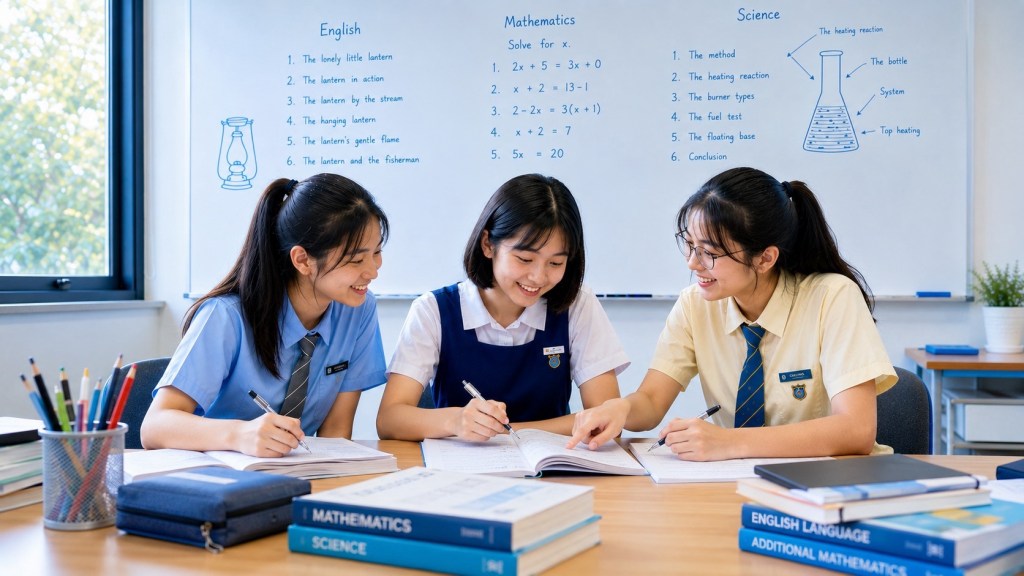
Direct Answer: A scientific experiment works by turning a testable question into a designed comparison. The learner decides what will change, what will be measured, which other conditions must be managed, how observations will be recorded, and what result would count as evidence. The experiment then produces data that can support, weaken or fail to distinguish between possible explanations. A good experiment is not defined by having apparatus. It is defined by whether its design makes the intended question answerable.
The simplest definition of a scientific experiment
A scientific experiment is a planned investigation in which conditions are deliberately arranged or changed so that observations can test a question, prediction or causal relationship.
In one line: An experiment is a comparison designed so that the result means something.
The apparatus can be correct while the experiment is wrong
A student sets up two beakers, two thermometers and a stopwatch. The table is neat. Every reading has a unit. The graph has labelled axes.
But one beaker began with more water, one was closer to the window, the thermometers were inserted to different depths and the student started timing one minute apart.
The lesson is important: experimental quality lives in the relationship between the question, the comparison and the method—not in how scientific the equipment looks.
The experiment mechanism
QUESTION → HYPOTHESIS / PREDICTION → DEFINE WHAT WILL BE CHANGED → DEFINE WHAT WILL BE MEASURED → CONTROL PLAUSIBLE ALTERNATIVES → CHOOSE METHOD → CHECK SAFETY → RUN → OBSERVE / MEASURE → REPEAT → ORGANISE DATA → ANALYSE → CONCLUDE → STATE LIMITS → IMPROVE / REPLICATE
This guide follows the broad investigation cycle. For the narrower mechanics of variables and fair comparison, see How Fair Tests Work. For precision and repeatability, see How Scientific Measurement Becomes Evidence. For systematic and random error, see How Students Distinguish Systematic and Random Error in Science.
1. The question comes before the method
Students are often given apparatus first and asked what to do with it. Real scientific reasoning should run in the opposite direction. Begin with the question, then choose a method capable of answering it.
“What happens to dissolving time when water temperature changes?” suggests a different design from “Which of these materials dissolves in water?” or “How does the temperature of a cooling liquid change over ten minutes?”
A useful question defines the relationship we want to inspect. How Students Learn to Ask Testable Scientific Questions focuses on that upstream skill.
2. A hypothesis or prediction should expose a relationship
A prediction is useful when it makes a relationship explicit enough to be tested. “I think cup A will be better” is weak. “If the exposed surface area is larger, the water will cool faster under otherwise comparable conditions” is more useful because the learner has named the changed factor, the expected outcome and the direction of effect.
The prediction does not have to be correct for the experiment to be valuable. A wrong prediction can still generate good evidence. The scientific job is to let the world answer back.
3. The independent variable is what the experiment deliberately changes
In a controlled experiment, the independent variable is the factor deliberately varied between conditions. The dependent variable is the outcome measured or observed in response.
Students often memorise these definitions but still struggle to design a test. The stronger question is functional: What comparison would let us see whether changing X is associated with a change in Y?
Variables are not labels to insert after the method has already been written. They are the architecture of the comparison.
4. Control variables protect the meaning of the comparison
Suppose we change water temperature and measure dissolving time. If the amount of solute also changes, the final difference becomes harder to interpret. Two explanations now compete.
Control variables are conditions kept sufficiently comparable so that plausible alternative causes are reduced. The purpose is not ceremonial sameness. The purpose is interpretability.
This is why fair testing matters. A fair test does not prove the claim automatically; it makes a causal comparison cleaner.
5. Operational definitions turn vague ideas into measurable events
Words such as “fast,” “strong,” “healthy,” “bright,” “effective” and “growth” can be scientifically slippery unless the experiment states how they will be observed.
Does “growth” mean height, mass, leaf area or something else? Does “dissolved” mean the last visible crystal disappeared? Does “bright” mean a sensor reading or a human judgement?
An operational definition makes the measurement rule explicit. See How Operational Definitions Turn Scientific Ideas Into Measurable Variables.
6. Measurement design decides what the experiment can detect
A ruler cannot detect a change smaller than the precision with which it is read. A timer started inconsistently can create variation larger than the effect being studied. A sensor placed in the wrong part of a system can measure something real but irrelevant.
The question is not only “Did we measure?” but “Was the measurement capable of revealing the effect we care about?”
How Measurement Resolution Limits the Smallest Change Students Can Detect explores this boundary.
7. Repeats tell us whether the result is stable
One reading can be unusual. Repeated measurements let us inspect variation and reduce the chance that a conclusion depends on one accidental event.
But repetition is not a repair for every problem. If a thermometer is miscalibrated, repeating the same measurement may produce beautifully consistent but biased results. If two groups are not comparable, ten repeats do not remove the confounding difference.
Separate random variation from systematic problems. They need different repairs.
8. An anomaly should be investigated, not automatically deleted
A data point far from the rest may come from a reading mistake, an equipment problem, a genuine rare event, an unrecognised condition or ordinary variation.
The student should not erase it merely because it damages the expected pattern. Ask what evidence justifies treating it as anomalous. Repeat the measurement when appropriate. Check the method. Record the decision.
Scientific integrity includes keeping inconvenient observations visible long enough to understand them.
9. Tables and graphs are reasoning tools, not decoration
A table preserves individual readings and conditions. A graph can reveal trend, curvature, threshold, outlier or lack of relationship. The representation should match the type of data and question.
Students should be able to move both ways: data → graph and graph → scientific interpretation. For this broader evidence-reading skill, see How Students Read Science Diagrams, Tables and Graphs as Evidence.
10. The conclusion should answer the original question
A common school-laboratory failure is to complete every procedural step and then write a conclusion disconnected from the question.
Return to the original comparison. What changed? What was measured? What pattern appeared? Does the pattern support the prediction? How large is the claim we can reasonably make?
The conclusion should not introduce a new claim that the experiment never tested.
11. “Human error” is not a useful limitation by itself
Humans perform experiments, so saying “human error” often explains almost nothing.
Name the mechanism. Was reaction time inconsistent when starting the stopwatch? Was the endpoint judged visually? Was liquid lost during transfer? Was the initial temperature not matched? Did parallax affect scale reading?
A good limitation identifies how the method could distort the result and, where possible, the likely direction or consequence.
12. An improvement must repair the named limitation
“Repeat the experiment” is not a universal improvement. It helps with some forms of random variation, but it does not repair a biased instrument, an irrelevant measurement, a confounded design or a poorly defined endpoint.
Match the repair to the problem: automate timing if reaction time dominates; calibrate or replace a biased instrument; redesign the comparison if two variables changed; increase measurement resolution if the predicted effect is smaller than the instrument can detect.
13. Replication asks whether the finding travels beyond one run
A result becomes more trustworthy when it survives new runs, new samples, and—at higher levels of science—independent groups using appropriate methods.
Replication does not require every number to be identical. Natural and measurement variation remain. The question is whether the underlying finding persists strongly enough under renewed scrutiny.
How Replication and Reproducibility Strengthen Scientific Evidence follows this in detail.
14. Not all science is experimental
This boundary matters enough to state plainly.
Science also uses observation, field studies, comparative methods, natural experiments, modelling, historical traces and other forms of enquiry. We cannot manipulate every important system. The best method depends on the question and on what access to the world is possible.
How Observational and Experimental Evidence Answer Different Scientific Questions explains why “no experiment” does not mean “no science.”
There is no single universal scientific method
The familiar school sequence—question, hypothesis, experiment, results, conclusion—is useful as an introductory organiser. It becomes misleading if treated as the one path all science must follow.
Real investigations can loop. New data can force a new question. A failed measurement can redesign the method. A model can generate a prediction that changes what is measured next. Observational work may precede experiments; experiments may reveal a pattern that requires new theory.
The deeper constant is not a rigid sequence. It is correctability: methods, observations and claims remain open to checking against the world.
What a scientific experiment is not
- An experiment is not simply practical work. Following a recipe can build technique without requiring much experimental reasoning.
- It is not defined by apparatus. A complicated setup can still answer the wrong question.
- It is not automatically a fair test. Fair comparison has to be designed.
- It is not proof because the expected result appeared. Method quality and alternatives still matter.
- It is not a reason to delete inconvenient data.
- It is not improved automatically by more repeats.
- It is not the only form of scientific enquiry.
- It is not safe merely because it is educational. School and laboratory safety rules remain part of sound method design.
The smallest useful experiment test
Before running an investigation, ask:
- What exact question does this method answer?
- What factor changes?
- What outcome is measured?
- What other factor could produce the same outcome?
- How are we reducing that alternative?
- Can the measurement detect the expected difference?
- What result would make us revise the prediction?
If those questions cannot be answered, assembling the apparatus is premature.
Five experimental failures that look similar on a worksheet
| Visible problem | Possible weak link | Better repair |
|---|---|---|
| No clear pattern in results | Natural/random variation or weak effect | Repeat appropriately and inspect spread |
| Strong pattern but conclusion still unreliable | Confounding variable | Redesign comparison |
| Repeated values are close but wrong | Systematic measurement bias | Calibrate/check instrument or method |
| Student cannot state dependent variable | Question–measurement disconnect | Return to what outcome would answer the question |
| Improvement says only “repeat more times” | Limitation not diagnosed | Name the mechanism of error first |
For students: how to study experiments instead of memorising them
- Start from the question, not the apparatus list.
- Explain why each major step is present.
- Name what would become ambiguous if a control variable changed.
- Predict the expected pattern before seeing the result.
- Read the table or graph as evidence, not decoration.
- Write a conclusion that answers the question and no more.
- Name one specific limitation and one repair matched to it.
- Then change the context and see whether you can design the investigation again.
For parents: what does it mean to “know the experiment”?
It is not enough for a child to remember that “we used two beakers and a thermometer.” Ask them what the experiment was trying to distinguish. Why were two conditions needed? Why was one variable controlled? What did the measurement represent? What result would challenge the expected explanation?
A learner who can reconstruct those decisions understands more than a learner who can recite the procedure.
How do we know experimental reasoning is improving?
- The learner can derive a method from a question instead of only memorising a recipe.
- Independent, dependent and control variables are explained functionally.
- Measurements are chosen because they represent the outcome of interest.
- Repeats are used for a reason, not by ritual.
- Anomalies are investigated rather than automatically discarded.
- Conclusions remain proportional to the data and design.
- Limitations identify a mechanism rather than saying only “human error.”
- Improvements repair the named limitation.
- The learner recognises when an observational design is more appropriate than a controlled experiment.
The complete experiment chain
ASK → PREDICT → DEFINE VARIABLES → DESIGN COMPARISON → OPERATIONALISE → CONTROL ALTERNATIVES → CHECK SAFETY → MEASURE → REPEAT → REPRESENT DATA → ANALYSE → CONCLUDE → STATE LIMITS → IMPROVE → REPLICATE → UPDATE
Frequently asked questions
Is every school practical an experiment?
No. Some practicals demonstrate a phenomenon, practise a technique or collect observations without manipulating a causal variable. The learning job should be named accurately.
Do experiments always need a hypothesis?
Not every scientific investigation begins with a formal hypothesis. Exploratory and descriptive work can generate patterns and questions. For many school controlled experiments, however, a prediction or hypothesis is useful because it makes the expected relationship explicit before the result is known.
Why do we repeat measurements?
Repeats help reveal random variation and make estimates more stable. They do not automatically repair systematic bias, confounding or an inappropriate measurement.
What is the difference between an experiment and an investigation?
An investigation is the broader category. A controlled experiment deliberately manipulates one or more factors to test their effects under designed conditions. Scientific investigations can also be observational, comparative, field-based, model-based or otherwise non-manipulative.
Read next
- How Scientific Evidence Works
- How Scientific Explanation Works
- How Fair Tests Work
- How Observational and Experimental Evidence Answer Different Scientific Questions
- How Replication and Reproducibility Strengthen Scientific Evidence
Evidence bridge
The OECD PISA 2025 Science Framework treats constructing and evaluating designs for scientific enquiry, interpreting scientific data and evidence critically, and understanding procedural and epistemic knowledge as core science competencies. The Next Generation Science Standards likewise develop planning and carrying out investigations, analysing data and constructing explanations across age levels. For current Singapore examination context, see the SEAB 2026 O-Level syllabus directory and the SEAB Secondary Education Certificate syllabus directory. These sources support experimental reasoning as a core science practice; they do not support teaching one rigid universal scientific method.
