
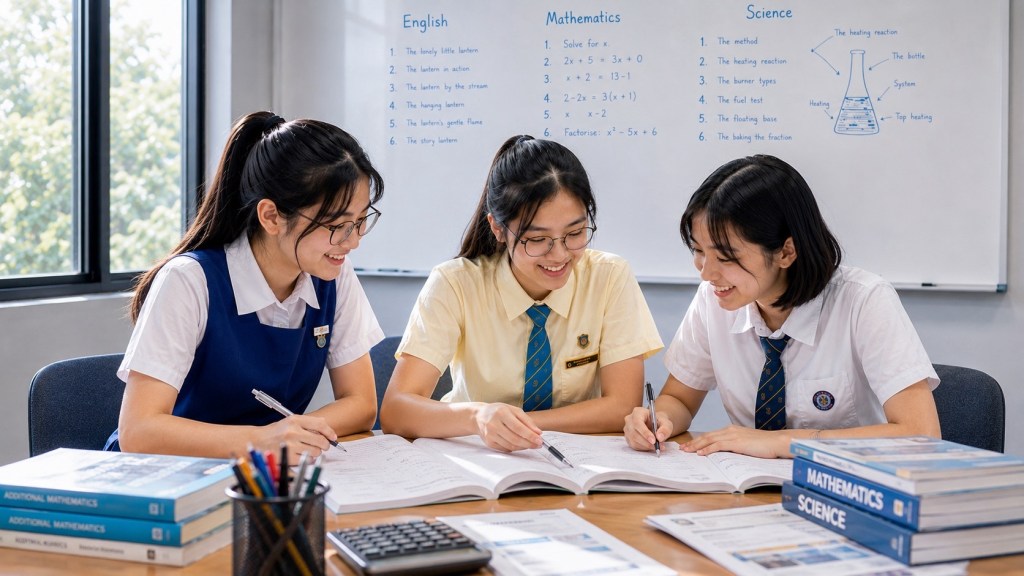
The June holidays are the mid-year repair window: late enough to reveal what the first semester exposed, early enough to change the second half of the year. For Primary 5, Primary 6, Secondary 3 and Secondary 4 students, June should not become a generic “catch-up month”. Each stage has a different job.
For parents searching for a June holiday revision plan 2027, P5 June revision, P6 PSLE June plan, Sec 3 holiday study plan or Sec 4 SEC revision plan, the most useful structure is four weeks of diagnose → repair → transfer → re-enter. The learner should return to school with fewer weak dependencies and a clearer second-semester route, not simply a larger stack of completed worksheets.
For Secondary 4 in 2027, the examination destination is the Singapore-Cambridge Secondary Education Certificate (SEC), with subjects taken at G1, G2 or G3 as applicable. June planning should therefore be SEC-native rather than built around the old GCE O-Level label. Official framework: SEAB SEC overview.
The four-week June architecture
| Week | Job |
|---|---|
| Week 1 | Recover + read Semester 1 evidence. |
| Week 2 | Repair the strongest repeated weak links. |
| Week 3 | Mix, vary and transfer the repaired learning. |
| Week 4 | Rebuild school-week routine and test re-entry readiness. |
Primary 5: protect the PSLE runway before it becomes urgent
Primary 5 June should stabilise upper-primary foundations. English comprehension and writing need more control; Mathematics dependencies such as fractions, ratio, percentage and multi-step representation become increasingly expensive when fragile; Science needs concept-to-evidence explanation rather than keyword accumulation.
- Review Semester 1 papers for repeated error families.
- Repair one English and one Mathematics high-value dependency.
- Keep Science retrieval cumulative.
- Use mixed questions after topical repair.
- Avoid turning P5 into premature full-PSLE-paper season.
Primary 6: the PSLE mid-year checkpoint
Primary 6 June is a major calibration point. The learner has enough evidence to identify recurring marks leaks, but there is still time to repair them before prelim and final-stretch pressure rises.
| P6 lane | June job |
|---|---|
| English | Evidence, answer scope, writing control, editing and timed sections. |
| Mathematics | Method selection, ratio/percentage/speed dependencies, paper control. |
| Science | Open-ended mechanism, variables, data, Booklet A/B pacing. |
| Exam craft | Mistake log, past-paper use, checking, leave-and-return. |
Secondary 3: build the system before the graduation year
Sec 3 June is not only about current chapters. It is the best time to stabilise the learning system that Secondary 4 will depend on. Algebra, A-Math foundations where applicable, English reading/writing, Science models and independent study routines should become less dependent on adult prompting.
- Repair algebraic dependencies before later A-Math and Mathematics integrate them.
- Use English mixed reading/writing work, not assignment-only practice.
- Retrieve older Science topics so Semester 2 does not erase Semester 1.
- Install a weekly planning routine the learner can manage.
- Use one or two realistic timed sections near the end of June.
Secondary 4: SEC 2027 mid-year control
For the 2027 graduating cohort, June is an SEC preparation window. The student should know which subjects are G1, G2 or G3 and use the correct syllabus and paper route. The job is to convert Semester 1 and WA/prelim evidence into a smaller list of repair priorities.
- Map every subject to the correct SEC level.
- Identify repeated mark leaks rather than broad topic anxiety.
- Repair high-frequency dependencies.
- Move strong subjects toward mixed/full-paper execution.
- Reserve fresh papers for later verification.
- Re-enter Term 3 with an explicit prelim/SEC route.
A weekly June timetable
| Day type | Primary job |
|---|---|
| Repair day | One or two high-value weak links. |
| Retrieval day | Old content without notes. |
| Transfer day | Mixed or unfamiliar work. |
| Paper day | Timed section or selected full paper where appropriate. |
| Recovery day | Low-load review, reading, exercise, family time, sleep recovery. |
Do not fill all four weeks
A holiday plan needs slack. Family travel, school programmes, CCA and ordinary rest are real. A timetable that collapses after one missed day is too brittle. Build minimum viable work: the smallest recurring set that keeps the important learning moving.
The 60-25-15 holiday split
A practical starting point for many learners is roughly 60% repair and learning, 25% mixed/timed application and 15% review/planning. The balance should shift with learner state. Exam-ready Sec 4 students may need more paper execution; Blocked P5 learners need more foundational repair.
What not to do in June
- Do not complete next term’s syllabus simply to be ahead.
- Do not sit full papers before previous corrections have changed behaviour.
- Do not spend the whole month only on the weakest subject.
- Do not let stable subjects become a comfortable avoidance activity.
- Do not sacrifice recovery and then return to school exhausted.
- Do not carry the old O-Level naming into a 2027 SEC plan.
The final three days before school resumes
- Reduce total revision load.
- Retrieve the three most important repaired capabilities.
- Prepare school materials and digital systems.
- Return sleep toward school-week timing.
- Write the first two learning priorities for Term 3.
- Stop with a clear re-entry plan rather than one last panic paper.
Where this page sits in Atlas V2.0
This is the mid-year Examination Craft owner under Learning Atlas V2.0. It connects P5, P6, Sec 3 and Sec 4 learners to subject hubs, learner states and the 2027 SEC framework while preserving June as a repair-and-transfer window rather than generic holiday tuition.
Last updated: 26 September 2026.
