
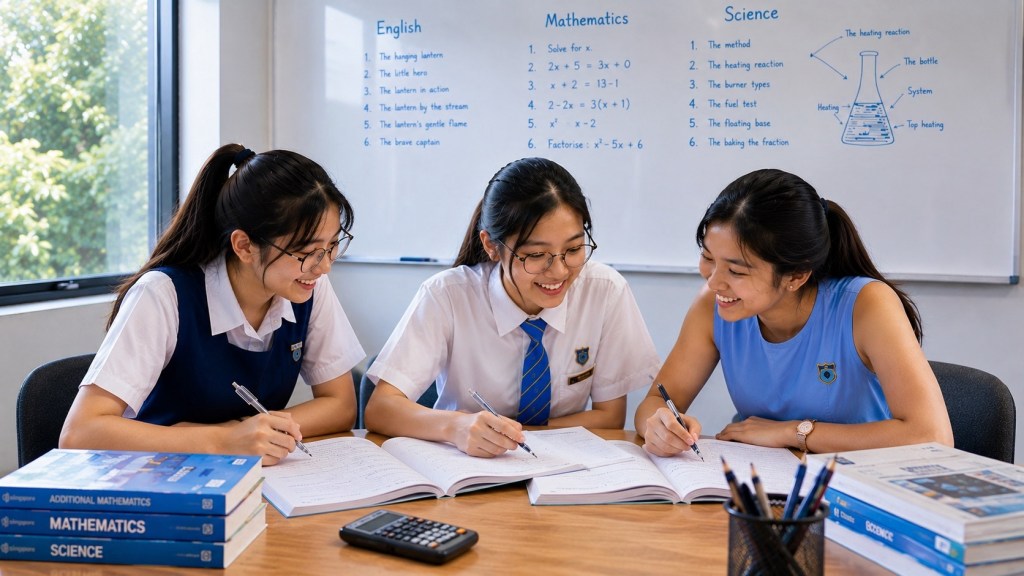
A headline says, “Students Love the New Study Room.” A chart underneath shows that twelve students returned a feedback form and nine said the room made it easier to start homework. The headline may sound broader than the evidence.
Non-fiction reading asks more than “What does this text say?” It also asks: What exactly is being claimed, what evidence supports it, whose perspective shapes the presentation and what remains uncertain?
Secondary 2 students need this control because informative and persuasive texts often mix facts, interpretations, examples, recommendations and design choices. A reader who treats them all as the same kind of statement can be persuaded by a tone rather than by the evidence.
What this guide develops
This guide belongs to the Secondary English Learning Hub. It extends Reading, Viewpoint and Evidence and connects to Visual and Multimodal Texts: Layout, Persuasion and Evidence.
All texts, organisations, numbers and quotations below are fictional eduKate teaching materials. They are designed to teach reasoning rather than report real research. Where a source type is described as official, student or promotional, that label belongs to the exercise only.
Four categories to separate
| Category | Question | Example |
|---|---|---|
| Fact within the source | What does the source explicitly report? | “Twelve students returned the form.” |
| Claim | What conclusion does the writer want accepted? | “The new room is a successful programme.” |
| Evidence | What information supports the claim? | Nine respondents said starting homework was easier. |
| Inference | What can reasonably be concluded, and with what limits? | The room may help some participating students begin work. |
A careful reader does not reject claims merely because they are claims. The reader checks whether the evidence is relevant, sufficient for the scope of the claim and represented fairly.
Original source pack A: The study-room trial
Source 1: School office note. “The study room operated on four Tuesdays and four Thursdays. Eighteen students registered at least once. Twelve returned the optional feedback form. Nine respondents said they found it easier to begin homework in the room than at home. Three respondents reported difficulty arranging transport home after the later session.”
Source 2: Student council poster. Headline: “A Better Way to Study After School.” Subheading: “Most feedback respondents said the room helped them start homework.” A small footer says: “Results refer to twelve returned feedback forms. The trial did not measure examination performance.”
Source 3: Student comment. “I liked the quiet desks, but on Thursday I had to wait for a later bus. I would use the room before a difficult assignment, not every week.”
Source 4: Teacher comment. “The room gave students a place to work, but the feedback does not show whether the trial improved grades. A second trial could test different times and collect responses from students who did not volunteer.”
Claim check 1: What does “most” describe?
Nine of twelve feedback respondents said it was easier to begin homework. Therefore, “most feedback respondents” is supported within this packet. “Most students in the school” is not supported. The denominator changes.
When reading percentages or majority language, identify the group. Ask: majority of whom? The answer may be participants, respondents, classes, surveyed adults or the whole population. A broad claim can emerge from a correct number applied to the wrong group.
Claim check 2: Starting homework is not the same as academic improvement
The packet supports a claim about some respondents’ experience of beginning homework. It does not establish higher grades, better examination results or long-term study habits. The poster footer and teacher comment both preserve this boundary.
A reader should therefore reject the sentence “The study room improved academic performance” as unsupported by this packet. A more accurate sentence is “The trial received positive feedback from several respondents about starting homework, while academic outcomes were not measured.”
Evidence relevance: a true detail can still be the wrong evidence
Suppose the claim is “The study room creates transport difficulties for some students.” The student comment and the three reported feedback responses are relevant. The fact that eighteen students registered is true but does not directly support the transport claim.
Evidence selection therefore depends on the claim. The biggest number or most memorable quotation is not automatically the best support.
Evidence sufficiency: one example can reveal a possibility without proving prevalence
The single student comment shows that at least one participant valued the room selectively and experienced transport inconvenience. It does not establish how many students would make the same choice.
A useful language distinction is: “This example shows that the problem can occur” versus “This example shows that the problem is common.” The first may follow from one case; the second usually requires broader evidence.
What bias means in a reading exercise
Bias does not simply mean “lying”. A source can be accurate and still select, frame or emphasise information from a particular perspective. The student council poster wants to encourage support for a study space, so its headline foregrounds the benefit. The footer still acknowledges important limits.
Ask what the source includes, what it leaves less prominent and what purpose may explain the selection. Do not infer dishonest intent merely from a positive tone. A claim of deception needs stronger evidence than a persuasive presentation.
Framing: the same evidence can be presented differently
Using the same twelve responses, one headline might say “Three in Four Respondents Found It Easier to Start Homework.” Another might say “One in Four Respondents Did Not Report Easier Starts.” Both can be numerically consistent with nine positive responses, but they direct attention differently.
A strong reader notices the frame and returns to the underlying numbers before deciding what the result means. Framing can influence emphasis without making the arithmetic false.
Source reliability is question-specific
Ask what kind of information you need. For the trial dates, the school office note may be a strong source within the fictional packet because it records the programme. For one student’s personal experience, the student is the direct source. For the claim that grades improved, none of the four sources provides measured evidence.
Reliability is not a single permanent score attached to a person. A teacher may be a strong source about classroom procedures but not automatically the best source for another student’s private feelings. Match source, claim and access to the information.
Authority, expertise and direct access
Three useful questions are: Does the source have authority over the matter? Does the source have relevant expertise? Does the source have direct access to the event or information? These are different strengths.
A school office may have authority to confirm an official deadline. A subject teacher may have expertise to explain a learning task. A student may have direct access to their own experience. A strong evaluation identifies the relevant strength rather than saying “official sources are always correct” or “first-hand sources are always best”.
Original source pack B: A recycling campaign
Source A: Campaign flyer. “Bring unused exercise-book pages to the collection point. Together we can reduce waste.”
Source B: Collection record. “On Monday and Tuesday, volunteers received 146 books. After checking, 91 contained usable blank pages. The record does not state how many pages were recovered.”
Source C: Student quote on the flyer. “I used to throw old books away. Now I check whether blank pages can still be used.”
Source D: Volunteer note. “Some donated books included personal documents, so volunteers reminded students to remove private papers before collection.”
Evaluate the campaign claim without overreaching
The flyer’s broad purpose is to encourage reuse and reduce waste. The collection record shows that usable material was found in many donated books. It does not tell us the total number of blank pages, the amount of waste prevented or the campaign’s long-term environmental effect.
A careful evaluation might say: “The collection record supports the narrower claim that many donated books still contained usable blank pages, but it does not quantify the campaign’s overall waste reduction.”
This response neither dismisses the campaign nor converts an encouraging result into a measured environmental conclusion.
Anecdote versus dataset
The student quote provides a personal example of changed behaviour. It can illustrate how the campaign influenced one person. It cannot tell us how typical the change is across all participants.
Conversely, a dataset can show a pattern without explaining every individual reason. The 91 usable books do not tell us why each donor participated. Evidence types answer different questions.
Missing data matters
The record does not state the number of recovered pages. That absence matters if the claim is about the quantity of paper saved. A strong reader names the missing information rather than guessing it.
Other potentially useful missing data could include the number of students invited, how many participated, whether books would otherwise have been discarded and what happened to unusable materials. Not every missing fact is equally relevant to every claim.
Language that signals certainty
Compare these claims: “The campaign reduced waste.” “The campaign may have reduced some waste.” “The campaign collected books containing reusable blank pages.” The third is most directly supported by the record. The second is a cautious inference. The first is broader and would require clearer measurement.
Words such as shows, suggests, indicates, proves, may, probably and must carry different levels of certainty. Choose them according to the evidence, not according to how confident you want to sound.
Bias check: selection, omission and language
| Feature | Question |
|---|---|
| Selection | Which evidence is highlighted? |
| Omission | Which relevant information is absent? |
| Word choice | Which words praise, criticise or intensify? |
| Order | Which point appears first or last? |
| Visual prominence | What receives the largest or most noticeable treatment? |
| Source position | What interest or role does the source have in the issue? |
These questions help identify perspective. They do not automatically prove manipulation. Evaluation should remain proportional to the evidence.
A source can be both useful and limited
The student council poster is useful for understanding how the council presents the trial. It is limited as evidence of school-wide outcomes. The teacher comment is useful for identifying what the trial did not measure. It is not direct evidence of every student’s experience.
This “useful for X, limited for Y” structure is more mature than simply labelling sources “reliable” or “unreliable”. It forces the reader to identify the exact claim being evaluated.
Original comparison task
Source E says: “Our trial was a clear success because three quarters of respondents reported easier homework starts.” Source F says: “Nine of twelve respondents reported easier homework starts. The trial did not measure grades and did not include feedback from six registered students who did not return the form.”
Question: Which source gives a more complete basis for evaluating the trial?
Suggested answer: “Source F gives a more complete basis because it provides the numerator and denominator, identifies missing responses and states what the trial did not measure. Source E presents the same positive proportion but turns it into a broad judgement of success without explaining these limits.”
This does not mean Source E’s percentage is false. The issue is the strength and completeness of the conclusion built from it.
Non-fiction comprehension questions still require question control
“What does the source report?” asks for retrieval. “What can be inferred?” asks for a bounded conclusion. “How convincing is the claim?” asks for evaluation against evidence. “How does the headline frame the result?” asks for language or presentation analysis.
Use Comprehension Question Control and Answer Precision when you repeatedly give an answer that is sensible but belongs to a different question type.
Independent challenge: The reading challenge poster
A fictional poster says, “Reading Challenge Doubles Participation!” The small print states: “Twenty students joined last term. Forty joined this term after the challenge was introduced. Other changes were also made to library opening hours. The school has not determined which change caused the increase.”
Answer four questions: Is participation twice as high? Does the poster prove the challenge caused the increase? What alternative explanation is mentioned? How could the headline be rewritten more precisely?
Answer check: Forty is twice twenty, so participation doubled. The source does not establish that the challenge caused the increase because opening hours also changed. A more precise headline would be “Participation Doubled During the Term of the Reading Challenge” or “Library Participation Rose from 20 to 40 Students”.
A practical source-evaluation routine
- State the claim exactly.
- Identify the evidence actually provided.
- Match the evidence to the claim.
- Check group, time, place and measurement.
- Notice source role and possible perspective.
- Identify missing information relevant to the judgement.
- Use certainty language that fits the evidence.
This routine is a scaffold, not an official marking scheme. With practice, the steps become internal questions rather than a visible checklist.
A two-week critical-reading cycle
Week one: work with short claims and one evidence source. Practise scope, denominator, causation and certainty separately. Record the decision error: “I changed respondents into all students” or “I treated sequence as cause”.
Week two: use three or four sources with different roles. Ask which source is useful for which claim and where two sources agree or conflict. End with an unfamiliar poster, article paragraph or results card and require a short evaluation.
Transfer the habit outside worksheets. When you see a strong headline, ask what evidence would be needed to support its exact scope. Do not assume the headline is wrong; identify what would make it well supported.
For parents and teachers
Ask “What does this source actually prove?” and then “What does it not prove?” These paired questions help students avoid both gullibility and reflexive cynicism. Critical reading is not disbelief. It is calibrated belief.
When a learner calls a source biased, ask for the feature: selection, omission, wording, order or interest. Then ask whether that feature makes the information false, incomplete or simply perspective-shaped. This forces the judgement to become specific.
Use age-appropriate real-world texts only after the learner can control the reasoning on bounded practice material. The objective is not to overwhelm students with misinformation anxiety. It is to give them a repeatable method for asking better questions.
Connect critical reading to the next Secondary 2 steps
This skill feeds Discursive Writing: Claims, Counterarguments and Judgement, because writers must not use evidence more strongly than readers should accept it. It also supports Study-to-Exam Transfer and Error Analysis, where students learn to test whether a reading method survives under new conditions.
Return to the Secondary English Learning Hub for the full sequence.
Read the claim. Find the evidence. Check the scope. Notice the frame. Then decide how much confidence the source has actually earned.
