
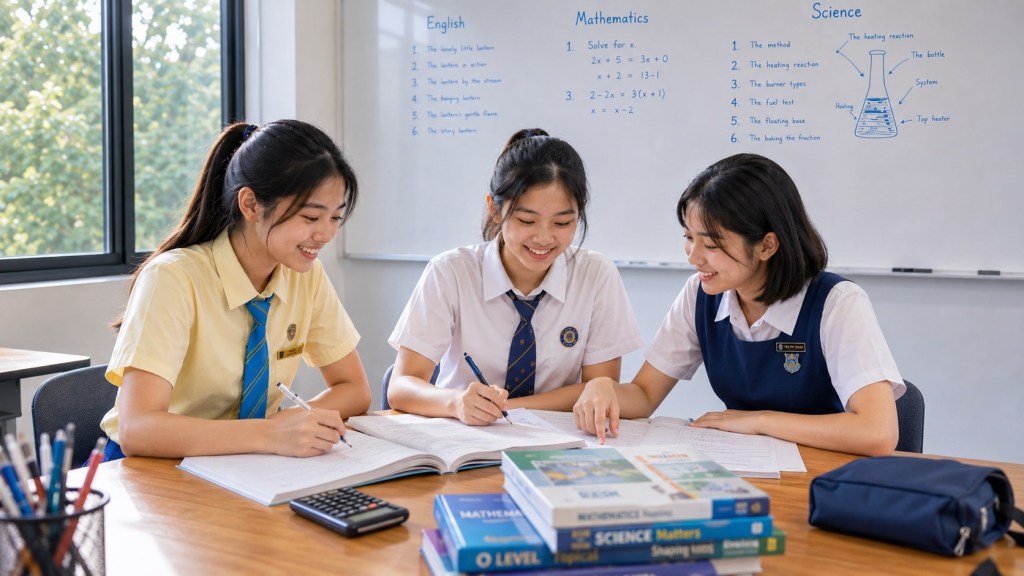
Wait, What? Secondary 2 Is Not a Waiting Room
Secondary 2 can look deceptively quiet. Secondary 1 had the obvious transition from Primary school. Secondary 3 will bring upper-secondary specialisation and a clearer examination horizon. In between, Secondary 2 is sometimes treated as the year to keep up, complete the worksheets and wait for the serious work to begin.
That is a mistake. Secondary 2 is the year in which the language system has to become more connected, more independent and more able to survive unfamiliar tasks. A student who still relies on Primary-style retrieval, memorised writing frames or repeated teacher rescue can appear functional while familiar work continues. The weakness becomes visible only when the text is longer, the prompt is less predictable, the viewpoint is less explicit or several language jobs have to run at the same time.
Secondary 2 is not mainly about learning more English tricks. It is about making the existing system strong enough to carry more load without falling apart.
Quick Answer
The central Secondary 2 English job is consolidation with increasing independence. Students should connect reading, inference, evidence, vocabulary, grammar, writing, listening and oral communication into a working system, then test whether that system transfers to unfamiliar tasks with less prompting.
A useful operating sequence is:
READ THE TASK → BUILD THE TEXT MODEL → LOCATE VIEWPOINT AND RELATIONSHIPS → SELECT EVIDENCE → DECIDE PURPOSE AND AUDIENCE → PLAN THE RESPONSE → DEVELOP IDEAS → CONTROL SENTENCES → CHECK MEANING → TEST TRANSFER.
Owned Secondary 2 Learning Job
This guide owns one broad job: helping a Secondary 2 student turn the lower-secondary English foundation into an increasingly independent system that is ready for the greater demands of Secondary 3 and Secondary 4.
It does not replace the companion guides on reading, viewpoint and evidence, writing, organisation and argument, or vocabulary, grammar, listening and oral control. This page explains how the pieces fit together and how to find the earliest weak link when the system breaks.
The Singapore Secondary-English Frame in 2026
Full Subject-Based Banding has been fully implemented from the 2024 Secondary 1 cohort. Students can offer subjects at G1, G2 or G3 according to strengths, interests and learning needs rather than being defined by the old stream labels. From 2027, the Singapore-Cambridge Secondary Education Certificate replaces the former N(T), N(A) and O-Level certificates, and students sit subjects at the respective subject levels.
For a Secondary 2 learner in 2026, the immediate purpose is not to imitate a graduation-year candidate. The better job is to strengthen the capabilities that later assessment assumes: accurate comprehension, inference, viewpoint, evidence selection, purposeful writing, language precision, oral and listening control, and the ability to work without constant rescue.
Official reference routes: MOE English Language Syllabus 2020 Secondary, SEAB Secondary Education Certificate, 2027 G1 syllabuses, 2027 G2 syllabuses and 2027 G3 syllabuses.
The Secondary 2 Shift: From Parts to System
Secondary 1 often exposes the parts. The student notices that reading is harder, vocabulary matters more, writing needs a clearer audience and grammar must survive longer sentences. Secondary 2 should begin joining those parts.
| Capability | Early lower-secondary form | Secondary 2 consolidation |
|---|---|---|
| Reading | Understand the main idea and sequence | Hold relationships, viewpoint, qualification and implied meaning across the text |
| Evidence | Find a supporting detail | Select evidence for relevance and sufficiency, not merely proximity |
| Writing | Produce a coherent response | Organise around purpose, develop ideas and control progression for a reader |
| Vocabulary | Know meanings | Choose words for precision, register, connotation and collocation |
| Grammar | Apply rules in short tasks | Keep sentence relationships stable under extended writing load |
| Listening | Catch main points | Track relationships, emphasis, stance and supporting detail in real time |
| Oral | Answer and elaborate | Develop, qualify, exemplify and respond with greater independence |
| Self-regulation | Follow routines | Choose an appropriate routine, notice failure and recover without waiting to be told |
Seven Secondary 2 Consolidation Jobs
1. Build a Text Model, Not a Trail of Highlighted Sentences
Students often underline many sentences and still miss the passage. Highlighting is useful only if the student knows why a detail matters. A text model holds the larger pattern: who is speaking, what is happening, what changed, what caused what, where the writer’s attitude appears, and how later information modifies earlier information.
A student should be able to pause after a section and state, in their own words, what job that section performed. If that cannot be done, the learner may be reading locally without integrating globally.
2. Separate Evidence From Interpretation
The line between evidence and interpretation becomes increasingly important. The passage may state that a character folds a letter twice, places it in a drawer and returns to the drawer several minutes later. The student may infer reluctance, uncertainty, attachment or anxiety. Those interpretations are not identical to the evidence. They must be justified by the pattern of clues.
Evidence is what the text gives. Interpretation is what you conclude. Strong comprehension keeps the bridge between them visible.
3. Notice Viewpoint Before Judging Content
Two texts can describe the same event and create different impressions through selection, emphasis, tone and framing. Secondary 2 is a good stage to make viewpoint explicit. Ask not only, “What happened?” but also, “Who is presenting it this way, what is emphasised, what is omitted and what response is encouraged?”
4. Make Paragraphs Do Jobs
A paragraph should not exist because the student remembers that essays need paragraphs. It should perform a function: establish context, make a point, develop an example, explain a consequence, contrast an alternative, qualify a claim, or return the reader to the main purpose.
If a student cannot label a paragraph’s job in a short phrase, the paragraph may be a container of sentences rather than a unit of thought.
5. Move From Big Vocabulary to Available Vocabulary
A long word list creates no benefit if the words do not appear when the learner needs them. Secondary 2 vocabulary should be learned through meaning networks: synonyms with differences, antonyms, word families, collocations, register, examples and counterexamples.
Instead of memorising significant = important, compare significant change, significant evidence, significant difference and statistically significant. Ask which combinations sound natural and why.
6. Keep Grammar Alive Under Real Writing Load
Grammar knowledge is useful only when it survives the moment of composition. A student may identify tense errors in isolation but lose control while planning an argument, choosing vocabulary and meeting a time limit. This is a load problem, not necessarily a knowledge problem.
The repair is to reconnect explicit grammar to the student’s own sentences. Select one recurring error family, diagnose it, revise it, rewrite from memory and test it again in a new paragraph.
7. Convert Help Into Independence
A good scaffold should disappear gradually. If the learner always needs the same prompt—“Where is your evidence?”, “Who is your audience?”, “What does this pronoun refer to?”—the next teaching move is not simply to keep asking forever. The student needs an internal checking routine that eventually asks the question without the tutor.
The First-Weak-Link Diagnostic
Do not diagnose Secondary 2 English with one label such as “weak comprehension” or “bad writing”. Trace the failure upstream.
| Visible problem | Earlier possibility | Discriminating test |
|---|---|---|
| Inference is wrong | Vocabulary or reference tracking | Ask the student to paraphrase the crucial sentence and identify what each pronoun refers to |
| Evidence is weak | Answer idea not yet precise | Ask the student to state the claim first, then choose the smallest evidence set that proves it |
| Essay goes off topic | Purpose or key term misunderstood | Rewrite the prompt as one job sentence before planning |
| Paragraphs repeat | No distinct paragraph functions | Label each paragraph in five words and check for duplication |
| Vocabulary is awkward | Definition known but usage unknown | Ask for two natural collocations and one context where the word would sound wrong |
| Grammar collapses late in the essay | Cognitive load or fatigue | Compare accuracy in the first and last 100 words |
| Oral response is thin | Development structure unavailable | Use Point → Why → Example → Qualification → Return |
| Good practice, weak test | Prompt dependence | Repeat the capability on an unfamiliar text without notes or model answers |
Worked Example 1: The Answer Is Plausible but Not Proven
A narrative describes a boy laughing when his friends congratulate him, then later deleting the congratulatory message and sitting alone outside the classroom.
Question: What does the passage suggest about how he feels about the achievement?
Weak answer: “He is sad.”
The answer may be possible, but it is too broad. A stronger diagnosis asks: Which clues point to discomfort? Does the laughter conflict with the later behaviour? Could he be embarrassed, conflicted, disappointed, guilty or simply tired? Which interpretation explains the whole pattern with the least invention?
The learning move is not to guess a more impressive emotion word. It is to compare candidate interpretations against the evidence.
Worked Example 2: The Student Who Knows the Topic but Misses the Task
Prompt: “Describe a situation in which a small act of responsibility made an important difference.”
A student writes a long story about organising a school event. The writing contains action, dialogue and description, but the “small act” is never clear and the important difference is not developed.
The visible problem is not lack of content. The earlier weak link is task control. Before drafting, the student should be able to complete two sentences:
- The small act of responsibility was ______.
- It mattered because ______ changed as a result.
Only then should the story architecture be built around the task.
Worked Example 3: Good Ideas, Repetitive Paragraphs
A student is asked whether schools should give students more opportunities to learn outside the classroom. Three body paragraphs all say, in slightly different language, that outdoor learning is interesting.
The student does not necessarily need more ideas. The student needs categories. One paragraph could address application of knowledge, another collaboration and communication, another motivation or memory, and a final section could acknowledge cost, safety or curriculum time.
Organisation improves when each paragraph is given a distinct job before sentences are written.
The Secondary 2 Load Test
Many students can perform a capability in isolation. The real question is whether it survives combination.
- Can the student infer while also tracking viewpoint?
- Can the student use evidence while paraphrasing rather than copying?
- Can the student develop an idea while keeping grammar stable?
- Can the student use precise vocabulary without forcing unnatural words?
- Can the student listen for detail while holding the speaker’s main position?
- Can the student speak for longer without losing the question?
- Can the student notice an error and recover without waiting for a teacher?
This is why Secondary 2 practice should sometimes combine skills rather than isolate them permanently.
Depth, Load, Transfer and Recovery
Depth
Can the student explain why an answer works, not merely recognise it after seeing the model?
Load
Does the capability survive when the task requires several things at once?
Transfer
Can the student use the capability when the topic, text type or surface features change?
Recovery
When the first attempt fails, can the learner locate the failure, choose a repair and continue? Recovery is a major part of independence. Strong students are not students who never make mistakes; they are increasingly able to detect and correct them.
A 12-Week Secondary 2 Consolidation Cycle
This is a learning framework rather than a school calendar. Adjust it to the student’s actual work and school requirements.
| Weeks | Main job | Evidence of progress |
|---|---|---|
| 1–2 | Baseline and error map | Specific causes identified across reading, writing and language control |
| 3–4 | Text model, viewpoint and evidence | Student explains paragraph relationships and justifies interpretations |
| 5–6 | Writing purpose and paragraph function | Plans show distinct jobs and drafts stay aligned to the prompt |
| 7–8 | Vocabulary precision and grammar transfer | More exact language with stable sentence meaning |
| 9 | Listening and note capture | Student tracks main position, support and change in real time |
| 10 | Oral development and qualification | Responses move beyond one-point answers and remain relevant |
| 11 | Mixed-skill timed load test | Capabilities survive under moderate time pressure |
| 12 | Unfamiliar transfer and recovery | Student notices weak points and repairs them with less prompting |
A Practical Weekly Minimum
- One close reading: explain structure, viewpoint, one inference and the evidence.
- One purposeful writing task: plan, draft, revise and label each paragraph’s job.
- One language repair: take a recurring grammar or vocabulary error from real work and retest it.
- One listening task: capture main idea, key support and one change or contrast.
- One oral response: develop a position with reason, example and qualification.
- One return: redo an earlier problem after a delay without looking at the correction.
- One unfamiliar transfer: apply a recently learned method to a new text or prompt.
The Independence Ladder
| Stage | What it looks like | Next move |
|---|---|---|
| 1. Rescue | Student cannot begin without direct instruction | Model the first decision explicitly |
| 2. Prompt | Student can continue when asked the right question | Reduce prompts and make the checking question visible |
| 3. Routine | Student follows a checklist independently | Vary the surface and require choice among routines |
| 4. Selection | Student chooses an appropriate method | Increase ambiguity and load |
| 5. Recovery | Student notices that the method is failing and changes course | Test under unfamiliar conditions |
| 6. Transfer | Student adapts the capability to a new task | Increase depth, precision and speed gradually |
What Parents Can Observe
Parents do not need to become English markers. Observe the learner’s process.
- Can the student explain what the question is asking before answering it?
- Can the student summarise a text without retelling every detail?
- Can the student point to the evidence behind an inference?
- Can the student explain why each paragraph is included?
- Does newly learned vocabulary appear naturally in later work?
- Can the student name one recurring grammar problem and check for it?
- Can the student continue an oral answer beyond the first idea?
- When stuck, does the student have a recovery routine?
- Can the student redo an earlier error without looking at the answer?
What Tutors Should Protect
- Protect the diagnosis. Do not prescribe five techniques when one earlier weakness explains the failure.
- Protect transfer. After teaching with a familiar example, change the surface.
- Protect the student’s voice. Strong writing is not produced by replacing the learner’s language with a tutor’s model.
- Protect precision. Difficult vocabulary is useful only when it is the right vocabulary.
- Protect meaning during grammar correction. A grammatically tidy sentence that changes the intended meaning is not a successful repair.
- Protect independence. Scaffolds should reduce as capability rises.
- Protect the stage. Secondary 2 should prepare for upper secondary without turning every lesson into premature graduation-year drilling.
Common Secondary 2 Traps
- Doing more comprehension passages without analysing why the same question types keep failing.
- Highlighting most of the text instead of modelling relationships between ideas.
- Memorising model essays without understanding paragraph function.
- Collecting sophisticated vocabulary that is rarely used accurately.
- Correcting grammar only after writing instead of building one or two live checks during drafting.
- Assuming fluent speaking equals strong reasoning.
- Assuming quiet speaking equals weak reasoning.
- Giving the same scaffold after the student has shown readiness to work independently.
- Turning one subject level into a permanent identity rather than a current learning level.
Secondary 2 Student Receipt
- What exactly is the task asking me to do?
- What is the main text model I am holding?
- Whose viewpoint am I reading or hearing?
- What is stated, and what am I inferring?
- Which evidence actually proves my answer?
- What is my purpose and who is my reader?
- What distinct job does each paragraph perform?
- Is my vocabulary precise, natural and appropriate?
- Which grammar error am I most likely to make under load?
- Can I detect when my method is not working?
- What can I try before asking for rescue?
- Could I do this again if the topic changed?
Unfamiliar Transfer Challenge
Give the student a short article, narrative extract, speech, infographic or mixed-mode text they have not practised before. Ask the student to:
- state the main idea and the writer’s or speaker’s apparent viewpoint;
- explain one relationship between two parts of the text;
- make one inference and show the evidence;
- identify one word or phrase whose connotation affects meaning;
- write one purposeful paragraph responding to a related prompt;
- revise one sentence for clearer grammar without changing the intended meaning;
- give a one-minute oral response that includes a qualification or alternative view;
- name one place where the first attempt was weak and describe the repair.
The final step matters. Independence is not only successful performance. It is knowing what to do after performance is imperfect.
Evidence Boundary
The diagnostic labels, practice cycles and independence ladder in this guide are eduKate teaching scaffolds. They are not official MOE lesson sequences, school assessment rubrics or SEAB marking schemes. Secondary 2 assessment differs among schools and according to subject level. Students should follow their school’s instructions and official syllabus requirements while using this guide to make the underlying learning system visible.
Continue the Secondary 2 English Learning Guide
- Reading, Viewpoint and Evidence
- Writing, Organisation and Argument
- Vocabulary, Grammar, Listening and Oral Control
- Return to the Secondary English Learning Hub
The Quiet Return
Secondary 2 is where English should begin to feel less like a collection of school exercises and more like one connected system. Reading changes writing. Vocabulary changes inference. Grammar changes clarity. Listening changes response. Self-checking changes all of them.
Consolidate the working parts. Find the first weak link. Repair it. Remove one layer of help. Change the task. Then see whether the student can carry the system forward.
