
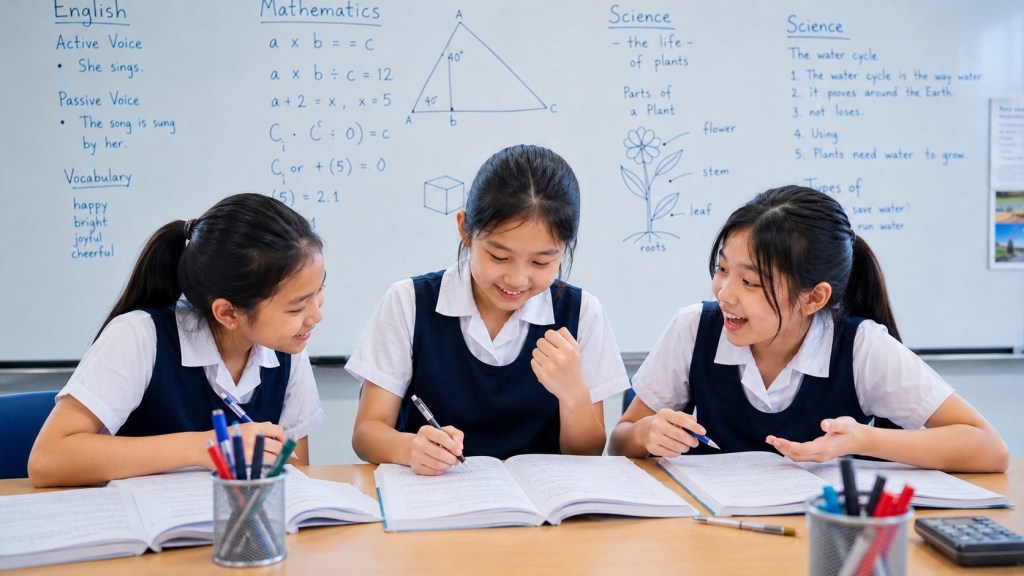
A pupil sees a photo of an unfamiliar activity and freezes.
“I don’t know anything about this.”
Another pupil recognises the topic from a tuition worksheet and gives a polished speech. Then the examiner asks a follow-up from a different angle, and the memorised response collapses.
Oral communication does not require encyclopaedic knowledge. It requires the ability to observe, form a reasonable view, explain it clearly, listen to a follow-up and continue using familiar language.
This guide extends Stimulus-Based Conversation: Opinion, Reason, Example, Follow-Up and Recovery, Reading Aloud and Metacognition and Independent Exam Control.
Quick answer: you do not need to know everything about the topic
If the topic is unfamiliar, use what is available:
- Observe: what can you actually see or infer safely?
- Interpret: what might the activity, problem or purpose be?
- Relate: what familiar experience or general principle connects?
- Reason: give a cause, benefit, problem, comparison or solution.
- Qualify: distinguish what you know from what you are guessing.
- Respond: listen to the next question and adapt.
A compact routine is SEE → THINK → CONNECT → EXPLAIN → QUALIFY → ADAPT.
The current SEAB boundary
SEAB’s 21 August 2026 media reply on the PSLE oral examination states that students are assessed on their ability to communicate effectively, including expressing ideas and engaging in conversation with appropriate vocabulary, sentence structures and pronunciation. It also states that students are not assessed on specialised knowledge of a particular subject or context, nor expected to reproduce specific vocabulary, technical terms or pre-prepared responses.
Official reference: SEAB, 21 August 2026: PSLE Oral Examination Aims to Assess Students’ Communication Skills.
SEAB made the same underlying point in its 28 August 2025 reply about PSLE oral topics, including English Language: pupils are assessed on their ability to converse using appropriate vocabulary, sentence structures and pronunciation, not on specific content knowledge.
Official reference: SEAB, 28 August 2025: PSLE Oral Examination Topics Are Accessible to Students.
The examples below are original eduKate teaching material and are not predictions of actual examination topics.
Unfamiliar topic does not mean impossible topic
Imagine a photo showing people repairing bicycles in a community workshop.
A pupil may never have repaired a bicycle.
That pupil can still discuss:
- why people repair things;
- why safety matters;
- how learning practical skills can help;
- why a trained adult may be needed;
- whether repairing is always possible;
- how the activity could help a community.
The conversation does not require a technical lecture on bicycle mechanics.
Observation before expertise
Photo: an adult demonstrates a tool while two children watch.
Safe observation: “An adult appears to be demonstrating how to use a tool.”
Unsafe invented detail: “He is teaching them how to replace a hydraulic brake cable.”
If you cannot identify the exact tool or process, do not invent technical knowledge.
Use ordinary words well
Forgotten technical term: recycling compactor.
Possible recovery: “the machine that presses the recyclable material into a smaller shape.”
Forgotten term: protective goggles.
Possible recovery: “the protective glasses they are wearing.”
Communication survives because meaning is preserved.
Paraphrase is an oral survival skill
If the exact noun disappears, describe:
- what it looks like;
- what it does;
- where it is used;
- why it matters.
Do not freeze while searching for one word.
Say what you know and what you infer
“The people are wearing gloves, so safety seems important in this activity.”
This is bounded inference.
“The activity must be dangerous because they are wearing gloves.”
This overstates what the image proves.
Observation, inference, judgement
Use three layers:
Observation: “Several people are working at separate tables.”
Inference: “The activity may have different stations for different tasks.”
Judgement: “That could be useful because participants can go directly to the station they need.”
Original Stimulus 1: Urban Farming
Imagine a photo showing pupils beside raised planting beds on a rooftop. Some are watering plants. An adult is pointing to a small sign beside the beds.
Question: Would you like to take part?
Model response:
“Yes, I would like to try it because I do not usually grow food myself. I think the activity would help me understand how much care is needed before vegetables reach a kitchen. I would probably need guidance at first because I would not know how much water each plant needs, but that is also why the activity could be useful.”
Why this works without specialised knowledge
The pupil does not pretend to know farming techniques. The response uses:
- personal position;
- a learning reason;
- an honest knowledge boundary;
- a practical observation about guidance.
Follow-up: What problem might the school face?
Possible response:
“One problem is maintaining the plants during holidays. If the garden depends only on pupils who are not in school, watering may become irregular. The school could create a holiday roster or choose plants that need less frequent care.”
This is general reasoning, not expert agriculture.
Original Stimulus 2: Repair Café
Imagine a photo showing people bringing broken household objects to a community table where volunteers inspect them.
Question: Why might people attend?
Model response:
“They may want to avoid throwing away an item that can still be repaired. Some people may also want to learn a basic skill from the volunteers. However, not every object should be repaired there, especially if it involves electricity or specialist work.”
The response includes benefit plus boundary.
Follow-up: Should everyone learn repair skills?
Possible response:
“I think everyone can benefit from knowing a few safe basic repairs, such as fixing a loose button or protecting a torn book cover. More technical repairs should be left to trained people. So the useful goal is not to make everyone an expert, but to help people judge what they can safely handle.”
Original Stimulus 3: Public Art Installation
Imagine a large colourful structure in a town square. People are walking through it and taking photographs.
Question: What do you think this is for?
Bounded response:
“I cannot tell the exact purpose from the photo alone, but it appears to be a public art installation. It may be designed to make the space more interesting and encourage people to stop and interact with it. Because people are walking through it rather than only looking from a distance, the artist may want the audience to experience the work physically.”
The phrase I cannot tell the exact purpose from the photo alone is not weakness. It shows evidence control.
Follow-up: Is public art important?
Possible response:
“It can be important because public spaces are used by many people, not only for movement but also for community life. Art can make a place memorable or start conversations. At the same time, I would want public projects to consider cost, safety and whether people can still use the space comfortably.”
Original Stimulus 4: Robotics Demonstration
Imagine pupils watching a small wheeled robot move around obstacles.
Question: Do you need to understand robotics to discuss this?
No.
A pupil can discuss:
- why demonstrations make learning visible;
- how trial and error helps improvement;
- why programming requires clear instructions;
- how teamwork might divide roles;
- why testing is needed before real use.
Model response
“I do not know how the robot is programmed, but the demonstration still shows one useful idea: the instructions have to work in the real environment. If the robot keeps hitting an obstacle, the pupils can observe the error and change the program. That makes the activity a practical form of problem-solving.”
Use general principles
When topic knowledge is limited, reason from broad principles:
- safety;
- fairness;
- cost;
- convenience;
- accessibility;
- learning;
- community;
- environment;
- time;
- responsibility;
- evidence;
- trade-offs.
These principles travel across many topics.
Reasoning modes are more transferable than topic scripts
For an unfamiliar topic, choose a reasoning mode:
- benefit → why it helps;
- problem → why it happens;
- solution → how it addresses the problem;
- comparison → which criterion matters;
- trade-off → benefit versus cost;
- personal response → experience or preference;
- future suggestion → what could improve.
A topic can change; the reasoning survives
Topic A: community garden.
Problem: holiday maintenance.
Topic B: school library.
Problem: noise management.
Topic C: cycling event.
Problem: safety and route access.
The reasoning pattern is still problem → cause → solution → limitation.
Do not pretend expertise
Weak:
“This machine definitely reduces carbon emissions by 72%.”
If the stimulus does not give that figure, the statement is invented.
Better:
“If the machine reduces the amount of waste sent away, it could have environmental benefits, but I would need more information to know how large the effect is.”
Do not panic over unfamiliar vocabulary
The examiner is listening to communication, not waiting for one rare technical term.
Use category language:
“the equipment”, “the device”, “the protective clothing”, “the container”, “the structure”, “the activity”.
Then explain function if needed.
But do not become vague everywhere
Paraphrase should preserve enough meaning.
Weak: “They use the thing for the thing.”
Better: “They use the handheld tool to tighten the loose part.”
Ask yourself: what is actually needed for this answer?
Question: “Would you enjoy this activity?”
You do not need the scientific name of every object.
You need:
- a position;
- a reason;
- an example or explanation;
- perhaps a condition.
Prepared structures can help; prepared speeches are fragile
Useful reusable structure:
answer → reason → example → qualification.
Fragile prepared script:
“Good morning. Today I would like to discuss the importance of recycling…”
If the question is about whether a child should repair a bicycle, the script no longer fits.
Question words matter more than topic familiarity
Same stimulus, different jobs:
“What do you notice?” — observation.
“Why might this be useful?” — reasoning.
“Would you take part?” — personal judgement.
“What problem might happen?” — risk analysis.
“How could it improve?” — solution design.
Listen to the full follow-up
Examiner: “You said the activity is useful. Why might some pupils disagree?”
If the pupil begins answering after hearing only “Why”, they may repeat the benefit instead of shifting to another viewpoint.
Use another person’s perspective
“I would enjoy a gardening activity, but some pupils may dislike working outdoors in hot weather. Others may have allergies or physical needs that require a different role.”
Perspective-taking does not require abandoning your own view.
Qualify when evidence is limited
Useful oral words:
- may;
- might;
- could;
- probably;
- in some cases;
- from the photo;
- it seems;
- I cannot be certain, but…
Qualification is especially valuable when interpreting a visual stimulus.
Do not over-qualify until nothing is said
Weak:
“Maybe perhaps it could possibly be useful, but I don’t know.”
Better:
“It could be useful because participants learn by doing, although I cannot tell from the photo how much instruction they receive.”
Personal experience when you have none
Question: “Have you ever taken part in an activity like this?”
It is acceptable to say no and still continue:
“No, I have not tried this exact activity, but I have joined a group project where we had to learn a new task from a teacher. I think the same challenge would apply here: at first I would need instructions, but after practising I could become more independent.”
Do not invent a fake experience
Honest comparison is stronger than a made-up story that becomes difficult to sustain under follow-up questions.
Original Stimulus 5: Guide Dog Training
Imagine a photo showing an adult walking with a dog wearing a working harness through a training area.
Question: What might the training be trying to achieve?
Safe model:
“The dog appears to be receiving training to guide or assist a person safely. I would not want to guess the exact training method, but the activity probably requires the dog to respond consistently to instructions and environmental obstacles.”
The pupil can discuss consistency, safety and responsibility without specialist animal-training knowledge.
Follow-up: Why is patience important in training?
“Learning a behaviour usually takes repetition, and mistakes may happen before the correct response becomes reliable. If a trainer becomes impatient, the instructions may become inconsistent. Patience helps keep the learning process clear.”
Original Stimulus 6: Heritage Craft
Imagine a craftsperson demonstrating a traditional weaving technique to children.
Question: Why might schools introduce pupils to traditional crafts?
“It can help pupils understand that culture is not only something written in a textbook. A craft shows how people used materials, skills and design in everyday life. Pupils may also appreciate the amount of patience and practice involved.”
Follow-up: Should old crafts be preserved exactly?
“Not always exactly. Preserving the original method can be valuable for history, but people can also adapt a craft for modern needs. The important thing is to understand what is being changed and what cultural meaning might be lost or retained.”
Trade-offs create mature oral answers
Many unfamiliar topics become manageable through trade-offs:
- speed versus safety;
- cost versus quality;
- convenience versus waste;
- individual freedom versus shared rules;
- innovation versus tradition;
- privacy versus convenience;
- competition versus cooperation.
Original rapid reasoning drill
For each unfamiliar stimulus, give one benefit, one risk and one improvement.
1. Self-checkout machine.
2. Community compost bin.
3. Shared bicycle station.
4. Outdoor classroom.
5. Robot delivering books inside a library.
Possible directions
1. Benefit: faster for small purchases. Risk: some users need help. Improvement: staff support nearby.
2. Benefit: reduces food waste. Risk: contamination or smell. Improvement: clear instructions and maintenance.
3. Benefit: convenient short-distance travel. Risk: unsafe riding or uneven access. Improvement: safe routes and clear parking zones.
4. Benefit: different learning environment. Risk: heat/rain/distraction. Improvement: use selectively with shade and backup space.
5. Benefit: moves routine items. Risk: obstacles or confusion. Improvement: limited routes and human supervision.
Recovery when the examiner uses an unfamiliar word
If one word in the question is unclear, use surrounding meaning. If the whole question is genuinely unclear, asking for clarification may be better than answering a different question.
Classroom practice should include polite clarification language:
“Sorry, could you please repeat the question?”
Do not overuse this when the question was heard clearly.
Recovery when your answer contradicts itself
“I think schools should make it compulsory—actually, I would not make it compulsory. I would strongly encourage it but allow exceptions.”
A brief self-correction is better than continuing a position you no longer mean.
Recovery when you run out of ideas
Shift dimension:
- who benefits?
- who may struggle?
- what could go wrong?
- what would make it safer?
- what does it cost?
- what happens over time?
- how does it compare with an alternative?
Do not fill silence with unrelated material
A short complete answer is better than a long speech that loses the question.
Vocabulary range without technical vocabulary
Useful general-purpose academic words:
- benefit;
- drawback;
- practical;
- effective;
- accessible;
- reliable;
- responsible;
- appropriate;
- efficient;
- reasonable;
- evidence;
- condition;
- alternative;
- consequence;
- priority.
These words travel across topics.
Build semantic flexibility
If you forget efficient, say “works well without wasting much time”.
If you forget accessible, say “easy for different people to use”.
If you forget reliable, say “works consistently when needed”.
Oral performance is not a vocabulary exhibition
Rare words that slow retrieval can harm fluency if the pupil cannot control them.
Use precise familiar language first. Add more advanced vocabulary only when it arrives naturally.
Original unfamiliar-topic practice: Aquaponics
Suppose the photo shows fish tanks connected to growing plants, but the pupil does not know the word aquaponics.
Possible opening:
“I am not sure what this system is called, but it appears to connect fish tanks with plants. I think the main idea may be to reuse resources between the two parts of the system.”
This keeps communication moving while protecting factual honesty.
Follow-up: Would you like your school to have one?
“I would be interested because pupils could observe how a living system works over time. However, I would want the school to consider maintenance and animal care before installing it. A learning project is useful only if the school can manage it responsibly.”
Original unfamiliar-topic practice: 3D Printing
Suppose the photo shows a machine creating a plastic model layer by layer.
Possible answer:
“I have seen this kind of machine before, although I do not know the technical process in detail. It seems useful for turning a digital design into a physical model. In a school, that could help pupils test whether a design actually works instead of only looking at it on a screen.”
Follow-up: What problem could occur?
“The machine may be expensive or slow to use, and pupils would still need to design carefully. If printing becomes too easy, they might waste material on unnecessary models. Clear limits could help.”
Reasoning without pretending certainty
Notice the verbs:
seems, could, may, might.
These protect the boundary between observation and expert fact.
Original unfamiliar-topic practice: Community Fridge
Imagine a shared refrigerator where people can leave or take suitable food.
Question: What might be a benefit?
“It could reduce waste by allowing unopened or suitable food to be used by someone else instead of thrown away. It may also help people who need food. However, the organisers would need clear safety rules about what can be stored and for how long.”
How to practise unfamiliarity deliberately
Do not practise only familiar topics.
Once a week, choose a safe age-appropriate image from a field the pupil does not usually discuss:
- craft;
- transport;
- environment;
- community service;
- technology;
- sports;
- public space;
- museum;
- food production;
- animal care.
The objective is not to teach the entire field. It is to practise communication under unfamiliarity.
Topic knowledge still helps
General world knowledge gives pupils more examples and vocabulary. Reading widely remains valuable.
But the oral system should not collapse when a topic falls outside the pupil’s favourite subjects.
Prepare capabilities, not predictions
Prepare:
- observation;
- reasoning;
- personal connection;
- comparison;
- problem-solution;
- qualification;
- paraphrase;
- follow-up adaptation.
These survive topic changes.
Original five-question transfer set
Use any unfamiliar image.
1. What do you notice?
2. Why might this activity exist?
3. Would you take part? Why?
4. What problem might occur?
5. How could the activity be improved?
Then add an unexpected sixth question from another viewpoint.
The unexpected sixth question
Examples:
- Why might an adult disagree with you?
- Would this work in every school?
- What if the budget were smaller?
- What if younger children joined?
- What evidence would you need before deciding?
This trains adaptation rather than rehearsal.
Three pupil profiles
The topic-dependent speaker: performs only on familiar themes. Repair unfamiliar but accessible stimuli.
The technical-word freezer: stops when one noun is unknown. Repair paraphrase by function.
The memorised-script speaker: gives polished first answers but cannot follow the conversation. Repair unpredictable follow-ups.
A four-week unfamiliar-topic cycle
Week 1: observation versus inference. Week 2: general reasoning principles. Week 3: paraphrase and vocabulary recovery. Week 4: unannounced follow-ups across unfamiliar stimuli.
What parents can observe
- Can the child keep speaking when the exact noun is unknown?
- Can the child distinguish what is seen from what is inferred?
- Can the child give a reason without technical expertise?
- Can the child qualify uncertain claims?
- Can the child answer an unexpected follow-up?
- Can the child say honestly that they have not had a particular experience and still develop the answer?
What tutors can observe
- dependence on rehearsed topics;
- technical-vocabulary freezing;
- scope control;
- follow-up adaptation;
- general reasoning transfer;
- paraphrase quality;
- recovery after self-correction.
Secondary 1 bridge
Secondary oral communication, class discussion and presentations increasingly require pupils to respond to unfamiliar material in real time. The Primary 6 capability to carry forward is not memorising more topics. It is learning how to think aloud responsibly.
Continue with Secondary 1 Oral Communication: Planned Response, Conversation and Interaction.
Batch 12 route
Strengthen grammatical time through Tense and Aspect, sentence ownership through Subject–Verb Agreement, and lexical grammar through Verb Patterns.
Return to the Secondary English Learning Hub.
The quiet return
An unfamiliar topic is not a blank page. The photo gives evidence. Your experience gives connections. General principles give reasoning. Language gives you a way to explain.
Do not pretend to know what you do not know. Observe carefully, reason from what you can support, use familiar language well, and stay alive to the next question.
