
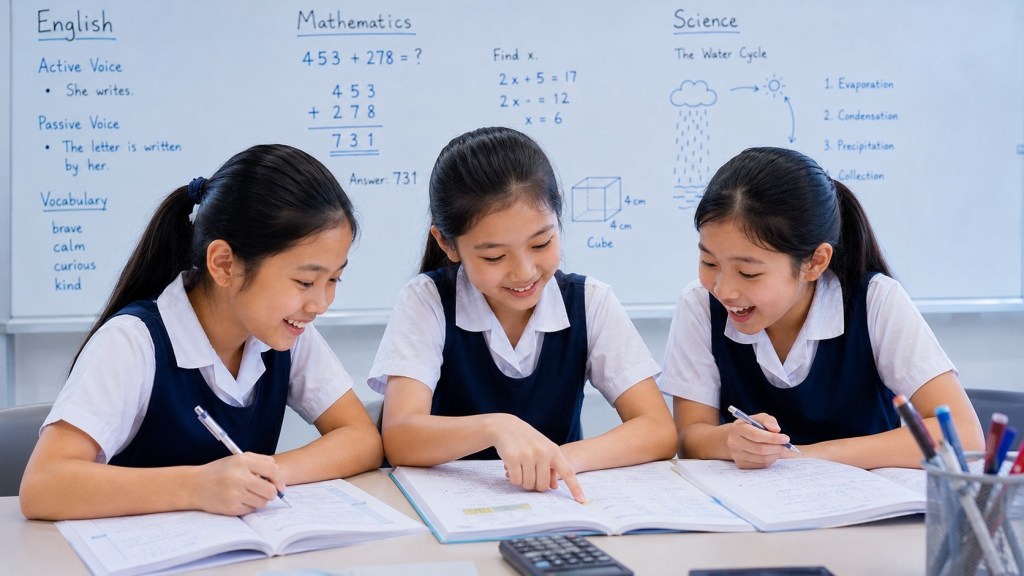
A pupil sees three pictures and immediately chooses the most dramatic one. The story begins with the picture, but halfway through the pupil realises the picture has nothing useful to do with the topic.
Another pupil builds a strong story first, then inserts the required picture at the end with one sentence: “There was also a bicycle nearby.” The picture has been mentioned, but it has not been integrated.
Picture-stimulus control means choosing at least one image because it can do real story work: create a problem, trigger a decision, provide evidence, change a relationship, shape the setting or produce a consequence.
This guide deepens Continuous Writing: Topic, Plot and Revision and Composition Sentence Craft, Cohesion and Paragraph Flow.
Quick answer: choose the image by job, not excitement
Before selecting a picture, ask:
- How can this picture connect to the exact topic?
- Can it create or reveal a meaningful problem?
- Can it change what a character decides?
- Can it reappear later as evidence, consequence or resolution?
- Can I write about it naturally without distorting the story?
A useful routine is TOPIC → PICTURE JOB → CAUSAL LINK → REAPPEARANCE → ENDING.
The official 2026 boundary
SEAB’s 2026 English Language document states that Continuous Writing provides three pictures and candidates must use at least one of them while writing on the given topic. The minimum length is 150 words.
Official reference routes: SEAB PSLE Formats Examined in 2026 and the 2026 PSLE English Language document. The prompts and pictures described below are original eduKate practice material.
Picture use is not picture description
If the picture shows a torn bag, the pupil does not need to spend a paragraph describing its colour, size and zip. The bag can matter because something falls out, because it reveals a mistake, because another character returns a lost item or because the narrator must decide whether to admit responsibility.
Use the picture as a story mechanism.
Three possible picture jobs
Trigger: the picture starts the central problem.
Complication: the picture makes an existing problem harder.
Resolution evidence: the picture helps solve or reveal the outcome.
One picture can perform more than one job if the story remains natural.
Original prompt 1: “An unexpected responsibility”
Picture A: a set of keys.
Picture B: a wet floor sign.
Picture C: a box labelled FRAGILE.
Which is easiest to integrate?
All three can work. The best choice depends on the plot.
Picture A: keys as responsibility
Possible causal chain:
Teacher asks narrator to hold the storeroom key → narrator feels trusted → friend asks to borrow it quickly → narrator must decide whether to hand it over → key is temporarily misplaced → narrator has to recover and report honestly → changed habit: responsibility includes controlling access, not simply holding an object.
The key is central from beginning to end.
Picture B: wet floor sign
Possible chain:
Narrator is asked to place a safety sign → thinks the task is trivial → moves it aside because it blocks a display → visitor nearly slips → narrator realises the sign’s job → restores it and changes the route.
The picture supports responsibility through consequence.
Picture C: fragile box
Possible chain:
Narrator agrees to carry a fragile model → rushes because friends are waiting → ignores handling instruction → box bends → admits mistake → helps repair model.
The image creates a responsibility test around care.
Do not choose by vocabulary convenience
A pupil may choose the wet-floor sign because “slippery” and “dangerous” are familiar words. That is fine only if the story remains relevant to the topic.
Picture choice should serve meaning before vocabulary comfort.
Original prompt 2: “A misunderstanding”
Picture A: two identical envelopes.
Picture B: a phone screen showing a missed message.
Picture C: a chair with a bag underneath.
Plan one story for each before deciding.
Envelope plan
Two identical envelopes are placed side by side. Narrator assumes one belongs to them and hands it to the teacher. Later another pupil cannot find a form. The misunderstanding is traced to the identical envelopes.
Strong because the picture naturally creates mistaken identity.
Missed-message plan
A change in meeting location is sent by message. Narrator does not see it and concludes friends have left without them. Later the missed message explains the event.
Strong because the picture contains missing information.
Bag-under-chair plan
Narrator sees a bag under a chair and assumes someone has abandoned it. They carry it to the office, but the owner had simply gone to collect something.
Possible, but the writer must manage the misunderstanding carefully so the action remains reasonable.
Picture selection matrix
| Question | Score 0–2 |
|---|---|
| Does it connect directly to topic? | 0–2 |
| Can it cause a meaningful event? | 0–2 |
| Can it return later? | 0–2 |
| Does it create character choice? | 0–2 |
| Can I write it naturally? | 0–2 |
This is a teaching aid, not an official scoring rubric. Its job is to slow down impulsive picture choice.
Use one picture well before using three poorly
The official requirement is at least one picture. More pictures do not automatically improve the composition.
Using three images can work if they belong in one causal chain. Forcing all three into separate scenes can make the plot episodic.
When two pictures support one event
Example: keys + fragile box.
The narrator is trusted with storeroom keys to collect a fragile display model. The key enables access; the fragile box creates the care responsibility. Both pictures serve one event.
This is stronger than mentioning keys in paragraph 1 and a random fragile parcel in paragraph 5.
Picture as evidence, not decoration
If the picture shows a cracked phone screen, the crack can reveal that the device was dropped. It can also challenge a character’s claim that nothing happened.
The image becomes evidence inside the story.
Picture as symbolic object
At Primary 6, symbolism should remain natural. A broken trophy can represent disappointment if it is genuinely tied to the event. Do not force abstract symbolism if the story needs basic causal clarity first.
Picture and topic must both survive
A story can use the image accurately and still fail the topic.
Topic: “A promise”. Picture: bicycle.
Weak story: narrator repairs a bicycle but no promise matters.
Stronger: narrator promised to return a borrowed bicycle before evening, damages it, considers hiding the problem, then keeps the deeper promise by telling the truth and arranging repair.
Topic test
Complete this sentence before writing:
My story answers the topic because…
If the explanation is vague, the picture may be controlling the story instead of the topic.
Original model plan: “A difficult choice”
Picture: labelled box.
Paragraph 1: narrator helps at a school event; sees two similar boxes.
Paragraph 2: friend asks narrator to move one quickly.
Paragraph 3: narrator notices labels: DISPLAY PARTS and RECYCLING.
Paragraph 4: rushing would be easier; checking means delaying setup.
Paragraph 5: narrator checks, discovers the display parts are fragile.
Paragraph 6: choice seems small but prevents damage.
The difficult choice is not dramatic. It is meaningful because convenience competes with responsibility.
Model opening
“The two boxes looked almost identical. Both were brown, both were sealed with clear tape, and both were sitting beside the stage. The only difference was the handwritten label on each lid.”
The picture enters immediately, but the paragraph does not stop to describe every detail.
Model turning point
“‘Just take the nearer one,’ Ben said. The teacher was already calling for the display parts.
I bent down and read the label again.
RECYCLING.
The other box was marked FRAGILE DISPLAY PARTS.”
The picture creates the choice.
Model ending
“Later, when another pair of boxes arrived, Ben reached for one and stopped.
‘Which label?’ he asked.
I smiled. The delay took three seconds.”
The ending shows transfer without explaining the moral directly.
Picture integration checklist
- Does the picture appear before the final paragraph?
- Does it affect what happens?
- Would removing it damage the plot?
- Does it connect to the topic?
- Does it return as consequence, evidence or changed habit?
If removing the picture changes nothing, integration is weak.
Common failure: picture inserted after planning
Draft story is complete. Pupil remembers picture requirement and adds: “I noticed a bicycle outside.”
Repair: choose a scene where the bicycle can cause or solve something. If no such scene exists, re-plan rather than decorate.
Common failure: picture creates unrelated subplot
Main story concerns a misunderstanding over a lost form. Midway, a bicycle accident appears only because the picture shows a bicycle.
The second plot competes with the first.
Common failure: picture dominates topic
The image is exciting, so the entire story becomes about it. The topic disappears.
Use the topic test at each paragraph: how does this event develop the central idea?
Common failure: impossible coincidence
A required object appears at exactly the right moment with no preparation. The reader feels the writer is inserting the image mechanically.
Prepare the object earlier or choose a more natural picture.
Picture selection under time
Do not spend a large part of the writing period comparing every possible plot.
Give each picture one fast role idea. Choose the one with the clearest topic connection and causal path.
Then commit unless the plan clearly fails.
Original practice set 3: “An act of kindness”
Picture A: umbrella.
Picture B: lunch box.
Picture C: stack of books.
Possible uses:
- Umbrella: sharing shelter with someone in heavy rain.
- Lunch box: returning a forgotten meal or sharing food appropriately.
- Books: helping carry or recover scattered materials.
Choose the picture that lets kindness involve a decision or cost, not only a simple action.
Original practice set 4: “A mistake I learned from”
Picture A: timetable.
Picture B: name label.
Picture C: open locker.
Build a cause chain for each.
Do not write the full story yet. Planning variety makes picture selection more flexible.
Picture stimulus and sentence craft
The image can provide a concrete anchor that supports precise verbs and nouns.
Instead of “I handled the thing badly,” use “I lifted the model by one corner.”
Specificity comes from the event, not from forced adjectives.
Picture stimulus and inference
A character may interpret an image wrongly: two identical labels, a bag under a chair, an unread message. This can create a natural misunderstanding.
The story becomes stronger when the mistaken interpretation later meets new evidence.
Independent transfer task
Topic: “A second chance”.
Picture choices:
- a cracked model;
- a returned key;
- a blank application form.
For each picture, write:
- its story job;
- the decision it creates;
- the consequence;
- how it appears again near the ending.
Then choose one and write a six-paragraph plan.
Transfer model for cracked model
Job: evidence of earlier carelessness.
Decision: admit damage or hide it.
Consequence: narrator tells teacher and is allowed to help repair it.
Return: repaired crack remains visible, reminding narrator that second chance means responsibility, not pretending nothing happened.
Parent and tutor use
Ask the pupil to explain why one picture is better than another for the topic. Do not choose the image for them automatically.
Ask: “If I remove this picture from your plot, what changes?” If the answer is “nothing”, integration needs repair.
The Secondary 1 bridge
Secondary writing may no longer use the same picture-stimulus structure, but the planning capability transfers: use source material or prompts as meaningful constraints rather than decoration.
Continue with Secondary 1 Continuous Writing: Ideas, Plot, Character and Revision.
Continue Batch 7
For functional source use, continue with Situational Writing: Source-Pack Selection and Transformation. For command control, use Question Command Words and Answer Forms. For reading language effects, return to Vocabulary in Context, Language Effect and Tone.
Return to the Secondary English Learning Hub.
The quiet return
The picture is not a decoration the story must carry. It is a tool the story can use.
Choose the image that does work. Connect it to the topic. Let it cause something. Let it matter again later.
