
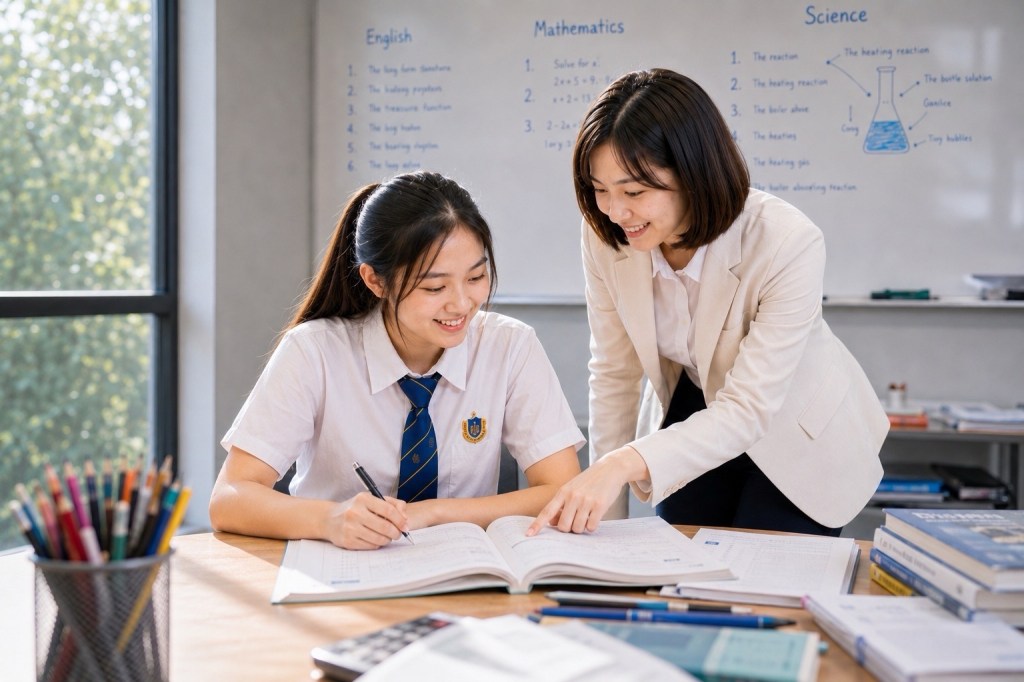
Quick Read: Secondary 1 English Tuition in Punggol
Secondary 1 English is where many students discover that being able to do Primary 6 English is not the same as being ready to operate independently in Secondary school.
For Punggol families looking at English tuition across G1, G2 and G3, the most useful question is not which label a student carries. It is what the student can currently do without help, what becomes unstable under greater load, and what needs to be strengthened next.
At eduKate Sengkang, we use small groups of up to three students so the tutor can see the difference between a reading problem, a vocabulary problem, an inference problem, a writing problem, an accuracy problem and a confidence problem. The work may look similar on paper. The cause often is not.
Secondary 1 is not a verdict on a child. It is a new environment that reveals which parts of English are already stable and which parts still need support.
What Changes When Primary School Ends?
Primary 6 gives students a substantial English foundation. Secondary 1 does not throw that foundation away. It asks the learner to carry more with it.
- Texts become longer and denser.
- Meaning may be implied rather than directly stated.
- Students need to select evidence rather than merely find matching words.
- Vocabulary is more dependent on context, tone and purpose.
- Writing requires stronger organisation and greater independence.
- Oral responses need clearer development.
- Students are expected to check and correct more of their own work.
The transition can therefore expose weaknesses that were previously hidden by shorter tasks, greater scaffolding or familiar question formats.
G1, G2 and G3: Different Calibration, One Human Language System
Singapore’s Full Subject-Based Banding environment allows students to study subjects at different subject levels. The expected depth, complexity and assessment demand can differ, but the underlying English capabilities remain recognisable across the levels.
| Capability | What we look for |
|---|---|
| Reading | Can the student maintain meaning through an unfamiliar text? |
| Vocabulary | Can words be understood in context and used accurately? |
| Comprehension | Can the student locate, infer, select evidence and answer precisely? |
| Writing | Can ideas be developed and organised for a reader? |
| Grammar | Does sentence control survive real writing? |
| Oral | Can the student organise and express an idea in real time? |
| Independence | Can the student begin, check, correct and continue with less prompting? |
The useful teaching decision is therefore not “teach the label”. It is “teach the learner at the correct level of challenge”.
Why Two Students With the Same Mark May Need Different Help
Imagine two students both scoring 60%.
Student A reads accurately, understands the passage and finds evidence, but writes incomplete answers.
Student B writes fluent answers, but frequently misunderstands what the question is asking.
The final score looks similar. The repair should not.
This is why we pay attention to process:
What did the student notice? What did the student think the question meant? Which evidence was chosen? Why was that wording used? Where did certainty become guesswork?
The student’s working method often tells us more than the final tick or cross.
Reading: From Decoding to Reconstruction
At Secondary 1, good reading increasingly means reconstructing a larger world from the text.
A student should be able to track:
- who is involved;
- what changed;
- what caused the change;
- whose viewpoint is being represented;
- what the writer wants the reader to notice;
- which details are important;
- how one paragraph affects the next.
This becomes the foundation for stronger comprehension. A student who has built the passage as a coherent whole is less likely to treat every question as an isolated hunt for keywords.
Comprehension: The Answer Must Be Supported
Secondary comprehension often demands a more disciplined relationship between text and answer.
The student may need to move through:
Question → Locate relevant text → Understand it → Infer if necessary → Select evidence → Construct answer → Check against the question
Each stage can fail independently. A student may understand the text but answer too broadly. Another may choose the correct evidence but fail to explain why it matters. Another may write a plausible inference that the passage does not actually support.
We want students to learn the boundary between possible and supported.
Vocabulary: Precision Before Decoration
Secondary students often feel pressure to sound more sophisticated. That can lead to long words being inserted where a simpler word would be more accurate.
We prefer a different progression:
Know the meaning → Understand the shade → Recognise the context → Retrieve the word → Use it naturally
A stronger vocabulary is not merely a larger vocabulary. It is a vocabulary the student can control.
Grammar: The Difference Between Knowing a Rule and Owning It
A student can explain subject-verb agreement correctly and still make agreement errors in a composition. This is not necessarily a contradiction.
During a grammar exercise, attention is focused on grammar. During writing, attention is shared across content, organisation, vocabulary, sentence structure, spelling, punctuation and timing.
So we test whether grammar survives load. We bring corrected patterns back into real writing, oral explanation and comprehension answers until accuracy becomes more reliable.
Writing: A Good Paragraph Has a Job
Secondary writing becomes more demanding because a paragraph is no longer valuable simply because it contains correct sentences.
Ask:
Why does this paragraph exist?
Does it establish the situation? Develop a problem? Explain a reason? Provide an example? Respond to another viewpoint? Move the reader towards the conclusion?
This is a powerful shift. Students begin to see writing as organised communication rather than a container that must be filled with words.
From Opinion to Developed Thought
A student may say:
School rules are important.
That is a starting point. We can then ask:
- Important for what?
- Which rules?
- Who benefits?
- What happens without them?
- Can a rule ever be unreasonable?
- What example would support the point?
The student does not need an instant perfect answer. The aim is to learn how to open an idea, test it and develop it.
Oral English: A Useful Window Into Thinking
Oral discussion is useful because it reveals where thought becomes difficult. A student may have the vocabulary but not the organisation. Another may have a good idea but no example. Another may understand the question only after it is rephrased.
In a small group, one student’s answer can also create a new question for another. Students learn that a topic can be represented from more than one perspective.
This becomes increasingly important as English develops from simple response towards judgement, argument and audience awareness.
The Secondary 1 Independence Shift
One of the quietest but most important changes after Primary 6 is that the learner becomes responsible for more of the process.
At first, the tutor may ask:
- What is the question asking?
- Where is your evidence?
- Does this sentence make sense?
- What is missing from this paragraph?
- Have you checked the tense?
Over time, the student should begin asking these questions internally.
Good tuition should gradually transfer control from tutor to learner.
Why Three Students?
eduKate Sengkang uses small groups of up to three students. For Secondary English, the value of this format is visibility.
The tutor can see how each student enters a question. At the same time, the group provides useful contrast. Three students may interpret the same issue differently, choose different evidence or organise ideas differently.
That gives us material for teaching:
- Which answer is better supported?
- Which wording is more precise?
- Which example actually proves the point?
- Which paragraph is more useful to the reader?
- Where did one student make an assumption another avoided?
Students learn from the tutor and from comparison, while remaining visible enough for individual correction.
What a Good Secondary 1 English Programme Should Reduce
Parents often think improvement must mean adding more: more worksheets, more vocabulary, more model essays, more homework.
Sometimes improvement comes from reducing:
- repeated misunderstandings;
- guessing;
- unnecessary copying;
- vague answers;
- grammar errors that recur every week;
- dependence on prompts;
- panic when the question looks unfamiliar;
- time wasted using a weak method.
A quieter learning system can be a stronger one. When the student knows what to do, why it works and how to check it, English becomes less chaotic.
When Should Parents Consider Secondary 1 English Tuition?
Additional support may be useful when the transition has exposed persistent difficulty in reading, comprehension, writing, grammar, oral expression or independent work.
It may also be useful for a strong student who needs greater depth and more demanding transfer work.
However, tuition should have a reason. If a student is progressing well, reading independently, understanding school lessons and responding to feedback, there may be no need to add another programme simply because Secondary school has begun.
A Parent’s Five Useful Checks
- What exactly is difficult? Avoid “English is weak” as the final diagnosis.
- Does the programme inspect causes? A wrong answer should trigger investigation, not only correction.
- Does practice change after correction? Retest and variation show whether learning transferred.
- Does support reduce over time? Students should become more independent, not more dependent.
- Is the class right for the learner? The student should receive enough challenge, feedback and room to think.
A Calm Route Through the Secondary 1 Reset
The transition can feel large because several demands arrive at once. We break it into manageable steps.
See the present state → find the first weak link → repair it → practise → remove support → change the task → check transfer → build the next layer.
This matters for the child and for the family. The goal is not to create more stress around English. It is to replace uncertainty with a clearer next move.
Secondary 1 English Tuition in Punggol at eduKate
eduKate Sengkang teaches Secondary English in small groups of up to 3 students at 83 Punggol Central, Singapore 828761. Lessons are 1.5 hours. We begin with a consultation so the student’s current English, school context and likely priorities can be understood before class placement.
For the main Secondary 1 service and learning framework, visit Secondary 1 English Tuition Sengkang. For a broader diagnostic route, visit the English Tuition Sengkang hub.
Frequently Asked Questions
Does eduKate teach G1, G2 and G3 English?
The teaching is calibrated to the student’s subject level and actual current capability. The underlying work remains connected across reading, vocabulary, comprehension, writing, grammar, oral communication and independent learning.
Why can a strong Primary 6 student struggle in Secondary 1?
Because the environment changes. Longer texts, more inference, stronger writing demands and reduced prompting can expose a capability that was previously adequate but not yet robust.
Should we wait for poor results before getting help?
Not necessarily. Repeated difficulty, growing dependence or visible loss of confidence can be useful signals before a major assessment confirms the problem. Equally, one poor result alone should not create panic. Patterns matter.
What if my child is already strong?
Then the objective changes. Strong students can develop deeper reading, more precise vocabulary, stronger evidence, more sustained writing, better oral reasoning and greater control over unfamiliar tasks.
What is the main goal of Secondary 1 English tuition?
To help the learner move from a Primary-school level of support towards a more independent Secondary-school English system that can read, interpret, reason, communicate, check and adapt.
Secondary 1 English should feel increasingly manageable as the learner understands what changed, strengthens the right capability and learns how to operate with less help. That is the purpose of the Punggol Secondary 1 English route at eduKate.
For the Punggol-local Secondary 1 service owner, continue to eduKatePunggol. This eduKateSengkang page remains a legacy learning entrance into the shared Secondary 1 transition system. Secondary 1 English Tuition at eduKatePunggol.
Legacy Punggol route preserved on eduKateSengkang
This page is being kept at its existing URL because it is part of the older eduKate estate and may still be useful to readers arriving through historical links or search. Current Punggol discovery and local-family routing now belongs to the eduKatePunggol Atlas.
If your question is about the learner rather than the location—what is blocked, fragile, stable, transfer-ready or examination-ready—return to the eduKateSengkang Learning Atlas V2.0. The URL is preserved; ownership is made explicit so the two estates do not compete for the same job.
