
Quick Read
Oral English is often reduced to confidence: speak louder, smile, maintain eye contact, sound natural. These behaviours can help, but they sit on top of a deeper system.
To speak well, a student has to understand what was said or shown, decide what matters, retrieve relevant vocabulary, organise an idea, build sentences quickly, listen to the other person and adjust the next response. All of this happens while time is moving.
Oral English therefore trains something important that writing cannot fully reproduce: language under live conditions.
- Early Primary: speaking connects experience to language.
- Middle Primary: students learn to explain, sequence, compare and support simple opinions.
- Upper Primary: oral responses require development, evidence, interaction and examination control.
- Secondary: students increasingly need perspective, judgement, argument and responsive discussion.
This article explains how oral English fits into the wider Sengkang English Tuition journey.
The One-Sentence Answer
Oral English becomes powerful when a student can turn incoming meaning into organised, responsive language in real time.
Speaking Is the Fastest Language Test
Writing gives the student time to stop, cross out, search for a word and rebuild a sentence. Conversation keeps moving.
That makes oral English revealing. Vocabulary that looked strong on a worksheet may disappear when the student must retrieve it immediately. Grammar that is accurate in editing may become unstable in spontaneous speech. Ideas that seem clear internally may emerge as short fragments because the student has not yet learned how to organise them for another person.
Oral work shows us how much of the language system is available without scaffolding.
Oral English Begins With Receiving, Not Speaking
A good response begins before the student opens their mouth.
The student must listen accurately, notice the actual question, interpret the prompt and identify what kind of response is required. A child can speak fluently and still answer poorly because the incoming message was only partially understood.
This is why listening is not a separate minor skill. It is the receiving side of oral communication.
The Question Is a Route, Not an Invitation to Say Everything
Students sometimes hear a familiar topic and begin delivering whatever they prepared about it. The answer may be fluent, detailed and still miss the question.
Oral control begins with recognising the route: Are you being asked to describe, explain, compare, recommend, evaluate, recall an experience or give an opinion?
The response should be shaped by that demand. This is the oral equivalent of reading a comprehension question correctly before searching for evidence.
A Strong Oral Answer Has a Centre
Many weak responses are not wrong; they are shapeless.
The student begins with one idea, adds another, remembers an example, changes position and eventually stops without a clear conclusion. This often happens because speaking is being generated one sentence at a time rather than from an organised thought.
A useful oral habit is to establish the centre quickly: What is my main point? Then add a reason, example, consequence or qualification around it.
This does not require memorised structures in every answer. It requires awareness that a response should go somewhere.
Vocabulary Has to Be Retrieved, Not Recognised
Oral English exposes the difference between receptive and productive vocabulary immediately.
A student may understand words such as responsibility, consequence, frustrated or considerate when reading, yet fall back on “good”, “bad”, “thing” and “like” during speech.
The problem is not necessarily lack of knowledge. Retrieval may be too slow for live use.
Repeated oral use helps move useful vocabulary closer to the front of the student’s language system. The companion article How Vocabulary Becomes Writing Power explains how words move from recognition to control.
Grammar Under Live Conditions
Spontaneous speech is less polished than formal writing, and it does not need to sound written. But grammar still matters because listeners need to follow relationships.
If tense shifts randomly, pronouns lose their references or connectors do not match the relationship between ideas, meaning becomes harder to track.
Oral practice therefore gives grammar a different kind of training. The student has to build structure quickly enough that attention can remain on meaning and interaction.
For the deeper sentence system, see How Grammar Becomes Sentence Control.
Confidence Is Not the Same as Capability
Some students speak readily but say very little. Others have strong ideas but hesitate because retrieval is slow or they fear making mistakes.
If we treat both students as having a “confidence problem”, we miss the difference.
One student may need deeper ideas and language precision. Another may need repeated low-risk speaking experience until known language becomes easier to access. Another may need help listening to the whole question before responding.
Confidence often grows as capability becomes dependable. It is an outcome as much as a starting condition.
Fluency Is Not Speed
Speaking quickly can create the impression of fluency, but real fluency is smoother than speed.
A fluent speaker can maintain meaning, recover after a pause, select appropriate language and help the listener follow. Pauses are not automatically weaknesses. Sometimes a short pause shows that the student is organising a better response.
We would rather hear controlled thought with natural pauses than rapid language that outruns meaning.
Reading Aloud Is About Meaning, Not Performance Tricks
Reading aloud is sometimes trained through volume and dramatic expression alone. But good oral reading begins with comprehension.
The student needs to recognise sentence boundaries, phrasing, punctuation, emphasis and shifts in meaning. Expression should emerge from understanding what the text is doing.
If a student does not understand a sentence, forcing exaggerated intonation can mask rather than solve the problem.
Good reading aloud lets another person receive the text more easily.
Pronunciation Matters Most When It Protects Meaning
The goal of pronunciation teaching is intelligibility, not erasing identity or producing one artificial accent.
Sounds, word stress and endings matter when they change or obscure meaning. Students should learn to notice recurring pronunciation patterns and speak clearly enough that the listener does not have to reconstruct the message.
Clarity is a service to the listener.
Oral Discussion Is Not a Mini Composition Recited From Memory
Memorised answers can sound impressive until the follow-up question changes direction.
Real oral capability is adaptive. The student can receive a new question, connect it to the previous idea, revise a position or supply another example.
This is why we do not want students to build a bank of speeches for every possible topic. We want a reusable thinking process.
Examples Make Oral Answers Concrete
A broad statement such as “People should be responsible” is difficult to evaluate because it floats above experience.
An example gives the idea a body. The student might explain what responsibility looks like in school, at home, online or in a community. Once the example appears, the speaker can explain consequences and limitations.
Examples therefore do more than lengthen answers. They give abstract thinking something to attach to.
The Next Step Is Explanation
Students are often told to “elaborate”. That instruction can feel mysterious.
Elaboration usually means adding a useful relationship: Why? How? What happened because of this? Who is affected? Under what conditions? What would an example look like? Is there another side?
Once students learn these moves, longer answers become a consequence of deeper thinking rather than deliberate padding.
Listening to Another Person Changes the Next Sentence
Oral communication is not simply alternating monologues.
A responsive speaker listens for what the other person has already established. The next answer can agree, qualify, extend, challenge or clarify.
This makes oral English a social form of reasoning. The student is not merely expressing a private thought; the student is participating in a shared construction of meaning.
Oral English Strengthens Writing
Speaking can become a rehearsal space for writing.
If a student cannot explain an idea aloud in simple language, writing it clearly is usually harder. Oral discussion lets ideas be tested before the extra load of spelling, punctuation and handwriting or typing is added.
Students can hear whether an explanation has a missing step. They can discover a stronger example through conversation. They can practise qualifying a claim before placing it in an essay.
Oral and writing are different outputs of the same deeper language system.
Oral English Strengthens Comprehension
Discussion also reveals reading.
Ask a student to explain why a character acted a certain way and the comprehension process becomes audible. The student has to retrieve evidence, infer meaning and express the relationship.
When the explanation breaks, we can ask where the evidence came from. The article Why Comprehension Answers Need Evidence develops that connection in detail.
P1–P2: Speaking Connects Experience to Language
Early-primary oral work should help children name, describe, sequence and explain familiar experience.
What happened? What did you notice? What came next? Why do you think that happened? These questions build the bridge from observation to organised language.
At this stage, the goal is not a polished performance. It is confident meaning-making.
P3–P4: Oral English Becomes Explanation
Middle-primary students can increasingly compare, justify preferences, explain simple causes and develop examples.
The teaching focus shifts from complete sentences alone to connected responses. Students learn that another person should be able to follow how one idea leads to the next.
Vocabulary and grammar now have to operate more quickly and with less prompting.
P5–P6: Oral English Enters the PSLE Runway
Upper-primary students need greater independence. They have to understand prompts quickly, generate developed responses, support opinions and maintain clarity under assessment conditions.
This is where practising only model answers becomes dangerous. The examination can vary the prompt. Flexible students need a thinking system that survives novelty.
The wider examination relationship is covered in PSLE English | From Language Capability to Examination Craft.
Secondary 1–2: Oral English Becomes Perspective
Secondary students begin dealing with more abstract topics and competing viewpoints.
They need language for agreement, disagreement, qualification and uncertainty. They need to recognise that a question may have several defensible positions and that examples need to support the chosen position.
Oral discussion becomes a useful training ground for thinking before students are expected to sustain the same reasoning in formal writing.
Secondary 3–4: Oral English Becomes Judgement and Adaptation
At upper secondary, mature oral responses require more than fluent opinion.
Students should be able to recognise trade-offs, acknowledge limitations, compare perspectives and adjust certainty. They should be able to respond to a follow-up without abandoning the main logic of the conversation.
This is language functioning as public reasoning.
Why Students Freeze
Freezing is not always a confidence issue.
The student may not understand the question. The topic may trigger no accessible examples. Vocabulary retrieval may stall. The student may be trying to produce a perfect opening sentence before deciding the main point. Or the student may have practised only predictable questions.
Each cause suggests a different repair. Telling every student to “be more confident” can add pressure without adding capability.
Recovery Is Part of Oral Skill
Strong speakers are not people who never hesitate. They know how to recover.
They can pause, restate the question, correct a word, clarify what they meant or take a simpler route into the idea. Recovery prevents one difficult moment from collapsing the entire response.
This matters in examinations, but it also matters in real conversations. Communication is resilient, not perfect.
Diagnose First: “Weak Oral” Can Mean Many Things
- The student does not fully understand prompts.
- The student has ideas but retrieves vocabulary too slowly.
- The student speaks fluently but gives shallow answers.
- The student has strong content but poor organisation.
- The student relies on memorised scripts and struggles with follow-ups.
- Pronunciation or volume interferes with intelligibility.
- Grammar breaks down under live conditions.
- Anxiety increases because the student has no recovery strategy.
- The student has little real conversational practice.
These are not one problem. They should not receive one generic set of oral tips.
Catch Up | Keep Up | Move Ahead
Catch Up: rebuild listening, basic response structure, high-frequency vocabulary and safe speaking routines. Reduce pressure while creating successful repetitions.
Keep Up: maintain regular discussion so oral language develops alongside reading and writing rather than appearing only before an examination.
Move Ahead: deepen examples, perspective, qualification, argument, interaction and recovery so the student can respond intelligently to unfamiliar prompts.
Why Three Students Is an Interesting Oral Classroom
Oral English needs an audience, but very large groups can reduce each student’s speaking time. One-to-one teaching offers attention but removes peer variation.
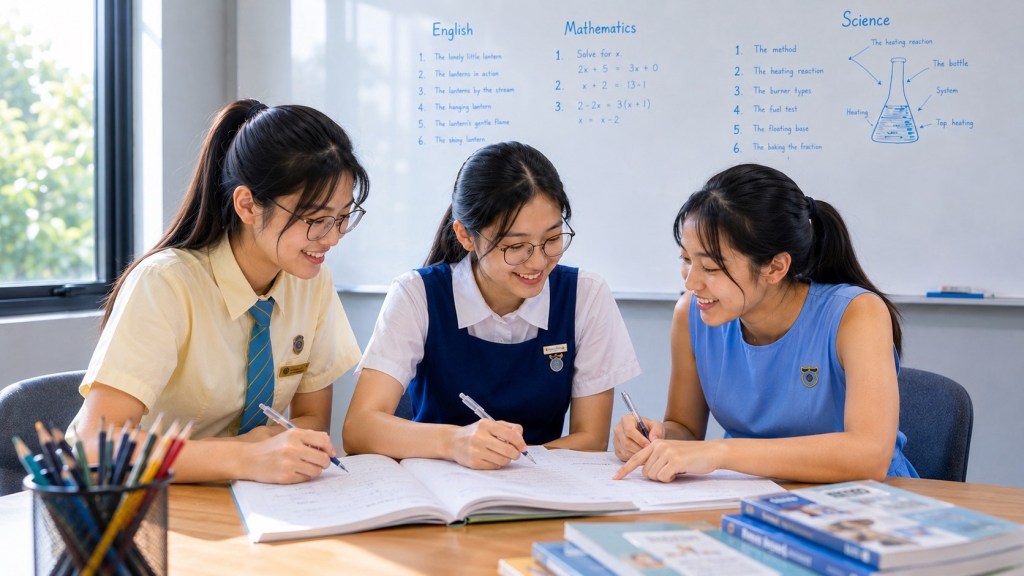
With three students, each learner can speak frequently while still hearing two other minds respond to the same prompt. One student may notice an angle another missed. One may use a phrase worth borrowing. One may challenge an assumption.
The tutor can then ask follow-ups, compare reasoning and make language choices visible. The group becomes a small communication field rather than three private tutorials happening beside one another.
For the broader small-group model, see English Tutor Sengkang | Small-Group English Tuition.
What Parents Can Do at Home
Oral development does not require turning dinner into an examination.
- Ask genuine questions whose answers you do not already know.
- Invite the child to explain a decision, not merely report what happened.
- Ask for one example after an opinion.
- Occasionally ask, “What makes you think that?”
- Let the child finish before correcting language.
- Discuss books, news appropriate to the child’s age, school experiences and everyday choices.
- Model disagreement that remains respectful and reasoned.
The home does not need to become another classroom. It can simply remain a place where ideas are worth expressing.
How We Know Oral English Is Improving
- The student answers the actual question more consistently.
- Responses develop beyond one-line opinions.
- Examples become more relevant.
- Useful vocabulary appears with less prompting.
- Pauses become purposeful rather than panicked.
- The student handles follow-up questions more flexibly.
- Grammar remains clearer during spontaneous speech.
- The student can recover after losing a word or idea.
- Speaking confidence grows together with content quality.
We are not looking only for a more polished performance. We are looking for greater control.
Frequently Asked Questions
Should children memorise model oral answers?
Models can show what a developed answer looks like, but memorising whole responses is fragile. It is better to learn reusable thinking moves—position, reason, example, consequence, qualification—and practise them across many prompts.
My child is shy. Does that mean oral English will always be weak?
No. Personality and oral capability are different. A quiet student can learn to give thoughtful, clear responses. The goal is effective communication, not becoming the loudest person in the room.
Should students speak as quickly as possible?
No. Clear pacing, meaningful phrasing and organised thought matter more than speed. A controlled pause can improve a response.
How can vocabulary improve for oral English?
Use important vocabulary repeatedly in real discussion. Retrieval improves when students have to generate the word themselves across different topics rather than merely recognise it on a list.
Can oral practice help composition?
Yes. Speaking allows students to test ideas, examples and explanations before managing the additional mechanical demands of writing. Strong oral reasoning can become a useful bridge into composition and argument.
When should parents consider oral English tuition?
When weak oral performance persists because of identifiable language or reasoning gaps, when the student cannot respond flexibly to unfamiliar prompts, or when examination preparation has become dependent on memorised scripts, targeted teaching can help.
A Final Reflection: Speaking Is Thought Becoming Public
Language begins inside a person, but its value grows when it can cross the distance to another person.
Oral English makes that crossing immediate. There is no long drafting interval. The student listens, thinks, chooses and speaks while another mind is present.
At first, a child learns to name and describe. Later, to explain and compare. Later still, to justify, qualify, disagree, reconsider and respond.
That progression is larger than an oral examination. It is the development of a person who can receive another person’s meaning and send back a thought that is clear enough to continue the conversation.
For the full English developmental spine, return to Sengkang English Tuition.
