
Category: Blog
-

Inequalities for Sengkang Families: Compare Values, Read Limits and Solve Clearly
An inequality compares values rather than saying that they are equal. For Sengkang families helping with maths at home, the useful starting point is not a page of algebra. It is a sentence such as “we need at least six cards” or “the total must stay below twenty”. The mathematical sign records exactly which values…
-

Modal Verbs for Sengkang Children: Can, Could, Must, Should and Meaning
Modal verbs help a speaker express ability, permission, possibility, advice or obligation. For Sengkang children, begin with the intended message before choosing can, could, may, might, must or should. ‘You may use the ruler’ grants permission; ‘You must use the ruler’ states a requirement in the supplied context.
-
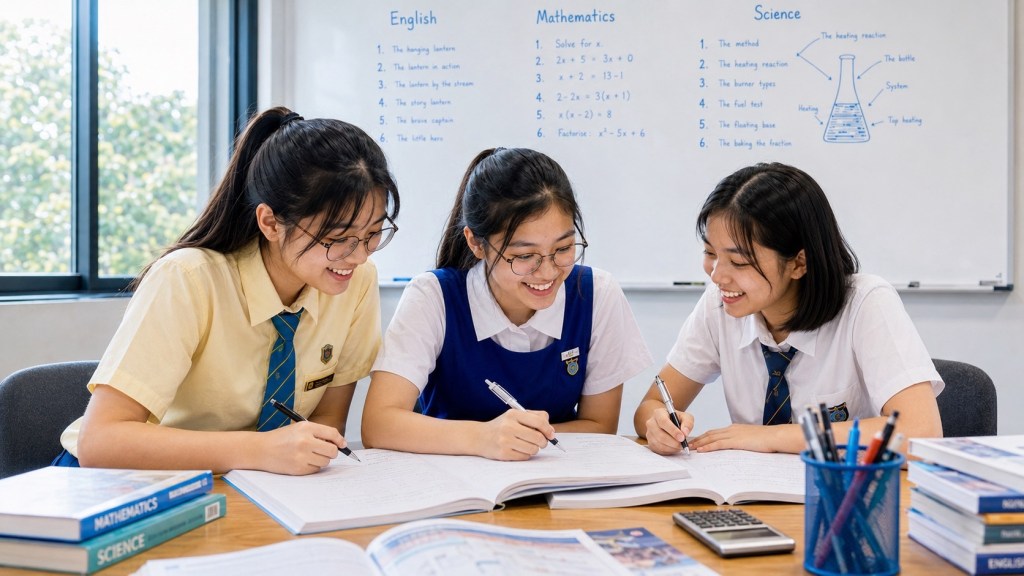
Conditional Sentences for Sengkang Children: If, Unless and Clear English Meaning
Conditional sentences connect a condition with a result, possibility or response. For Sengkang children, begin by identifying the two parts: in ‘If we find the folder, we will return it’, finding the folder is the condition and returning it is the stated response.
-

Mean, Median, Mode and Range for Sengkang Families: Read Data and Explain the Result
Mean, median, mode and range describe different features of data. For Sengkang families, begin by asking what the numbers measure and which question the summary should answer. The mean uses the total and count, the median uses ordered position, the mode uses frequency, and the range describes the gap between extremes.
-
Solving Equations for Sengkang Families: Balance, Unknowns and Clear Algebra
Solving an equation means finding the value that makes its two sides equal. For Sengkang families helping with early algebra, start with that meaning before teaching shortcuts. In 3x + 2 = 17, x is five because three times five plus two is seventeen.
-

Relative Clauses for Sengkang Children: Who, Which, That and Clear Sentences
Relative clauses help a reader identify a person or thing, or learn extra information about it. For Sengkang children, a useful starting sentence is ‘The child who found the folder gave it to the teacher.’ The clause who found the folder tells us which child the sentence concerns.
