
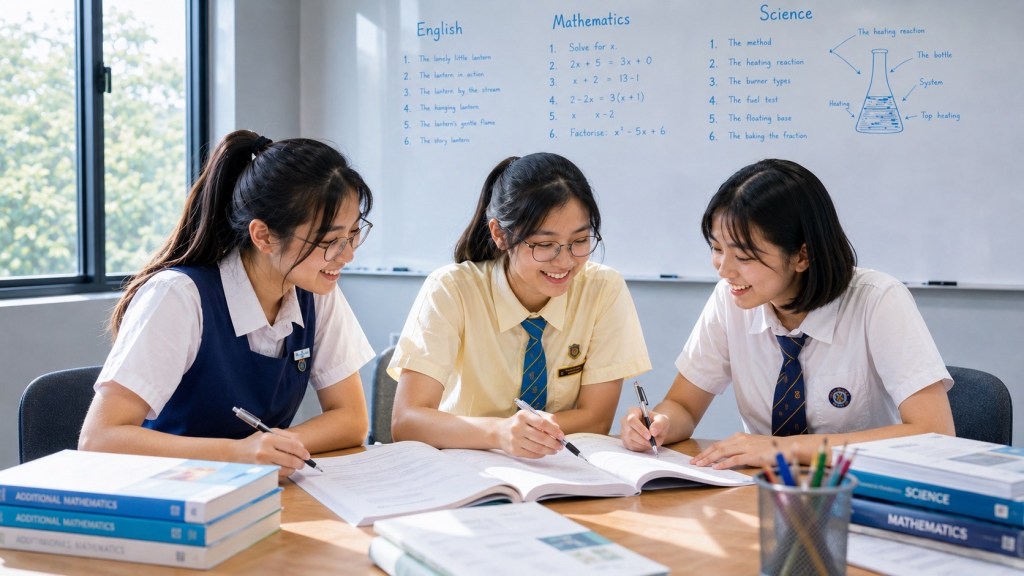
A Secondary 3 student walks out of a Mathematics test saying, “I knew everything except one question.” The marked paper later shows that half the marks were lost through method selection and interpretation. Another student expects to fail because the revision felt difficult but solves a fresh assessment competently. Both have a gap between perceived learning and demonstrated performance.
Self-assessment calibration is the ability to compare a prediction about one’s knowledge or performance with actual evidence, identify where the prediction was inaccurate and improve the next judgment. It is not the same as confidence, self-esteem or a willingness to mark one’s own paper. A learner can feel confident and be wrong; a learner can feel uncertain and be well prepared.
The educational purpose is not to remove all uncertainty. It is to make judgments sufficiently informative for action: What should I revise? Which problem should I attempt without help? Is my strategy producing results? Where should I ask for feedback? Can I accurately distinguish a remembered idea from one I merely recognise when shown the answer?
Calibration is also different from grading oneself harshly. Students who systematically underestimate their ability may choose unnecessarily easy tasks, seek excessive reassurance or abandon productive opportunities. The aim is neither inflated confidence nor permanent doubt. It is a judgement that tracks evidence and adjusts appropriately.
This article complements Uncertainty Skills, Observation Skills, Verification Skills, Practice Design Skills and the site’s MindOS Metacognitive Monitoring State. Those own uncertainty management, evidence handling, practice construction and strategy monitoring. This article owns the prediction-versus-performance loop in specific school tasks.
Before the Top 10: What Is a Calibration Check?
Every calibration exercise needs two measurements: a judgment made before seeing the outcome, and evidence of the outcome under defined conditions. If the student learns the answer first, a later “I knew that” feeling is not a clean prediction. If one task is unreasonably easy or tests unrelated background knowledge, the outcome may not reveal much about the targeted skill.
Use small, low-stakes judgments embedded in normal learning: estimate whether you can solve a fresh item independently, name which step might fail, attempt it, inspect the result and update the estimate. Avoid turning every lesson into public confidence ranking or a numerical personality label.
Accuracy depends on what is being predicted. Confidence in spelling ten specific words is not confidence in writing a persuasive essay. Predictions should be scoped to tasks, criteria, time and support conditions. The learner’s judgment can improve even while performance remains imperfect; noticing that distinction is useful.
The following ten skill headings are an eduKate / Wintour House educational synthesis informed by metacognition research. They are not an official MOE/SEAB proficiency framework, a psychological assessment instrument or a fixed formula for predicting grades.
PREDICTED PERFORMANCE → INDEPENDENT EVIDENCE → MISMATCH → REVISED JUDGMENT → NEXT LEARNING ACTION
1. Predict a Specific Task Outcome Before Seeing the Answer
“I understand algebra” is too broad to compare with a single outcome. Ask for a prediction that has a defined task and support level: “I can solve this two-step equation without a hint,” or “I can explain the purpose of this image in the passage using evidence from the text.” The estimate may be verbal rather than numerical for younger pupils.
A pupil reads a new Science question about how evaporation differs from boiling. Before checking the book, they choose one of three judgments: can explain independently; can explain with one cue; or need the model. Then they attempt the explanation. The result can be compared with the prediction without pretending it measures all of Science.
Keep the judgment brief and private where possible. Teachers can model predicting and then being surprised. A good classroom culture treats changed predictions as evidence of learning to judge more accurately, not as proof that the pupil should feel embarrassed.
Worth learning because precise predictions create a fair comparison between what the student thought was available and what the student could actually produce.
2. Separate Familiarity From Retrieval
Recognition after rereading is not the same as independent recall. Seeing a worked solution can make the steps feel obvious because the missing choices have already been made. Calibration must therefore include some closed-book or otherwise unaided evidence. Otherwise the learner may measure familiarity rather than accessible knowledge.
After studying a Biology diagram, close it and label a blank version while explaining the function of each structure. After learning a formula, derive or apply it to a fresh numerical example before looking at the original worked solution. After reading an English passage, explain the main inference without peeking at the teacher’s annotation.
Record the level of help: no hint, retrieval cue, partial model or full solution. A correct answer after a prompt can be a useful training result, but should not silently be counted as fully independent performance. If the learner succeeds only with the answer visible, adjust the next study task accordingly.
Worth learning because recalling a skill without the original cues exposes gaps that repeated exposure can hide.
3. Compare Predicted Method Choice With the Actual First Step
A learner may accurately remember a procedure but overestimate their ability to select it. Calibration should sometimes focus on the decision that begins a problem, not merely the final answer. That is particularly important when an examination mixes topics and removes chapter labels.
Place ratio, percentage and simple-interest questions together. Before solving, ask the pupil which model will be needed and how certain they are. Then compare the selected method with the structure of the question. If the student solves every direct-percentage question but misclassifies fixed-fee problems as direct proportion, the issue is recognition rather than arithmetic execution.
For English, predict whether a question requires a literal detail, an inference or explanation of language effect. In Science, predict whether a claim can be answered from observational data or requires an additional experiment. The method-selection check must be scored separately from a later copying or calculation error.
Worth learning because a correct-looking final answer can conceal poor method selection, while calibrated first-step judgments reveal what needs to be practised.
4. Identify Which Evidence Should Change Your Confidence
Not all information deserves equal weight. A student feeling fluent after rereading, an unusually easy practice paper, a single guessed correct answer and repeated success on varied unaided questions provide different strengths of evidence. Self-assessment should ask what observation would reasonably raise or lower a judgment.
Suppose a student predicts strong performance on unseen graph questions because they just completed five examples in the same format. A new graph with altered units exposes a recurring axis-reading error. That is high-value contrary evidence about transfer. Rather than ignoring it, the learner should narrow the claim: “I am secure on the practised graph type but not yet reliable when units change.”
Use small evidence labels: seen before, fresh task, with help, without help, under time constraint, after a delay. The labels are not a universal scoring scale; they preserve context so a learner knows why some successes count more for a particular intended outcome.
Worth learning because good calibration follows the quality and relevance of evidence rather than the emotional intensity of a success or mistake.
5. Check Errors at the Level Where the Prediction Failed
An overconfident overall prediction can hide several different errors. The problem may be an unfamiliar word, incorrect recall, a wrong procedure, a sign mistake or an unsupported conclusion. An accurate next judgment depends on finding where the expectation and performance diverged, not simply subtracting two test scores.
If a student predicts success in an electricity question but confuses current and potential difference, the failed prediction concerns conceptual distinction. If the concept was correct but the units were copied wrongly, it concerns execution or checking. If the question itself was misinterpreted, another worksheet of formula substitution may not solve it.
Create a small mismatch log: predicted skill, observed step, likely reason, next check. Compare repeated attempts. Do not diagnose stable personal traits from one result. A useful correction is “I need to check the sign when multiplying by a negative,” not “I am hopeless at algebra.”
Worth learning because locating the mismatch precisely turns a global confidence problem into an actionable learning plan.
6. Learn to Recognise Both Overconfidence and Underconfidence
Students may consistently overpredict or underpredict in particular subjects or task types. Overconfidence can lead to insufficient practice or premature method choices. Underconfidence can lead to redundant checking, unnecessary avoidance or a false belief that no progress has occurred. Neither pattern should become a label for the whole person.
A student who predicts failure on every oral response may discover through recorded independent attempts that most content claims are accurate, while pacing remains uneven. Their appropriate next goal is pacing rather than relearning everything. Another student who predicts perfect results on every edited writing task may benefit from a fresh prompt that checks whether corrections transfer without a model.
After several low-stakes tasks, inspect direction rather than dramatic single scores: were predictions usually above, below or close to performance? Look for patterns by type of task. Respond to the evidence with a changed practice decision, not a motivational slogan.
Worth learning because calibration improves decision quality in both directions: it protects against premature certainty and against unjustified self-doubt.
7. Use a Delayed Check to Separate Immediate Fluency From Retention
Learning can feel strongest immediately after a clear explanation or repeated example. Later access may be weaker. Predicting future performance provides different information from predicting the next minute’s task. A learner should know whether “I can do this now” also means “I can reconstruct it next week.”
After a Maths lesson on solving simultaneous equations, ask for a prediction about an unaided mixed question several days later. Schedule the later task before sharing its answer. In English vocabulary, revisit meanings and usage in new sentences after a gap. In Science, use a new diagram or scenario to check whether the concept still connects to its explanation.
Record the delay and whether hints were available. Do not insist on the same interval for every student; initial knowledge, task difficulty and the stakes change what a useful schedule looks like. If predictions repeatedly exceed later outcomes, plan spaced returns rather than merely increasing the intensity of same-day drills.
Worth learning because delayed comparisons reveal whether an estimate was based on lasting knowledge or temporary familiarity.
8. Make Confidence Conditional on Task Conditions
A learner may be able to explain a concept in conversation but fail to organise it in a timed paper; or perform accurately alone but struggle when the text is unfamiliar. That does not make either result dishonest. It means the prediction must name the conditions under which the ability was tested.
For example, a student may say, “I can solve these linear equations when they are clearly labelled, but my method choice is uncertain in mixed sets.” That is more calibrated than claiming to have mastered all equations. A JC student may recognise that a Physics approximation works for an idealised model but is unsure when the assumptions no longer hold.
Vary one consequential condition at a time: allowed notes, amount of time, task wording, problem context, whether a model is visible. Keep the learning goal stable enough that the effect of the changed condition can be interpreted. Avoid pretending that one very noisy timed test settles the whole judgment.
Worth learning because conditions explain why the same student can perform differently without either hiding a weakness or denying a genuine strength.
9. Use Calibration to Choose the Next Learning Action
Calibration is not an exercise in predicting marks for entertainment. It should redirect practice, feedback requests or method selection. If predictions are accurate and independent work is strong, extend the challenge. If confidence is high but results repeatedly fail, examine the specific error. If confidence is low but results are secure, consider removing unnecessary prompts.
A Primary 5 pupil may predict that they need a teacher beside them for every comprehension inference, then solve several new items successfully alone. The next task should test a slightly harder unseen passage, not repeat an overly supported basic set. A Secondary 4 chemistry student may confidently recall ionic charges but mishandle multi-step mole-ratio questions; design practice for the transfer point rather than revising the entire periodic table.
Write one next action from each mismatch: practise a prerequisite; ask for clarification; vary the context; space a review; or check an assumption. Link that action to a fresh test. Use the Practice Design Skills workflow so self-assessment leads to meaningful work.
Worth learning because a calibrated judgment is valuable when it improves the next choice, not merely when the prediction happens to be numerically close.
10. Keep a Small Prediction–Evidence–Revision Record
Memory tends to preserve surprising failures or satisfying successes unevenly. A short calibration record allows learners to check whether their judgments actually become better over time. The record need not be a spreadsheet. A few dated entries can reveal which kinds of tasks are consistently overestimated or underestimated.
Example: “Task: identify the author’s main inference on an unseen passage. Prediction: could answer independently. Result: identified evidence but stated a literal detail, not an inference. Mismatch: confused support with conclusion. Next action: contrast two inference questions and explain how evidence warrants each claim.” That log is much more useful than “English not good yet.”
Review records at sensible intervals with attention to privacy and dignity. The goal is a sharper individual learning model, not a public scoreboard comparing different pupils. Avoid recording unnecessary personal or sensitive information. Stop tracking when the record ceases to influence a concrete instructional decision.
Worth learning because the history of predictions and outcomes helps learners distinguish a real improvement in judgment from a one-day feeling.
The Top 10 Self-Assessment Calibration Skills as One System
The sequence is SPECIFIC PREDICTION → UNAIDED ATTEMPT → METHOD CHECK → EVIDENCE QUALITY → ERROR LOCATION → DIRECTION OF BIAS → DELAYED TEST → CONDITIONS → NEXT ACTION → SHORT RECORD. It is not a ten-stage interrogation of every homework answer. A brief prediction and check can be sufficient for a simple task; detailed tracking is for recurring uncertainties that change learning decisions.
A useful sentence is: “For this type of task, under these conditions, I predicted I could do X; the evidence showed Y; next time I will change Z.” The sentence separates feeling, observation and action.
Calibration Is Not the Same as Confidence or Self-Esteem
Confidence is the subjective strength of a belief. Calibration asks whether confidence varies appropriately with evidence. A very confident learner can be accurately confident or inaccurately confident; likewise, uncertainty can be justified or excessive. Self-worth should not be measured by this distinction.
Calibration should be practised in a psychologically safe manner. Teachers can demonstrate making a wrong estimate, explaining what the result taught them and updating without humiliation. Parents can praise the learner’s good evidence-seeking behaviour rather than demand perpetual certainty.
Calibration Is Not the Same as Observation, Verification or Metacognitive Monitoring
Observation Skills owns disciplined noticing and recording. Verification Skills owns deciding whether a claim is justified. Calibration is a narrower self-assessment problem: comparing a prediction about one’s own future performance with an appropriately designed outcome.
The existing MindOS Metacognitive Monitoring State concerns recognising when a learning strategy stops working. The present article owns accuracy of predicted versus observed performance. These meet when a strategy feels effective but repeated unaided performance contradicts that feeling.
For Primary School Learners: Use Three Clear Judgments
Instead of asking a younger pupil to estimate a precise probability, offer simple choices: “I can do it myself,” “I might need one clue,” and “Please show me a first example.” Then compare the choice with a short independent attempt. Ask the child what surprised them and what would help next.
Keep predictions about small skills. A Primary 2 learner might judge whether they can regroup ten ones as one ten without blocks; another might judge whether they can identify the subject of a simple sentence. Do not turn the choice into a personality grade. Support remains available when a child genuinely needs it.
For Secondary School Learners: Calibrate Method and Explanation
Secondary students often confuse recognising a formula with knowing when it applies. Ask them to predict method choice and then performance on mixed questions. For Science, predict whether they can explain cause rather than state an observed effect. For English, predict whether a paragraph will meet the criterion for evidence and explanation rather than simply be grammatically acceptable.
Review mistakes at the first invalid decision and ask students whether they expected that step to be difficult. If a predictable weakness continues, choose focused practice. If a difficulty was not anticipated, teach the cue that should have triggered closer checking.
For JC Learners: Calibrate Assumptions and Limits
JC Mathematics and Science often include unfamiliar conditions and multiple representations. Ask students to judge confidence in the model, not merely in the numerical answer: Did they recognise domain restrictions? Were approximation assumptions stated? Can an observed trend support the causal claim? A correct numerical answer with an invalid model should not be counted as robust mastery.
In General Paper, a student may feel confident about an argument because several examples are memorable. Calibration checks whether those examples are relevant, independent and sufficient under the essay’s actual question. An elegant paragraph can still have weak evidence.
A Four-Week Classroom Illustration
Week 1: choose one subject skill, make a small pre-task judgment, attempt a short unseen item and write down the mismatch. Week 2: teach how to identify the first failed decision and distinguish a misunderstanding from an execution slip. Week 3: vary the context and the level of help; ask whether the judgment changes with conditions. Week 4: conduct a delayed independent check and choose the next learning action.
This is an example schedule for teachers or tutors, not a proven optimal intervention length. A learner may need more foundational instruction, fewer measurements or a different pace. The principle is to keep the prediction, evidence and response connected in the normal curriculum.
Self-Assessment Calibration With AI
An AI tutor can ask for confidence predictions, produce fresh questions and compare a learner’s answer with supplied criteria. This can create useful opportunities to notice gaps. However, AI can misgrade a correct response, supply flawed worked solutions or give a clue that changes what is being assessed. Treat its assessment as a proposal, not an infallible ground truth.
Keep the prediction before the answer reveal. Ask AI to distinguish correctness, method choice and amount of prompting; verify consequential marking claims against reliable sources or a teacher. Then give a truly fresh task with the solution hidden. Do not equate the model’s ability to solve the problem with the learner’s own skill.
The learner’s dignity and privacy still matter. Avoid uploading identifying school records or private assessment materials without proper permission. If AI repeatedly supplies hints, mark subsequent success as supported rather than independent evidence.
The Wintour House Test: What If AI Could Forecast Every Score?
Even an extremely capable prediction system cannot make a learner’s own judgement irrelevant. The student still needs to know when their knowledge is thin, whether a task is within reach, what kind of help to ask for and how to make an independent next attempt. Forecasting does not teach those decisions by itself.
A resilient learning system would use predictions to create opportunities for better practice, then ask whether the learner can describe the evidence behind a judgment. The educational success criterion is a useful decision from well-calibrated self-knowledge, not the performance of confidence for an audience.
Research Anchors and Claims Boundary
The Education Endowment Foundation’s 2025 updated Metacognition and Self-Regulated Learning guidance emphasises explicit teaching, modelling and scaffolding of pupils’ planning, monitoring and evaluating within subject learning. It supports teaching learners to make their strategy use and progress visible rather than merely asking them to “reflect more.”
The EEF’s metacognition and self-regulation toolkit describes a body of educational evidence across settings. Its reported average impacts concern broad programmes, not proof that the ten calibration exercises presented here yield the same result.
Dunlosky and colleagues’ 2013 review of learning techniques explains why practice testing is a useful way to evaluate learning compared with relying solely on rereading and familiarity. It provides a learning-technique anchor, not an individual test of calibration accuracy.
The National Research Council’s Learning and Transfer chapter stresses that performance depends on the conditions and representations of the target. This supports making predictions task-specific rather than announcing global mastery.
The ten skills are a practical Wintour House editorial model. They are not a clinical scale, intelligence measure or official assessment rule. They should improve educational decisions only insofar as judgments are compared with credible evidence, revised when wrong and linked to suitable next learning actions.
Final calibration check: Can the learner predict a defined task outcome before trying it, compare the prediction with credible unaided work, explain the mismatch and choose the next appropriate learning action?
