
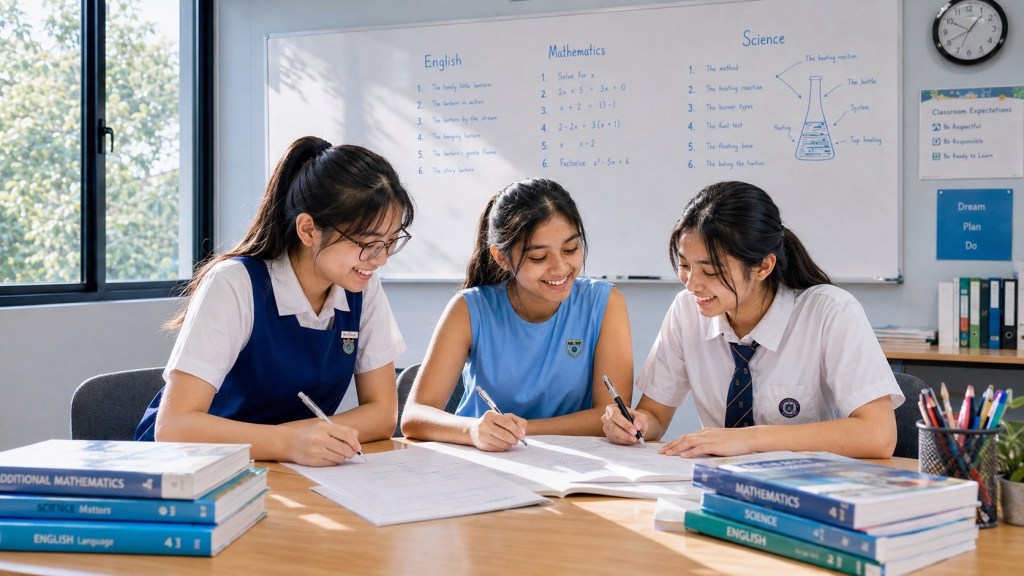
Did you know? Solving an equation is easier to explain when a student sees each step as preserving equality. Help a Secondary 2 learner name the operation applied to both whole sides, write the resulting equation and check the final value in the original statement. Avoid treating symbols as objects that move mysteriously across a line.
Try this original example: (2x + 4) ÷ 3 = 6. Multiply both sides by 3 to get 2x + 4 = 18, subtract 4 from both sides to get 2x = 14, then divide both sides by 2 to get x = 7. Substitution gives (14 + 4) ÷ 3 = 6.
Use equations appropriate to the student’s actual Mathematics G level and current school topic. PG1–3 are admission Posting Groups, not a complete subject-level description. This is a worked equality-checking workshop, not an identical syllabus checklist for G1, G2 and G3 or a promise of progression.
eduKateSengkang · Secondary 2 learning
Find your next learning step
Choose the question closest to today’s difficulty. Each section offers a small action and a way to check understanding.
1. Identify the complete left and right sides
2. Choose an operation that undoes a layer
3. Apply the operation to the whole side
4. Distinguish a structural error from arithmetic
Contents: six practical learning steps
In our equation, the left side is the entire quantity (2x + 4) divided by 3; the right side is 6. The brackets show that the numerator’s whole sum is divided. Reading this structure first prevents operations being applied to only a convenient part.
Ask the student to say what the equals sign states. It asserts that both expressions have the same value for a solution. The aim is to find a value making the original equality true, not merely to produce a final line containing x.
Multiplying both sides by 3 removes the division by 3 on the left. The right becomes 18, not 2. Write the operation on both sides if needed: 3 × ((2x + 4) ÷ 3) = 3 × 6.
Compare an incorrect attempt, 2x + 4 = 2. It has multiplied the left by 3 while dividing the right by 3. Those are different operations, so the line does not preserve the original relationship. Locate that first mismatch rather than correcting only the final answer.
From 2x + 4 = 18, subtract 4 from each side. This gives 2x = 14. Then divide each entire side by the nonzero number 2, giving x = 7. Each step has a stated mathematical reason.
When equations become more complex, brackets help show what an operation acts on. Do not divide only one term of a sum while claiming to divide the whole expression. Follow teacher methods and keep the structure visible until the learner can explain it independently.
Substitute x = 7 into the original equation, not only the last rearranged line. The left becomes (2 × 7 + 4) ÷ 3 = 18 ÷ 3 = 6, matching the right. This confirms the proposed value satisfies the starting statement.
The incorrect equation above would give x = −1. In the original equation, that produces (−2 + 4) ÷ 3 = 2 ÷ 3, not 6. Substitution exposes the mismatch even if the later arithmetic followed the incorrect line consistently.
If the operation differs across the two sides, repair equality reasoning. If the operation is valid but 18 − 4 is calculated incorrectly, repair arithmetic. Both can give wrong answers, but they call for different practice and feedback.
A useful parent prompt is, “What did you do to the whole left side, and did you do the same to the whole right side?” Give thinking time. Avoid insisting on a different notation when the school’s taught method is valid and the student understands it.
Try the original practice (3y + 6) ÷ 2 = 12. Multiplying by 2 gives 3y + 6 = 24; subtracting 6 gives 3y = 18; dividing by 3 gives y = 6. Check: (18 + 6) ÷ 2 = 12.
Ask the learner to explain one step without seeing the worked example. Move forward using teacher feedback and the actual topic sequence. Later SEC revision needs the correct Mathematics syllabus and examination year, not an assumed common paper for all G levels.
Contents · Previous step · Continue your subject-by-subject learning plan
Useful learning routes
Plan learning after PSLE · Find your subject-specific SEC route
Official sources and scope
MOE G2 and G3 Mathematics syllabuses
MOE secondary curriculum directory
SEAB SEC school-candidate syllabus directory
Practice situations and routines in this guide are original teaching illustrations, not official examination questions or marking schemes. Official sources provide curriculum context; follow current school instructions and the applicable subject-level syllabus.
Secondary 2: relevance, equality and accurate interpretation
How Can a Secondary 2 Student Tell Whether an English Summary Detail Is Relevant?
How Can a Secondary 2 Student Read a Science Graph Without Confusing Value and Change?
How Do Secondary 2 Students Answer Mother Tongue Oral Questions Without Drifting Off Topic?
