
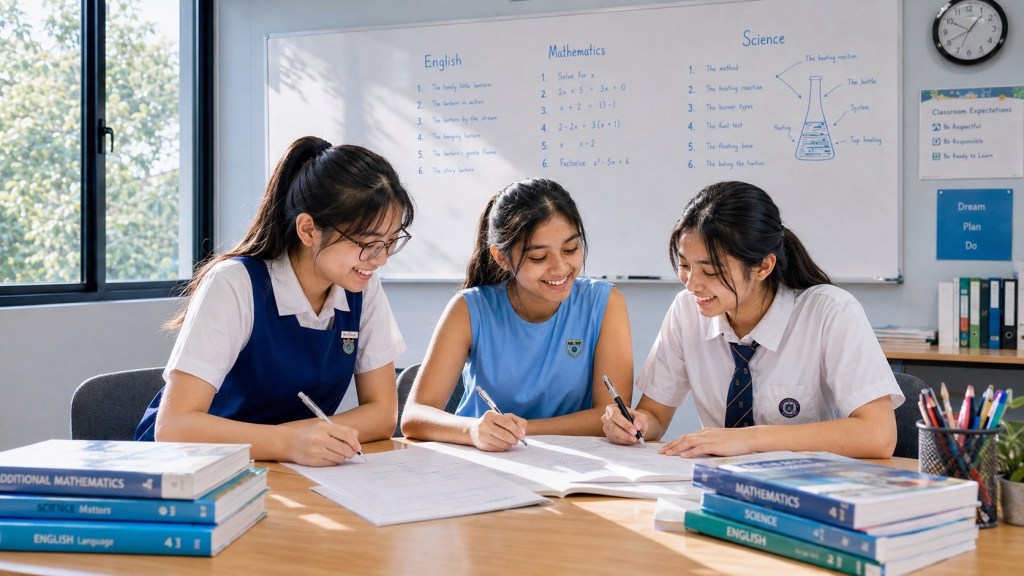
Did you know? A respectful disagreement does not require Secondary 1 students to pretend that they share the same opinion. In Character and Citizenship Education, practise stating the issue clearly, listening to another person’s reason and explaining your own view without attacking them. Look for a constructive next step rather than trying only to win.
Try this original classroom scenario: two pupils disagree about whether a group project should use a poster or slides. One values easy viewing during a display; the other wants space for more examples. Both reasons can be examined against the task before the group chooses an approach.
Follow the teacher’s discussion ground rules and current CCE activity. This is a practical communication workshop, not a SEC examination preparation guide or a substitute for help with bullying or threats. PG1–3 and G1–3 should not be used to label a student’s character or decide whose opinion deserves respect.
eduKateSengkang · Secondary 1 learning
Find your next learning step
Choose the question closest to today’s difficulty. Each section offers a small action and a way to check understanding.
1. State the issue without a personal label
2. Listen and check what the other person means
3. Give a reason connected to the task
4. Recognise when to pause and seek support
Contents: six practical learning steps
In our example, the issue is the presentation format, not whether one pupil is lazy or another is bossy. Begin with the decision the group needs to make. Personal labels can shift attention away from evidence and make it harder for someone to explain their concern.
Ask the student to separate what happened from what they assume about another person’s motives. “They suggested slides” is an observation. “They want to control everything” adds an interpretation that may not be supported. Clarifying the difference keeps the conversation more useful.
Invite one person to explain their reason without interruption. Then paraphrase it: “You think a poster would be easier for people to view during the display. Have I understood?” Give them a chance to correct the account before responding.
Understanding a reason does not mean agreeing with it. The student can say, “I understand that concern, and I have a different suggestion.” Practise genuine checking rather than a rehearsed phrase used while ignoring the answer.
The pupil favouring slides might explain that several examples need to be shown. Ask whether the task allows slides and what resources will be available. A preference becomes easier to discuss when it connects to a shared purpose or a relevant constraint.
Distinguish a fact, an assumption and a preference. The teacher’s instructions are something to check; “we will probably have a screen” is an assumption until confirmed. “I enjoy making slides” is a preference, not proof that slides fit this task best.
Compare both proposals against the actual brief. The group might choose a poster with carefully selected examples, or slides if a screen and format are authorised. Combining suggestions is an option, not an obligation to create an impractical compromise.
Sometimes disagreement remains. Follow the agreed class decision process or ask the teacher to clarify a requirement. A respectful discussion can end with a fair decision and continuing difference of opinion; unanimous enthusiasm is not the only successful outcome.
If voices rise, suggest a pause and return when participants can listen. Keep criticism focused on the proposal rather than insulting the person. The student does not need to remain in a conversation that feels unsafe merely to demonstrate good discussion skills.
Bullying, threats, discriminatory attacks or repeated harmful behaviour need trusted-adult support, not just a nicer debate script. Speak to a teacher, parent or other appropriate school adult. This simple project scenario must not be used to minimise a serious situation.
After the discussion, ask whether the student represented the other view fairly, gave a relevant reason and helped identify a next step. Choose one improvement, such as checking an assumption before arguing from it. Reflection concerns actions, not declaring someone a good or bad person.
Try a different low-stakes classroom scenario with less prompting. Seng Kang Secondary’s public CCE information describes discussion of contemporary issues and student voice; individual lesson content and processes follow each school. Learning includes listening, reasoning and responsible action, not memorising a supposedly perfect opinion.
Contents · Previous step · Continue your after-PSLE learning plan
Useful learning routes
Plan learning after PSLE · Explore later subject-specific SEC routes
Official sources and scope
Seng Kang Secondary School CCE and student voice
MOE secondary Character and Citizenship Education syllabus
Practice situations and routines in this guide are original teaching illustrations, not official examination questions or marking schemes. Official sources provide curriculum context; follow current school instructions. This workshop does not imply a tuition service offering for the subject.
Secondary 1: creative, practical and character learning
These classroom-learning workshops cover Art, Music, Food and Consumer Education and CCE. They are not interchangeable SEC examination specifications.
How Can a Secondary 1 Student Explain Art Choices Without Saying Only It Looks Nice?
How Do Secondary 1 Students Compare Music Without Calling Everything Fast or Slow?
How Can a Secondary 1 Student Read Recipe Quantities Accurately for Food and Consumer Education?
