
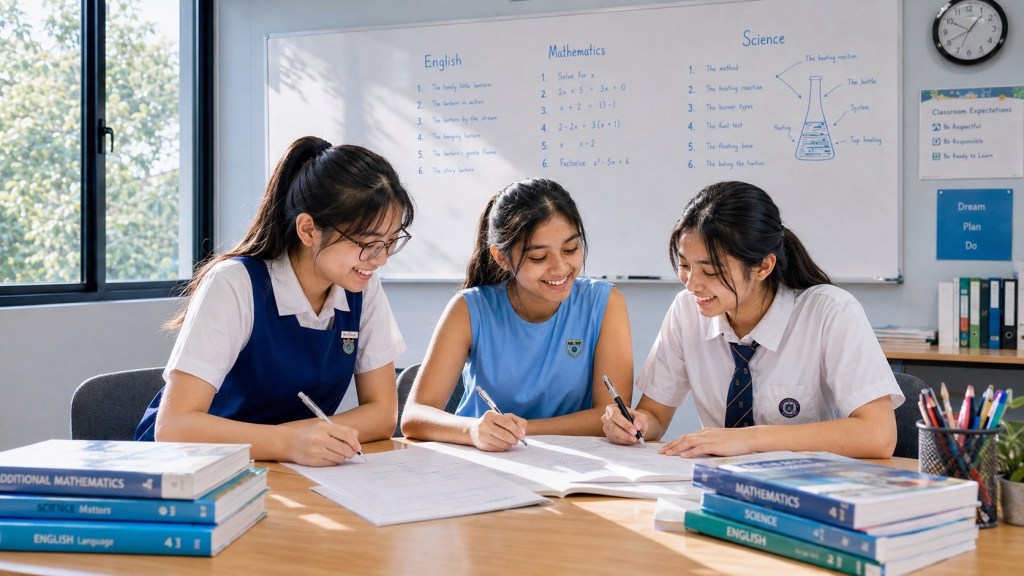
Did you know? A balanced Social Studies and Literature in English plan needs source reasoning as well as close reading. Give each component a regular independent task, keep its evidence in a separate record and add extra time where feedback identifies a current difficulty.
If Literature revision becomes plot retelling, practise a text-supported interpretation. If Social Studies revision becomes memorising notes, practise using a source to answer a particular question. If both need writing practice, begin with one focused paragraph in each and review it before expanding the response.
For 2027 SEC, the combined Humanities route is G2 K231 or G3 K337. Both components are compulsory and each contributes 50%. Confirm your literary texts and requirements with school; standalone Literature in English has its own syllabus, and this combined subject is not a PSLE examination.
Find your next learning step
eduKateSengkang · Effective learning series
Confirm the route and the texts · Make Social Studies practice question-led · Read a literary passage for a defensible claim · Balance the week through completed tasks · Measure progress through independent reasoning
Contents: eight practical study steps
- Confirm the route and the texts
- Develop the primary reading habit into interpretation
- Make Social Studies practice question-led
- Read a literary passage for a defensible claim
- Give unseen reading its own practice where required
- Keep evidence appropriate to its component
- Balance the week through completed tasks
- Measure progress through independent reasoning
Write the combined syllabus code and examination year on your plan. Record the texts confirmed by the Literature teacher and the Social Studies material currently taught. Do not select revision content from a standalone Literature course simply because the subject name is familiar.
Keep two work records beneath the combined subject heading. Note the last independent task, the feedback and the next repair in each. This lets you see whether balanced intentions have turned into practice rather than relying on a general feeling of being prepared.
Primary 1–2 stories can encourage listening, retelling and simple reasons for a character’s action. Primary 3–4 students can select details supporting an idea. Primary 5–6 reading can strengthen attention to question wording and relevant evidence within the child’s actual subjects.
Secondary Literature asks what a writer’s choices contribute to meaning. Social Studies asks how evidence supports reasoning about an issue. Earlier comprehension habits are useful foundations, but the secondary answer needs the additional interpretation specified by the course.
Start with the demand of the source question. Identify the relevant message and select supporting details. Explain the inference or judgement those details justify, rather than assuming the quotation makes the reasoning obvious to the reader.
Where evaluation or comparison is needed, apply the course guidance to the particular sources. Familiar issue knowledge can support understanding, but it cannot replace analysing the evidence provided. Keep an uncertain step visible when requesting feedback so the teacher can address it directly.
Choose a short passage from the confirmed text and a focused question. Make an interpretation, locate precise evidence and explain how it supports the claim. Attend to a language choice when its effect matters; simply naming a device does not explain its contribution.
Keep plot summaries as locating tools, then ask what the events reveal in their context. A character’s action may have several possible meanings. Test your interpretation against the surrounding text and teacher feedback instead of relying on a fixed theme paragraph.
Check your syllabus and teacher’s guidance on the reading tasks you need to prepare. When unfamiliar material is used, read for the speaker or viewpoint, the developing meaning and relevant changes. Mark precise details that support an interpretation before attempting a paragraph.
The practice aim is to reason from the material in front of you. A remembered interpretation of a different poem or story may be misleading. Discuss uncertainty with the teacher, then try another short passage independently to check whether the reading approach transfers.
For Social Studies, explain what the source supports in relation to the issue and task. For Literature, show how the text supports the interpretation. Both require relevance, but a claim about a writer’s language is a different job from evaluating a societal source.
Write one short response in each area on separate days. Check whether the evidence matches the claim and whether the explanation goes beyond repetition. Use the comparison to understand the writing decisions, rather than forcing both components into an identical answer template.
Protect a manageable task for each component, then allocate an extra slot to the current gap or deadline. A literary rereading and a source evaluation may take different lengths. Equal component weighting does not require equal minutes in every session.
Specify the passage or question in advance and include feedback follow-up. If the week becomes crowded, shorten the task while retaining its purpose. One checked paragraph can give a clearer next step than a long unfinished response that never receives attention.
Compare similar early and later work separately. Look for more precise evidence, a clearer interpretation or judgement and less prompting. Quotation recall and topic familiarity are useful, but the independent answer shows whether they can be selected and explained appropriately.
Parents can ask what each component’s next task will accomplish. When progress stalls, bring the text or sources, the attempted response and the feedback to the relevant teacher. Keep the plan responsive to that evidence so both parts remain visible and achievable.
Continue with the learning series
How students study SEC G1, G2 and G3 subjects
Social Studies learning from primary school to SEC
Official syllabus and source checks
Checked on 10 October 2026. Confirm your subject route, examination year and course requirements with school.
G2 Humanities (Social Studies, Literature in English): K231
G3 Humanities (Social Studies, Literature in English): K337
SEAB 2027 G2 school-candidate syllabuses
