
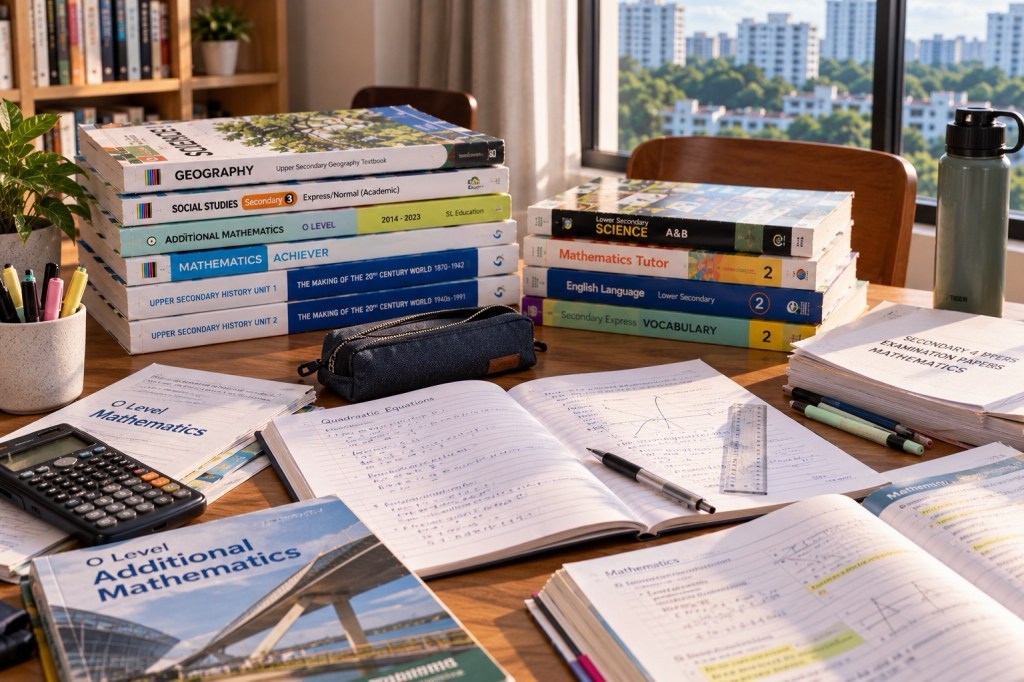
Learning G3 Mathematics with a Yew Tee tutor should make an unfamiliar problem less mysterious. A pupil can know all the operations and still choose the wrong one: doubling a fixed charge, rounding a packet count down or treating a graph drawn on a stretched axis as a different relationship. Real improvement begins when a student can name the unknown and select the model before calculating.
For Yew Tee parents comparing G3 Mathematics tuition, the priority is independent method choice across algebra, functions, coordinate geometry, trigonometry, measurement, statistics, probability and applied questions. A learner should know what each term in an equation means, what conditions apply and how to challenge a result. This guide adds original worked examples to show the first modelling decision and an alternative way to check it.
SEAB’s 2027 G3 school-candidate listing identifies Mathematics K310, separately from Additional Mathematics K341. G3 refers to the level of the subject, not a school year. Use the child’s enrolment, current school topics and marked work to choose practice rather than treating every pupil as being at the same point in preparation.
Practical location note: Yew Tee is within Choa Chu Kang, whereas eduKate Sengkang lists its teaching address as 83 Punggol Central, Singapore 828761. This learning guide does not establish a Yew Tee tuition outlet or available class. Families should confirm subject provision, fees, group size and the actual journey with eduKate Sengkang.
G3 Mathematics Is a Recognition Problem
A student may know a method perfectly once the chapter is named. Mixed papers are harder because the label disappears.
The learner must infer the mathematical structure from the information.
The student who can recognise the structure has access to the method. The student who cannot is forced to guess.
Algebra
Algebra is the operating language of G3 Mathematics.
We train expansion, factorisation, equations, inequalities, substitution and rearrangement while keeping equality visible.
Small symbolic errors are treated seriously because they spread into graphs, geometry and later Additional Mathematics.
Functions and Graphs
Students learn that a graph is not an illustration but a representation of a relationship.
We connect equations, tables, coordinates and graphical behaviour.
The learner should be able to interpret changes in the graph and translate them back into mathematical meaning.
Geometry and Trigonometry
Geometry is trained through properties, deduction and clear diagram annotation.
Trigonometric reasoning is connected to the geometry rather than reduced to button pressing.
Students learn to check whether their answers are consistent with shape, magnitude and units.
Statistics and Probability
Statistics requires interpretation before calculation.
Students learn to compare data, read distributions and understand what a representation can and cannot justify.
Probability is trained through structured sample spaces and relationships.
Real-World Application
Real-world questions often combine familiar topics in unfamiliar ways.
We teach a stable sequence:
- identify the quantities;
- decide what information matters;
- choose a representation;
- form the relationship;
- solve carefully;
- check units and scale;
- interpret the result in context.
The eduKate G3 Mathematics Runtime
1. Diagnose
We identify the earliest repeatable error.
2. Rebuild
If a current topic depends on an older weak skill, the older skill is repaired first.
3. Model
The tutor makes the reasoning sequence visible.
4. Vary
The problem changes enough to prevent copying.
5. Remove support
The learner reconstructs the method independently.
6. Interleave
Earlier topics return inside mixed practice.
7. Transfer
The student meets unfamiliar questions without a topic label.
Three G3 Mathematics Pathways
Repair
For a learner with gaps, we rebuild the earliest unstable dependency.
Stabilise
For a learner whose marks fluctuate, we train retrieval, checking, timing and mixed-topic recognition.
Extend
For a strong learner, we use less familiar problems, multiple methods and deeper explanation.
Why Working Matters
Working is part of mathematical communication and part of error control.
- state the relevant relationship;
- substitute clearly;
- show significant transformations;
- keep units visible;
- avoid premature rounding;
- label important quantities;
- check the final result.
When Should a Yew Tee Student Begin G3 Mathematics Tuition?
- when algebra is slow or fragile;
- when the student can follow examples but cannot start alone;
- when graphs and diagrams are frequently misread;
- when topical work is strong but mixed papers are weak;
- when calculator use replaces estimation;
- when working is too compressed to diagnose;
- when earlier topics are forgotten quickly;
- when K310 preparation needs more structure.
Yew Tee Convenience and the Actual Classroom Location
A tutor based in Yew Tee may make weekly travel easier for families who live or study in the western part of Singapore.
Parents should also compare whether the tutor diagnoses the mechanism behind mistakes, inspects working carefully and revisits corrected skills later.
eduKate Sengkang is not located in Yew Tee. Our Sengkang/Punggol classroom is at 83 Punggol Central, Singapore 828761, by appointment.
Class Details
- Class size: up to 3 students
- Subject: G3 Mathematics
- SEC route: K310 for 2027 school candidates
- Duration: 1.5 hours
- Focus: algebra, graphs, geometry, trigonometry, statistics, probability and problem solving
- Method: diagnose → rebuild → model → independent practice → retrieval → transfer
- Location: 83 Punggol Central, Singapore 828761
Learning G3 Mathematics with a Yew Tee Tutor
Good G3 Mathematics tuition should make the learner more capable of recognising structure, selecting a method, showing the working and checking the result.
For students who are behind, we rebuild. For students who are inconsistent, we stabilise. For students who are ready, we extend.
Task recognition
In G3 Mathematics, this part of the learning system is trained through number sense. The student is asked to do more than recognise a correct answer after it is shown. The learner must identify what the task requires, decide which knowledge or representation is useful, make an independent attempt and then inspect the result for signs that something has gone wrong. The tutor watches the decision process as carefully as the final answer because the same score can be produced by very different causes.
This matters for a student travelling from Yew Tee because tuition time has to produce something that survives the journey back into school. A correction that only works inside the lesson is not enough. The idea should return later, appear in a changed form and eventually sit beside other topics so the learner has to choose it without being told. That sequence—understand, attempt, correct, retrieve, mix and transfer—is what turns a short-term success into a usable capability.
As the capability becomes more stable, support is reduced. The tutor stops supplying the first move, waits longer before intervening and asks the student to explain why the chosen route belongs. This can feel slower than simply showing the answer, but it builds a learner who can continue when the task is unfamiliar. The standard is therefore not perfect performance during tuition; it is increasingly organised performance when the tutor is silent.
Building a reliable first move
In G3 Mathematics, this part of the learning system is trained through algebra. The student is asked to do more than recognise a correct answer after it is shown. The learner must identify what the task requires, decide which knowledge or representation is useful, make an independent attempt and then inspect the result for signs that something has gone wrong. The tutor watches the decision process as carefully as the final answer because the same score can be produced by very different causes.
Correction that changes future work
In G3 Mathematics, this part of the learning system is trained through graphs. The student is asked to do more than recognise a correct answer after it is shown. The learner must identify what the task requires, decide which knowledge or representation is useful, make an independent attempt and then inspect the result for signs that something has gone wrong. The tutor watches the decision process as carefully as the final answer because the same score can be produced by very different causes.
Retrieval after delay
In G3 Mathematics, this part of the learning system is trained through ratio and rate. The student is asked to do more than recognise a correct answer after it is shown. The learner must identify what the task requires, decide which knowledge or representation is useful, make an independent attempt and then inspect the result for signs that something has gone wrong. The tutor watches the decision process as carefully as the final answer because the same score can be produced by very different causes.
Choosing between methods
In G3 Mathematics, this part of the learning system is trained through geometry. The student is asked to do more than recognise a correct answer after it is shown. The learner must identify what the task requires, decide which knowledge or representation is useful, make an independent attempt and then inspect the result for signs that something has gone wrong. The tutor watches the decision process as carefully as the final answer because the same score can be produced by very different causes.
Working under mixed conditions
In G3 Mathematics, this part of the learning system is trained through trigonometry. The student is asked to do more than recognise a correct answer after it is shown. The learner must identify what the task requires, decide which knowledge or representation is useful, make an independent attempt and then inspect the result for signs that something has gone wrong. The tutor watches the decision process as carefully as the final answer because the same score can be produced by very different causes.
Checking before submission
In G3 Mathematics, this part of the learning system is trained through statistics. The student is asked to do more than recognise a correct answer after it is shown. The learner must identify what the task requires, decide which knowledge or representation is useful, make an independent attempt and then inspect the result for signs that something has gone wrong. The tutor watches the decision process as carefully as the final answer because the same score can be produced by very different causes.
Explaining the reasoning
In G3 Mathematics, this part of the learning system is trained through probability. The student is asked to do more than recognise a correct answer after it is shown. The learner must identify what the task requires, decide which knowledge or representation is useful, make an independent attempt and then inspect the result for signs that something has gone wrong. The tutor watches the decision process as carefully as the final answer because the same score can be produced by very different causes.
G3 Mathematics in Yew Tee: learn to see structure when the chapter heading disappears
G3 Mathematics K310 is the relevant Mathematics syllabus listed by SEAB for 2027 SEC school candidates. Under Full Subject-Based Banding, that is the subject level, not a permanent single label for the student. The learner’s immediate priorities still depend on the school’s current Mathematics teaching and upcoming assessments. Good tuition supports that real programme while preparing for the broader demands of unfamiliar problem solving.
Mathematics marks are often lost before the visible calculation begins. A learner may mistake a discount’s reference quantity, misread a line graph, choose area when the task asks for perimeter or confuse the side opposite an angle with the hypotenuse. Practising more calculations without finding those decisions can reproduce the same error at greater speed. A good tutor asks what relationship the question represents, which method fits and how the result can be checked.
For families around Yew Tee Central, Yew Tee, Yew Tee West and Yew Tee Central, a sustainable tutorial is as important as a sophisticated worksheet. A child who spends the rest of the evening exhausted after travel may have little time to retrieve the method afterwards. The realistic goal is a teaching-and-practice rhythm that makes mathematical independence possible while preserving schoolwork and rest.
Worked clinic 1: signed-number reasoning under algebraic pressure
Evaluate -7 – (-4) + 6. Since subtracting negative four is adding four, the expression becomes -7 + 4 + 6 = 3. The final value is straightforward, but students sometimes treat the two negative signs as unrelated symbols and mistakenly obtain -5. A tutor should ask whether the value is moving left or right on the number line rather than simply supply a mnemonic.
Next, embed the sign issue in an equation: x – (-4) = 9. The equation means x + 4 = 9, so x = 5. Substitution confirms 5 – (-4) = 9. The student should be able to explain the equivalence instead of asserting that a minus sign “moves across”. The same reasoning will reappear in coordinates, algebraic expressions and financial contexts.
To check retention, give a new signed-number question after several days without naming the skill. If the learner recognises the relationship, explains the operation and checks the result, the repair is becoming dependable. Immediate success beside a demonstration is not enough.
Worked clinic 2: reverse percentage problems need a clear base
An item has been reduced by 15% and now costs $68. The sale price represents 85% of the original. If P is the original amount, 0.85P = 68, so P = 68/0.85 = $80. Check: 15% of $80 is $12, and $80 – $12 equals $68. A student who merely adds 15% of 68 calculates a percentage of the wrong quantity.
The tutor can draw a percentage bar with the original 100% and remaining 85% labelled before using an equation. That picture helps the learner see why the unknown is the full amount, not the discounted one. The next exercise changes a reduction into an increase: if a price increases 10% to $55, the original was $50, because the final amount is 110% of the original.
Now ask which operation is justified before calculating. Does the problem give an original amount and seek the final, or give the final and seek the original? The student learns a decision rule that works across tax, discounts, changes in population and other everyday percentage questions.
The first operation depends on the unknown quantity
A fictional class needs eighty-five labels sold only in packs of twelve. Dividing gives approximately 7.08 packs, but seven packs provide eighty-four labels and are insufficient. The practical answer is eight sealed packs. Rounding to the nearest whole number would fail the actual requirement.
Ask the student which quantity the decimal represents and whether fractional packs can be purchased. Compare a different question asking how many complete groups of twelve can be made from eighty-five loose labels: now seven complete groups are possible with one left over.
At review, use a seating-capacity problem. The same division may require rounding up, down or reporting a remainder depending on the question. Interpretation cannot be replaced by a single memorised rounding rule.
Estimation protects against place-value mistakes
Nine fictional notebooks cost $3.80 each, so the total is $34.20. Before exact calculation, nine items costing just under four dollars should total just under thirty-six dollars. An answer of $342 or $3.42 is therefore implausible even if it came from a calculator.
Ask how the estimate was formed and whether it is independent of the exact calculation. Estimation does not replace working; it creates a separate check on magnitude and decimal placement.
Change the task to recovering one price from the total and number of items. The learner should identify the unit rate before choosing division, showing that the quantity rather than the last practised operation controls the method.
Standard form and units communicate magnitude
The quantity 0.000056 can be written as 5.6 × 10⁻⁵. The exponent is negative because the original positive number lies between zero and one. A student who writes 5.6 × 10⁵ has changed the magnitude by ten powers rather than simply reformatted it.
Ask the learner to expand the notation and estimate whether the answer is a very small or very large number. Then compare two values expressed with different powers of ten without converting everything into a long string of zeros.
A fresh science-style quantity can use units alongside standard form. The student should preserve both magnitude and unit rather than assume the exponent tells the entire physical meaning.
Rate models change when a fixed contribution is added
A fictional service costs $4 to begin and $3 for each unit used. Its total for five units is $19. The function y = 3x + 4 expresses a fixed amount and a repeated contribution. Doubling use to ten units produces $34, not $38.
Ask the learner what y means when x is zero and what changes for each extra unit. A direct-proportion model y = 3x would describe a different service with no initial fee.
At review, offer a table instead of the equation. The student should recover the variable rate and starting value before deciding whether a linear model suits the data.
Reverse percentage questions need the correct reference
A fictional item costs $76.50 after a 15% reduction. Since the sale price represents 85% of the original, the original price is $90. A forward check subtracts $13.50 from $90 and recovers $76.50.
The common wrong move adds 15% of the sale price to the sale price, using the wrong base. Ask which quantity is 100%, then mark it on a bar or represent it with an algebraic unknown.
For a changed problem, reverse a 20% increase. The final quantity is 120% of its original. The learner should use the relationship rather than choose addition or subtraction by instinct.
Graph scale is part of the mathematical model
One coordinate graph marks ten units per vertical grid division and two per horizontal division. Counting squares without reading the labels may give a visually neat but mathematically wrong gradient. Select two points and calculate vertical change divided by horizontal change using the actual scales.
Ask what quantity and unit each axis represents. On a distance-time graph, gradient expresses a rate; on a price-quantity graph, the gradient may describe a unit price. The same geometric operation can have different interpretations.
At review, show identical numerical data on axes with different visual scales. The calculated gradient should stay the same, even when the line looks steeper or flatter on the page.
Algebraic structure decides whether cancellation is valid
The expression (x² − 16)/(x − 4) simplifies to x + 4 when x is not four, because the numerator factors as (x − 4)(x + 4). The original denominator excludes x = 4 even though the simplified expression no longer shows it.
A pupil who crosses out matching x characters from (x + 4)/(x + 5) has cancelled terms rather than common factors. Test x = 1 to see that the proposed shortcut does not preserve the original value.
For a fresh rational expression, require the learner to factor fully and state any excluded values before simplifying. A neat expression is not correct if it silently changes the domain.
Simultaneous equations require one shared pair
Solve x + y = 15 and 2x − y = 9. Adding the equations gives 3x = 24, so x = 8 and y = 7. The pair satisfies both conditions: eight plus seven is fifteen, and sixteen minus seven is nine.
A learner may find a pair that satisfies only the first equation and assume the job is finished. Another may choose elimination without adjusting coefficients when the unknowns will not cancel. Ask which method is justified by the visible structure.
At review, ask the learner to form both equations from a fictional ticket-sales story. Modelling the story and solving supplied algebra are related but separate skills.
Quadratics connect roots, factors and graphs
For y = x² − 6x + 8, factorisation gives (x − 2)(x − 4), so horizontal intercepts occur at two and four. Completing the square gives y = (x − 3)² − 1, showing a minimum at (3, −1). These forms describe the same parabola.
Ask which representation is best for a question about roots and which reveals the turning point. A plotted graph should agree with the algebra and cannot place the minimum above the horizontal axis in this example.
A new quadratic changes one coefficient. The learner should identify how the roots and turning point change without relying on a memorised picture.
An applied model can have a fixed fee and a variable charge
A fictional printing arrangement starts with a $9 setup cost and adds $2.50 per label bundle. Its rule is C = 9 + 2.5n. Four bundles cost $19; eight cost $29, not $38. A student doubling the entire cost assumes everything is proportional even though the one-time setup has not changed.
Ask which charge occurs once and which repeats. A table for zero, one, four and eight bundles can verify the rule. Then give a supplier with no setup fee and ask whether direct proportion would apply.
On a later mixed task, hide the formula and provide only a brief description. The pupil should construct the model before performing arithmetic.
The condition of a percentage problem identifies its base
An invented service price is $138 after a fifteen-percent increase. The final value is 115% of its original, so the starting price is $138 ÷ 1.15 = $120. Subtracting fifteen percent of the final amount would use the wrong reference and not correctly reverse the increase.
Draw a 100% bar and name the original whole. Then check forward: 15% of $120 is $18 and adding it gives $138. The relationship matters more than a memorised instruction to divide.
Change the situation to a reduction, ending at $102 after fifteen percent off. The original is $120 because the final represents 85%. The learner should rebuild the base before calculating.
Simultaneous conditions can describe a purchasing problem
An invented order includes notebooks costing $4 each and folders costing $3 each. A club buys ten items for $36. If x counts notebooks and y folders, x + y = 10 and 4x + 3y = 36. Subtracting 3(x + y) from the cost equation gives x = 6 and y = 4.
Check both conditions: six notebooks plus four folders is ten items; their cost is $24 + $12 = $36. A pupil who supplies two counts totaling ten but not matching the cost has solved only one part of the model.
For transfer, change the prices and total while keeping the number of items. The student should define variables and form the equations independently.
A quadratic may have a minimum outside an allowed interval
The quadratic y = (x − 3)² − 5 has an unrestricted minimum of −5 at x = 3. If a contextual task permits only 4 ≤ x ≤ 8, the lowest value on that restricted interval occurs at x = 4, giving y = −4. The algebraic vertex remains valid as a feature of the curve but is outside the feasible set.
Ask students to identify the domain before reporting a contextual optimum. The graph or a table at endpoints and turning points can confirm the correct restricted answer.
For a new task, change the allowed interval so the vertex lies inside. The learner should decide whether the unrestricted or boundary value is relevant.
A right-triangle answer must meet the stated geometry
A right triangle has perpendicular sides nine and twelve centimetres. Its hypotenuse is √(9² + 12²) = fifteen centimetres. If fifteen is the given hypotenuse and nine is one leg, the missing leg is √(15² − 9²) = twelve. Addition or subtraction follows which side is unknown.
A learner who computes a leg longer than the hypotenuse has a reason to reject the answer. Mark the right angle and hypotenuse before using a theorem, regardless of the triangle’s orientation.
Use a rotated figure and different side labels for a delayed exercise. The child should reconstruct the relationship, not recall the previous picture.
The sine rule only pairs an angle with its opposite side
An imaginary non-right triangle has a side of eight centimetres opposite 30° and an unknown side b opposite 45°. The sine rule gives b = 8 sin45°/sin30°, approximately 11.31 centimetres. The side opposite the larger angle is longer in this example, a useful check.
Mark the matched sides and angles before substituting. Selecting a length adjacent to the angle by visual proximity would invalidate the relation.
Give a changed triangle with insufficient opposite pairs, requiring consideration of another valid technique such as the cosine rule. The student should select the method from the givens.
Geometry solutions need named properties, not guesses from drawings
In an invented triangle, the two known interior angles measure 42° and 76°. The third is 62°. Its adjacent exterior angle is 118° because two angles on a straight line sum to 180°. A response of 62° may correctly find an intermediate angle but fail the actual exterior-angle request.
Ask the child to circle the target and annotate the property used at each step. A rough sketch should not override the numeric or geometric information supplied.
For transfer, rotate the triangle and change the values. The learner should produce a reasoned deduction without relying on where an angle appears visually.
A circle theorem requires identifying the actual intercepted arc
If a central angle is 130° and an angle at the circumference stands on the same arc, the circumference angle is 65° under the corresponding theorem. A similar-looking angle standing on a different arc does not automatically share the relationship.
Ask the student to mark both arc endpoints and the relevant angle before dividing the central angle by two. This makes the geometric condition visible.
In an unfamiliar diagram, change the point positions while preserving or breaking the same-arc condition. The pupil should explain when the theorem is applicable.
A box plot describes a distribution, not individual identities
An invented box plot has minimum two, lower quartile six, median nine, upper quartile thirteen and maximum seventeen. Its interquartile range is seven, while the full range is fifteen. A plot with the same median but smaller interquartile range may indicate a different central spread.
Teach the learner to identify the box boundaries and whiskers, not assume that the maximum is the upper quartile. A box plot does not reconstruct all individual observations or establish that every member of one group exceeds every member of another.
A later two-group comparison should discuss centre and spread, naming what the visual evidence cannot show.
The mean can be unrepresentative in a small skewed dataset
Consider fictional readings 4, 5, 6, 6 and 29. The mean is ten while the median is six. One large value raises the mean far above most observations. This difference may matter when describing a typical reading.
Change twenty-nine to nine: the mean becomes six and the median remains six. Ask which statistic changed most and how the distribution differs.
In a later problem, use a second small sample and require a cautious comparison. A few imaginary observations should never be presented as evidence about every local student.
Probability with replacement and without replacement are distinct
A bag contains four black counters and three white ones. Two black counters drawn without replacement have probability (4/7)(3/6) = 2/7. With replacement, the probability is (4/7)² = 16/49. The second fraction changes because the first counter is or is not returned.
Ask what remains in the bag after each stage before constructing a probability tree. This is a statement about the experiment, not a mechanical instruction to multiply the two most visible fractions.
For a new bag, change the colours and ask for unlike successive results. The student should rebuild the branches.
A graph’s axis labels determine the significance of a gradient
A graph of distance against time can display a gradient measured in metres per second; a cost-against-quantity graph gives currency per unit. Two visually identical straight lines can therefore express entirely different physical or practical relationships.
Ask the learner to state both axis quantities, units and scales. A graph that starts its vertical scale above zero can exaggerate apparent variation while leaving actual numerical changes unchanged.
At review, supply two different axes with similar shapes. The student must calculate and explain what the rate means in each context.
A practical budget requires quantity and cost checks
A fictional event needs ninety-five labels sold in packs of twelve for $4.60 per pack, with a single $2.20 delivery fee and a $40 budget. Eight packs provide ninety-six labels and cost 8 × $4.60 + $2.20 = $39, leaving one spare and one dollar in the budget.
Seven packs would supply only eighty-four. Treating the single delivery fee as paid eight times would overstate the cost. A solution is complete only if both capacity and budget conditions are checked.
For a changed order, raise the requested number to ninety-seven without changing the budget. Nine packs cost $43.60 and exceed the limit, even though enough labels would be supplied.
A result’s unit can expose a wrong formula
A cuboid measuring six by five by two centimetres has volume sixty cubic centimetres. Total surface area is 2(30 + 12 + 10) = 104 square centimetres. Reporting sixty square centimetres as volume would disguise a wrong physical quantity behind a correct-looking number.
Ask whether the question concerns covering, containing or measuring an edge. The dimensions of the result should follow the operation and the interpretation.
In a changed task, request the volume in cubic metres after dimensions are given in centimetres. The student should apply the volume conversion rather than one length conversion only.
Selecting a complementary check improves independent work
After solving a system of equations, substitute values in both originals. After finding a minimum, confirm whether it lies in the permitted domain. After ordering packs, compare the capacity of one fewer pack. These checks address different likely errors.
Repeating exactly the same calculator entry may reproduce an incorrect model or sign. Encourage a separate method or condition check that could reveal a mistake.
At review, give a mixed unfamiliar problem and require the pupil to explain which check they chose and what it establishes.
Six weeks of G3 Mathematics practice with independent checkpoints
Week one records an unassisted mixed baseline across algebra, graphs, geometry and data. Week two repairs the first consequential modelling error. Week three changes the representation without naming the chapter. Week four revisits earlier mistakes after a delay, week five introduces manageable timing and checking, and week six compares fresh independent work with the baseline.
This is an illustrative learning cycle, not a promised grade in six weeks. One student may need stronger fraction foundations, another may lose signs while manipulating equations, and another may need to read practical constraints before choosing a formula. A small group should diagnose those differences rather than assign a single answer key as the whole lesson.
Yew Tee study resources, the real centre and family workload
Yew Tee is a residential part of the Choa Chu Kang planning area. For optional independent Mathematics reading or practice, the NLB directory lists Choa Chu Kang Public Library at Lot One Shoppers’ Mall in the wider area. It is not in Yew Tee itself, not an eduKate teaching venue and not a guaranteed study desk.
For tuition at Punggol Central, account for school dismissal, CCAs, meals, the journey in both directions, other homework and rest. A useful weekly commitment should leave time for short delayed practice when the child must recall a method without immediate help.
Questions Yew Tee parents ask about G3 Mathematics
Is G3 Mathematics the same subject as G3 A-Math?
No. K310 Mathematics and K341 Additional Mathematics are separately assessed. Confirm the student’s enrolment and syllabus.
Why can a child solve chapter work but not mixed papers?
Chapter headings supply a method hint. Mixed questions require recognising the model, conditions and checking method independently.
Can more challenging questions always replace foundation repair?
No. A fragile fraction, sign or algebraic prerequisite should be addressed before rushing into harder-looking calculations.
How should progress be checked?
Compare unfamiliar work before and after targeted teaching, recording which method decisions and checks are now independent.
Is a Yew Tee eduKate Mathematics centre confirmed?
No. The teaching address is 83 Punggol Central. Verify current classes, fees and travel directly.
Can tuition guarantee a G3 result?
No. Lessons can improve understanding, but examination outcomes and school subject decisions depend on multiple factors.
Continue the G3 Yew Tee subject group
Read G3 English with Yew Tee Tutor, G3 Additional Mathematics with Yew Tee Tutor and G3 Science with Yew Tee Tutor. The G2 Mathematics Yew Tee guide covers the separate K210 level.
Use the Mathematics Tuition hub and the official G3 2027 syllabus list for wider context. Compare the Choa Chu Kang G3 Mathematics guide for the neighbouring planning area.
Discuss a diagnostic that leads to a better method
Contact eduKate Sengkang with unassisted G3 Mathematics schoolwork. Ask which first model-choice error is most important, how a later changed problem will confirm the correction, and what present fee and travel arrangements fit the family.
