
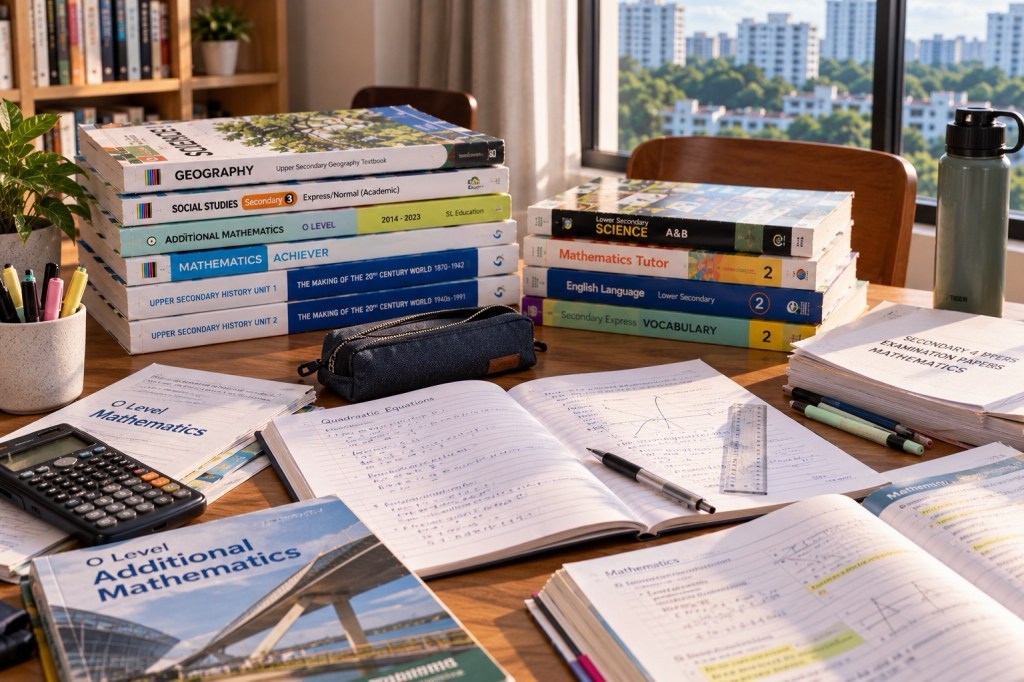
Thinking about G2 Mathematics tuition in Choa Chu Kang because your child solves routine sums but becomes stuck on word problems? The first difficulty is often choosing the right model, not calculating. A student may mistake a fixed charge for one paid on every item, round a purchase down when whole packets are required or copy a graph coordinate without reading the scale. The solution is to teach the decision before the formula.
For families near Yew Tee, Keat Hong, Teck Whye and Choa Chu Kang Central, this guide shows how a G2 Mathematics tutor can make number, ratio, algebra, graphs, geometry, statistics and probability more independent. The central habit is to define the unknown, identify the relationship, check its conditions and interpret the answer. Each worked example should end with a changed task that demonstrates understanding without prompting.
The 2027 SEAB G2 syllabus listing confirms Mathematics K210, distinct from Additional Mathematics K232. G2 identifies subject level rather than Secondary 2 alone, so lesson planning should reflect the student’s real school year, enrolment and marked work. The aim is confident mathematical reasoning, not a guarantee of marks or school placement.
Location transparency: eduKate Sengkang is at 83 Punggol Central, Singapore 828761, not Choa Chu Kang. This page is a study guide and does not establish a local western classroom or a particular G2 class vacancy. Families should confirm available lessons, class size, fees and the actual weekly travel through eduKate Sengkang.
Understand the K210 assessment before planning revision
The official K210 scheme comprises two papers of two hours each, with 70 marks and 50% weighting per paper. Paper 1 contains approximately 23 short-answer questions. Paper 2 includes compulsory questions in Section A, ending with a real-world application, and a choice between two questions in Section B based on specified Geometry and Measurement or Statistics and Probability content. Essential working and interpretation therefore matter as much as calculator fluency.
The syllabus includes standard techniques, problem solving in different contexts and mathematical reasoning and communication. It explicitly anticipates real-world problems involving such situations as travel schedules, bills, floor plans and financial calculations. These examples are not predictions of particular examination questions. They indicate that the ability to select relevant quantities, combine topics and interpret results is part of the intended assessment.
A student should not practise every current-school topic at examination speed. First establish accurate meaning, then a valid method, then independent retrieval. Timed mixed questions become useful when errors can be classified rather than simply marked wrong.
The boundary-and-assumption checklist
Before calculating, ask: what quantity is required, what unit does it use, and which facts are given? Next identify the relationship—additive, multiplicative, linear, geometric, probabilistic or something else. State any conditions that make the method valid: a constant rate, non-zero denominator, equally likely outcomes, a right angle or a specified measurement scale.
During calculation, preserve those conditions and show essential steps. Afterwards check whether the answer satisfies the original equation or situation. A decimal quantity of buses might need rounding up, while a negative coordinate may be perfectly valid. The context, not a generic rule, determines what can be accepted.
Clinic 1: signed numbers should preserve meaning
Evaluate −6 − (−9) + 2. Subtracting negative nine is equivalent to adding nine, giving −6 + 9 + 2 = 5. A student who obtains a negative value by simply counting minus signs has treated the notation as a visual pattern instead of reading the operations.
Use a number line or compare −6 − (−9) with −6 + (−9). The first equals three before the final addition, whereas the second equals negative fifteen. Both contain similar symbols but describe different relationships. The tutor should ask the learner to explain why subtracting a negative produces a larger number in this example.
After a delay, use a signed quantity inside a formula or graph coordinate. The learner should recognise its role without a worksheet heading announcing that the topic is negative numbers.
Clinic 2: fraction division asks about groups
Three quarters divided by one eighth equals six. The question can be interpreted as asking how many one-eighth portions fit into three quarters. Since three quarters is six eighths, six portions fit. The result is larger than the dividend because the divisor is a positive fraction smaller than one.
A pupil who believes division always makes a number smaller may reject the correct answer. Drawing a strip divided into eighths clarifies the counting units. Compare with three quarters multiplied by one eighth, which is three thirty-seconds, a different operation and a smaller quantity.
The delayed test should vary the values and context. Understanding the size of a result helps students detect unreasonable algebraic fraction work later, even when the formal procedure is performed using a calculator.
Clinic 3: a ratio is not an additive comparison
Divide fifty-six points in the ratio 3:5. There are eight equal parts, so one part represents seven points. The shares are twenty-one and thirty-five, which add to the required total and simplify back to 3:5. Both conditions must hold.
Now suppose three points are added to each share. The new shares are twenty-four and thirty-eight; their ratio is no longer 3:5. Adding an equal amount to both quantities is not equivalent to scaling both quantities by a common multiplier. This distinction protects against inappropriate additive reasoning in proportional problems.
For a new task, give one share rather than the total. The learner should identify how many ratio parts that amount represents before computing the whole.
Clinic 4: direct proportion requires a constant ratio
Four identical items cost $18 when the unit price is constant. Ten items then cost $45 because the unit rate is $4.50. A table of quantity and price makes the ratio visible. The important assumption is that there is no fixed charge, volume discount or other rule changing the relationship.
Add a one-off $3 processing fee. Four items now cost $21, while ten cost $48. Doubling the number of items would not double the total bill in this model, because the fee is applied only once per order. The old direct-proportion method is no longer valid for the overall total.
Ask the student to describe what remains proportional—the variable item component—and what does not—the final amount including the fee. A change in assumptions should lead to a change in mathematical modelling.
Clinic 5: inverse proportion has its own condition
Suppose twelve equally capable workers would take five hours to complete a fixed amount of independent work at a constant rate, and adding workers creates no additional coordination cost. Under that simplified assumption, six workers would need ten hours for the same work. The product of worker count and time remains constant.
Real projects may not scale that neatly because people share tasks, resources or space. The learner should state the simplifying condition before multiplying and dividing. Inverse proportion is not a universal model for every activity involving time and people.
Change the task to a fixed-distance journey at constant speed. Doubling speed halves travel time under the stated conditions. The student should identify why the relation is inverse and what further factors a realistic journey might introduce.
Clinic 6: reverse percentages use the original base
A fictional product costs $76.50 after a 15% discount. This is 85% of its original price, so the original is $76.50 divided by 0.85, which equals $90. Checking forward, fifteen percent of ninety is $13.50 and the discounted result is $76.50.
The common error is adding 15% of $76.50. That uses the wrong percentage base because the discount was calculated on the original amount, not the sale price. Draw a bar representing 100% before deciding which amount is known.
Now reverse an increase: a quantity rises by 20% to become seventy-two. The original was sixty. The method follows the meaning of 120% of the original, not an unexplained rule to subtract the given percentage.
Clinic 7: compound growth is repeated multiplication
An invented savings amount of $1,000 increases by 5% per year for two years, with growth applied to the updated amount each year. After one year the amount is $1,050; after two it is $1,102.50. The increase in the second year is $52.50 because the base is no longer $1,000.
A student who adds $50 twice obtains $1,100, which corresponds to a different simple-interest model. Ask which quantity serves as the base in the second year and why repeated multiplication represents the stated relationship.
Change the yearly factor or number of periods and use the formula only after identifying the compound-growth assumption. All amounts and rates here are fictional teaching values, not financial product recommendations.
Clinic 8: average speed is not the average of two speeds
An object travels 60 kilometres in one hour and then 30 kilometres in half an hour. Its total distance is 90 kilometres and total time is 1.5 hours, so average speed is 60 kilometres per hour. Here both intervals happened to have the same speed, making the interpretation straightforward.
Now use one hour at 60 kilometres per hour followed by one hour at 30 kilometres per hour. Average speed becomes 45 kilometres per hour because equal times were spent at both speeds. If distances rather than times were equal, taking the simple average of speeds could be misleading.
Ask the student to reconstruct total distance and total time in every case. The definition is more dependable than an automatic average of the printed speeds, particularly in a multi-leg journey.
Clinic 9: convert speed units consistently
A constant speed of 72 kilometres per hour equals 20 metres per second. Multiply 72 by 1,000 to obtain metres per hour, then divide by 3,600 seconds per hour. The ratio of units determines the conversion and helps expose a reversed factor.
A pupil who writes 72 metres per second has changed the unit without changing the quantity. Another may multiply by 3.6 rather than divide. Ask whether the numerical value should become larger or smaller when one metre per second corresponds to 3.6 kilometres per hour.
Use a second speed and have the learner reverse the conversion. The two routes should agree. This is a useful checking habit for Science and applied travel questions.
Clinic 10: algebraic brackets represent one fee or many
Three identical notebooks cost x dollars each and a single order charge is $2. The total expression is 3x + 2. In contrast, 3(x + 2) adds two dollars to the cost of every notebook. The two expressions differ despite containing the same letter and numbers.
Set x = 4 to test. The first arrangement costs fourteen dollars, while the second costs eighteen. Ask the learner to invent a plausible story for each expression. Words, symbols and substituted values should describe the same relationship.
For an unfamiliar problem, define the variable clearly, then ask which quantities repeat and which are fixed once. Misplacing brackets is often a modelling problem before it becomes an algebraic one.
Clinic 11: expand and factorise in both directions
The expression 2(x + 5) expands to 2x + 10. Moving backwards, the common factor two can be extracted from 2x + 10. Both forms must have the same value for every allowed x. An error such as 2x + 5 applies multiplication to only one bracket term.
Use x = 3 as a quick check: the original is sixteen, while the incorrect version is eleven. A numerical test can reject a false equivalence, though one matching numerical test alone is not a complete proof of an identity.
Then vary signs: −3(x − 2) expands to −3x + 6. Ask the student to explain each sign instead of counting negative symbols. Small structural accuracy underlies many later equation and graph questions.
Clinic 12: a fractional expression has a domain
For x not equal to three, (x² − 9)/(x − 3) can be simplified by factoring the numerator as (x − 3)(x + 3). Cancelling the common factor gives x + 3, but the original expression remains undefined at x = 3.
The simplified appearance must not erase the restriction. In another expression such as (x + 5)/(x + 2), the x terms cannot be crossed out individually, because addition does not create a common multiplicative factor.
Ask the learner to test a permitted numerical value to reject an incorrect cancellation, then explain the factor structure. The numerical check supports the reasoning; it does not replace it.
Clinic 13: a linear equation should be checked in its original form
Solve 5x − 7 = 23. Add seven to both sides and divide by five, giving x = 6. Substitute in the original: thirty minus seven equals twenty-three. The sequence works because each transformation preserves equality.
Students sometimes memorise that a term moves across and changes sign. Ask what operation is actually applied to both sides. This becomes important when brackets or fractions make the shorthand unreliable.
For variation, solve 5(x − 2) = 20. Dividing first gives x − 2 = 4 and x = 6. The same solution arises from a differently structured equation, so a learner should understand the method rather than merely remember the result.
Clinic 14: inequalities can reverse direction
Solve −2x less than 8. Dividing by negative two reverses the inequality, so x is greater than −4. Test x = 0: it satisfies the original condition. Test x = −5: the left side becomes ten, which is not less than eight.
The reversal reflects the order of numbers when multiplied by a negative quantity. It is not an arbitrary rule that every subtraction changes an inequality sign. The tutor can demonstrate with the true statement 2 is less than 4; multiplying both sides by negative one reverses the order.
A changed inequality should be checked with representative values from either side of the boundary. The answer describes a range, not one isolated value.
Clinic 15: simultaneous equations impose two constraints
Solve x + y = 12 and 2x − y = 9. Adding them gives 3x = 21, so x = 7 and y = 5. Check both equations: seven plus five is twelve, and fourteen minus five is nine.
A pair such as eight and four satisfies the first condition but not the second. This reveals why checking just the total is insufficient. Two equations describe two restrictions that a valid solution must satisfy simultaneously.
Next, write the relationships as a fictional question about two quantities and ask the learner to create the equations. Modelling and solving are separate skills, even when they appear in one problem.
Clinic 16: a quadratic has multiple valid representations
Consider y = x² − 4x + 3. Factoring gives y = (x − 1)(x − 3), showing horizontal intercepts at x = 1 and x = 3. Completing the square gives y = (x − 2)² − 1, showing the minimum point (2, −1).
The two forms describe the same curve and reveal different information. A student who can factorise but cannot explain the minimum may need help connecting the algebraic form to graph structure, not another page of identical factorisations.
Ask which form best serves a question about roots, a turning point or a graph sketch. The first decision is what information the task requires.
Clinic 17: the quadratic formula requires signed coefficients
For x² − 6x + 8 = 0, the coefficients are a = 1, b = −6 and c = 8. The discriminant is thirty-six minus thirty-two, giving four. The quadratic formula yields x = (6 ± 2)/2, so x equals four or two.
The student may know the formula but substitute b as positive six because the minus sign is overlooked. Have them record each coefficient in a separate labelled position, then retain brackets around negatives during substitution.
Factorisation provides an independent check: (x − 2)(x − 4) = 0 gives the same roots. The objective is accurate interpretation and verification, not preference for a single method.
Clinic 18: a graph gradient has units and direction
Points (1, 4) and (5, 12) lie on a line. The gradient is (12 − 4)/(5 − 1) = 2. The line through them can be written y − 4 = 2(x − 1), giving y = 2x + 2. Substitution verifies that both points satisfy the equation.
A student may compute the reciprocal by treating horizontal change as the numerator. Draw a small right-angled step showing rise over run and link it to the axes. If the axes measure different physical quantities, the gradient has a compound unit describing the rate.
For a new problem, use a negative gradient and ask what decreases when the horizontal variable increases. The learner should read the numerical relationship rather than guess from the line’s appearance.
Clinic 19: a tangent gives a local gradient estimate
A curved graph has a changing gradient. A straight line drawn tangent at a specified point can be used to estimate its local gradient by selecting two separated points on that tangent and computing vertical change over horizontal change. The endpoints on the original curve are not necessarily appropriate for the tangent calculation.
Ask what makes the estimate more dependable: accurate drawing, appropriate scale reading and a sufficiently wide interval along the tangent. A visually steep line on distorted axes may not correspond to the largest numerical gradient.
This is distinct from advanced symbolic differentiation. The G2 Mathematics syllabus includes estimating curve gradient using a tangent. Students should identify which representation and technique the question expects rather than import a different course’s procedure automatically.
Clinic 20: similar figures change area by the square of the length factor
If a smaller square has side three centimetres and a similar larger square has side nine centimetres, the linear scale factor is three. Their areas are nine and eighty-one square centimetres, a factor of nine apart.
A learner who multiplies area by three has used the length factor for a two-dimensional quantity. Draw both shapes and show that both dimensions increase by three. This is more persuasive than memorising an isolated statement about squaring the scale factor.
At review, supply the area ratio and ask for the corresponding length ratio. The student should reverse the relationship and identify matching sides rather than compare arbitrary lines in differently oriented diagrams.
Clinic 21: geometry depends on properties, not rough appearance
A triangle has two angles of 44° and 71°. The third angle is 180° − 44° − 71° = 65°. This uses the interior-angle sum, not a measurement estimated from the sketch.
Now suppose the question asks for an adjacent exterior angle. It is supplementary to the 65° interior angle, giving 115°. The earlier 65° result was valid but incomplete for the new request. The pupil should mark which angle is required before calculating.
Change the figure orientation and introduce parallel lines. Each new deduction should have an appropriate stated property. Clear reasons make the working auditable and help locate the first conceptual error.
Clinic 22: circle theorems need the correct angle relationship
A central angle subtends an arc and measures 100°. An angle at the circumference standing on the same arc is 50°, under the usual circle theorem conditions. The learner should identify the points and the corresponding arc before applying the factor of two.
A student who uses a similarly positioned but different arc can obtain an apparently tidy answer that has no geometric basis. Sketch or mark the relevant arc and explain which two angles are related.
The next task may ask about angles in the same segment or a radius tangent to a circle. The tutor should demand the named property, not just an unexplained subtraction. The diagram’s shape can change while the relationship remains valid.
Reading a right triangle is more important than its orientation
A right-angled triangle with perpendicular sides eight and fifteen centimetres has hypotenuse √(8² + 15²) = seventeen centimetres. The side opposite the right angle is always the hypotenuse, even when the diagram is rotated. A student who chooses a formula from how a familiar picture looks may subtract where addition is needed, or vice versa.
Ask what quantity is given and which side is missing. If seventeen is the known hypotenuse and eight is a perpendicular side, the missing side is √(17² − 8²) = fifteen. The calculation is supported by the geometry, not memorised as a blanket instruction to add squares.
At review, turn the drawing on its side and change the labels. The learner should identify the same relationship and reject an impossible result in which a perpendicular side exceeds the hypotenuse.
Trigonometric ratios begin with a reference angle
Consider a right triangle with sides six, eight and ten. The sine of the acute angle opposite six is 6/10. The sine of the other acute angle is 8/10. The triangle’s measurements have not changed, but opposite and adjacent refer to different sides depending on the specified angle.
A pupil who selects the side touching the printed angle label without carefully defining the reference angle can use a valid-looking ratio incorrectly. Mark the chosen angle, label sides relative to it and then choose a formula. The method needs a diagram the learner can explain.
Later give an unfamiliar rotated triangle with an unknown side rather than an angle. The student must adapt the ratio and check whether the calculated length fits the triangle.
The sine rule pairs a side with its opposite angle
In a triangle, the side opposite 30° measures six centimetres. Another side b is opposite 45°. The sine rule gives b/sin45° = 6/sin30°, so b is about 8.49 centimetres. The larger angle has the larger opposing side in this example, a useful plausibility check.
The frequent wrong turn is pairing a side with an adjacent rather than an opposite angle. Mark each pair before substituting numbers. The resulting formula should express the geometry rather than mimic the order of numbers on a worksheet.
For transfer, present a different triangle and ask whether the sine rule, cosine rule or right-triangle relationships are appropriate. Choosing a method is itself part of mathematical competence.
Surface area is not the same as volume
A cuboid has dimensions five, four and three centimetres. Its volume is 5 × 4 × 3 = 60 cubic centimetres, while its total surface area is 2(20 + 15 + 12) = 94 square centimetres. Both results are correct, but they answer different questions about holding material and covering the outside.
Ask what the physical purpose is before calculating. An answer in cubic centimetres should not be presented as the quantity of paint needed for a surface. The unit provides a check on the chosen formula.
Give a new container with dimensions in metres and ask for a result in cubic centimetres. The learner must handle the three dimensional conversions consistently, not multiply by a one-dimensional conversion factor only once.
Similar solids require three-dimensional scaling
Two similar cubes have sides two and six centimetres. Their linear scale factor is three, but their volumes are eight and 216 cubic centimetres, a scale factor of twenty-seven. All three dimensions increase, so volume scales with the cube of the length factor.
A student who multiplies the smaller volume by three has used a one-dimensional relationship for a three-dimensional quantity. Use actual side multiplications to make the distinction clear before memorising a rule.
In a reverse task, supply a volume ratio and ask for the length ratio. The child should explain the inverse relationship and check the resulting side lengths.
Summaries of data measure different features
For the invented values 3, 4, 4, 5 and 19, the mean is seven while the median is four. The large value nineteen raises the mean, but does not move the middle position of the ordered data. Saying one summary is always correct and the other always misleading would be another mistake.
Replace nineteen with six and the mean becomes 4.4 while the median remains four. Ask what changed in the set and which statistic best addresses a specific description. The purpose of the comparison matters as much as the arithmetic.
A later sample should use different values and a question about typical performance or variability. Avoid extending conclusions from a small fictional sample to every pupil or family.
A box plot represents centre and spread
An invented box plot shows minimum two, lower quartile five, median eight, upper quartile twelve and maximum eighteen. Its interquartile range is seven and its total range sixteen. The box edges, median line and whisker endpoints represent different statistics.
A learner who reads the far right whisker as the upper quartile will compute the wrong interquartile range. Ask the student to identify the plot’s features before any subtraction. Accurate reading comes before a valid calculation.
At review, give two box plots with similar medians but different spreads. The learner should compare what the plots actually show without inventing individual values not supplied by the diagrams.
Probabilities depend on whether objects are replaced
A bag contains three red counters and two blue counters. Drawing red then red without replacement has probability (3/5)(2/4) = 3/10, because only two red counters remain after the first draw. With replacement, the probability becomes (3/5)(3/5) = 9/25.
Ask what remains in the bag before forming the second probability. A tree diagram makes the changed sample visible, but should eventually be removed as a permanent support. The situation, not the latest formula practised, determines the denominator.
In a new task, change the colours and counts while preserving the replacement rule. The learner should explain whether the second stage is independent of the first.
Mutually exclusive does not mean independent
On one roll of a fair six-sided die, the outcomes two and five cannot both occur. The events are mutually exclusive. On two separate independent rolls, getting two first and five second is possible and has probability (1/6)(1/6) = 1/36.
Confusing these cases can lead a student to add probabilities when multiplication is needed or treat incompatible same-roll outcomes as if they could occur together. Start by describing precisely which experiment and number of stages the question concerns.
At review, change to a spinner or bag. The learner must identify whether events share one trial, can co-occur, and whether any stated replacement affects independence.
An integrated purchase has several separate constraints
A fictional club needs 97 numbered tags. They are sold in packs of twelve costing $4.20 each, with one $3 delivery fee. The budget is $42. Nine packs provide 108 tags, leaving eleven spare, and cost 9 × $4.20 + $3 = $40.80. The plan fits the budget, leaving $1.20.
Eight packs would supply only 96, so rounding down would create a shortage. Multiplying the one-off delivery fee by nine would overstate the cost. Forgetting the budget check could produce a numerical answer without a useful practical conclusion.
Reduce the budget to $40 for a changed task. The quantity needed remains nine packs, but the purchase is no longer feasible with delivery. The student must update the decision rather than recompute unrelated values.
Build a check chosen for the likely failure
An equation solution can be checked by substitution into the original expression. An angle can be checked against the appropriate sum. A purchase can be tested by calculating what one fewer pack would provide. These are different checks because the problems invite different types of mistakes.
Re-entering the same numbers into a calculator may reproduce the same wrong operation. A stronger review asks which independent representation could show the answer is unacceptable. The learner should select the check, not wait for the tutor to name it.
For a fresh mixed problem, require a short explanation of the checking choice. The student should be able to justify the method and the result without knowing the chapter before reading the question.
A six-week cycle makes independence visible
Week one uses short unassisted examples across algebra, graphs, geometry and data. Week two repairs the first consequential weak decision. Week three varies task context and removes topic labels. Week four revisits earlier learning after a delay, and week five introduces manageable timing and a final reasonableness check.
Week six compares unseen mixed work with the baseline. The tutor records method choice, working, units, restrictions and prompts required. This is an illustrative cycle, not a promise that every pupil will receive a particular grade after six weeks. Faster students may need deeper reasoning while others need more foundation repair.
Choa Chu Kang resources and realistic tuition logistics
Families in Choa Chu Kang, Yew Tee, Keat Hong, Teck Whye and Choa Chu Kang Central can keep home practice compact: one earlier retrieval question, one current school problem and one explanation of a corrected error. The NLB library directory identifies public libraries, including Choa Chu Kang Public Library as an optional independent study resource. It is not an eduKate classroom or a guaranteed seat.
When comparing classes at Punggol Central with nearby options, account for school dismissal, transport in both directions, meals, CCAs, homework and sleep. A programme that cannot be attended regularly is not practical even if its teaching content is good.
Frequently asked questions about G2 Mathematics
Is G2 Mathematics the same as G2 Additional Mathematics?
No. K210 and K232 are different SEC subjects. The student’s actual school enrolment determines which syllabus should guide the programme.
Why do mixed questions cause more mistakes than chapter practice?
Chapter headings often supply a method hint. Mixed work requires recognising the relationship without that hint, selecting the correct model and checking the final answer.
Does a calculator replace mathematical reasoning?
No. It evaluates an expression but does not decide which expression belongs to the problem or whether its output satisfies the conditions.
How should repeated careless errors be handled?
Name the actual pattern, such as a sign slip, misread graph, forgotten unit or wrong fixed-charge interpretation. Use a targeted check rather than a vague instruction to pay attention.
Does this page confirm a Choa Chu Kang tuition centre?
No. eduKate Sengkang’s teaching location is at 83 Punggol Central. Contact the provider for current availability, fees and journey details.
Can tuition guarantee a particular SEC score?
No. Learning progress and examination results vary. Independent improvement can be measured without promising a particular outcome.
Continue the Choa Chu Kang G2 learning cluster
Read G2 English, G2 Additional Mathematics and G2 Science for Choa Chu Kang. The G1 Mathematics guide covers the adjacent K110 subject level.
Visit the Mathematics Tuition hub and official 2027 SEAB G2 list for broader guidance. Compare G2 Mathematics in Bukit Batok for a different local context.
Arrange a parent–student consultation
Contact eduKate Sengkang with the student’s actual school Mathematics work and ask which modelling decision needs repair first. Discuss the independent follow-up, current availability, fees and the journey from Choa Chu Kang before committing.
Choa Chu Kang worked clinic: enough labels without breaking the budget
An invented class needs 112 information labels. Packs contain fifteen labels each and cost $5.40 per pack. One handling charge of $2.50 applies, and the budget is $45. The exact pack calculation is 112 ÷ 15, a little over seven. Since seven packs supply only 105 labels, eight whole packs are needed. Eight packs cost $43.20, and handling increases the total to $45.70. The purchase exceeds the budget by seventy cents.
Several different mistakes can occur. Rounding the number of packs to seven leaves a shortage. Multiplying the handling charge by eight repeats a one-off amount. Reporting $43.20 as the final cost omits the fee and falsely suggests the budget is sufficient. Ask which condition rejects each proposed answer.
For a fresh problem, remove the handling fee but decrease the budget. The child should still calculate the required pack count but re-evaluate affordability. The purpose is independent modelling, not remembering that eight is the answer whenever a task mentions labels.
A fixed starting value changes how a graph behaves
An invented service has a $7 starting fee and adds $3 per unit. Its rule is y = 3x + 7. A table gives y = 7 when x = 0 and y = 22 when x = 5. The gradient of three is a repeated increase; the intercept of seven is the amount already present before any units are used.
A student who uses direct proportion from five units to ten will double $22 and obtain $44. The correct model gives 3(10) + 7 = $37. Ask which component should double and which should not. Then compare the formula with a service lacking a starting fee, where a directly proportional model may apply.
At review, present only the table for two or three input values. The learner should infer the constant difference and intercept, sketch the relationship and explain what both numbers mean without a heading revealing linear graphs.
Ratios are not preserved when the same amount is added
Divide forty-nine tokens in a ratio of two to five. Seven equal parts are required, so one part is seven and the shares are fourteen and thirty-five. Check both the sum and the original ratio. A neat pair of numbers that adds to forty-nine is not enough if it fails the second condition.
Now add three tokens to each share. The new quantities are seventeen and thirty-eight, whose ratio is no longer two to five. Adding the same absolute amount is different from multiplying both quantities by the same factor. A student who assumes a ratio is preserved under any identical operation has missed the difference between additive and multiplicative relationships.
For a changed task, give one share and the ratio but not the total. The learner must recover the number of equal parts and explain what each part represents.
Reverse percentages ask which value means one hundred percent
A fictional item is sold at $80 after a twenty-percent reduction. The sale price is eighty percent of the original, so the original price is $80 ÷ 0.80 = $100. Forward checking confirms that a $20 discount produces the stated sale price.
Adding twenty percent of $80 would give $96, which uses the wrong base. A bar model identifying original 100%, discount 20% and remaining 80% can make the relationship visible. This is a comprehension and modelling error before it becomes arithmetic.
On a changed problem, a quantity has risen twenty percent and finishes at $144. The original is $120 because the final amount is 120% of its former value. The student should rebuild the base, not automatically subtract twenty percent whenever a percentage appears.
Distance and time should never be confused with a real commute estimate
In a fictional Mathematics exercise, a vehicle moves at a constant 18 kilometres per hour for two hours. It covers thirty-six kilometres under that simplified condition. If the same distance is covered at twelve kilometres per hour with no stops, it takes three hours. The calculation is based on an explicitly constant speed, not real traffic, transfers or waiting.
Ask which quantities are given and what the question requests. A child who divides time by speed because the numbers are placed in that order has ignored units. The relationship distance = speed × time determines what is mathematically valid.
This teaching example is not a travel-time estimate between Choa Chu Kang and eduKate’s actual classroom. Families should determine real transport and lesson commitments separately rather than treat school word-problem figures as practical directions.
Geometry reveals the first invalid assumption
A right-angled triangle has perpendicular sides seven and twenty-four centimetres. The hypotenuse is √(7² + 24²) = twenty-five centimetres. That result relies on the stated right angle. Applying Pythagoras to an arbitrary triangle simply because it contains three lengths would be unjustified.
If twenty-five and seven are supplied, the missing perpendicular side is √(25² − 7²) = twenty-four. The change in rearrangement follows which side is known, not a general instruction to add every square.
At review, rotate the diagram or make a different side unknown. The child should mark the right angle, name the hypotenuse and confirm that a proposed perpendicular leg is shorter than the hypotenuse.
Statistics asks more than which number is largest
Consider the invented dataset 3, 4, 5, 5 and 23. Its mean is eight, while its median is five. Both are correct but describe different features. The unusually high final observation raises the mean above most values. A student who calls the mean wrong because it differs from the median has confused calculation with interpretation.
Replace twenty-three with eight. The mean becomes five and the median remains five. Ask what changed and how the large observation affected the earlier summary. The tutor can then discuss why one statistic might better describe the typical value in a given context.
A tiny fictional dataset should never be presented as proof of behaviour throughout Choa Chu Kang or any real school. An appropriately qualified interpretation states what the supplied sample shows, not what everyone must experience.
Probability rules depend on whether the situation changes
A bag contains three blue counters and four red counters. Two blue counters drawn without replacement have probability (3/7)(2/6) = 1/7. With replacement, the probability would instead be (3/7)(3/7) = 9/49. The second fraction changes because the contents of the bag either change or remain the same.
Ask the learner to list what remains after the first draw before writing the next probability. A simple tree diagram may help initial understanding, but it should be removed when students can reason independently.
On another task, change the number of colours and allow a different outcome sequence. The first question must always be what the experiment actually does, not which fractions appeared in the previous worked example.
A three-student Mathematics lesson should still test three independent starts
When one pupil confidently selects the right method, the group may appear to understand before everyone has made a decision. Another pupil might be following the example without recognising the relationship. The tutor should let students discuss valid routes, then ask each to complete a changed problem with the original opening line hidden.
Keep a short record of the first error, the teaching correction and the later independent attempt. A student who still chooses a fixed fee as a repeated charge needs another modelling example; a student who understands the model but loses negative signs needs a different repair.
At home, parents can ask what the unknown represents and whether the final answer satisfies the practical restriction. They need not become Mathematics specialists or solve every secondary school question personally.
Local planning: choose sustainable tuition rather than worksheet volume
Families from Keat Hong, Yew Tee or Teck Whye should consider school dismissal, CCAs, meals, transport to Punggol Central, the return journey, remaining homework and rest. A well-taught idea still needs retrieval time a few days later. The largest homework pack is not automatically the best learning plan.
The NLB library directory gives current information on Choa Chu Kang Public Library at Lot One Shoppers’ Mall, 21 Choa Chu Kang Avenue 4. It may support optional independent study under library rules, but it is not an eduKate teaching venue or a guaranteed seat.
A meaningful six-week review moves from an unassisted mixed baseline to targeted repair, varied questions, delayed retrieval and another independent mixed attempt. This is an illustrative cycle, not a grade guarantee. The useful report names which decisions the child can now make without help.
