
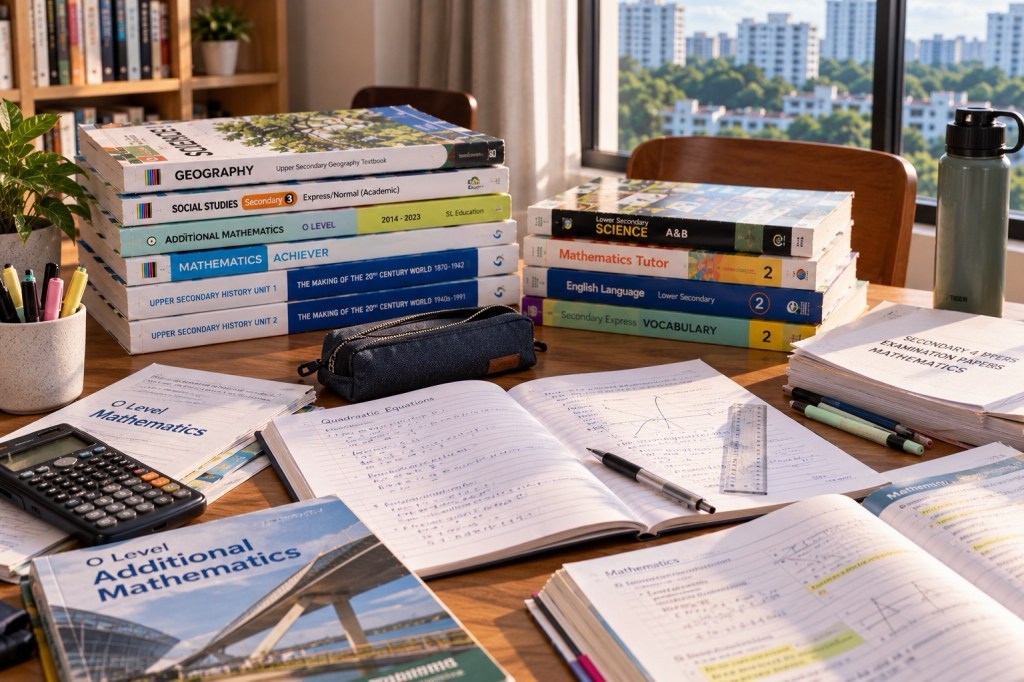
Learning G1 Mathematics with a Limbang tutor should help a pupil recognise the mathematical relationship before selecting an operation. When a student counts packets as individual objects, reverses a percentage using the wrong starting amount or overlooks a fixed fee, more arithmetic alone may not solve the underlying problem. The first teaching move is to identify precisely what the unknown represents.
For Limbang families in Choa Chu Kang, G1 Mathematics tuition should connect fractions, ratios, algebra, graphs, geometry, statistics and probability through meaningful worked examples and independent checks. The tutor can model a decision, change the problem and then remove the opening hint to see whether the student can reconstruct a solution.
The official 2027 SEC G1 subject list confirms Mathematics K110. G1 is a subject level, not necessarily the first year of secondary school. Schoolwork and current enrolment should guide lesson difficulty and timing.
Location disclosure: eduKate Sengkang lists its classroom at 83 Punggol Central, Singapore 828761, not Limbang. This is a learning guide, not a claim of a local branch or guaranteed class place. Confirm present tuition arrangements, fees and the actual journey at eduKate Sengkang.
Why a correct operation can still answer the wrong question
Imagine a question states that six equal boxes contain forty-two notebooks. Dividing forty-two by six gives seven notebooks per box. But if the question asks how many notebooks are in four boxes, seven is only an intermediate answer. The learner must identify what the number represents and use it to reach twenty-eight notebooks.
A student can carry out every arithmetic step accurately and still stop at the wrong quantity. Ask them to label the answer in words before deciding it is finished. “Seven” is ambiguous; “seven notebooks in each box” makes the remaining step visible. This is especially useful when a problem contains several totals, rates or different kinds of units.
The tutor should therefore inspect interpretation separately from arithmetic. Does the learner know what is given, what is missing and how the quantities relate? A calculation worksheet can help fluency, but it does not by itself establish that the student can select and organise the right calculation from a word problem.
Prepare for the actual K110 assessment
The official 2027 K110 syllabus has two 90-minute papers, each carrying 50 marks and half the qualification. Number and Algebra appears in both; Geometry and Measurement is included in Paper 1, and Statistics and Probability in Paper 2. Approved calculators may be used, and essential working must be shown.
Use the actual subject-content pages rather than assume G1 means arithmetic alone or treat a notation appendix as an extra syllabus. A student may encounter graphs, simultaneous equations and quadratic work while still needing repair in fractions or negative numbers. The current school sequence determines which connection should be taught next.
The teaching examples below illustrate selected relationships, not every assessed topic. Keep school exercises and official requirements alongside them. A strong programme can prepare for the next assessment while rebuilding a missing prerequisite, provided the tutor identifies which earlier idea is preventing current work from making sense.
Clinic 1: equivalent fractions describe the same quantity
Three fifths and six tenths represent the same proportion. If a strip is divided into five equal parts and each part is split in two, the three selected parts become six smaller parts. The selected amount has not doubled; the counting unit has become smaller.
Ask the learner to explain why multiplying numerator and denominator by the same non-zero number preserves the fraction. Then compare a mistaken change from 3/5 to 6/5. Here only the numerator changes, so the amount really does double. The contrast makes the denominator’s role visible.
A later task can ask which of several fractions equals 0.6. The student should connect the decimal and fractional representations instead of treating them as unrelated chapters. Check the size on a number line and ask why a value greater than one cannot represent the same amount in this example.
Clinic 2: adding fractions requires comparable parts
To calculate 3/5 + 1/10, first express three fifths as six tenths. The total is seven tenths. Adding both numerators and denominators would give four fifteenths, which cannot be correct because it is smaller than the first positive quantity alone.
Use that size comparison as a check independent of the written algorithm. The learner can see that adding a positive tenth must increase three fifths. The common-denominator method then explains exactly how many equal parts are being combined, rather than appearing as an arbitrary classroom procedure.
Change the task to finding three fifths of one tenth. Now multiplication gives three fiftieths, a smaller quantity. The learner must identify the relationship before using the most recently practised fraction method. This small contrast is useful when a student performs well on labelled exercises but guesses in mixed practice.
Clinic 3: directed numbers need a reference point
An invented temperature problem begins at −6°C and increases by nine degrees. The new temperature is 3°C. The change is positive nine, while the initial reading is negative six. Confusing a value with a change can lead to a wrong sign before any difficult calculation appears.
Draw the starting point and movement on a number line. Then ask what change is needed to move from 3°C back to −6°C: a decrease of nine degrees. The numbers are the same, but the direction has reversed. Keep the interpretation explicit rather than relying solely on a rule about signs.
For a later symbolic task, evaluate −6 − (−9). The result is also three, though the expression uses subtraction of a negative. Ask the learner to explain the equivalent operation and check it independently. Negative quantities are not errors to remove; they are values whose meaning must be preserved.
Clinic 4: decimal place value should agree with an estimate
In a fictional exercise, nine items cost $3.40 each. Their total is $30.60. Before exact calculation, nine items at a little more than three dollars should cost a little more than $27. An answer of $306 or $3.06 should therefore trigger a check.
Ask which part of the calculation controls the unit price and which part controls quantity. The student should not simply move a decimal point until the answer resembles the answer key. A reasonable range provides an independent basis for detecting a scale error.
Reverse the task by giving the total and number of items and asking for one item’s price. The operation changes to division. Keep the labels visible so the learner recognises that a unit price is being recovered from a total. All prices here are invented for teaching and should not be interpreted as live shop information.
Clinic 5: one ratio part is not one object
A fictional group shares forty-eight cards in the ratio 3:5. There are eight parts altogether, so one part represents six cards. The two shares are eighteen and thirty. Verify both conditions: they add to forty-eight and their ratio simplifies to three to five.
A student who assigns three cards and five cards has confused a relative relationship with actual quantities. Another may divide by five because it is the larger ratio entry. A bar divided into eight equal sections makes the total visible and shows why all parts must be counted.
Change the information: the group with three parts receives eighteen cards, but the total is not stated. The learner can still find one part and then the total. Ask exactly which portion the given number represents. This interpretation is more dependable than memorising a single instruction to divide by the sum.
Clinic 6: a percentage needs a named whole
A quantity rises from eighty to one hundred. The increase is twenty, and relative to the original eighty that is 25%. Dividing by one hundred would describe the increase as a proportion of the final amount instead. The calculation must use the reference quantity the question requires.
Ask the learner to label original, change and final before substituting numbers. Then reverse the direction: a decrease from one hundred to eighty is 20% of the original one hundred. Equal absolute changes do not imply equal percentage changes when the starting amounts differ.
Use an unfamiliar context at review, such as a fictional attendance count rather than a price. The student should identify the same relationship without relying on shopping vocabulary. Percentage work becomes more reliable when the learner knows what represents the whole at each step.
Clinic 7: a reduced price can reveal the original
An invented price after a 25% reduction is $81. The reduced amount represents 75% of the original, so the original is 81 ÷ 0.75 = $108. A forward check gives a reduction of $27, leaving $81.
Adding 25% of eighty-one does not recover the original because the discount was calculated on a different base. A percentage bar or equation can make that distinction clear: 0.75P = 81. The variable P describes the original price, not whichever amount happens to be visible first.
Give a new task with an increase rather than a decrease. Ask the learner to state what percentage the final amount represents before calculating. The procedure should follow that relationship. A student who immediately adds or subtracts the printed percentage may need more work on the underlying whole-and-part model.
Clinic 8: clock time and duration have different jobs
A fictional session starts at 15:35 and lasts one hour fifty minutes. It ends at 17:25. One route adds an hour to reach 16:35, then fifty minutes. Another counts twenty-five minutes to 16:00 and the remaining eighty-five minutes to the end.
Compare a clock reading with a duration. The value 17:25 identifies a time of day; one hour fifty minutes describes an interval. A student who writes 16:85 has not regrouped minutes into hours. A timeline can expose the issue without introducing more complicated arithmetic.
For a Limbang family’s real planning, use personally checked departure and arrival information rather than fictional travel claims. The same mathematical skill can help distinguish lesson length from the full weekly commitment, but the article cannot infer an exact journey for every school or home.
Clinic 9: a rate belongs to two quantities
An imaginary printer produces ninety-six cards in eight minutes at a constant rate. Its rate is twelve cards per minute. Printing one hundred and fifty-six cards at that rate takes thirteen minutes. Each calculation should retain its units so the learner knows whether the answer is a quantity, a rate or a duration.
Now add a fixed three-minute setup period. The total time becomes sixteen minutes, though the production rate is unchanged. A student who incorporates the setup into every card’s production time has modelled a different situation. Separate the fixed contribution from the repeated rate.
At review, provide a different context with the same structure. Ask what assumption allows scaling and what would change if the rate varied. The student should not force proportional reasoning onto a situation merely because two quantities are present.
Clinic 10: an unknown needs a definition
In a fictional purchase, four equal items plus one $3 packing charge cost $31. Let x be the price of one item in dollars. The equation is 4x + 3 = 31, giving x = 7. The answer describes one item, not the entire order.
Compare 4(x + 3) = 31. That expression adds three dollars to every item. Ask the learner to explain the different story represented by the brackets. Substituting seven makes the mismatch obvious, but the deeper repair is understanding which charge occurs once and which quantity repeats.
Define the variable in every unfamiliar modelling task until the habit is dependable. A letter can represent a price, count, length or time. The algebra may look similar across questions, but the final interpretation and allowed values depend on what the letter means.
Clinic 11: equation balance makes checking possible
Solve 6x − 5 = 37. Add five to both sides, giving 6x = 42, then divide by six to obtain x = 7. Substitution in the original equation gives 42 − 5 = 37. Every transformation keeps the original relationship true.
Ask why adding five to only one side would be invalid. A balance picture can support the explanation initially, but the learner should gradually describe the operation in words. Avoid treating “move across and change sign” as the entire explanation; it can hide what must happen when the equation becomes less familiar.
For variation, use 6(x − 2) = 30. Dividing by six first gives x − 2 = 5, so x is again seven. The same answer does not mean the questions have the same intermediate structure. Ask the student to explain the route selected and verify both independently.
Clinic 12: simultaneous conditions need one shared pair
Suppose x + y = 17 and x − y = 7. Adding the equations gives 2x = 24, hence x = 12 and y = 5. Both conditions must be checked. Eleven and six satisfy the total but not the difference.
A younger learner may benefit from a diagram before symbolic elimination is introduced. An older learner should explain why adding these equations removes y. The method is justified by opposite coefficients, not because addition is always the correct first step for any pair of equations.
Then express the relationships through a short original story and ask for the equations. Record modelling and solving separately. A student who solves a supplied pair but cannot form it from words needs a different next lesson from someone who models accurately but makes algebraic errors.
Clinic 13: formula substitution must preserve signs
For x² − 7x + 10 = 0, the coefficients are a = 1, b = −7 and c = 10. Using the quadratic formula gives x = (7 ± √9)/2, so x = 5 or x = 2. Check both values in the original equation.
The difficulty may begin with identifying b, not with the formula itself. A student who uses positive seven has changed the equation before calculating. Write the coefficients separately and retain brackets when substituting a negative value. This makes a hidden sign assumption visible.
Where school teaching permits, compare the factorised form (x − 5)(x − 2). Different valid representations should agree. The learner should understand the distinction between rewriting an expression and finding values that make an equation true, rather than report a pair of brackets when roots are requested.
Clinic 14: a graph interval is a unit too
A graph’s vertical labels increase from zero to twenty to forty. Each marked interval therefore represents twenty units, not one. A point halfway between twenty and forty has value thirty if the scale is linear. Counting grid squares without reading the labels can produce a neat but incorrect answer.
Ask the learner to describe both axes before reading a coordinate. What is measured, in which unit, and how much does an interval represent? Then show the same data with another scale. The physical steepness on the page may change while the numerical relationship does not.
For a new task, include a non-zero starting value on an axis. The student should not assume the bottom label is zero simply because many textbook graphs begin there. A deliberate first inspection helps prevent several later errors in plotting, differences and interpretation.
Clinic 15: tables, equations and lines should tell one story
For y = 4x − 3, the inputs zero, one and two produce outputs −3, 1 and 5. Each increase of one in x adds four to y. The value at x = 0 is negative three. These relationships appear in the table and the plotted line as well as the equation.
A plotted point at (2, 4) is not correct merely because it looks close to the line. Substitute x = 2 and check the output. Encourage the student to use another representation as a verification tool rather than consider tables, equations and graphs separate exercises.
At review, supply the table first and ask for a verbal description before the equation. Then change the starting value while retaining the rate of increase. The learner must distinguish those two features instead of using only the difference between consecutive outputs.
Clinic 16: quadratic graph values can expose a sign error
For y = x² − 9, inputs −3, −1, 0, 1 and 3 give outputs 0, −8, −9, −8 and 0. The matching values for opposite inputs provide a useful symmetry check. The minimum occurs at (0, −9) in this example.
If the learner obtains −10 at x = −1, inspect the square: (−1)² is positive one. The error may be a negative-number misconception carried into graphing. Repeating plotting practice without repairing that substitution would leave the same mistake available for future questions.
Change the expression to y = 9 − x² and compare the values. Ask how the graph differs and which calculation supports the explanation. Use this clinic only when the school sequence has reached quadratic graphs; earlier students can practise the relevant substitution separately.
Clinic 17: distinguish boundary length from coverage
A rectangular display measures 1.5 metres by 0.8 metres. Its perimeter is 2(1.5 + 0.8) = 4.6 metres. Its area is 1.5 × 0.8 = 1.2 square metres. Edging and covering ask for different quantities even when the same dimensions are supplied.
Ask the learner to point to what is being measured on a sketch. A boundary is a length; coverage is two-dimensional. The units can then warn against a mistaken formula. An answer in square metres cannot directly state how many metres of edging are needed.
Convert the dimensions to centimetres and check again. The area is 150 × 80 = 12,000 square centimetres, consistent with 1.2 square metres. This illustrates why an area conversion changes both dimensions. A familiar conversion factor for length should not be applied blindly to area.
Limbang Mathematics clinic: units determine the first operation
A fictional club buys seven packs of twelve coloured cards, then distributes sixty-nine. The initial quantity is seven times twelve, or eighty-four cards. After distribution, fifteen remain. A child who subtracts sixty-nine from seven has mixed packs with individual cards and used an arithmetic operation on incompatible quantities.
Write a unit beside each number before calculating. The multiplication converts packs into cards; the subtraction then compares card counts. A final answer must return to the question’s wording and unit.
At review, supply a remainder and the number used, and ask how many packs were purchased. The learner should reconstruct the reverse operation from meaning, not copy the earlier calculation sequence.
Limbang Mathematics clinic: whole-number capacity can override ordinary rounding
A fictitious event expects ninety-three participants. Each shuttle in a school word problem seats fourteen. Six shuttles seat eighty-four and cannot serve everyone; seven are required under the stated capacity. A calculator gives about 6.64, but a fraction of a shuttle is not an available unit in the problem.
Ask the learner to test one fewer vehicle and the selected amount rather than round a decimal by habit. The answer depends on whether all participants must be accommodated, how many complete groups are asked for, or whether a remainder should be reported.
This is a mathematical example, not transport advice or a real journey estimate to Punggol. A changed problem with groups of twelve asks how many complete groups can be formed from ninety-three: seven with nine remaining.
Limbang Mathematics clinic: a fixed fee breaks direct proportion
An invented printing service charges $5 once per order and $2 for each booklet. Ten booklets cost $25. Twenty booklets cost $45, not $50, because the fixed contribution is not doubled. The relationship is C = 2n + 5 rather than C = 2n.
Label the starting fee and per-booklet charge with different marks. A table for zero, one and two booklets can reveal the intercept and repeated increase. Multiplication applied to the whole $25 may be a neat calculation but represents the wrong model.
For a new provider with no starting fee, direct proportion may fit. The pupil should decide which assumption changed and why the equation must change.
Limbang Mathematics clinic: reverse percentage needs its reference whole
A fictional backpack costs $68 after a fifteen-percent discount. The sale price represents 85% of the original, so its original price is $68 ÷ 0.85 = $80. Simply adding fifteen percent of $68 gives the wrong base and does not reverse the discount.
Ask which amount corresponds to 100% before choosing any operation. Draw a bar showing original value, discount and remaining price. Check forward: a $12 reduction from $80 gives $68.
At review, describe an increase instead: a value grows by twenty percent to $150. The original is $125 because the final is 120% of the starting amount.
Limbang Mathematics clinic: a ratio contains equal parts
Two pupils share fifty-four tokens in the ratio four to five. Nine equal ratio parts are needed; each part is six tokens. The shares are twenty-four and thirty, which sum to fifty-four and retain the required 4:5 relationship.
A pair such as twenty-five and twenty-nine also totals fifty-four but fails the ratio. Ask the learner to check both constraints independently, not stop when only the total agrees.
For an unfamiliar ratio, supply one share rather than the total. The student must determine the value of a part, then reconstruct the missing share.
Limbang Mathematics clinic: a coordinate pair has an order
A fictional graph contains the point (3, 7). Three describes the horizontal x-coordinate and seven describes the vertical y-coordinate. Plotting (7, 3) instead gives a different point even if both numbers are correct. The order is part of the information.
Ask the learner to move horizontally from the origin, then vertically, reading actual labelled scales. A grid with unequal unit steps makes it necessary to check axis labels rather than count squares automatically.
For a later question, give a point in a different quadrant and ask for its coordinates. The child should preserve sign and order independently.
Limbang Mathematics clinic: graph steepness depends on the scale
Imagine the same linear data shown on two charts, one with a narrow horizontal axis and the other stretched across a page. One line looks steeper, but the numerical rate between points is unchanged when the axis values remain the same.
Calculate change in the vertical quantity divided by change in the horizontal quantity using labels, not visual angles on the paper. Then ask what units the gradient has and what an increase in x means in this context.
At review, use an axis beginning above zero. The student should notice the truncated scale and avoid drawing a misleading conclusion from the visual height of a bar.
Limbang Mathematics clinic: linear equations represent a balance
Solve 6x − 7 = 29. Adding seven to both sides gives 6x = 36; dividing by six gives x = 6. Checking forward in the original produces thirty-six minus seven, or twenty-nine. The checking method explains why each change preserved equality.
Teach the operation performed to both sides rather than only the phrase move the seven across. A learner who forgets to reverse the sign can test the candidate in the original equation and reject it.
For transfer, use 6(x − 7) = 30. Although similar numbers appear, the bracket creates a different first decision and different solution. The pupil should read structure rather than reproduce a rule.
Limbang Mathematics clinic: a shape’s perimeter and area are different quantities
A rectangle is 2.5 metres long and 1.2 metres wide. Its perimeter is 2(2.5 + 1.2) = 7.4 metres, while its area is 2.5 × 1.2 = 3 square metres. Both are correct calculations, but they answer different practical questions.
Ask whether the task concerns edging or covering the surface. The unit expected—metres or square metres—can expose a wrong formula before the answer is final.
At review, give dimensions in centimetres and an answer required in square metres. The student should convert the dimensions or area consistently rather than apply a one-dimensional factor once.
Limbang Mathematics clinic: similar figures require corresponding dimensions
A smaller rectangle measures four by three centimetres; a similar larger rectangle has corresponding length ten centimetres. The linear scale factor is 2.5, so the matching width is 7.5 centimetres. Comparing a length to an unmatched width does not describe similarity.
Mark matching corners and dimensions, then verify that both length-to-width ratios agree. Visual rotation must not change which sides correspond.
A new task provides the area ratio instead. The student should recognise that area scales by the square of the length factor, rather than multiply a linear dimension by the area ratio directly.
Limbang Mathematics clinic: geometry depends on stated properties
An invented triangle has two interior angles of 49° and 68°. Its third interior angle is 63°. An adjacent exterior angle would instead be 117° because the pair lies on a straight line. A pupil who reports sixty-three when asked for the exterior angle has solved an intermediate but not final target.
Mark the exact unknown angle and write a concise property beside every deduction. A rough drawing is not a trustworthy scale diagram unless the problem specifies it.
At review, rotate the figure and change the values. The child should use properties rather than remember where the previous angle appeared on the page.
Limbang applied task: check both quantity and budget
An invented community activity needs ninety-four identification cards, packed in groups of twelve for $4.50 per pack. One delivery charge of $2.80 applies and the budget is $40. Eight packs give ninety-six cards, two spare, and a total cost of $38.80. Seven packs would not supply enough. A correct answer must show both sufficiency and affordability.
Raise the demand to ninety-seven cards. Nine packs are necessary and cost $43.30, so the same budget no longer works. The change tests whether the student reasons from the constraints rather than remembers that eight packs was the original solution.
Limbang applied task: a fixed amount does not double
A fictional printing firm charges $5 once and $3 for every item. The total for ten items is $35; for twenty it is $65, not $70. A student who doubles the first total has mistaken a fixed contribution for a rate that scales with quantity.
Build an equation and then a table with zero, one and ten items. Change the fixed fee in the next problem so the pupil has to create a new model.
Limbang applied task: reverse the percentage from the correct base
An imaginary item sells for $92 after a 20% reduction. That price represents 80% of the original amount, so the original was $115. Checking forward, 20% of $115 is $23, and subtracting $23 leaves $92. Adding 20% of the reduced price would not undo the discount.
Ask what amount represents 100% before selecting an operation. A later 15% increase question should trigger a different relationship rather than a copied discount rule.
Limbang applied task: a time period is not a clock display
A fictional programme starts at 14:35 and finishes at 16:10, a duration of one hour thirty-five minutes. If there is a fifteen-minute break, active programme time is eighty minutes. These are different quantities although the same clock readings appear.
Use a timeline for the first explanation. Remove it for the changed task and ask the pupil to distinguish elapsed time from activity time.
Limbang applied task: area cannot be measured in length units
A rectangle measuring 2.5 metres by 1.2 metres has area three square metres and perimeter 7.4 metres. Both are correct but describe different features. A student can perform the appropriate arithmetic and still answer the wrong question if the physical purpose is ignored.
Ask whether the task is about covering a surface or edging a boundary, then predict the unit. Change the dimensions and units for independent practice.
Limbang applied task: one observation can alter a data summary
For the fictional values 3, 4, 4, 6 and 23, the mean is eight while the median is four. The relatively large reading raises the mean above most of the data. These statistics are not contradictory; they summarise different aspects of a small distribution.
Replace twenty-three with eight, then recalculate and discuss what changes. A small teaching sample does not justify claims about any real school or neighbourhood.
Limbang applied task: probability depends on the stated procedure
A bag has four green counters and two blue. The probability of green twice without replacement is (4/6)(3/5) = 2/5, while replacing the first counter gives (4/6)² = 4/9. The second draw’s sample space depends on what happened in the first.
Ask what remains in the bag, then give a different colour order and number of counters for a new attempt.
Six weeks of G1 Maths learning that parents can inspect
Week one collects an unassisted short mixed baseline. Week two repairs the first significant misconception. Week three varies the story, week four tests retrieval after a delay, week five adds manageable timing and verification, and week six compares fresh independent work with the baseline. This is an illustrative teaching cycle, not a grade guarantee.
Different learners may need different repairs for similar marks. In a small group, each pupil should have an independent changed question after shared discussion so that a peer’s correct first step does not conceal another child’s uncertainty.
Limbang facilities and the real classroom journey
HDB lists Limbang Shopping Centre as a Choa Chu Kang neighbourhood centre. The NLB directory provides information about Choa Chu Kang Public Library at Lot One, which can be an optional independent reading resource. Neither is an eduKate classroom.
Parents should check school dismissal, CCAs, meals, the outward and return journey to Punggol Central, homework and rest before choosing a tuition timetable. Learning needs room for delayed retrieval, not only attendance at a lesson.
Frequently asked questions about G1 Mathematics in Limbang
Does G1 Mathematics mean Secondary 1? No. It is a subject level, while the year in school is another detail.
Why are word problems difficult? The issue may be selecting the relationship, not calculating. Identify the quantity and conditions before operating.
Does a calculator replace reasoning? No. It evaluates expressions but cannot decide the model, units or validity of the answer.
Is there a Limbang eduKate classroom? This guide does not claim one. The stated teaching location is 83 Punggol Central.
Are exam results guaranteed? No. Independent improvement can be monitored but scores vary.
Explore the connected G1 Limbang subject guides
Read G1 English, G1 A-Math Readiness and G1 Science for Limbang. See also G1 Mathematics in Yew Tee for another local perspective.
The Mathematics Tuition hub and official SEAB 2027 G1 list provide wider subject information.
Arrange a focused Mathematics consultation
Contact eduKate Sengkang with original school Mathematics work. Ask which first modelling error should be repaired, how a changed problem will test it and whether current classes, fees and travel suit the family.
