
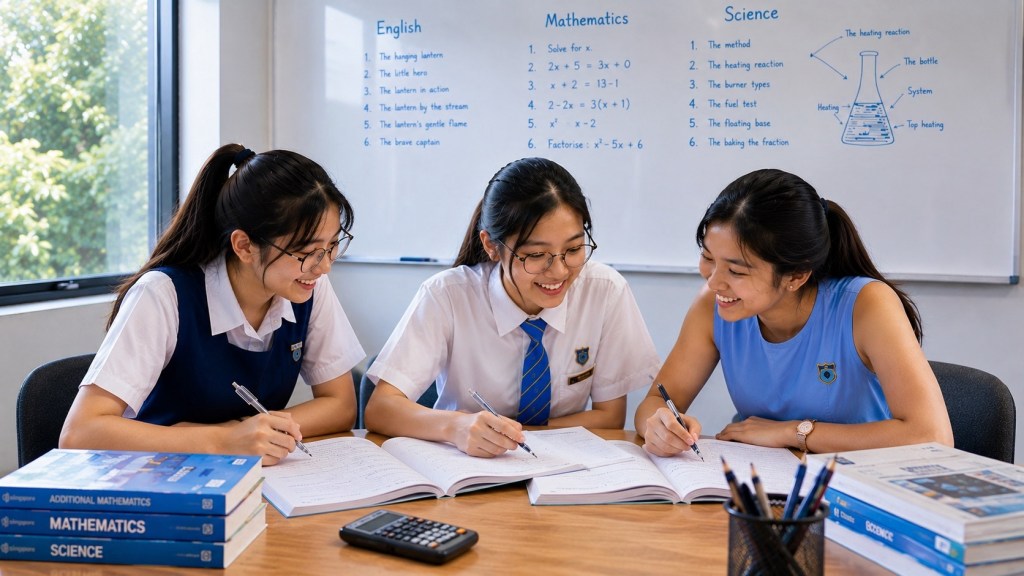
Preparing for university academic writing and research after Polytechnic is less about writing longer essays and more about constructing clearer arguments from trustworthy evidence. Diploma graduates may already have experience with reports, presentations, projects and internships. University assignments can ask them to engage more critically with published research, compare explanations, justify methods and show exactly where evidence ends and their interpretation begins.
For students asking how to write university essays, research reports, literature reviews and citations in Singapore, the official support is useful. NUS’s Writing and Communication Hub resources cover thesis statements, critical reading, evidence, synthesis, scientific reports and referencing. SUSS’s academic-integrity course explains how students should acknowledge sources and avoid plagiarism, including responsible use of generative AI tools.
This guide provides a practical study transition from Polytechnic final-year projects to university-level research and writing, with fictional examples, a small drafting workflow, academic integrity and ways to get feedback. It is not a replacement for an individual lecturer’s assessment instructions or an excuse to submit someone else’s written work as one’s own.
University writing makes reasoning visible
A report can be grammatically correct yet weak because it does not explain why the evidence supports the conclusion. Academic writing requires the reader to follow the question, claim, evidence, reasoning and limitations without filling gaps from their own imagination.
The best preparation is therefore to practise one clear argument rather than produce many pages quickly. A student should be able to explain what they believe, why they believe it, what would challenge it and which part remains uncertain.
What changes after Polytechnic?
Polytechnic assignments often emphasise practical application, projects and professional communication. University degrees can demand deeper engagement with theory, independent reading and research methods. These are tendencies, not universal differences: both institutions can require rigorous academic and applied work.
A graduate should begin by examining the actual first-year degree modules and assessment briefs. The most important gap may be critical reading, quantitative interpretation, formal writing or unfamiliar subject theory. Preparation is strongest when it addresses the learner’s demonstrated need.
Read the task verbs before writing
An assignment asking students to describe a process is different from one asking them to analyse causes, evaluate evidence or defend a recommendation. Mark the verbs and any specified sources, method, length or citation style before beginning.
For an evaluation task, identify the criteria and available evidence. For a comparison, establish which dimensions are comparable. For an argumentative essay, define the central position and the best serious alternative. Correct structure follows the question, not a generic five-paragraph template.
Start with a question that can be answered
Broad topics can become unmanageable. Instead of ‘Technology changes education’, a student might examine which limitations exist in two specified ways of using a learning tool, under clearly described conditions. A narrower question makes evidence and conclusion more precise.
The question should be supported by an appropriate method or relevant literature. If sources do not address it, revise the scope rather than make the conclusion sound stronger. A precise question is a sign of intellectual honesty, not a lack of ambition.
A thesis statement is a claim with direction
A thesis tells the reader what the paper is arguing or investigating. It should be specific enough that evidence could support or challenge it. The NUS Writing and Communication Hub includes resources for understanding thesis statements and organising complex academic ideas.
A weak thesis says that research is important. A stronger one identifies a contestable question, clear scope and reasoned position. The writing can evolve as the student discovers better evidence. Revising a thesis is appropriate when the original no longer matches what the research establishes.
A paragraph needs more than a topic sentence
A useful paragraph introduces a claim, supplies relevant evidence and explains how that evidence supports the claim. The explanation is crucial: quoting a number or source without interpreting it can leave the reader wondering why the information matters.
Try a short paragraph on a fictional service experiment. State the relevant result, explain the comparison and acknowledge a limitation such as small sample size. Avoid padding the paragraph with descriptive sentences that do not develop the argument.
What counts as evidence?
Evidence can include peer-reviewed research, official data, well-designed experiments, credible primary documents or appropriately collected qualitative material. The best form depends on the discipline and claim. An anecdote may illustrate an issue without supporting a general conclusion.
Ask how the source was produced, when it applies and whether it answers the precise question. A government statistic about one cohort cannot automatically prove an explanation for a different population. Use evidence because it is relevant and reliable, not merely because it comes from an impressive institution.
Primary and secondary sources serve different roles
A primary research paper may report the data and methods of an investigation. A review article may integrate findings from several studies. Official policy documents can serve as primary sources for what a rule actually states. Different sources help answer different questions.
For a claim about a policy, prefer the relevant current official notice. For a claim about an intervention’s measured effect, examine research that actually studied that question. Do not use a news summary as a substitute when the original evidence contains necessary caveats.
Read research papers actively
Begin with the research question, design, population, key results and limitations. Then inspect the method and whether the conclusion follows. An abstract is a starting point, not a replacement for understanding the study.
Make a small note with five fields: question, method, evidence, finding and uncertainty. This encourages the student to distinguish what researchers observed from what they inferred. A long list of highlighted passages without an explanation of their relationships is less useful.
What a literature review is
A literature review does not simply list three authors and summarise each in order. It identifies how existing studies agree, differ or leave questions unresolved. Good synthesis helps explain what is known about the problem and what a new investigation might contribute.
Group studies by method, evidence or issue rather than by alphabetical order. A student might compare findings from a small experimental study and a broad survey, noting that they answer different questions. Respect the boundaries of each source.
Synthesis is more than summarising
Summarising states what one source says. Synthesis examines relationships among several sources: agreement, conflicting evidence, variation in methods or the possibility that different conditions explain different results.
A useful practice exercise is to create a two-column comparison of claims and methods. Then write one paragraph explaining the relationship without exaggeration. A comparison becomes stronger when it identifies why two results may differ, not merely that one number is larger.
Read source quality before using it
Source credibility depends on author expertise, method, evidence, publication context and relevance. A peer-reviewed article can still use a limited sample, while a carefully documented official statistical series may be more appropriate for certain questions.
Avoid judging every source only by whether it is recent or famous. Read the actual methodology and ask whether the claim is supported. Where a fact is contested, present relevant uncertainties and identify what more evidence would help.
Citations let readers verify claims
NUS’s plagiarism and attribution guidance explains that other people’s words, ideas and data should be acknowledged and that references must allow readers to locate the source. This applies to internet information as well as conventional publications.
A citation is not merely a decoration added at the end. It should be placed so readers can identify which claim derives from which source. The actual lecturer or discipline determines the required style and conventions.
Paraphrasing still requires attribution
Changing the wording of another author’s idea does not turn it into the student’s original discovery. Good paraphrasing shows understanding by expressing the point accurately in a new structure and citing its source.
Copying an original sentence and replacing two words is not meaningful independent work. A better practice is to read, close the source, explain the idea from understanding, reopen it to check accuracy and record the proper reference. Avoid misrepresenting the author’s certainty.
Direct quotations should be purposeful
A quotation can be valuable when the wording itself matters, such as a precise definition or a text being critically analysed. Otherwise, paraphrasing with attribution may be more useful because it demonstrates the student’s understanding.
Always follow the assigned citation style and quotation rules. A long string of quoted sentences does not amount to an argument, and text copied without proper attribution can create an academic integrity problem regardless of how polished the final document looks.
Choose the citation style required
Different disciplines and courses use systems such as APA, MLA, Chicago or other field-specific referencing conventions. SUSS’s academic-integrity materials introduce several recognised styles and instruct students to follow their actual programme requirements.
Do not assume that a format used in a Polytechnic report remains valid for every university module. Check sample references from the course guide and learn to cite books, articles, webpages and datasets in the prescribed form. Consistency matters but cannot compensate for inaccurate bibliographic details.
Do not invent references
A reference is a claim that a particular source exists and supports something. Fabricating a journal article, page number, author or DOI undermines the work’s credibility. This risk can arise when an applicant copies an autogenerated citation without checking the original.
Open each referenced document and verify the publication details and relevant argument. If the source cannot be found or does not support the statement, remove or revise the claim. A shorter paper with dependable citations is better than a longer one built on imaginary scholarship.
Using generative AI requires course-specific rules
Universities can allow, restrict or require disclosure of AI assistance depending on the module and task. SUSS’s SD104 materials cover responsible AI use, and NUS’s academic guidance emphasises truthful representation of authorship and sources.
A student should never assume that permission to brainstorm means permission to submit machine-generated analyses as original research. Follow the actual instructions, verify every fact and citation, and disclose assistance where required. AI cannot legitimately supply an experiment that was never performed.
Academic integrity covers data too
Plagiarism is not the only risk. Fabricating observations, altering evidence, taking another person’s contribution or presenting a simulated result as a real measurement can mislead an assessor even when every sentence is newly written.
Keep research notes that separate original data, calculations, interpretation and fictional practice examples. If a result is uncertain or a test fails, explain the limitation rather than replace it with an attractive invented outcome. Honest reporting is essential across humanities, business and science.
Understand the difference between a report and an essay
A technical report may use sections such as methods, results and discussion, while an argumentative essay may organise around claims and counterarguments. Both need evidence and coherent reasoning, but the required structure depends on the assignment.
Do not force every task into one generic template. Read the course’s brief or model papers and ask what the reader needs to understand next. The order should serve the argument and the discipline’s standards.
Scientific and quantitative writing
Science and engineering papers often need precise definitions, methods, units, graphs, error explanations and limits. The NUS Writing and Communication Hub includes materials on scientific abstracts, methods, charts and experimental discussion.
A good sentence distinguishes observation from inference: ‘Under these test conditions the measured value changed’ differs from ‘The intervention caused the change everywhere’. Accuracy about scope is more important than impressive technical vocabulary.
A worked claim-and-evidence paragraph
Imagine a fictional classroom experiment comparing two information sheets. In a tiny demonstration, seven of eight readers find the deadline using Sheet A and six of eight using Sheet B. A useful paragraph can report the observations, compare the proportions and explain what the result may suggest under the exercise conditions.
It would be misleading to claim that A has been proven superior for all university students. The sample is too small and may not represent the wider population. The paragraph should link the conclusion to evidence while explaining the limits. This is the difference between a confident assertion and a defensible argument.
A worked counterargument
Suppose an essay argues that online discussion can support learning in a particular course. A serious counterargument is that students may participate less effectively when access, prior knowledge or task design differ. The writer should not dismiss that concern merely because it challenges the preferred position.
A useful response identifies conditions under which the original claim may hold and evidence that might distinguish the explanations. The goal is not to win a debate by sounding certain. It is to show why the conclusion remains reasonable after considering credible alternatives.
Do not confuse correlation with cause
A student may observe that higher class attendance and stronger grades occur together. That does not automatically prove that attendance alone caused the differences. Motivation, prior understanding, assessment design and other factors may contribute.
When reviewing a research paper, ask what method was used to isolate possible causes. A simple survey correlation supports a different conclusion from a well-designed intervention under controlled conditions. Academic writing should preserve this distinction instead of exaggerating an interesting pattern.
Statistics belong inside an explanation
A percentage, mean or regression coefficient does not explain itself. The writer should define the measured quantity, population, units, sample and relevant uncertainty, then state what the number can reasonably support. The goal is interpretation, not filling a report with impressive figures.
A graph may help show a pattern, but labels and denominators must be correct. An otherwise accurate statistic can become misleading when applied to the wrong population. Students should learn to inspect both the calculation and the meaning of the comparison.
A fictional pooled-data problem
Imagine one invented group records nine successes in ten attempts and another records fourteen in twenty. Their separate success rates are 90% and 70%. The overall rate across both groups is 23 successes in 30 attempts, approximately 76.7%, rather than the simple average of the two percentages.
This example helps students explain why different denominators matter. It also raises a deeper research question: were the groups comparable enough to pool? The correct arithmetic cannot answer that methodological issue. Good academic writing discusses both rather than treating one number as the complete conclusion.
Qualitative evidence needs transparent methods
Interview and observation research can reveal useful themes that numerical summaries overlook. But the writer must explain how material was collected, who or what it represents and how themes were identified. A few interesting quotations do not establish that everybody shares a particular view.
Protect participant privacy and follow the university’s ethics requirements. Do not invent interviewees or rewrite their statements to strengthen a claim. The researcher should distinguish what a participant said from the interpretation drawn from it.
A research proposal needs feasibility
A student may be enthusiastic about studying an important issue but propose methods requiring inaccessible data, participants without consent or equipment they cannot use safely. A good proposal identifies the question, intended method, available resources, risks and realistic scope.
Consult the supervisor before collecting sensitive data or promising major outcomes. A modest approved project with clear evidence can be more valuable than an ambitious plan that cannot be completed honestly within the assessment period.
Literature review notes should capture disagreements
Instead of taking isolated quotations, create a small matrix listing source, question, method, finding and limitation. Then identify where authors agree and which differences might result from populations, measurements or theoretical assumptions.
Do not force every paper into one story of agreement. Contradictions can be valuable when they show what remains uncertain. A careful synthesis may conclude that evidence is mixed under specified conditions rather than declare that one side has been permanently proven wrong.
The introduction should explain stakes and scope
A good opening tells readers what problem the paper addresses, why it matters for the chosen discipline and what the assignment will argue or investigate. It does not require sweeping claims such as ‘Since the beginning of time’ or a lengthy account of unrelated history.
Use the first paragraphs to define important terms and the question’s boundaries. Readers should understand what will be examined and what is intentionally outside scope. A narrow, well-explained introduction makes the later method and conclusion easier to evaluate.
Use topic sentences as a map
Each major paragraph should develop one meaningful point that advances the paper’s central argument. When two paragraphs repeat the same point with different words, reconsider whether the material belongs together or whether a new analytical step is missing.
A simple outline can list each paragraph’s claim and its strongest evidence. If a topic sentence would fit anywhere in the essay, it may be too generic. Revise it so the relationship with the central question is visible.
Transitions should show relationships
A transition can identify whether the next paragraph adds evidence, contrasts results, introduces a limitation or considers an alternative explanation. Words such as however, therefore and meanwhile are useful only when the logic really matches.
Do not add transitions mechanically to create a polished appearance. Test whether the two claims genuinely relate. Sometimes a missing connection requires another sentence of reasoning, not simply a linking phrase. Coherence comes from thought before style.
Academic conclusions do not promise more than evidence
A conclusion should return to the original question and explain the answer supported by the paper. It can summarise the main reasoning, state important limitations and identify a proportionate next question. It should not introduce unsupported new results.
Avoid ending every essay with claims that the issue will change society forever. A precise conclusion that explains one useful finding and its limits demonstrates more judgement than a grand statement disconnected from the work.
Revision is different from proofreading
Proofreading catches wording, spelling and formatting errors. Revision checks whether the argument makes sense, the evidence is relevant and the structure allows the reader to follow the reasoning. These are different stages of improving a draft.
First read for the central claim and logic. Next inspect the sources and calculations. Then improve paragraph organisation and clarity. Finally check language and reference formatting. Correcting commas before resolving a faulty conclusion rarely produces meaningful academic improvement.
A small feedback exercise
Give a reader the essay’s introduction and one main paragraph without a verbal explanation. Ask them to identify the question, main claim and evidence used. If they cannot do so, the writing may be missing an essential connection that the author knows but has not expressed.
Feedback should be concrete. ‘The source is named but you have not explained how it supports this conclusion’ is more useful than ‘Make it stronger’. Students should revise an actual sentence or reasoning step in response, rather than simply thank the reviewer and submit the same draft.
Use university writing support legitimately
NUS’s Writing and Communication Hub offers peer support for writing and oral communication, including academic assignments and presentations. SUSS also offers student learning resources and workshops through its Teaching and Learning Centre.
These services can help a learner clarify argument structure and develop independence. They are not services for someone else to author the assessed paper. Read the centre’s appointment rules and prepare a specific question with the student’s own draft.
NUS and SUSS have explicit integrity guidance
NUS’s undergraduate integrity policy says students must clearly distinguish their own work from others’ ideas and data. SUSS’s SD104 module teaches plagiarism avoidance, references and responsible handling of generative AI.
The general lesson is to identify the actual university’s rules and follow the lecturer’s course-specific requirements. A student must not assume that a permitted tool in one module may automatically be used in the same way in another.
How to use reading notes without plagiarising
Write notes in separate sections for direct quotations, paraphrases, source facts and the student’s own ideas. Include enough bibliographic detail to retrieve the source. This helps prevent accidental copying when the final essay is assembled from many readings.
A student can mark a quotation clearly at the moment it is copied. Later, they should decide whether its precise wording matters or whether a careful attributed paraphrase is better. Never remove quotation marks while leaving somebody else’s words substantially unchanged.
Responsible digital reference tools
Reference-management software can help organise source details and format citations, but imported metadata can be inaccurate. A generated bibliography also cannot establish that the writer actually read the cited works or that each reference supports its surrounding claim.
Open the original source and check author, title, date and relevant pages when needed. Match in-text citations with the required reference list. Tools are valuable when they reduce mechanical error without replacing the student’s responsibility for accuracy.
Avoid overquoting official or academic sources
Long quotations can crowd out the student’s analysis. Use brief, appropriately attributed quotations when wording matters, and otherwise synthesise source ideas in a way that demonstrates understanding. A source should be represented fairly, including qualifications that affect its meaning.
A literature review becomes stronger when it identifies relationships among studies. Merely reproducing excerpts from many papers, even when cited, may fail to answer the lecturer’s question. Select material according to argumentative purpose.
Different fields use different writing conventions
Engineering may require mathematical notation, diagrams and test methods. Business may emphasise case analysis, evidence and recommendations. Humanities can require close reading, conceptual argument or primary-text analysis. Social sciences often use explicit theoretical and methodological reasoning.
Students should read legitimate model assignments and the receiving discipline’s style guide rather than force every topic into the same format. The transferable foundation is accurate evidence and clear reasoning, even when the final presentation looks different.
A practice abstract for a fictional study
An abstract should communicate the question, method, principal result and appropriate conclusion within the assigned word limit. For a fictional classroom exercise, it might summarise a comparison of two instruction layouts using a small number of voluntary simulated participants.
The abstract must not claim a representative national sample when the method involved only a few readers. It should describe exactly what was done and where conclusions remain limited. This is a drafting exercise, not a fabricated study to submit as real coursework.
A practice report on a simple data chart
Choose a safe, fictional dataset and create a chart with units and a clear title. Write a paragraph describing the main pattern, another discussing a plausible interpretation and a third explaining why that interpretation is not proven by the figures alone.
This exercise connects quantitative accuracy with writing. It helps students avoid treating a chart as a self-explanatory conclusion. If the learner cannot trace a value back to its source or calculation, the paragraph should not confidently claim to have established it.
What parents can do during the transition
Parents can support students by encouraging independent reading habits, realistic timetables and access to university writing resources. They should not rewrite assessed essays or supply fabricated research, even when trying to help a stressed student.
Ask the learner what the assignment requires and what evidence is difficult to interpret. Helping them formulate a precise question for a lecturer is more valuable than polishing a paragraph whose underlying logic remains wrong. Ownership of academic work must remain with the student.
A practical six-week preparation plan
During week one, examine a sample university assignment and identify its question and citation rules. In week two, practise active reading of two legitimate articles. Week three can focus on source comparison; week four on drafting a short evidence-led argument.
Use week five for feedback and revision and week six for a fresh task that tests whether the same habits transfer. This is a suggested learning sequence, not an official university calendar. Follow actual enrolment and assessment deadlines whenever they are earlier.
Prepare a first-semester writing system
Create an organised folder for assignment briefs, reading notes, verified references, draft versions and feedback. Record due dates early and leave time for revising arguments, not simply checking grammar. Use the institution’s approved systems and security practices.
A student should be able to locate a source, explain its relevance and identify the version actually submitted. This basic organisation helps when several university modules demand different writing and research tasks at the same time.
How to know the preparation is working
Compare an early paragraph with a recent one. Is the claim clearer? Are sources accurately attributed? Can the learner explain why evidence supports the conclusion and acknowledge what remains unknown? These observations show learning better than simply counting pages written.
If the same issue persists, focus on that reasoning step rather than add another generic practice essay. Improvement should be visible in the work and transferable to a fresh question. A polished surface is useful only when the analysis underneath is reliable.
Frequently asked questions
Is university writing just longer Polytechnic writing? No; the demands can include deeper source analysis, theory and explicit argumentation. Must every essay use APA? No; follow the discipline and assignment’s required citation style. Can I paraphrase without citation? Not when the underlying idea belongs to another source.
Can AI create references for me? Never trust an unverified reference; confirm the original source. Are all university research assignments experiments? No; methods differ by discipline. What is the best early practice? Read critically, develop one evidence-led paragraph and revise it with useful feedback.
Official resources and connected eduKate reading
Primary resources: NUS Writing and Communication Hub resources, NUS plagiarism guidance, SUSS SD104 academic integrity and SUSS study resources.
For the education journey, read bridging from Higher Nitec, Polytechnic Final Year Projects and university admissions after Polytechnic.
Final thought: write to make thinking inspectable
University-level academic writing improves when students can pose a worthwhile question, analyse trustworthy sources, explain their own reasoning and recognise the limits of a result. Strong language supports these decisions but cannot substitute for them.
A Polytechnic graduate does not need to abandon practical experience to become a good university writer. They can bring careful testing, honest records and project judgement into more demanding academic conversations. Reviewed 8 October 2026; the lecturer’s current assessment and integrity requirements always take priority.
Continue learning: Parents’ Guide.
