
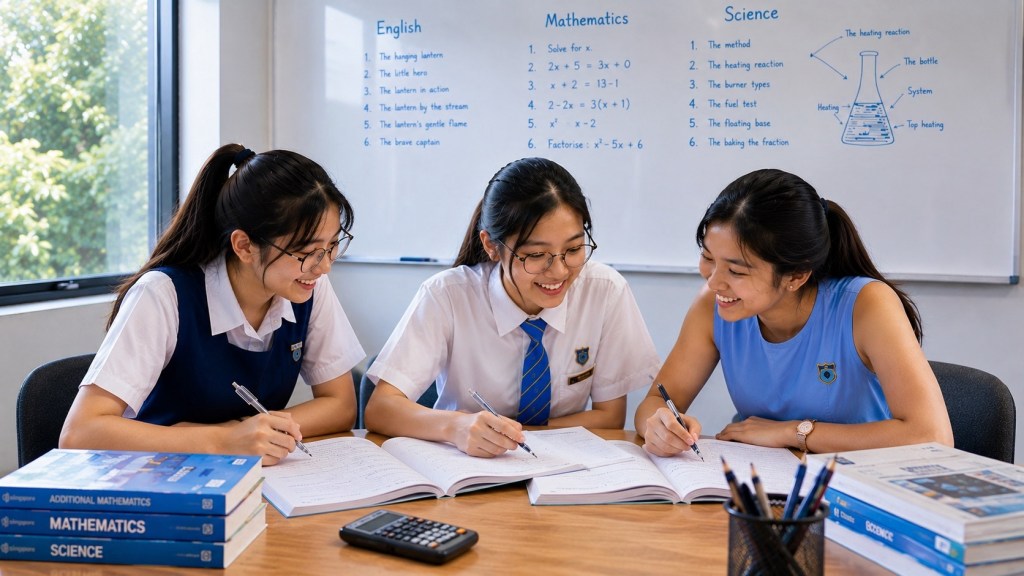
Preparing for Junior College after the Singapore-Cambridge Secondary Education Certificate should begin before the first JC lesson. The biggest transition is not simply that the subjects become harder. The pace changes, the volume increases, and students are expected to manage more of the learning themselves.
From the 2028 admissions framework, JC entry uses the revised L1R4 structure. A learner who qualifies still needs to be ready for what comes after admission: faster lectures, denser notes, more independent revision, stronger writing or quantitative reasoning, and a timetable that combines academics with CCA and school commitments.
The best Secondary 4 preparation therefore has two jobs. First, finish the SEC strongly. Second, build the study habits that will survive when the JC pace accelerates.
The Short Answer: What Should a Student Prepare Before JC?
- strong English reading and writing;
- reliable algebra and quantitative foundations where relevant;
- independent note-making;
- retrieval practice instead of rereading;
- weekly planning;
- error analysis;
- sleep and recovery habits;
- the ability to ask for help early;
- realistic expectations about workload.
Admission Is Not the Same as Readiness
The revised JC L1R4 framework sets the academic entry structure. From 2028, the qualifying threshold is 16 points before bonus points, with English or Higher Mother Tongue plus four relevant subjects counted. But a learner can meet the threshold and still find the first term difficult if study habits remain dependent.
JC readiness is not merely about being clever enough. It is about whether the learner can manage complexity without waiting for an adult to organise every step.
Read the Junior College After SEC guide.
The Pace Changes First
Secondary school often gives students more repeated exposure before a topic is fully assessed. JC moves faster. New content can arrive before older content feels completely comfortable.
That makes one habit especially important:
Do not wait to feel finished before revisiting older material.
Students need a rolling review system where new learning and old learning coexist.
Build a Weekly Retrieval Cycle
- Same day: review the lesson briefly and identify what is unclear.
- Two to three days later: retrieve the main ideas without notes.
- One week later: attempt mixed questions.
- Two to four weeks later: revisit the topic inside interleaved revision.
This prevents the familiar JC problem where a student recognises the notes but cannot use the idea independently.
English Matters in Every JC Combination
Even students planning Mathematics and Science-heavy combinations need strong language control. JC requires reading speed, interpretation, argument, reports, essays, explanations and clear written reasoning.
- read dense text efficiently;
- extract the writer’s argument;
- summarise accurately;
- write clear explanations;
- use evidence precisely;
- develop coherent paragraphs;
- communicate questions to teachers clearly.
Weak English can make strong subject knowledge harder to demonstrate.
Mathematics Readiness
For learners considering mathematically demanding JC subjects, the transition is much easier when algebra is already stable.
- manipulate expressions accurately;
- work with functions confidently;
- handle equations and inequalities;
- read graphs;
- understand trigonometric relationships;
- check signs and units;
- show complete working.
Students who still rely on pattern-matching in Secondary 4 Mathematics should repair that before trying to accelerate into harder JC material.
Additional Mathematics as Preparation
Additional Mathematics can provide valuable preparation for learners considering H2 Mathematics and other quantitatively demanding JC subjects. It develops symbolic fluency, functions, trigonometry and more advanced algebraic reasoning.
But the useful question is not whether the subject appears on the timetable. It is whether the learner actually understands the mathematics.
Do You Need A-Math for H2 Mathematics?.
Science Readiness
JC Science expects students to move beyond recall. Strong preparation includes:
- mechanistic explanations;
- quantitative reasoning;
- graphs and data;
- experimental design;
- precision with units;
- evidence-based conclusions;
- comfort with unfamiliar contexts.
A student who memorises model answers without understanding the mechanism may experience a sharp transition.
Humanities Readiness
Humanities-heavy JC study requires reading, interpretation, argument and writing stamina.
- identify claims and assumptions;
- use evidence selectively;
- compare perspectives;
- write structured arguments;
- distinguish description from evaluation;
- manage large amounts of reading.
Stop Depending on Perfect Notes
One of the biggest pre-JC traps is spending too much time making beautiful notes and too little time retrieving knowledge.
A useful note should help the student think, not become a craft project.
- one-page topic maps;
- error lists;
- question prompts;
- formula sheets built from understanding;
- comparison tables;
- short mechanism chains.
Build an Error Ledger
Students should enter JC already knowing how to analyse mistakes.
- Knowledge: the idea was missing.
- Retrieval: the idea was known but inaccessible.
- Reading: the question was misinterpreted.
- Method: the wrong approach was chosen.
- Execution: algebra, grammar or working failed.
- Timing: the answer was incomplete.
- Checking: a detectable error survived.
This turns correction into a repeatable learning process.
Learn to Ask Better Questions
JC students benefit enormously from asking specific questions early.
Weak question: “I don’t understand this chapter.”
Stronger question: “I understand the formula, but I cannot see why the sign changes in this step.”
Specific questions shorten the distance between confusion and repair.
Prepare for Independent Planning
A good JC week needs deliberate structure.
- fixed review blocks;
- homework deadlines;
- CCA time;
- sleep;
- meal and travel time;
- consultation slots;
- longer weekend consolidation;
- recovery time.
The timetable should be realistic enough to survive a difficult week.
Do Not Pre-Study the Entire JC Syllabus
Premature acceleration can create shallow familiarity without durable understanding. The better transition strategy is to repair Secondary 4 foundations, build strong study systems and preview only high-leverage bridging topics where needed.
Depth before speed remains the safer rule.
The First Six Weeks of JC
Week 1–2
Learn the timetable, platforms, teacher expectations and subject requirements. Build a consistent routine immediately.
Week 3–4
Track where work starts accumulating. Repair one emerging weakness before it becomes a backlog.
Week 5–6
Review early tests and tutorials. Ask whether the issue is content, retrieval, pace or planning.
What Parents Should Do
- avoid turning every evening into a results interrogation;
- help protect sleep and recovery;
- encourage early consultation;
- watch for chronic backlog;
- ask what the learner is doing differently after feedback;
- support routines rather than micromanaging every assignment.
What Parents Should Avoid
- booking tuition for every subject before the learner experiences the real need;
- comparing the child constantly with classmates;
- pushing excessive holiday pre-study;
- assuming qualifying for JC guarantees an easy transition;
- ignoring sleep loss as a normal part of JC.
The eduKate JC Transition Framework
- Repair foundations.
- Build retrieval.
- Build error analysis.
- Build weekly planning.
- Reduce dependence.
- Protect sleep.
- Ask for help early.
- Increase complexity only after the process is stable.
Useful Reading
Prepare for the Work, Not Just the Admission
The strongest JC transition is not the learner who has pre-read the most chapters. It is the learner who already knows how to retrieve, diagnose, plan, ask questions and recover from difficult work.
Finish Secondary 4 strongly. Repair the foundations. Then enter JC with a learning system that can scale.
Contact eduKate Sengkang if you want help strengthening the Secondary 4 foundations that matter most for a smoother JC transition.
Continue learning: Parents’ Guide.
