
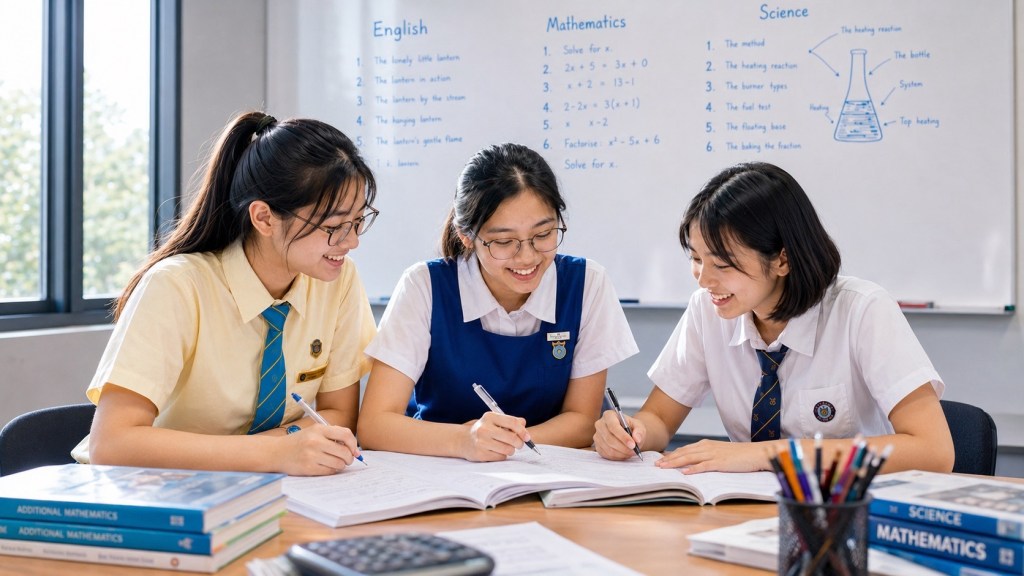
Small-group Mathematics tuition can help students learn from peers, compare methods and build independence—but peers can also distract, rush, intimidate or quietly distort the lesson. Parents searching for Secondary Mathematics tuition in Sengkang, whether friends should attend Math tuition together, or whether a child is distracted by classmates in a small group need a group-dynamics diagnosis rather than a simple “group tuition is good/bad” answer.
In a three-student class, every peer has a large effect because each person occupies a meaningful fraction of the social and instructional environment. One fast student can set pace. One talkative student can dominate discussion. One close friend can turn waiting time into conversation. One anxious learner can create tension. But the same three-student structure can also produce powerful benefits when private first attempts, fair tutor rotation, useful method comparison and differentiated branch work are protected.
At eduKate Sengkang, this Advanced Mathematics Tutorials article owns peer distraction and group dynamics inside small-group Mathematics tuition. It is distinct from the Three-Student Mathematics Grouping owner, which handles placement, and from the Difficulty Fit owner, which handles challenge level. This page asks what happens once the students are already together: when peers help, when peers hurt, and how the tutor should redesign the interaction before deciding to regroup.
Quick answer: when are peers helping Mathematics tuition?
Peers help when each learner still attempts independently, shared discussion reveals useful mathematical differences, tutor attention remains fair, and no student becomes the permanent answer-giver, rescuer, competitor or distraction.
- Helpful group: private thinking before discussion.
- Helpful group: peer methods compared after attempts.
- Helpful group: students remain individually visible.
- Helpful group: waiting time stays productive.
- Helpful group: differences in pace are manageable.
- Harmful group: one student answers before others think.
- Harmful group: friends turn independent time into conversation.
- Harmful group: students compare marks in ways that reduce risk-taking.
- Harmful group: one learner becomes the class tutor.
- Harmful group: quiet learners disappear from tutor attention.
Peer influence is not automatically good or bad
The same peer can help on one task and distract on another. A fast student can model concise working yet also reveal answers too early. A friend can make the class feel safe yet also create off-task talk. Tutors should read the interaction by learning function.
The first group-dynamics question: does each student still think first?
Private first attempts are the most important protection against peer dependence. If students hear the method before committing to their own route, the tutor cannot tell what each learner genuinely knew.
The second question: does discussion add mathematics?
Useful discussion compares methods, identifies common errors, explains conditions or checks reasoning. Low-value discussion repeats the answer, copies the fastest student’s steps or becomes social chatter.
The third question: does peer presence change help-seeking?
Some students ask more when peers are present; others ask less because they feel embarrassed. Tutors should use private working and one-to-one check-ins to keep uncertainty visible.
The fourth question: does the group change pace?
A fast peer can make another learner rush. A slow peer can make a strong learner wait. Small-group tuition works when pace differences remain within a corridor the tutor can manage through branch work.
The fifth question: does the group change difficulty?
A strong peer may pull discussion toward advanced work; a fragile peer may pull shared teaching toward repair. The tutor should protect the shared mathematical spine and branch difficulty rather than letting one learner define the whole class.
The sixth question: does the group change confidence?
Peer comparison can calibrate confidence helpfully or distort it. A student may realise others also make mistakes, or may interpret every faster answer as proof they are weak. Tutors should compare methods, not identities.
Peer benefit 1: seeing another valid method
A small group can show that Mathematics allows multiple routes. This is useful after students have tried independently and can compare conditions, efficiency and error risk.
Peer benefit 2: normalising mistakes
Students can see that strong peers also make sign, interpretation or calculator errors. This can reduce perfectionism when the tutor keeps the discussion analytical rather than competitive.
Peer benefit 3: explanation as retrieval
Explaining a method briefly can strengthen the speaker’s understanding and give peers another representation. The tutor should not make one learner the permanent explainer.
Peer benefit 4: natural independent intervals
While the tutor helps another student, learners practise sustaining their own work. This can reduce tutor dependence if the independent task is clear and appropriately difficult.
Peer benefit 5: contrast creates transfer
Three students may approach the same question differently. Comparing why one method fits can strengthen structural understanding beyond a single tutor demonstration.
Peer benefit 6: realistic pace diversity
Students learn that good Mathematics is not always fastest Mathematics. A slower accurate method and a faster compact method can both be discussed on their merits.
Peer risk 1: answer leakage
One student says the method before others have thought. The remaining students appear fluent because the selection step has been removed. Use silent first attempts.
Peer risk 2: copying
A student watches a peer’s working and reproduces it without owning the method. Fresh individual questions after discussion are essential.
Peer risk 3: social distraction
Friends talk during tutor rotations or turn correction into conversation. The solution can be clearer independent tasks, seating changes or temporary separation—not necessarily ending the group.
Peer risk 4: speed competition
Students race to answer first and compress working. Accuracy and explanation suffer. Remove first-answer rewards and require private work before sharing.
Peer risk 5: status roles
Groups can develop fixed identities: the smart one, the weak one, the careless one. These labels distort how students interpret new evidence. Tutors should use capability-state language and allow roles to change.
Peer risk 6: reassurance dependence
A student may check answers with a peer before the tutor. This can externalise confidence and spread errors. Teach self-checking and delayed comparison.
Peer risk 7: peer tutoring overload
A strong student can become the unpaid assistant, sacrificing their own extension. Peer explanation should be occasional and reciprocal, not a permanent class role.
Peer risk 8: peer intimidation
A learner may hide confusion because another student seems stronger or reacts dismissively. The tutor should protect private attempts and respectful discussion.
Peer risk 9: friendship exclusion
Two friends can create an inside dynamic that leaves the third learner socially or mathematically outside. The tutor should structure turns and shared tasks so every student remains included.
Peer risk 10: conflict or teasing
Teasing about marks, mistakes or speed can damage learning. The tutor should set clear boundaries and intervene. Persistent bullying or serious conduct should not be treated as normal group friction.
The private-first rule
Before group discussion, every learner writes something: a method, representation, first step or confidence judgement. This protects individual evidence.
The no-shout-out rule
Do not reward the first student who calls the answer. Ask for written commitment first, then compare responses.
The wait-time rule
After asking a question, give enough silence for all three students to think. Fast verbal students should not monopolise the class simply because they process aloud.
The peer-comparison rule
Compare mathematical choices, not student rankings. “Method A has fewer algebra steps” is useful. “Student A is better at this” is not.
The tutor-rotation rule
Attention should rotate based on educational need, while every student has meaningful work between check-ins. One vocal learner should not absorb most of the session.
The branch-task rule
Shared concept, different next task. One learner repairs, one stabilises, one extends. This allows meaningful peer connection without identical worksheets.
The fresh-individual-retest rule
After any shared explanation or peer method comparison, use a fresh individual question. This confirms ownership and prevents peer-supported success from being mistaken for mastery.
The seating rule
Physical or virtual arrangement can reduce distraction. Friends may benefit from not sitting directly beside each other during independent blocks. Seating is a teaching variable, not a social punishment.
The device rule
If devices are used, peer distraction can multiply through messages or screen sharing unrelated to work. Keep digital tools purposeful and visible enough for the tutor to protect attention.
The conversation-reset rule
When social talk starts, redirect with a bounded mathematical task rather than extended scolding. “Complete these two questions independently, then we compare” gives the class a clear route back.
The friend-group question
Friends can attend tuition together if the group still produces independent Mathematics. Friendship is not automatically a benefit or risk. The tutor should monitor whether social comfort supports questions or weakens task focus.
The sibling-group question
Siblings may carry family competition or familiar teasing into tuition. A tutor should avoid comparing them and may need stronger individual boundaries than with unrelated peers.
The same-school group question
Same-school students share topic sequence and assessments, which can help alignment. They may also know each other’s marks and class reputations, increasing comparison pressure.
The mixed-school group question
Mixed-school groups reduce some direct ranking and expose students to varied question styles. They require stronger concept-led shared teaching because school sequences differ.
Secondary 1 peer dynamics
New Secondary students can be sensitive to speed and status. Protect private attempts and avoid turning algebra fluency into a race.
Secondary 2 peer dynamics
Bridge skills become more visible, and students may compare readiness for upper Secondary. Keep discussion focused on capability and repair rather than predicted ability labels.
Secondary 3 peer dynamics
A-Math participation can create status differences inside Mathematics groups. E-Math classes should not become implicit comparisons of who takes A-Math.
Secondary 4 peer dynamics
Exam pressure can intensify mark comparison. Use paper-error categories and personal targets rather than peer ranking.
Where this peer-dynamics guide sits in the Mathematics estate
Use the grouping-readiness owner for placement, the quiet-student owner for help-seeking visibility, the difficulty-fit owner for challenge calibration, and this page when the problem is the interaction among students after the group has already been formed.
The peer-effect dashboard
- Independent first moves.
- Answer leakage frequency.
- Copying or method imitation.
- Tutor-attention balance.
- Off-task conversation.
- Mark/speed comparison.
- Help-seeking safety.
- Extension quality.
- Repair quality.
- Fresh individual retest.
A small group is working when most of these remain healthy. One weak row can be adjusted; several persistent weak rows suggest structural mismatch.
The attention-balance problem
In a three-student class, the difference between receiving 20% and 50% of the tutor’s attention is large. Vocal students can unintentionally absorb more. Tutors should audit whether attention follows actual need rather than volume of speech.
The high-needs peer problem
One learner may require repeated rescue. The other two then spend long periods waiting or doing solitary filler. This is no longer merely a peer-dynamics issue; it can signal poor group placement.
The high-speed peer problem
A very fast student can make others rush or can dominate shared comparison. The tutor should use private work first and give the fast learner genuine extension rather than turning speed into the group pace standard.
The highly vocal peer problem
A learner who thinks aloud may be engaged, but their speech can remove selection work from peers. The tutor can say: “Write first, then we compare.” This protects everyone’s evidence.
The highly quiet peer problem
Quiet learners can disappear when social energy is high. The tutor should inspect written work and create predictable check-ins rather than waiting for verbal competition.
The anxious peer problem
One student’s visible anxiety can affect group mood. Keep corrections calm, tasks bounded and peer comparison neutral. Do not let another student’s emotional state become the class’s definition of difficulty.
The perfectionist peer problem
A student who overchecks may slow shared comparison or invite others to doubt correct work. Individual checking routines should remain personal rather than becoming contagious group behaviour.
The competitive peer problem
Competition can motivate some students but can also reduce risk-taking, encourage rushing and turn every answer into status. Academic comparison should focus on methods and improvement, not winners.
The friendship advantage
Friends can make tuition more comfortable, increase attendance and lower help-seeking barriers. They can also provide useful peer explanations when the tutor manages the timing.
The friendship risk
Friends may talk during independent blocks, joke about mistakes or rely on each other’s methods. The tutor needs stronger task boundaries because social familiarity lowers inhibition.
The best-friends rule
Best friends should be grouped only if the class still produces independent Mathematics. If conversation repeatedly dominates despite structure changes, separate them academically even if the friendship is positive outside tuition.
The acquaintance rule
Students who know each other lightly may have enough comfort for discussion without as much distraction. But actual evidence matters more than assumed social chemistry.
The strangers rule
Students do not need prior friendship to learn well together. A respectful mathematical culture can develop quickly when class routines are clear.
The sibling-competition rule
Siblings may compare marks, speed or parental praise. Tutors should avoid treating them as a pair and report each learner against their own capability and target.
The same-school-comparison rule
Students from the same school often know class ranking and test marks. Tutors should minimise unnecessary score discussion and keep school-specific evidence private.
The mixed-school-transfer rule
Mixed-school peers can expose different wording, homework and teacher conventions. This can strengthen transfer if the shared concept remains clear.
Peer explanation: when it helps
- After each student has attempted independently.
- When the explaining student truly understands.
- When the explanation is brief and mathematically relevant.
- When the tutor checks the receiving student’s fresh work afterwards.
- When roles vary over time.
Peer explanation: when it hurts
- Before others have attempted.
- When one student becomes the permanent explainer.
- When the peer gives the answer instead of the relationship.
- When the tutor uses peer teaching to replace needed instruction.
- When the receiving student copies without reconstruction.
The peer-tutor boundary
Students can explain occasionally, but the tutor remains responsible for diagnosis, correction and progression. Strong learners should not lose their own instructional time because they are convenient helpers.
The tutor’s private-thinking protocol
- Pose the question.
- Require individual working.
- Prevent early answer shouting.
- Inspect each first move.
- Then compare methods.
- Finish with a fresh private retest.
This simple sequence protects most of the benefits of peers while reducing answer leakage.
The group-comparison protocol
When comparing methods, ask what changed and what stayed the same. Keep the discussion about mathematical structure rather than whose method is “smartest”.
The correction protocol
Do not ask students to publicly announce every wrong answer. Select errors that are mathematically useful, anonymise where practical and allow students to self-correct before group discussion.
The mark-comparison boundary
Students may naturally know each other’s results, but the tutor should not use marks as public motivation. A student can improve from 55 to 70 while another moves from 85 to 88; both learning stories are legitimate.
The speed-comparison boundary
Fast completion is not the only signal of strength. Tutors should praise clear method, error detection, transfer and efficient checking, not only who finished first.
The homework-comparison boundary
Students should not compete over who completed more worksheets. Homework volume may differ because learning jobs differ.
The extension-comparison boundary
One learner may receive harder branch work. Explain that differentiated tasks follow current need, not rank or status.
The repair-comparison boundary
A student doing easier repair should not be described as “behind” in front of peers. The task is targeted at a dependency and should reconnect to shared work when ready.
The group-language rule
Use neutral language such as “your next task” rather than “easy set” and “hard set”. This reduces status interpretation inside differentiated small groups.
The error-culture rule
Students should see mistakes as normal evidence. Teasing, eye-rolling or exaggerated reactions to another student’s error need prompt correction because they damage future visibility.
The confidentiality rule
Parents should not receive detailed information about other students’ marks or difficulties. Group fit can be discussed without revealing peer data.
The parent-comparison trap
Parents may ask whether their child is the strongest or weakest in the group. A better question is whether the shared core remains useful and whether the child receives the right branch task.
The student-status trap
Learners can become attached to being “the strong one” or “the weak one”. Fresh questions and changing roles help prevent these identities from hardening.
The fixed-role reset
Every few weeks, use new tasks that do not reproduce old roles. A quiet learner may excel on graph interpretation; a fast algebra student may need help with modelling. The group should allow new evidence to change expectations.
The peer-pressure-to-rush pattern
Students begin skipping working or checking because peers finish first. Introduce a quality floor: no answer is complete until the required working and one targeted check are visible.
The peer-pressure-to-overcheck pattern
A student may doubt correct work after seeing a peer’s different answer. Teach independent confidence calibration before comparison.
The peer-pressure-to-hide pattern
A learner avoids asking because peers appear to understand. Create private uncertainty markers and tutor check-ins so help does not require public exposure.
The peer-pressure-to-perform pattern
Students may answer quickly in discussion but produce weaker written work. Give private evidence more weight than verbal fluency.
The peer-pressure-to-copy pattern
If copying increases, change seating, require private starts and vary question numbers or surface features while keeping the shared concept.
The peer-pressure-to-teach pattern
A strong learner can feel responsible for helping friends. The tutor should make clear that each student must attempt independently and that peer explanation is optional, not a duty.
The group should have a conversation budget
Small-group tuition benefits from talk, but discussion should serve Mathematics. If social conversation repeatedly consumes independent time, use shorter work blocks with clear endpoints.
The group should have a silence budget
Quiet time is necessary for retrieval, method selection and independent evidence. A class that talks continuously can feel engaging while producing little learner-owned Mathematics.
The group should have an attention budget
Tutor attention is finite. Group design should prevent one student’s confusion, confidence or personality from absorbing most of it every week.
The group should have an extension budget
Strong students need enough tutor attention on advanced reasoning, not only independent filler while the tutor repairs peers.
The group should have a repair budget
Fragile students need enough targeted help to reconnect, but not so much that the class becomes three private lessons stitched together.
The group should have a social-reset routine
When talk becomes off-task, use a short silent block, new seating or a clearly bounded problem. Avoid turning social correction into a long lecture that consumes more class time.
When seat changes are enough
If distraction is mainly between two friends, a different physical arrangement can solve the problem without changing the group.
When branch-task changes are enough
If one learner distracts others because they finish early, better extension can keep them productively occupied.
When tutor-rotation changes are enough
If quiet or slower students are overlooked, a more deliberate rotation can improve visibility without regrouping.
When group rules are enough
Private first attempts, no answer shouting, respectful error discussion and clear device use can resolve many ordinary dynamics.
When regrouping becomes reasonable
- Distraction persists after structure changes.
- One learner repeatedly dominates tutor attention.
- Two friends cannot sustain independent work together.
- Peer intimidation blocks help-seeking.
- Shared pace is chronically too fast or too slow for one learner.
- Strong learners receive mostly filler.
- Fragile learners remain permanently on disconnected repair.
When regrouping is premature
Do not move a student after one chatty lesson, one conflict or one difficult topic. First test seating, task design, private-thinking routines and tutor rotation.
When serious conduct requires faster action
Persistent bullying, harassment or behaviour that makes another student feel unsafe should not be treated as ordinary group chemistry. The provider should intervene promptly and protect the affected learner.
The one-month group-dynamics intervention
- Week 1: map peer interaction and attention.
- Week 2: enforce private-first routines.
- Week 3: adjust seating, branch tasks and tutor rotation.
- Week 4: review fresh individual evidence and decide whether regrouping is needed.
The group-dynamics progress review
- Independent work quality.
- Peer distraction frequency.
- Help-seeking visibility.
- Tutor-attention balance.
- Extension quality.
- Repair quality.
- Mark/speed comparison.
- Fresh-question ownership.
- Student’s own experience of the group.
Worked peer profile 1: two friends talk during every tutor rotation
Seat them apart during independent work, use five-to-ten-minute bounded blocks and require fresh individual questions. If conversation remains dominant, separate the group despite the friendship.
Worked peer profile 2: one fast student answers everything
Use silent first attempts, then ask different students to explain specific reasoning only after writing. Give the fast learner richer branch work so speed does not become the class’s organising principle.
Worked peer profile 3: quiet student hides confusion beside stronger peers
Use private uncertainty marks and tutor check-ins. If the student still cannot ask and class pace remains too high, review placement.
Worked peer profile 4: one learner needs much more repair
Keep shared teaching only if the core remains useful. Use a temporary repair branch or private block. Regroup if the learner’s needs dominate most lessons.
Worked peer profile 5: strong learner becomes peer tutor
Reduce peer-teaching requests and provide genuine extension. The student’s own learning job remains the tutor’s responsibility.
Worked peer profile 6: mark comparison causes rushing
Stop public score talk, use personal error targets and require working-quality criteria before answers are checked.
Worked peer profile 7: competitive peers improve each other
Competition can remain healthy when it focuses on reasoning, not rank. Compare methods, precision or self-correction rather than who finishes first.
Worked peer profile 8: same-school students obsess over class rank
Redirect toward capability states and individual paper errors. Tuition should not reproduce school hierarchy unnecessarily.
Worked peer profile 9: mixed-school students have different topic sequences
Use concept-led shared work and school-specific branch tasks. Peer variety can strengthen transfer if the group does not become three unrelated curricula.
Worked peer profile 10: one student is socially excluded
Structured turns and collaborative comparison may help, but persistent exclusion or hostility needs direct intervention. Learning quality includes a group environment in which each student can participate safely.
Peer roles should remain fluid
A healthy small group does not have permanent characters. The fastest student should not always be the explainer. The quietest student should not always be the listener. The learner currently repairing algebra can later be strongest at graph interpretation. Fresh evidence should be allowed to change roles.
The “smart one” role
This student may become risk-averse because they want to preserve status. They may avoid asking questions or admitting uncertainty. Tutors should give unfamiliar problems and normalise productive error.
The “weak one” role
This student may stop attempting because peers and adults already expect difficulty. Use private questions and visible improvement so the learner can generate new evidence that disrupts the label.
The “funny one” role
Humour can reduce tension but can also pull attention away from work. Keep the student’s personality welcome while setting clear moments for silent thinking.
The “helper” role
A capable, generous learner may repeatedly assist peers. Limit this so the learner still receives their own instruction, stretch and feedback.
The “quiet one” role
Silence should not become invisibility. The tutor should know the quiet student’s current error profile and extension/repair state.
The “competitive one” role
Competition can be redirected toward personal bests, clearer working, fewer repeated errors or faster recovery rather than peer rank.
The “copying one” role
Copying is often a symptom of poor independence, pace mismatch or fear of being left behind. Use differentiated questions and private first attempts rather than only reprimand.
The “distracted one” role
A learner may be socially distractible only during low-value waiting time. Improve branch tasks before treating the student as inherently unfocused.
The group should avoid public ability labels
Words like “top student”, “weakest”, “advanced one” and “slow one” can harden temporary states. Describe current tasks and capabilities instead.
The group should avoid public homework comparisons
Different homework volumes can be appropriate. Publicly comparing completion can create competition around quantity rather than learning.
The group should avoid public parent narratives
Students should not hear that another parent expects a particular mark or paid for extra support. Keep family context private.
The group should avoid public school-rank discussion
Same-school peers may volunteer class positions or results. The tutor can redirect to error categories and personal goals.
The group should avoid public tuition-rank discussion
Small-group tuition should not recreate a mini ranking system unless the task itself is a neutral game with clear educational purpose and no identity consequences.
Peer dynamics during first learning
Private thinking time is especially important when a concept is new. One student’s premature method can become everyone else’s borrowed script.
Peer dynamics during deliberate practice
Students can work independently in parallel and compare selected errors afterwards. This preserves repetition and individual evidence.
Peer dynamics during transfer practice
Multiple peer methods can be highly useful after private attempts. The tutor should surface the invariant structure across the different routes.
Peer dynamics during mixed practice
Avoid letting the fastest student classify every question. Each learner should privately identify the method family before group comparison.
Peer dynamics during timed work
Timed sections should usually remain individual. Public speed comparison can distort pacing and encourage rushing.
Peer dynamics during corrections
Use recurring errors as learning objects without attaching them permanently to the student who made them. Let students self-correct before discussion.
Peer dynamics during enrichment
Strong students can benefit from collaborative problem solving, but only after each has made an independent attempt. Otherwise collaboration can hide unequal contribution.
Peer dynamics during catch-up
A learner repairing foundations may feel exposed beside stronger peers. Keep repair branch work neutral and temporary, with a visible path back to shared tasks.
Peer dynamics during exam revision
Exam pressure can increase score comparison and answer leakage. Personal paper logs and quiet timed blocks are especially important.
Peer dynamics before a WA
Keep scope clear and use individual retrieval first. Students may compare how much they know; tutors should focus on each learner’s assessed gaps.
Peer dynamics after a WA
Do not turn returned marks into public ranking. Use private error review and selected anonymised patterns for group teaching.
Peer dynamics before EOY
Broader revision creates more opportunity for peer transfer but also more opportunity for copying. Use varied but parallel question sets where helpful.
Peer dynamics before prelims
Secondary 4 students may know each other’s prelim results. Keep the tuition room focused on recoverable marks, not peer position.
Peer dynamics after prelims
One student may have done far better than peers. Resist using that student as proof of a method or standard. Each learner’s final recovery plan should remain individual.
Peer dynamics and strong results
Success can increase status pressure. Strong learners may become afraid to make mistakes publicly. Rich unfamiliar problems and private attempts can keep learning honest.
Peer dynamics and weak results
A student with a disappointing paper may withdraw socially. Protect privacy and keep the repair plan bounded so peers do not define the learner by one result.
Peer dynamics and tutor praise
Praise specific actions rather than relative performance: clear representation, precise correction, improved checking, useful question. This reduces status competition.
Peer dynamics and tutor criticism
Correction should stay private or mathematically neutral where possible. Public criticism can make the whole group less willing to reveal mistakes.
Peer dynamics and parent reporting
Parents can be told whether the group is a good learning fit without being told another student’s marks, personality or difficulties. “The current group pace remains suitable” is enough.
Peer dynamics and parent requests for stronger peers
Parents may believe their child will rise by sitting with stronger students. This can help when shared teaching remains accessible, but a large mismatch can produce copying, intimidation and low tutor attention. Strong peers are not automatically strong placement.
Peer dynamics and parent requests for similar peers
Similarity in marks does not guarantee fit. Support dose, independence and learning job matter more than percentage alone.
Peer dynamics and parent requests for friends
Friendship can support attendance and comfort, but should not override evidence of distraction or poor pace fit.
The social-comfort versus academic-focus matrix
- High comfort + high focus → excellent group.
- High comfort + low focus → structure the friendship or separate.
- Low comfort + high focus → may still be academically healthy; build respectful interaction.
- Low comfort + low focus → strong case for regrouping.
The competition-versus-collaboration matrix
- Healthy competition + independent work → can motivate.
- Healthy collaboration + private first attempts → can deepen learning.
- Competition + rushing → harmful.
- Collaboration + copying → harmful.
- No interaction + strong individual progress → still acceptable if group structure adds value.
The attention-versus-independence matrix
- Low tutor attention + productive independent work → healthy.
- High tutor attention + genuine repair need → acceptable temporarily.
- High tutor attention + one student every week → placement concern.
- Low tutor attention + silent stuck work → invisibility concern.
The peer-distraction reset
- Reset seating.
- Shorten independent blocks.
- Clarify finish lines.
- Use parallel-but-not-identical questions.
- Require private starts.
- Rotate tutor attention deliberately.
- Delay group discussion until evidence exists.
The peer-competition reset
- Stop first-answer rewards.
- Reduce public mark discussion.
- Use personal performance targets.
- Compare method quality rather than speed.
- Give strong students unfamiliar work that allows visible mistakes.
The peer-copying reset
- Change surface values.
- Use individual method-selection prompts.
- Ask students to explain their own route.
- Retest privately.
- Move seats where necessary.
The peer-exclusion reset
- Use structured turns.
- Assign shared mathematical comparison, not social roles.
- Protect private think time.
- Address disrespect directly.
- Regroup if exclusion persists.
The group-noise reset
A lively group is not automatically distracted. The question is whether talk contains Mathematics and whether independent work remains strong. Use quiet blocks when evidence is being produced and discussion blocks when comparison adds value.
The overly-silent-group reset
A group can be so silent that no method comparison or question culture develops. The tutor can invite short mathematical explanations without requiring social chatter.
The group-stamina interaction
Peer distraction often rises late in a 90-minute lesson. Change task mode, reset seating or use a timed independent block before assuming the group is always poorly behaved.
The group-difficulty interaction
Overly easy work increases social distraction because students have spare attention. Overly hard work can increase copying. Calibrate challenge before treating every problem as behavioural.
The group-help-seeking interaction
Students should not use peers as the first source of reassurance on every question. Attempt, self-check and tutor/peer discussion should have clear order.
The group-method-conflict interaction
Different peers may use different valid routes. The tutor should compare them without letting one student’s method become the default merely because they are confident.
The group-dependence interaction
A student can become peer-dependent instead of tutor-dependent. Fresh individual work is the protection.
The group-regression interaction
If a student’s marks fall after joining a new group, compare independent work, pace and peer effects before blaming content teaching alone.
The group-progress-review interaction
A progress report can state whether the learner is benefiting from peer method comparison, remaining independent between tutor turns and receiving appropriate branch difficulty.
The group-trial interaction
A trial lesson should observe whether the student works productively when the tutor turns away and whether peer presence improves or worsens first attempts.
The group-switch interaction
If the tutor is effective but peer dynamics remain harmful, change group before changing tutor when a suitable alternative exists.
The group-release interaction
A learner who becomes highly independent may eventually need less group support. Peer benefits should remain distinct enough to justify the class.
Friendship case 1: two close friends improve attendance but lose focus
The social comfort is useful, but the group needs stronger work boundaries. Seat them apart for independent blocks, set visible finish lines and delay conversation until the comparison phase. Keep them together only if the Mathematics becomes reliably productive.
Friendship case 2: friends help each other ask questions
The students feel safer raising uncertainty when a familiar peer is present. Preserve this benefit, but require each student to attempt independently before discussion so comfort does not become dependence.
Friendship case 3: one friend carries the other
The stronger student explains, reminds formulas and checks answers. The weaker learner appears to improve but fresh individual questions remain weak. Reduce peer rescue and rebuild independent starts.
Friendship case 4: friendship conflict spills into tuition
Arguments outside class can reduce cooperation and attention. The tutor should keep the lesson professionally structured and may temporarily separate seating or regroup if the conflict persists.
Strong learner in a mixed group
The strongest learner can benefit from peer method comparison, but must receive genuine extension. If most lesson time becomes independent filler while the tutor supports others, the group no longer offers enough shared value.
Fragile learner in a mixed group
A fragile learner can benefit from hearing clear methods, but only after a private attempt. If the learner mostly copies or is chronically rushed, the group is too demanding or poorly structured.
Average-performing learner in a mixed group
This learner can be overlooked because attention goes to the strongest and weakest peers. Tutor rotation should ensure the middle student still receives diagnosis, challenge and feedback.
Quiet learner in a lively group
Use written-first routines and individual check-ins. If the learner’s fresh work remains visible and help-seeking improves, the group can still fit despite different communication styles.
Vocal learner in a quiet group
The tutor can channel the learner’s verbal energy into concise explanations after private work. Do not let one student’s thinking style erase others’ processing time.
Competitive learner in a collaborative group
Redirect competition toward personal precision, recovery and transfer. The student can still enjoy challenge without making peer rank the class currency.
Anxious learner in a competitive group
Public speed or mark comparison can worsen avoidance. Use private goals and remove ranking signals. If the culture cannot shift, regrouping may be necessary.
The peer-dynamics parent conversation
Parents can ask: “Does my child still work independently when the tutor is with someone else?” “Does the group help them think or mostly distract?” “Is my child receiving the right branch difficulty?” These questions are more useful than asking who is strongest.
The peer-dynamics tutor conversation
Tutors should be able to explain the learning benefit of the current group: shared concept, useful comparison, manageable pace and fair attention. “They get along well” is not enough.
The peer-dynamics student conversation
Students can be asked: “What do the other two students help you learn?” and “When do they make it harder to focus?” This produces actionable evidence without inviting gossip.
The one-week observation period
Before changing the group, observe the exact interaction pattern for several lessons if the concern is ordinary distraction. Record when distraction occurs, what task type is involved and which structural change restores focus.
The one-month intervention period
For persistent but non-serious problems, use four weeks of private-first work, seating changes, branch redesign and tutor rotation before deciding whether the group itself is unsuitable.
The immediate-regroup threshold
Faster action is appropriate when there is persistent bullying, serious exclusion, intimidation or a group dynamic that prevents the learner from participating safely. Educational fit includes interpersonal safety.
The stay threshold
- Private attempts remain strong.
- Peer discussion adds useful Mathematics.
- Distraction responds to structure.
- Tutor attention is balanced.
- Help-seeking remains safe.
- Branch difficulty is appropriate.
- Fresh individual retests show ownership.
The regroup threshold
- Distraction remains chronic after redesign.
- One learner consistently dominates or disappears.
- Peer dependence persists.
- Strong learners receive mostly filler.
- Fragile learners cannot access the shared core.
- Competition or exclusion damages risk-taking.
- Tutor attention cannot be distributed fairly.
The tutor-switch threshold
Change tutor only when the adult cannot or will not manage the group effectively and no better group with the same tutor/provider is available. Many peer problems are structural rather than tutor-specific.
The individual-tuition threshold
Temporary one-to-one support can help when one learner needs intensive repair or must rebuild help-seeking before re-entering a group. It should have an exit condition.
The no-group-needed threshold
A highly independent learner may eventually gain little from peer interaction relative to the scheduling or distraction cost. Consultation-style support or self-study can be considered.
Peer dynamics and WA preparation
Reduce chatter and increase individual retrieval. Group comparison should focus on high-value errors and method choices after private work.
Peer dynamics and EOY preparation
Broader revision can benefit from peer variation, but each student needs their own retrieval map and weak-topic plan.
Peer dynamics and prelim preparation
Use individual timed sections and private error logs. Shared discussion can compare recovery strategies, but score comparison should remain low-value.
Peer dynamics in the final examination weeks
Keep routines stable, reduce social noise and protect independent paper time. The group should not become a place for last-minute method contagion.
Peer dynamics after examinations
Use lower-pressure periods for enrichment, collaborative modelling and method comparison. The group can explore more freely when immediate assessment cost is lower.
Peer dynamics during school holidays
Holiday sessions can deepen collaboration, but friends may also become more social. Keep project roles mathematically meaningful and require individual evidence.
Peer dynamics after long breaks
Roles may reset after holidays. Use fresh diagnostics rather than assuming the same student remains strongest or most fragile.
Peer dynamics and regression
If one student’s marks fall, avoid publicising the recovery. Keep the learner’s repair private while preserving ordinary participation in shared work.
Peer dynamics and strong improvement
A student who improves rapidly may outgrow the group’s old pace. Increase branch challenge first; regroup if shared teaching becomes too low-value.
Peer dynamics and missed lessons
A returning student can feel socially and academically behind. Use a short re-entry bridge and avoid making peers responsible for catching them up.
Peer dynamics and relief tutors
A substitute tutor may not know the group’s social patterns. Handover should include only educationally relevant dynamics: friends who distract, quiet learner visibility, fixed roles to avoid.
Peer dynamics and dual tutors
Students in more than one programme may compare peer cultures. The main question remains whether the current group produces useful independent learning, not whether another class feels more competitive or relaxed.
The peer-independence test
- Can the student start before hearing peers?
- Can they keep working while the tutor rotates?
- Can they check without peer reassurance?
- Can they solve a fresh private question after discussion?
- Can they disagree with a peer method and explain why?
- Can they ask the tutor without waiting for a friend?
The peer-transfer test
After hearing another method, the student should be able to solve a changed question independently. If the method vanishes when the peer is absent, transfer has not occurred.
The peer-confidence test
Ask the learner to commit to an answer or method before comparison. This builds confidence based on evidence rather than peer consensus.
The peer-recovery test
When a learner gets stuck, they should first use their own recovery routine—re-read, represent, mark uncertainty—before looking at a peer’s page.
The peer-explanation test
When a learner explains, ask the receiving student to restate or apply the idea in a fresh example. This prevents explanation from becoming passive consumption.
The peer-dynamics termly review
- Shared core still useful?
- Pace differences still manageable?
- Peer distraction controlled?
- Tutor attention fair?
- Group roles fluid?
- Extension meaningful?
- Repair temporary?
- Student still independent?
The group-release path
The learner should become better at thinking alone because of the group—not worse. Over time, peer comparison becomes optional enrichment rather than a necessary cue for starting, checking or believing an answer.
The tutor’s final group rule
Peers are a learning resource, not a teaching substitute. Use them to reveal methods and normalise error, while preserving each learner’s independent evidence and direct tutor access.
The parent’s final group rule
Choose a group for the learning architecture, not for friendship, prestige or the average mark of the other students. The right peers are the ones with whom your child can think independently and still gain something useful from comparison.
The student’s final group rule
Use peers to broaden your thinking, not to borrow certainty. Attempt first, compare second, and make sure the final method is yours.
Final synthesis: good peer effects increase independence
The best small-group Mathematics class uses peers to expand perspective while keeping ownership individual. Students see other methods, hear useful questions and learn that mistakes are normal—but still produce their own first moves, corrections and fresh answers.
When peer presence starts replacing thinking, tutor attention or self-confidence, redesign the group. When redesign cannot restore independence and fair learning, regroup.
The parent should ask whether the peer effect survives outside class
A group can look excellent during tuition because students stimulate one another, yet the learner may be unable to reproduce the work alone. Compare homework, school tests and delayed fresh questions. Peer benefit is strongest when it transfers into independent performance.
The tutor should ask whether peer benefit is evenly distributed
One learner may gain from the group while another mainly provides value. A strong small-group model should create enough distinct benefit for all three.
The student should ask what peers are adding
Useful answers include another method, a helpful question, a realistic pace or a different school perspective. “They tell me the answer” is not a healthy group benefit.
The group should not depend on one personality
If the class only feels productive when one highly engaged student attends, the architecture is fragile. The tutor should provide enough structure that the group still works when any one learner is absent.
The group should not collapse when friends are separated
If changing seats destroys motivation, the friendship may have become too central to the class experience. Academic engagement should survive ordinary boundary changes.
The group should not collapse when the strongest student is absent
Other learners should still be able to identify methods and work independently. This is a direct test for hidden peer dependence.
The group should not collapse when the tutor is helping someone else
Each learner should have enough independence to continue for short periods. Small-group tuition builds this capacity deliberately.
The group should not rely on peer correction for basic accuracy
Students can compare answers, but personal checking routines should remain primary. Otherwise one peer’s error can spread across the class.
The group should not use embarrassment as motivation
Teasing someone into doing homework or avoiding mistakes may appear effective briefly, but it reduces honest evidence. Motivation should come from clear goals, feedback and growing capability.
The group should not use public praise as ranking
Specific praise can be shared without creating hierarchy. “That diagram made the relationship visible” is better than “you are always the best at these questions.”
The group should not equate loudness with leadership
Mathematical leadership can be a precise question, a careful check or a useful alternative method. Tutors should broaden what valuable participation looks like.
The group should not equate quietness with weakness
Fresh individual evidence remains the standard. Quiet students can be the strongest independent thinkers in the room.
The group should not equate speed with readiness for harder work
A fast learner may still lack transfer. Use changed questions and delayed retrieval before accelerating.
The group should not equate slowness with poor fit
A thoughtful learner may be slower yet highly independent and accurate. Regroup only when pace differences create chronic waiting, rushing or unequal attention.
The tutor should protect the final answer from peer contamination
After discussion, ask students to complete a fresh question separately. The final evidence should belong to the learner, not to the group conversation.
The tutor should protect the first move from peer contamination
Before discussion, require written commitment. This makes later comparison meaningful and preserves diagnosis.
The tutor should protect corrections from peer contamination
Students should first inspect their own working before seeing another person’s correction. Otherwise peer solutions can overwrite the evidence needed for self-correction.
The tutor should protect revision choices from peer pressure
One learner may need retrieval while another needs timed papers. Homework and revision should remain evidence-led rather than socially matched.
The tutor should protect question difficulty from status pressure
Students should not be given harder work merely to preserve a “strongest” identity. Challenge should follow capability.
The tutor should protect learner privacy in progress conversations
Parents can be told that the group remains a good fit without hearing details about the other two students. This protects trust across the class.
The parent decision: keep friends together
Keep them together when social comfort supports attendance and questions while independent work remains strong. Friendship is then an advantage.
The parent decision: separate friends
Separate academically when repeated structure changes fail to prevent distraction, copying or avoidance. This need not affect the friendship outside tuition.
The parent decision: seek stronger peers
Only if the learner can access the shared work independently and the group offers genuine extension. Stronger peers are not useful when they simply create answer leakage and rushing.
The parent decision: seek similar peers
Useful when pace and support differences are currently too wide, but similarity should be defined by learning job and independence rather than marks alone.
The parent decision: move to private tuition
Consider temporary private support when one learner needs intensive repair or must rebuild help-seeking. Define the condition for returning to a group where appropriate.
The parent decision: reduce tuition instead of regrouping
If the learner has become highly independent and peer benefit is low, less frequent consultation may be better than finding another small group.
The termly group audit
- What shared concept work was useful?
- How much independent time remained productive?
- Who received most tutor attention?
- Did anyone become a fixed role?
- Were peer methods useful or contaminating?
- Was distraction structural or occasional?
- Did each learner receive proper extension or repair?
- Should the group stay intact next term?
The stay-together decision after one term
Stay when all three learners still receive useful shared teaching, branch work remains meaningful, distraction is manageable and independent evidence is improving.
The regroup decision after one term
Regroup when the group’s social or instructional dynamics repeatedly prevent fair attention, useful challenge or independent thinking despite deliberate redesign.
The release decision after one term
A learner may no longer need the group if ordinary schoolwork, retrieval and revision are independently strong and peer interaction adds little distinct value.
The fresh-group trial
If regrouping is considered, use a trial lesson. Observe first moves, waiting behaviour, question safety, pace and branch work. Do not assume a new group is better because the average marks are closer.
The peer-dynamics handover
When moving groups, record only what matters educationally: pace, support dose, helpful/harmful peer patterns and current learning job. Avoid labels such as “distracting student” that can follow the learner unfairly.
The new-group reset
Do not recreate old roles. Give all students fresh private work and establish group routines from the beginning.
The learner should eventually manage peer influence personally
Older students can learn to keep working when peers talk, resist answer leakage, ask for quiet when needed, and compare methods without changing their own answer merely because someone else is confident.
The learner’s peer-boundary language
- “Let me try first.”
- “Don’t tell me the method yet.”
- “I got a different answer; let me check mine before I copy.”
- “Can we compare methods after this question?”
- “I need to ask the tutor about this step.”
These short phrases protect independence without requiring conflict.
The learner should know when peer help is appropriate
After a real attempt, a peer can explain a representation or compare methods. Before an attempt, peer help often removes the exact decision the student needs to practise.
The learner should know when peer help is not enough
If a misconception repeats, if two peers disagree on a rule, or if the student cannot generate a first move, tutor guidance is more appropriate than peer consensus.
The learner should know when to ignore peer speed
A peer finishing early does not change the learner’s own accuracy and working requirements. Examination success is personal, not synchronous.
The learner should know when to ignore peer marks
Another student’s score does not change the learner’s current repair, transfer or exam-control job.
The learner should know when peer comparison is useful
After independent work, compare where methods differ and what error risks each route contains. This turns social comparison into mathematical analysis.
The tutor should gradually need fewer group rules
As students mature, private-first thinking, respectful error discussion and independent waiting should become habitual. The group can become more conversational without losing ownership.
The group should eventually become a transfer environment
At maturity, peers expose students to variation rather than provide support they cannot do without. Each learner enters with an independent method and leaves with a broader view.
The ultimate peer-effect test
Would the student still be able to do the Mathematics if the other two were absent? If yes, peer presence is likely enriching. If no, the group may be carrying functions the learner has not internalised.
The ultimate group-fit test
Does peer presence make independent Mathematics stronger over time? This is the core standard. Better questions, broader methods, normalised errors and sustained work are positive. Copying, rushing, hiding and dependence are negative.
Final parent checklist
- My child still attempts before peers answer.
- The tutor sees my child’s own working.
- Peer discussion adds value after attempts.
- Distraction responds to structure.
- The class is not organised around one dominant student.
- Mark and speed comparison are controlled.
- My child receives appropriate challenge.
- Fresh individual work confirms ownership.
Final tutor checklist
- Do all three produce independent evidence?
- Does one peer leak answers?
- Are fixed roles forming?
- Is attention balanced?
- Are friends distracting each other?
- Are strong students still stretched?
- Are fragile students reconnecting?
- Would regrouping improve the architecture?
Final student checklist
- I try before I look at peers.
- I can keep working when the tutor helps someone else.
- I do not copy certainty.
- I can compare methods without losing my own reasoning.
- I can ask the tutor when peer help is insufficient.
- I know my own learning job regardless of peer marks.
Final standard: peers should widen thinking, not replace it
The purpose of small-group peers is to create useful variation, not a social shortcut through the Mathematics. A healthy group gives each learner something they could not obtain as easily alone—another method, another question, another perspective—while preserving independent first moves, error ownership and self-confidence.
When peers widen thinking and independence grows, the group is doing its job. When peers become the source of answers, status or distraction, change the structure. When structure cannot fix it, regroup.
The final peer audit after a major assessment
After a WA, EOY or prelim, ask whether group dynamics affected the paper in a recognizable way. Did the learner rush because speed competition had become normal? Did they hesitate without peer confirmation? Did they reproduce a peer’s method incorrectly? Or did exposure to several methods improve transfer? Assessment evidence can confirm whether the group effect is entering independent performance.
The final peer audit after a period of strong improvement
Improvement should change the role of peers. A learner who once benefited from watching others may now need less comparison and more independent extension. The group should not preserve old support patterns after the student outgrows them.
The final peer audit after regression
If marks fall, check whether the learner has become more dependent on peer cues, more rushed by comparison or less willing to ask. Do not assume the group is at fault without fresh individual evidence, but do not ignore social changes either.
The final peer audit after a tutor rotation change
If more balanced tutor attention reduces distraction or copying, keep the new rotation. Small-group dynamics often improve when students know when the tutor will return and what they should do meanwhile.
The final peer audit after seat changes
If separating friends restores independent work without reducing participation, the original issue was proximity rather than group membership. Keep the lowest-cost structural fix.
The final peer audit after branch-work redesign
If strong students stop distracting others once they receive richer extension, the group can remain intact. Under-challenge was driving the behaviour.
The final peer audit after private-first routines
If copying and answer leakage drop once every learner writes before discussion, the class has recovered one of the core advantages of small-group teaching: multiple visible minds rather than one shared answer stream.
The final regrouping rule
Regroup only when the social or instructional cost persists after deliberate structure changes and materially reduces learning. A group should not be preserved because friendships are convenient or changed because one lesson was noisy.
The final stay-together rule
Keep the group when all three remain individually visible, independent work is strong, peer comparison adds mathematical value and tutor attention remains equitable.
The final peer-release rule
The learner should eventually be able to use peer input selectively. They can hear another route without losing their own, accept a different answer without abandoning self-checking, and continue working when nobody else is available.
The peer-independence endpoint
- Peers are useful, not necessary.
- Discussion follows private thinking.
- Comparison broadens methods.
- Errors remain individually owned.
- Tutor attention remains direct.
- Peer marks do not define confidence.
- The learner can study alone between lessons.
The parent’s last question
“Would my child still know how to start, check and correct this Mathematics if the other two students were absent?” If yes, peers are likely enriching the system. If no, the group may be carrying too much of the learner’s thinking.
The tutor’s last question
“Is each learner becoming more independent because of this group?” This protects against attractive but shallow group energy. Lively classes are useful only when learner-owned Mathematics grows.
The student’s last question
“What did I learn from my peers that I can now do without them?” That answer turns group learning into transfer.
A final note on healthy social energy
Small-group tuition does not need to be silent or severe. Students can laugh, compare, encourage and enjoy being together. The standard is simply that social energy should return students to the Mathematics rather than displace it.
A final note on healthy competition
Competition can remain light and motivating when it does not determine status or push students to rush. Personal accuracy, clearer methods and fewer repeated errors are safer targets than being first.
A final note on healthy collaboration
Collaboration is strongest when every student brings an independent contribution. Shared problem solving becomes richer when no one is merely following.
A final note on friendship
Friends can be excellent tuition peers. They simply need boundaries that allow friendship to coexist with independent working. If those boundaries repeatedly fail, academic separation can protect both learning and the friendship itself.
A final note on group identity
The class should not become a fixed hierarchy. Let students surprise one another. New topics, fresh questions and changed representations should continually update what everyone thinks they know about each learner.
Closing standard
A three-student Mathematics group earns its value when peers widen the learning field without taking ownership away from the learner. Students should think privately, compare intelligently, ask safely, recover independently and leave with stronger Mathematics than they would have carried alone.
The group is successful when the presence of peers strengthens independent capability. That is the peer-dynamics standard worth keeping.
The final classroom-design rule
Peer dynamics should be designed, not left to chance. A three-student class is small enough that the tutor can shape who speaks, when discussion happens, how independent work is protected and how attention rotates. The group should not depend on personality chemistry alone.
When the tutor deliberately separates private thinking from shared comparison, even very different students can learn well together. The quiet student remains visible. The fast student remains challenged. The fragile student receives repair without becoming the class identity. Friends can enjoy one another without replacing the work.
The final parent decision rule
Parents should judge a small group by what happens when the tutor is not speaking. Does the child keep working? Do they wait for peers? Do they copy? Do they know what question to ask? The quality of those independent minutes often tells more about group fit than the liveliness of shared discussion.
The final tutor decision rule
If a group problem can be solved through seating, task design, private-first routines or attention rotation, keep the group and fix the structure. If the group repeatedly prevents one learner from thinking independently or receiving fair teaching despite these changes, regroup.
The final learner decision rule
Use peers after you have something of your own to compare. Their ideas should make your Mathematics broader, not replace your first move, your checking or your confidence.
That is the durable outcome: the group becomes a source of variation and perspective while each student remains responsible for the final route they can carry alone.
The last peer-quality test
Give each learner a fresh question after a period of lively group comparison and remove access to peer working. If all three can start, choose methods and explain their own route, the group discussion probably strengthened learning. If one or more students suddenly cannot begin, the class conversation may have been carrying too much of the thinking.
This test matters because small-group tuition can look excellent from the outside: students answer quickly, talk about methods and appear engaged. The deeper standard is whether each student’s independent Mathematics becomes stronger because of the interaction.
The last regrouping safeguard
Regrouping should remain a teaching decision, not a social judgement. A student may be moved because the shared pace, support dose or interaction pattern no longer creates enough value. Explain the change neutrally and preserve the learner’s dignity. “This group will give you more useful paper practice” is better than “you are too weak/strong for the others.”
The last stay-together safeguard
Do not separate a productive group simply because the students are friends, talk occasionally or have different marks. If private work remains strong, tutor attention is fair and fresh retests confirm ownership, social comfort can be a genuine learning asset.
The final immutable peer standard
Peers should create useful comparison after independent thinking, not before it. They should widen representation, normalise error, provide another perspective and make the class socially sustainable without becoming sources of answers, status or reassurance.
When those conditions hold, three students can produce a powerful Mathematics learning environment: small enough for individual visibility, social enough for comparison, and structured enough that every learner still owns the work they take home.
A final one-term question for the learner
At the end of a term, the student should be able to name what the group adds without describing dependence. “I see different methods,” “I learn from their questions,” or “the pace keeps me engaged” are healthy answers. “They tell me what to do,” “I wait for them to finish,” or “I only know I am right when they agree” are reasons to redesign the group.
The same test applies to parents and tutors. If peer presence is producing more individual capability, the small group is earning its place. If peer presence is reducing individual thinking, confidence or tutor access, the architecture needs correction.
The final aim is simple: students should leave the class more able to think alone because they learned alongside others. Peer presence should expand the learner’s mathematical world without becoming part of the machinery required for every answer.
A healthy group should therefore become easier to trust over time because the tutor can show individual evidence underneath the shared activity. Each student remains visible, each student receives an appropriate next task, and every shared explanation eventually returns to a private attempt. That cycle is what separates productive peer learning from social dependence.
When the group is doing this consistently, keep it. When one learner’s thinking repeatedly disappears inside the group despite deliberate redesign, change the group rather than asking the learner to adapt indefinitely.
The immutable small-group standard is independent thinking first, useful peer comparison second, and fresh individual evidence last. If peer dynamics preserve that sequence, the group is helping. If they repeatedly break it, the tutor should restructure or regroup.
Peer learning should widen understanding while leaving the final Mathematics individually owned. That is the standard for keeping a small group intact.
The learner should leave with broader perspective, stronger self-checking and no dependence on peer answers, speed or approval.
Independence remains the final group measure.
Continue learning: Mathematics Hub · Complete Mathematics Index.
