
G3 for Secondary Schools is the most demanding of the three General subject levels used under Singapore’s Full Subject-Based Banding system. For a Secondary 3 learner taking Science at G3, the label describes the level of scientific abstraction, experimental reasoning and evidence evaluation expected in that subject. It does not define the learner’s intelligence, character or level in every other subject.
Secondary 3 G3 Science is where the broad lower-secondary foundation begins to support more specialised upper-secondary Science. Strong performance now requires more than remembering content: the learner must analyse experiments, interpret quantitative data, use models, explain mechanisms, identify limitations and calibrate conclusions to evidence.
This guide explains what Secondary 3 G3 Science means, how it differs from G1 and G2, why G3 Science is not the same as Posting Group 3, what the current K326/K327/K328 SEC paired Science pathways mean, and how strong learners can deepen scientific thinking without confusing early specialisation with mastery.
The Short Answer: What Is Secondary 3 G3 Science?
G3 means General 3. Under Full Subject-Based Banding, G1, G2 and G3 are individual subject levels. A learner may therefore take Science at G3 while taking another subject at a different level.
- G3 Science is a subject level.
- It is not the same as Posting Group 3.
- Secondary 3 begins the upper-secondary specialisation stretch.
- Experimental reasoning becomes more important.
- Quantitative and model-based reasoning becomes denser.
- Evidence should control the conclusion.
The 2027 G3 SEC Science Pathways
For current 2027 reference, SEAB lists three paired G3 Science combinations for school candidates: K326 Science (Physics, Chemistry), K327 Science (Physics, Biology) and K328 Science (Chemistry, Biology). SEAB also lists pure Physics K323, Chemistry K324 and Biology K325.
The exact subject combination depends on the learner’s school programme. The important Secondary 3 teaching principle is that every pathway still depends on shared scientific habits: evidence, measurement, experimental control, modelling, quantitative reasoning and precise explanation.
Official reference: SEAB 2027 G3 Syllabuses for School Candidates.
Experimental Design: Ask Whether the Evidence Is Valid
A G3 learner should increasingly evaluate an experiment, not merely identify its variables.
- Is the independent variable changed deliberately?
- Is the dependent variable measured appropriately?
- Are important controlled variables stable?
- Is the range wide enough to reveal the pattern?
- Are repeats useful?
- Could another factor explain the result?
- Does the method actually test the stated question?
Measurement and Uncertainty
Scientific measurements are evidence with limitations. G3 learners should understand that instrument resolution, repeated readings, anomalies and procedural variation can affect confidence in a conclusion.
- record units correctly;
- avoid false precision;
- use suitable instruments;
- compare repeated measurements;
- identify anomalies cautiously;
- recognise when uncertainty matters;
- avoid reporting certainty the method cannot support.
Models: Powerful but Limited
Models simplify reality so that relationships become easier to reason about. A strong learner should understand both what a model explains and what it leaves out.
- identify what is represented;
- state the relationship the model makes visible;
- recognise assumptions;
- identify omitted features;
- explain when the model stops being useful.
Graphs and Data: Read Relationships, Not Isolated Values
- identify axes and variables;
- read scales accurately;
- describe trends;
- compare slopes or rates where appropriate;
- identify peaks, plateaus and anomalies;
- connect data patterns to scientific mechanisms;
- avoid claiming causation without adequate evidence.
Scientific Explanation: Mechanism and Evidence
G3 answers should show a causal chain rather than a string of keywords. The learner states the principle, explains the mechanism, connects it to the evidence and limits the conclusion appropriately.
A Secondary 3 G3 Science Runtime
- Decode: identify the command word and required depth.
- Locate: identify useful evidence, data or diagrams.
- Model: decide which scientific representation helps.
- Recall: retrieve the relevant principle.
- Connect: explain the mechanism.
- Calibrate: match certainty to evidence.
- Evaluate: inspect assumptions and limitations.
- Check: confirm units, terminology and completeness.
How G3 Science Differs From G1 and G2
- G1: foundational scientific understanding and practical application.
- G2: stronger evidence use, experimental control, explanation and quantitative reasoning.
- G3: greater abstraction, model evaluation, precision, quantitative complexity and transfer.
G3 Science Is Not Posting Group 3
Posting Group 3 is used to facilitate admission into Secondary 1. G3 Science is an individual subject level. By Secondary 3, the learner’s actual Science pathway and performance matter more than the original posting shorthand.
Three Secondary 3 G3 Science Pathways
Repair Hidden Foundations
A strong learner may still have one hidden weakness in units, graph interpretation, proportional reasoning, experimental controls or explanation. Repairing the gap now prevents upper-secondary complexity from multiplying the cost.
Stabilise High Performance
The learner knows the content but answers inconsistently. The improvement point may be command-word control, evidence calibration, practical design, precision or data interpretation rather than content knowledge.
Extend Through Depth
The learner is secure and ready for competing explanations, model limitations, more complex data, unfamiliar experiments and greater transfer. Depth should arrive before volume.
Our First-Principles Science Method
- Find the first divergence. Trace the answer back to the earliest point where the reasoning stops matching the evidence.
- Fence the target skill. Reduce unrelated complexity while one scientific capability is strengthened.
- Make evidence visible. Identify which observation, measurement or data pattern supports each claim.
- Explain mechanisms. Connect cause, scientific principle and observed effect.
- Retrieve after delay. Bring concepts and vocabulary back after time has passed.
- Interleave. Mix data, experiment, explanation and application tasks.
- Transfer. Change the context while preserving the underlying scientific principle.
- Calibrate conclusions. Match certainty to the strength of the evidence.
- Evaluate limitations. Ask what the method can and cannot establish.
What a 90-Minute Small-Group Science Lesson Can Look Like
- Retrieval: earlier vocabulary, concepts, units or graph skills.
- Concept: one scientific principle explained clearly.
- Evidence work: a graph, table, diagram or experiment is interpreted.
- Guided application: students answer with tutor prompts.
- Independent application: support is reduced.
- Error analysis: the first divergence is identified.
- Transfer: the same principle appears in a different context.
- Continuation: focused practice is set for the next weak link.
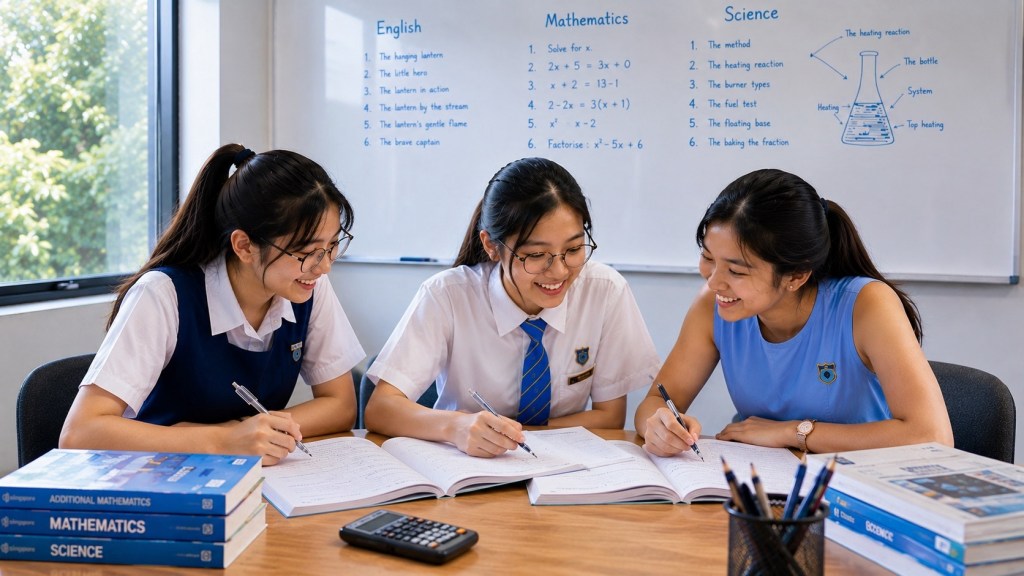
A three-student class gives the tutor enough visibility to see whether an error begins in vocabulary, graph reading, experimental design, Mathematics, evidence selection or explanation. The final wrong answer is only the visible end of the chain.
What Progress Looks Like
- uses evidence rather than expectation;
- identifies variables and controls reliably;
- uses units and precision appropriately;
- interprets quantitative data accurately;
- evaluates models and methods;
- explains mechanisms clearly;
- calibrates conclusions to evidence;
- recognises limitations;
- transfers principles into unfamiliar contexts;
- becomes increasingly self-correcting.
Secondary 3 G3 Science: Precision Before Specialisation
The strongest Secondary 3 G3 learner is not the student who has rushed furthest into upper-secondary content. It is the learner who can use evidence, models, measurement and mechanisms accurately when the context changes.
At eduKate Sengkang, we diagnose strong learners as carefully as struggling learners. Precision, evidence and transfer are what turn early strength into durable scientific performance. Contact eduKate Sengkang if you want help interpreting your child’s Secondary 3 G3 Science work.
