
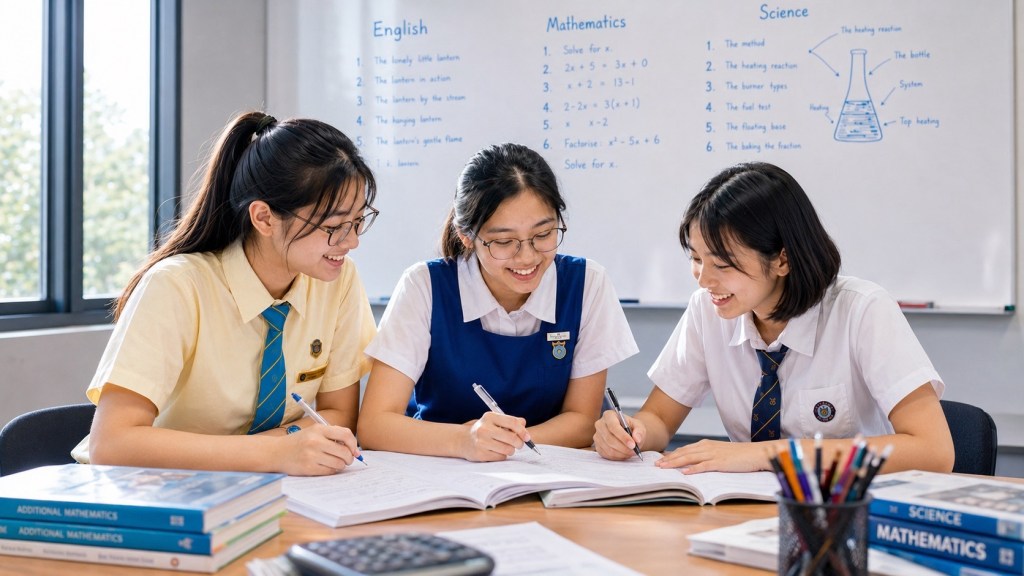
G1 for Secondary Schools is one of the three General subject levels used under Singapore’s Full Subject-Based Banding system. For a Secondary 3 learner taking English at G1, the label describes the level at which English is taught and assessed. It does not define the learner’s intelligence, potential, school identity or level in every other subject.
Secondary 3 is the beginning of the upper-secondary stretch. The learner is closer to the Singapore-Cambridge Secondary Education Certificate, so English becomes more performance-aware. But strong preparation is not the same as endless examination drilling. The more important job is to make reading, writing, listening, oral communication, vocabulary, grammar and checking increasingly reliable under time pressure.
This guide explains what Secondary 3 G1 English means, what should become more secure during the year, how G1 differs from G2 and G3 English, why G1 English is not the same as Posting Group 1, and how parents can support a clear route toward the SEC without turning every lesson into a mock paper.
The Short Answer: What Is Secondary 3 G1 English?
G1 means General 1. Under Full Subject-Based Banding, G1, G2 and G3 are individual subject levels. A learner may therefore take English at G1 while taking another subject at a different level.
- G1 English is a subject level.
- It is not the same as Posting Group 1.
- Secondary 3 is an upper-secondary preparation year.
- Exam familiarity matters, but capability matters more.
- The learner’s actual work should guide support.
What Changes in Secondary 3?
Secondary 1 is the transition. Secondary 2 is consolidation. Secondary 3 is where the learner begins to organise English around sustained performance.
- Reading questions require more consistent evidence use.
- Writing needs clearer task fulfilment and paragraph development.
- Vocabulary should be retrievable under pressure.
- Grammar should remain stable inside longer responses.
- Listening requires selective attention and note control.
- Oral responses should be developed with less prompting.
- Checking needs to become part of the learner’s own routine.
The student should be moving from “I know this when the teacher reminds me” toward “I can recognise the job and run the process myself”.
Reading: Question, Evidence, Answer
At Secondary 3 G1, reading should become more deliberate. The learner needs to read the question accurately before searching the passage.
- identify the main idea;
- locate relevant evidence;
- track pronouns and references;
- follow sequence, cause and consequence;
- make simple inferences from evidence;
- understand vocabulary in context;
- avoid copying more than the question requires.
A useful internal routine is question → evidence → answer. If the learner cannot show where the answer comes from, the answer may be guessing rather than comprehension.
Writing: Fulfil the Job Before Decorating the Language
Secondary 3 writing improves when the learner knows what the text is supposed to do.
- Who is the reader?
- What is the purpose?
- What information must be included?
- What tone is suitable?
- What order makes the message easiest to follow?
- Which details deserve development?
A composition with simple accurate language and clear development is stronger than a composition filled with difficult words that do not fit.
Vocabulary: Retrieval Matters
By Secondary 3, vocabulary should not exist only in lists. Useful words need to be retrievable during a real task.
- meaning;
- part of speech;
- word family;
- common collocations;
- register;
- example sentence;
- delayed retrieval;
- use in a new context.
The goal is not to sound impressive. The goal is to choose a word that says exactly what the learner means.
Grammar: Reduce Repeated Error Patterns
At Secondary 3, grammar should become increasingly self-monitored.
- subject–verb agreement;
- tense sequence;
- articles and determiners;
- pronoun reference;
- prepositions;
- sentence boundaries;
- word forms;
- punctuation for clarity.
The useful question after a correction is: what clue should help me notice this error next time?
Listening and Oral: Real-Time Language Control
Listening and oral communication reveal whether language knowledge is accessible quickly enough for live use.
- predict the information category before listening;
- listen for contrast and correction;
- record only useful information;
- answer oral questions directly;
- give a reason;
- add an example;
- explain why the example matters;
- respond to follow-up questions without losing the point.
How G1 English Differs From G2 and G3
- G1: dependable functional language control and increasing independence.
- G2: greater text complexity, inference, development and task control.
- G3: greater nuance, evaluative reading, rhetorical control and sustained precision.
The levels describe subject demand, not personal worth. The right level is where challenge remains learnable.
G1 English Is Not Posting Group 1
Posting Group 1 is used to facilitate admission into Secondary 1. G1 English is an individual subject level. By Secondary 3, the learner’s current English level and actual performance matter more than the original admission route.
The SEC Endpoint
For current 2027 reference, SEAB lists G1 English Language as K100 under the Singapore-Cambridge Secondary Education Certificate. Students should always use the syllabus for their actual examination year.
Secondary 3 preparation should therefore build the language engine that later examination performance depends on: accurate reading, task control, vocabulary retrieval, sentence stability, paragraph development, listening, oral communication and checking.
Official reference: SEAB 2027 G1 Syllabuses for School Candidates.
Three Secondary 3 G1 English Pathways
Repair
The learner still has a gap in reading fluency, vocabulary, sentence formation or task interpretation. The first priority is targeted repair while staying connected to current Secondary 3 work.
Stabilisation
The learner can perform at G1 but not consistently. We stabilise question reading, paragraph organisation, grammar, vocabulary retrieval and checking.
Extension
The learner is secure and ready for deeper reading, stronger writing development and more independent language use. Where school evidence supports it, the family can discuss whether a more demanding subject level is appropriate.
Our First-Principles Method for Secondary 3 G1 English
- Diagnose: identify the first weak link rather than call the learner “weak in English”.
- Fence: reduce unrelated difficulty while one capability is rebuilt.
- Model: make strong reading and writing decisions visible.
- Explain: require the learner to state why an answer works.
- Retrieve: bring vocabulary and grammar back after a delay.
- Interleave: mix task types so the learner must select the right skill.
- Transfer: use the skill in a new text or context.
- Check: build task fulfilment and language accuracy into the routine.
What Progress Looks Like
- reads the whole question before answering;
- uses evidence rather than guessing;
- writes clearer paragraphs;
- retrieves vocabulary more independently;
- makes fewer repeated grammar errors;
- develops oral responses beyond one sentence;
- listens for the information the task requires;
- checks work without reminders;
- needs less adult rescue;
- remains more stable under time pressure.
Frequently Asked Questions
What does G1 English mean in Secondary 3?
It means English is being taken at General 1, with the learner building increasingly independent control of upper-secondary reading, writing, listening and oral communication.
Is G1 English the same as PG1?
No. PG1 is an admission grouping. G1 English is an individual subject level.
What is the current SEC reference code for G1 English?
SEAB lists G1 English Language as K100 for 2027 school candidates. Always use the syllabus for the learner’s actual examination year.
Secondary 3 G1 English: Build Reliable Performance
Secondary 3 is where useful English habits should become reliable enough to operate under examination-like conditions. The goal is not endless paper volume. It is controlled performance.
At eduKate Sengkang, we diagnose the first weak link, rebuild what is missing, stabilise what works and deepen the work when the learner is ready.
Contact eduKate Sengkang if you want help reading your child’s Secondary 3 G1 English work and identifying the next useful step.
