
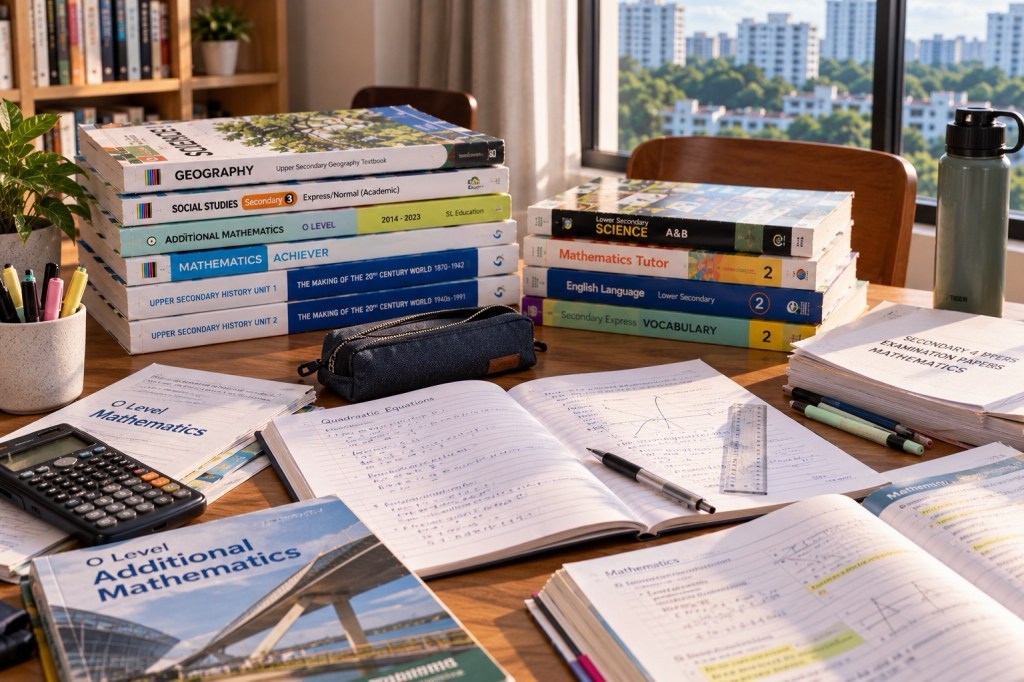
Learning G3 Mathematics with a Tampines tutor should teach a student to recognise mathematical structure before reaching for a formula. G3 Mathematics requires reliable technique, but it also requires the learner to decide which technique belongs.
For 2027 SEC school candidates, SEAB lists G3 Mathematics as K310. A useful tuition programme therefore has to prepare the learner for both routine fluency and unfamiliar problem solving.
For Tampines families, a nearby tutor may make the schedule easier. But the learning question is whether the tutor can trace an error back to its cause. A wrong final answer may begin with fractions, algebra, graph interpretation, geometry, probability, calculator use or poor checking.
eduKate Sengkang teaches Secondary Mathematics in groups of up to three students. The tutor can inspect each learner’s working and see where the reasoning changes direction.
G3 Mathematics tuition may be useful for students who need to:
- strengthen algebraic fluency;
- connect equations, functions and graphs;
- improve geometry and trigonometric reasoning;
- interpret statistics and probability more accurately;
- show essential working clearly;
- solve unfamiliar real-world problems;
- reduce sign and calculator errors;
- improve mixed-topic retrieval;
- prepare for K310 Paper 1 and Paper 2; or
- move from routine competence to flexible problem solving.
Read: G3 Mathematics Paper 1 vs Paper 2
Check the official 2027 SEC G3 syllabus list at SEAB
G3 Mathematics Is a Recognition Problem
A student may know a method perfectly once the chapter is named. Mixed papers are harder because the label disappears.
The learner must infer the mathematical structure from the information.
The student who can recognise the structure has access to the method. The student who cannot is forced to guess.
Algebra
Algebra is the operating language of G3 Mathematics.
We train expansion, factorisation, equations, inequalities, substitution and rearrangement while keeping equality visible.
Small symbolic errors are treated seriously because they spread into graphs, geometry and later Additional Mathematics.
Functions and Graphs
Students learn that a graph is not an illustration but a representation of a relationship.
We connect equations, tables, coordinates and graphical behaviour.
The learner should be able to interpret changes in the graph and translate them back into mathematical meaning.
Geometry and Trigonometry
Geometry is trained through properties, deduction and clear diagram annotation.
Trigonometric reasoning is connected to the geometry rather than reduced to button pressing.
Students learn to check whether their answers are consistent with shape, magnitude and units.
Statistics and Probability
Statistics requires interpretation before calculation.
Students learn to compare data, read distributions and understand what a representation can and cannot justify.
Probability is trained through structured sample spaces and relationships.
Real-World Application
Real-world questions often combine familiar topics in unfamiliar ways.
We teach a stable sequence:
- identify the quantities;
- decide what information matters;
- choose a representation;
- form the relationship;
- solve carefully;
- check units and scale;
- interpret the result in context.
The eduKate G3 Mathematics Runtime
1. Diagnose
We identify the earliest repeatable error.
2. Rebuild
If a current topic depends on an older weak skill, the older skill is repaired first.
3. Model
The tutor makes the reasoning sequence visible.
4. Vary
The problem changes enough to prevent copying.
5. Remove support
The learner reconstructs the method independently.
6. Interleave
Earlier topics return inside mixed practice.
7. Transfer
The student meets unfamiliar questions without a topic label.
Three G3 Mathematics Pathways
Repair
For a learner with gaps, we rebuild the earliest unstable dependency.
Stabilise
For a learner whose marks fluctuate, we train retrieval, checking, timing and mixed-topic recognition.
Extend
For a strong learner, we use less familiar problems, multiple methods and deeper explanation.
Why Working Matters
Working is part of mathematical communication and part of error control.
- state the relevant relationship;
- substitute clearly;
- show significant transformations;
- keep units visible;
- avoid premature rounding;
- label important quantities;
- check the final result.
When Should an Tampines Student Begin G3 Mathematics Tuition?
- when algebra is slow or fragile;
- when the student can follow examples but cannot start alone;
- when graphs and diagrams are frequently misread;
- when topical work is strong but mixed papers are weak;
- when calculator use replaces estimation;
- when working is too compressed to diagnose;
- when earlier topics are forgotten quickly;
- when K310 preparation needs more structure.
Tampines Convenience and the Actual Classroom Location
An Tampines Mathematics tutor may reduce weekly travel for east-side families.
Parents should also compare whether the tutor diagnoses the mechanism behind mistakes, inspects working carefully and revisits corrected skills later.
eduKate Sengkang is not located in Tampines. Our Sengkang/Punggol classroom is at 83 Punggol Central, Singapore 828761, by appointment.
Class Details
- Class size: up to 3 students
- Subject: G3 Mathematics
- SEC route: K310 for 2027 school candidates
- Duration: 1.5 hours
- Focus: algebra, graphs, geometry, trigonometry, statistics, probability and problem solving
- Method: diagnose → rebuild → model → independent practice → retrieval → transfer
- Location: 83 Punggol Central, Singapore 828761
Learning G3 Mathematics with an Tampines Tutor
Good G3 Mathematics tuition should make the learner more capable of recognising structure, selecting a method, showing the working and checking the result.
For students who are behind, we rebuild. For students who are inconsistent, we stabilise. For students who are ready, we extend.
Task recognition
In G3 Mathematics, this part of the learning system is trained through number sense. The student is asked to do more than recognise a correct answer after it is shown. The learner must identify what the task requires, decide which knowledge or representation is useful, make an independent attempt and then inspect the result for signs that something has gone wrong. The tutor watches the decision process as carefully as the final answer because the same score can be produced by very different causes.
This matters for a student travelling from Tampines because tuition time has to produce something that survives the journey back into school. A correction that only works inside the lesson is not enough. The idea should return later, appear in a changed form and eventually sit beside other topics so the learner has to choose it without being told. That sequence—understand, attempt, correct, retrieve, mix and transfer—is what turns a short-term success into a usable capability.
As the capability becomes more stable, support is reduced. The tutor stops supplying the first move, waits longer before intervening and asks the student to explain why the chosen route belongs. This can feel slower than simply showing the answer, but it builds a learner who can continue when the task is unfamiliar. The standard is therefore not perfect performance during tuition; it is increasingly organised performance when the tutor is silent.
Building a reliable first move
In G3 Mathematics, this part of the learning system is trained through algebra. The student is asked to do more than recognise a correct answer after it is shown. The learner must identify what the task requires, decide which knowledge or representation is useful, make an independent attempt and then inspect the result for signs that something has gone wrong. The tutor watches the decision process as carefully as the final answer because the same score can be produced by very different causes.
This matters for a student travelling from Tampines because tuition time has to produce something that survives the journey back into school. A correction that only works inside the lesson is not enough. The idea should return later, appear in a changed form and eventually sit beside other topics so the learner has to choose it without being told. That sequence—understand, attempt, correct, retrieve, mix and transfer—is what turns a short-term success into a usable capability.
As the capability becomes more stable, support is reduced. The tutor stops supplying the first move, waits longer before intervening and asks the student to explain why the chosen route belongs. This can feel slower than simply showing the answer, but it builds a learner who can continue when the task is unfamiliar. The standard is therefore not perfect performance during tuition; it is increasingly organised performance when the tutor is silent.
Correction that changes future work
In G3 Mathematics, this part of the learning system is trained through graphs. The student is asked to do more than recognise a correct answer after it is shown. The learner must identify what the task requires, decide which knowledge or representation is useful, make an independent attempt and then inspect the result for signs that something has gone wrong. The tutor watches the decision process as carefully as the final answer because the same score can be produced by very different causes.
This matters for a student travelling from Tampines because tuition time has to produce something that survives the journey back into school. A correction that only works inside the lesson is not enough. The idea should return later, appear in a changed form and eventually sit beside other topics so the learner has to choose it without being told. That sequence—understand, attempt, correct, retrieve, mix and transfer—is what turns a short-term success into a usable capability.
As the capability becomes more stable, support is reduced. The tutor stops supplying the first move, waits longer before intervening and asks the student to explain why the chosen route belongs. This can feel slower than simply showing the answer, but it builds a learner who can continue when the task is unfamiliar. The standard is therefore not perfect performance during tuition; it is increasingly organised performance when the tutor is silent.
Retrieval after delay
In G3 Mathematics, this part of the learning system is trained through ratio and rate. The student is asked to do more than recognise a correct answer after it is shown. The learner must identify what the task requires, decide which knowledge or representation is useful, make an independent attempt and then inspect the result for signs that something has gone wrong. The tutor watches the decision process as carefully as the final answer because the same score can be produced by very different causes.
This matters for a student travelling from Tampines because tuition time has to produce something that survives the journey back into school. A correction that only works inside the lesson is not enough. The idea should return later, appear in a changed form and eventually sit beside other topics so the learner has to choose it without being told. That sequence—understand, attempt, correct, retrieve, mix and transfer—is what turns a short-term success into a usable capability.
As the capability becomes more stable, support is reduced. The tutor stops supplying the first move, waits longer before intervening and asks the student to explain why the chosen route belongs. This can feel slower than simply showing the answer, but it builds a learner who can continue when the task is unfamiliar. The standard is therefore not perfect performance during tuition; it is increasingly organised performance when the tutor is silent.
Choosing between methods
In G3 Mathematics, this part of the learning system is trained through geometry. The student is asked to do more than recognise a correct answer after it is shown. The learner must identify what the task requires, decide which knowledge or representation is useful, make an independent attempt and then inspect the result for signs that something has gone wrong. The tutor watches the decision process as carefully as the final answer because the same score can be produced by very different causes.
This matters for a student travelling from Tampines because tuition time has to produce something that survives the journey back into school. A correction that only works inside the lesson is not enough. The idea should return later, appear in a changed form and eventually sit beside other topics so the learner has to choose it without being told. That sequence—understand, attempt, correct, retrieve, mix and transfer—is what turns a short-term success into a usable capability.
As the capability becomes more stable, support is reduced. The tutor stops supplying the first move, waits longer before intervening and asks the student to explain why the chosen route belongs. This can feel slower than simply showing the answer, but it builds a learner who can continue when the task is unfamiliar. The standard is therefore not perfect performance during tuition; it is increasingly organised performance when the tutor is silent.
Working under mixed conditions
In G3 Mathematics, this part of the learning system is trained through trigonometry. The student is asked to do more than recognise a correct answer after it is shown. The learner must identify what the task requires, decide which knowledge or representation is useful, make an independent attempt and then inspect the result for signs that something has gone wrong. The tutor watches the decision process as carefully as the final answer because the same score can be produced by very different causes.
This matters for a student travelling from Tampines because tuition time has to produce something that survives the journey back into school. A correction that only works inside the lesson is not enough. The idea should return later, appear in a changed form and eventually sit beside other topics so the learner has to choose it without being told. That sequence—understand, attempt, correct, retrieve, mix and transfer—is what turns a short-term success into a usable capability.
As the capability becomes more stable, support is reduced. The tutor stops supplying the first move, waits longer before intervening and asks the student to explain why the chosen route belongs. This can feel slower than simply showing the answer, but it builds a learner who can continue when the task is unfamiliar. The standard is therefore not perfect performance during tuition; it is increasingly organised performance when the tutor is silent.
Checking before submission
In G3 Mathematics, this part of the learning system is trained through statistics. The student is asked to do more than recognise a correct answer after it is shown. The learner must identify what the task requires, decide which knowledge or representation is useful, make an independent attempt and then inspect the result for signs that something has gone wrong. The tutor watches the decision process as carefully as the final answer because the same score can be produced by very different causes.
This matters for a student travelling from Tampines because tuition time has to produce something that survives the journey back into school. A correction that only works inside the lesson is not enough. The idea should return later, appear in a changed form and eventually sit beside other topics so the learner has to choose it without being told. That sequence—understand, attempt, correct, retrieve, mix and transfer—is what turns a short-term success into a usable capability.
As the capability becomes more stable, support is reduced. The tutor stops supplying the first move, waits longer before intervening and asks the student to explain why the chosen route belongs. This can feel slower than simply showing the answer, but it builds a learner who can continue when the task is unfamiliar. The standard is therefore not perfect performance during tuition; it is increasingly organised performance when the tutor is silent.
Explaining the reasoning
In G3 Mathematics, this part of the learning system is trained through probability. The student is asked to do more than recognise a correct answer after it is shown. The learner must identify what the task requires, decide which knowledge or representation is useful, make an independent attempt and then inspect the result for signs that something has gone wrong. The tutor watches the decision process as carefully as the final answer because the same score can be produced by very different causes.
This matters for a student travelling from Tampines because tuition time has to produce something that survives the journey back into school. A correction that only works inside the lesson is not enough. The idea should return later, appear in a changed form and eventually sit beside other topics so the learner has to choose it without being told. That sequence—understand, attempt, correct, retrieve, mix and transfer—is what turns a short-term success into a usable capability.
As the capability becomes more stable, support is reduced. The tutor stops supplying the first move, waits longer before intervening and asks the student to explain why the chosen route belongs. This can feel slower than simply showing the answer, but it builds a learner who can continue when the task is unfamiliar. The standard is therefore not perfect performance during tuition; it is increasingly organised performance when the tutor is silent.
Using school feedback
In G3 Mathematics, this part of the learning system is trained through working presentation. The student is asked to do more than recognise a correct answer after it is shown. The learner must identify what the task requires, decide which knowledge or representation is useful, make an independent attempt and then inspect the result for signs that something has gone wrong. The tutor watches the decision process as carefully as the final answer because the same score can be produced by very different causes.
This matters for a student travelling from Tampines because tuition time has to produce something that survives the journey back into school. A correction that only works inside the lesson is not enough. The idea should return later, appear in a changed form and eventually sit beside other topics so the learner has to choose it without being told. That sequence—understand, attempt, correct, retrieve, mix and transfer—is what turns a short-term success into a usable capability.
As the capability becomes more stable, support is reduced. The tutor stops supplying the first move, waits longer before intervening and asks the student to explain why the chosen route belongs. This can feel slower than simply showing the answer, but it builds a learner who can continue when the task is unfamiliar. The standard is therefore not perfect performance during tuition; it is increasingly organised performance when the tutor is silent.
Managing assessment time
In G3 Mathematics, this part of the learning system is trained through estimation. The student is asked to do more than recognise a correct answer after it is shown. The learner must identify what the task requires, decide which knowledge or representation is useful, make an independent attempt and then inspect the result for signs that something has gone wrong. The tutor watches the decision process as carefully as the final answer because the same score can be produced by very different causes.
This matters for a student travelling from Tampines because tuition time has to produce something that survives the journey back into school. A correction that only works inside the lesson is not enough. The idea should return later, appear in a changed form and eventually sit beside other topics so the learner has to choose it without being told. That sequence—understand, attempt, correct, retrieve, mix and transfer—is what turns a short-term success into a usable capability.
As the capability becomes more stable, support is reduced. The tutor stops supplying the first move, waits longer before intervening and asks the student to explain why the chosen route belongs. This can feel slower than simply showing the answer, but it builds a learner who can continue when the task is unfamiliar. The standard is therefore not perfect performance during tuition; it is increasingly organised performance when the tutor is silent.
Recovering after uncertainty
In G3 Mathematics, this part of the learning system is trained through number sense. The student is asked to do more than recognise a correct answer after it is shown. The learner must identify what the task requires, decide which knowledge or representation is useful, make an independent attempt and then inspect the result for signs that something has gone wrong. The tutor watches the decision process as carefully as the final answer because the same score can be produced by very different causes.
This matters for a student travelling from Tampines because tuition time has to produce something that survives the journey back into school. A correction that only works inside the lesson is not enough. The idea should return later, appear in a changed form and eventually sit beside other topics so the learner has to choose it without being told. That sequence—understand, attempt, correct, retrieve, mix and transfer—is what turns a short-term success into a usable capability.
As the capability becomes more stable, support is reduced. The tutor stops supplying the first move, waits longer before intervening and asks the student to explain why the chosen route belongs. This can feel slower than simply showing the answer, but it builds a learner who can continue when the task is unfamiliar. The standard is therefore not perfect performance during tuition; it is increasingly organised performance when the tutor is silent.
Strengthening home practice
In G3 Mathematics, this part of the learning system is trained through algebra. The student is asked to do more than recognise a correct answer after it is shown. The learner must identify what the task requires, decide which knowledge or representation is useful, make an independent attempt and then inspect the result for signs that something has gone wrong. The tutor watches the decision process as carefully as the final answer because the same score can be produced by very different causes.
This matters for a student travelling from Tampines because tuition time has to produce something that survives the journey back into school. A correction that only works inside the lesson is not enough. The idea should return later, appear in a changed form and eventually sit beside other topics so the learner has to choose it without being told. That sequence—understand, attempt, correct, retrieve, mix and transfer—is what turns a short-term success into a usable capability.
As the capability becomes more stable, support is reduced. The tutor stops supplying the first move, waits longer before intervening and asks the student to explain why the chosen route belongs. This can feel slower than simply showing the answer, but it builds a learner who can continue when the task is unfamiliar. The standard is therefore not perfect performance during tuition; it is increasingly organised performance when the tutor is silent.
Keeping earlier learning available
In G3 Mathematics, this part of the learning system is trained through graphs. The student is asked to do more than recognise a correct answer after it is shown. The learner must identify what the task requires, decide which knowledge or representation is useful, make an independent attempt and then inspect the result for signs that something has gone wrong. The tutor watches the decision process as carefully as the final answer because the same score can be produced by very different causes.
This matters for a student travelling from Tampines because tuition time has to produce something that survives the journey back into school. A correction that only works inside the lesson is not enough. The idea should return later, appear in a changed form and eventually sit beside other topics so the learner has to choose it without being told. That sequence—understand, attempt, correct, retrieve, mix and transfer—is what turns a short-term success into a usable capability.
As the capability becomes more stable, support is reduced. The tutor stops supplying the first move, waits longer before intervening and asks the student to explain why the chosen route belongs. This can feel slower than simply showing the answer, but it builds a learner who can continue when the task is unfamiliar. The standard is therefore not perfect performance during tuition; it is increasingly organised performance when the tutor is silent.
Connecting one topic to another
In G3 Mathematics, this part of the learning system is trained through ratio and rate. The student is asked to do more than recognise a correct answer after it is shown. The learner must identify what the task requires, decide which knowledge or representation is useful, make an independent attempt and then inspect the result for signs that something has gone wrong. The tutor watches the decision process as carefully as the final answer because the same score can be produced by very different causes.
This matters for a student travelling from Tampines because tuition time has to produce something that survives the journey back into school. A correction that only works inside the lesson is not enough. The idea should return later, appear in a changed form and eventually sit beside other topics so the learner has to choose it without being told. That sequence—understand, attempt, correct, retrieve, mix and transfer—is what turns a short-term success into a usable capability.
As the capability becomes more stable, support is reduced. The tutor stops supplying the first move, waits longer before intervening and asks the student to explain why the chosen route belongs. This can feel slower than simply showing the answer, but it builds a learner who can continue when the task is unfamiliar. The standard is therefore not perfect performance during tuition; it is increasingly organised performance when the tutor is silent.
Learning from repeated errors
In G3 Mathematics, this part of the learning system is trained through geometry. The student is asked to do more than recognise a correct answer after it is shown. The learner must identify what the task requires, decide which knowledge or representation is useful, make an independent attempt and then inspect the result for signs that something has gone wrong. The tutor watches the decision process as carefully as the final answer because the same score can be produced by very different causes.
This matters for a student travelling from Tampines because tuition time has to produce something that survives the journey back into school. A correction that only works inside the lesson is not enough. The idea should return later, appear in a changed form and eventually sit beside other topics so the learner has to choose it without being told. That sequence—understand, attempt, correct, retrieve, mix and transfer—is what turns a short-term success into a usable capability.
As the capability becomes more stable, support is reduced. The tutor stops supplying the first move, waits longer before intervening and asks the student to explain why the chosen route belongs. This can feel slower than simply showing the answer, but it builds a learner who can continue when the task is unfamiliar. The standard is therefore not perfect performance during tuition; it is increasingly organised performance when the tutor is silent.
Extending a strong learner
In G3 Mathematics, this part of the learning system is trained through trigonometry. The student is asked to do more than recognise a correct answer after it is shown. The learner must identify what the task requires, decide which knowledge or representation is useful, make an independent attempt and then inspect the result for signs that something has gone wrong. The tutor watches the decision process as carefully as the final answer because the same score can be produced by very different causes.
This matters for a student travelling from Tampines because tuition time has to produce something that survives the journey back into school. A correction that only works inside the lesson is not enough. The idea should return later, appear in a changed form and eventually sit beside other topics so the learner has to choose it without being told. That sequence—understand, attempt, correct, retrieve, mix and transfer—is what turns a short-term success into a usable capability.
As the capability becomes more stable, support is reduced. The tutor stops supplying the first move, waits longer before intervening and asks the student to explain why the chosen route belongs. This can feel slower than simply showing the answer, but it builds a learner who can continue when the task is unfamiliar. The standard is therefore not perfect performance during tuition; it is increasingly organised performance when the tutor is silent.
Tampines Learning Context
A local tuition page should reflect the conditions in which learning actually happens. Tampines families are balancing school timetables, travel, CCAs, family routines and the student’s available attention. A strong programme therefore needs to be academically precise and logistically sustainable.
For a G3 Mathematics learner in Tampines, compact continuation work should protect algebra, graphs, geometry, trigonometry, statistics and mixed problem solving. One retrieval set, one correction task and one unfamiliar application question can reveal more than a long worksheet of similar exercises because the student has to remember, select and check.
Students across Tampines East, Tampines West, Tampines North and Simei may be balancing K310 preparation with several other demanding subjects. A sustainable rhythm therefore keeps high-value methods available across the week so the next lesson can deepen rather than restart.
A practical weekly rhythm
A useful rhythm is one focused tuition lesson, one short retrieval session, one school-linked correction task and one brief check of upcoming assessment demands. The precise pattern changes by student, but consistency matters more than occasional bursts of heavy revision.
Travel versus teaching fit
A tutor physically located in Tampines may offer the shortest commute. eduKate Sengkang is at 83 Punggol Central, Singapore 828761, so families should compare travel time honestly against the value of the three-student format and the teaching system described here. The correct choice is the one the student can attend consistently and benefit from academically.
What makes the page genuinely local
The area name is not enough. The article should help a Tampines family think about actual scheduling, travel, school workload and the kind of independent practice that can fit between lessons. That local layer sits on top of a subject-accurate teaching system; it does not replace it.
A term-long continuity check
At the start of a term, we map the school sequence against the learner’s foundation. In the middle, we protect retrieval while new material arrives. Before assessments, we narrow toward high-value errors and representative mixed work. After the paper, we separate what the student knew from what the student actually performed. That cycle keeps tuition connected to real school evidence.
The independence benchmark
The final benchmark is what the learner can do when the tutor is silent. We look for an independent start, an appropriate representation or evidence choice, access to the relevant knowledge, an organised attempt and a deliberate check. The learner does not need perfection; the learner needs a process that keeps working when uncertainty appears.
Arrange a Parent–Student Consultation
Visit eduKate Sengkang for current class information, fees and contact details.
Continue learning: Mathematics Hub · Complete Mathematics Index.
