
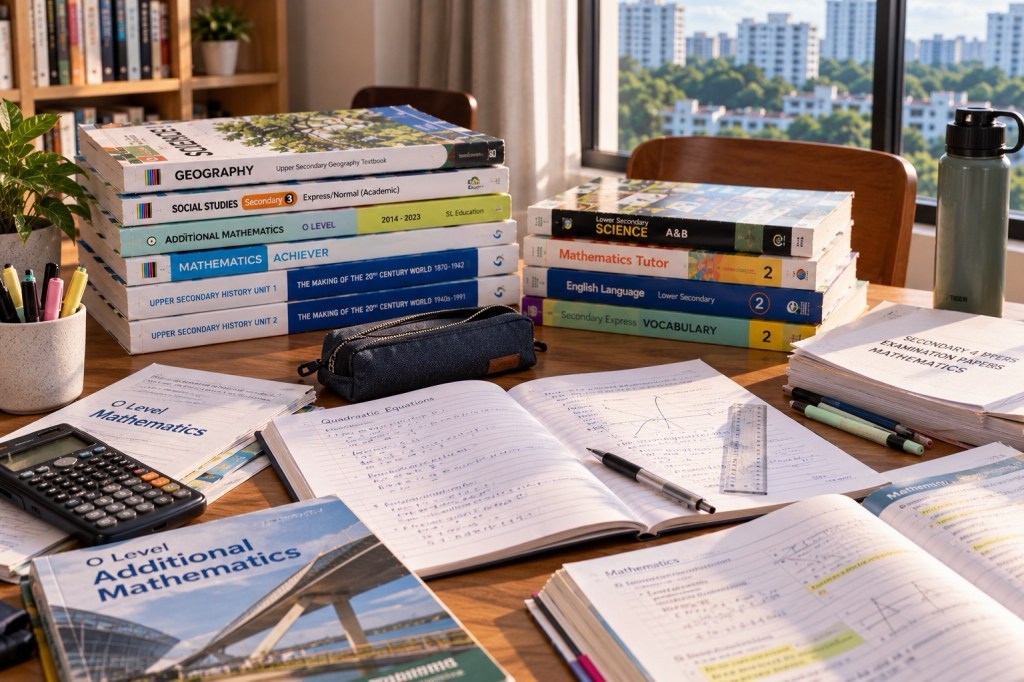
Learning G1 Mathematics with a Ang Mo Kio tutor should make practical mathematics dependable. G1 Mathematics is a defined subject level under Full Subject-Based Banding, with an emphasis on usable mathematical understanding rather than the memorisation of disconnected procedures.
For 2027 school candidates, SEAB lists G1 Mathematics as K110, with 4046 shown as the earlier reference code. The subject is organised around Number and Algebra, Geometry and Measurement, and Statistics and Probability, with strong attention to application.
For Ang Mo Kio, Bishan, Yio Chu Kang and the surrounding central-north corridor families, a nearby tutor can make weekly attendance easier. But the more important question is whether the tutor can identify the first weak link. A student struggling with algebra may actually have weak fractions. A learner losing marks in measurement may be misreading units rather than forgetting the formula.
eduKate Sengkang teaches Secondary Mathematics in groups of up to three students. The small group makes working visible.
G1 Mathematics tuition may be useful for students who need to:
- repair number sense and arithmetic foundations;
- strengthen fractions, decimals and percentages;
- understand ratio, rate and practical proportion;
- build confidence with algebraic notation;
- interpret tables, charts and graphs;
- use measurement accurately;
- improve geometry and spatial reasoning;
- develop statistics and probability skills;
- show working more clearly; or
- prepare for the 2027 K110 SEC route.
Check the official 2027 SEC G1 syllabus list at SEAB
G1 Mathematics Should Feel Useful
The subject becomes easier when the learner understands what the calculation is doing.
Percentages can represent discounts, change and part-whole relationships. Graphs can describe trends. Measurement supports planning and comparison. Probability helps the learner reason about uncertainty.
The strongest G1 Mathematics learner does not only know how to calculate. The learner knows what the calculation means.
Number and Algebra
We strengthen directed numbers, fractions, decimals, percentages, ratio and basic algebra according to the learner’s current school sequence.
The tutor checks whether the student can estimate before calculating. Estimation acts as an error filter.
Algebra is introduced as a language for relationships. The student learns what a variable represents before manipulation is accelerated.
Ratio, Rate and Percentage
These are high-value practical ideas because they appear across finance, scale, speed and everyday comparison.
Students learn to distinguish additive change from multiplicative change and to move between fractions, decimals and percentages.
We also train interpretation: what does the percentage refer to, and what is the base quantity?
Geometry and Measurement
Geometry is taught through properties, diagrams and measurement rather than visual guessing.
Students mark known information, select relevant relationships and keep units visible.
The tutor also trains reasonableness. A length, area or volume should make sense in the physical context.
Statistics and Probability
Students learn to read data rather than merely extract a number.
We teach them to check labels, units, scale and comparison before making a conclusion.
Probability is connected to outcomes and relative likelihood rather than intuition alone.
Problem Solving
A stable G1 problem-solving routine is valuable.
- Understand the situation.
- Identify the quantities.
- Choose a representation.
- Select the relationship.
- Calculate carefully.
- Check units.
- Interpret the answer in context.
This gives students a way to begin even when the question looks unfamiliar.
The eduKate G1 Mathematics Runtime
1. Diagnose
We identify the first repeatable weakness.
2. Rebuild
If the current topic depends on an older skill, the older skill is repaired first.
3. Model
The tutor demonstrates the reasoning, not only the calculation.
4. Vary
A small change in the problem forces the student to think rather than copy.
5. Remove support
The student completes a fresh problem independently.
6. Retrieve later
Earlier ideas return after time has passed.
7. Transfer
The learner meets the skill inside a new practical context.
Three G1 Mathematics Pathways
Repair
For a student with gaps in arithmetic or number sense, we rebuild the foundation first.
Stabilise
For a student who can do classwork but struggles in tests, we train retrieval, checking and mixed-topic recognition.
Extend
For a student who is already secure, we deepen application, explanation and problem solving.
When Should a Ang Mo Kio Student Begin G1 Mathematics Tuition?
- when basic number work remains slow;
- when fractions, percentages or ratio feel confusing;
- when the student can follow examples but cannot start alone;
- when graphs and tables are misread;
- when units are frequently lost;
- when working is too compressed to diagnose;
- when results are inconsistent across topics;
- when K110 preparation needs more structure.
Ang Mo Kio Convenience and the Actual Classroom Location
A Ang Mo Kio Mathematics tutor may make weekly attendance easier for central-north families.
Parents should still ask whether the tutor diagnoses the first weak link, checks working carefully and revisits corrected skills after time has passed.
eduKate Sengkang is not located in Ang Mo Kio. Our Sengkang/Punggol classroom is at 83 Punggol Central, Singapore 828761, by appointment.
Class Details
- Class size: up to 3 students
- Subject: G1 Mathematics
- SEC route: K110 for 2027 school candidates
- Duration: 1.5 hours
- Focus: Number and Algebra, Geometry and Measurement, Statistics and Probability, application and examination control
- Method: diagnose → rebuild → model → independent practice → retrieval → transfer
- Location: 83 Punggol Central, Singapore 828761
Learning G1 Mathematics with a Ang Mo Kio Tutor
Good G1 Mathematics tuition should make practical mathematics more understandable and more independent.
The learner should become better at recognising the situation, choosing a method, carrying out the calculation and checking whether the result is reasonable.
For students who are behind, we rebuild. For students who are inconsistent, we stabilise. For students who are ready, we extend.
Task recognition
In G1 Mathematics, this part of the learning system is trained through number sense. The student is asked to do more than recognise a correct answer after it is shown. The learner must identify what the task requires, decide which knowledge or representation is useful, make an independent attempt and then inspect the result for signs that something has gone wrong. The tutor watches the decision process as carefully as the final answer because the same score can be produced by very different causes.
This matters for a student travelling from Ang Mo Kio because tuition time has to produce something that survives the journey back into school. A correction that only works inside the lesson is not enough. The idea should return later, appear in a changed form and eventually sit beside other topics so the learner has to choose it without being told. That sequence—understand, attempt, correct, retrieve, mix and transfer—is what turns a short-term success into a usable capability.
As the capability becomes more stable, support is reduced. The tutor stops supplying the first move, waits longer before intervening and asks the student to explain why the chosen route belongs. This can feel slower than simply showing the answer, but it builds a learner who can continue when the task is unfamiliar. The standard is therefore not perfect performance during tuition; it is increasingly organised performance when the tutor is silent.
Building a reliable first move
In G1 Mathematics, this part of the learning system is trained through algebra. The student is asked to do more than recognise a correct answer after it is shown. The learner must identify what the task requires, decide which knowledge or representation is useful, make an independent attempt and then inspect the result for signs that something has gone wrong. The tutor watches the decision process as carefully as the final answer because the same score can be produced by very different causes.
This matters for a student travelling from Ang Mo Kio because tuition time has to produce something that survives the journey back into school. A correction that only works inside the lesson is not enough. The idea should return later, appear in a changed form and eventually sit beside other topics so the learner has to choose it without being told. That sequence—understand, attempt, correct, retrieve, mix and transfer—is what turns a short-term success into a usable capability.
As the capability becomes more stable, support is reduced. The tutor stops supplying the first move, waits longer before intervening and asks the student to explain why the chosen route belongs. This can feel slower than simply showing the answer, but it builds a learner who can continue when the task is unfamiliar. The standard is therefore not perfect performance during tuition; it is increasingly organised performance when the tutor is silent.
Correction that changes future work
In G1 Mathematics, this part of the learning system is trained through graphs. The student is asked to do more than recognise a correct answer after it is shown. The learner must identify what the task requires, decide which knowledge or representation is useful, make an independent attempt and then inspect the result for signs that something has gone wrong. The tutor watches the decision process as carefully as the final answer because the same score can be produced by very different causes.
This matters for a student travelling from Ang Mo Kio because tuition time has to produce something that survives the journey back into school. A correction that only works inside the lesson is not enough. The idea should return later, appear in a changed form and eventually sit beside other topics so the learner has to choose it without being told. That sequence—understand, attempt, correct, retrieve, mix and transfer—is what turns a short-term success into a usable capability.
As the capability becomes more stable, support is reduced. The tutor stops supplying the first move, waits longer before intervening and asks the student to explain why the chosen route belongs. This can feel slower than simply showing the answer, but it builds a learner who can continue when the task is unfamiliar. The standard is therefore not perfect performance during tuition; it is increasingly organised performance when the tutor is silent.
Retrieval after delay
In G1 Mathematics, this part of the learning system is trained through ratio and rate. The student is asked to do more than recognise a correct answer after it is shown. The learner must identify what the task requires, decide which knowledge or representation is useful, make an independent attempt and then inspect the result for signs that something has gone wrong. The tutor watches the decision process as carefully as the final answer because the same score can be produced by very different causes.
This matters for a student travelling from Ang Mo Kio because tuition time has to produce something that survives the journey back into school. A correction that only works inside the lesson is not enough. The idea should return later, appear in a changed form and eventually sit beside other topics so the learner has to choose it without being told. That sequence—understand, attempt, correct, retrieve, mix and transfer—is what turns a short-term success into a usable capability.
As the capability becomes more stable, support is reduced. The tutor stops supplying the first move, waits longer before intervening and asks the student to explain why the chosen route belongs. This can feel slower than simply showing the answer, but it builds a learner who can continue when the task is unfamiliar. The standard is therefore not perfect performance during tuition; it is increasingly organised performance when the tutor is silent.
Choosing between methods
In G1 Mathematics, this part of the learning system is trained through geometry. The student is asked to do more than recognise a correct answer after it is shown. The learner must identify what the task requires, decide which knowledge or representation is useful, make an independent attempt and then inspect the result for signs that something has gone wrong. The tutor watches the decision process as carefully as the final answer because the same score can be produced by very different causes.
This matters for a student travelling from Ang Mo Kio because tuition time has to produce something that survives the journey back into school. A correction that only works inside the lesson is not enough. The idea should return later, appear in a changed form and eventually sit beside other topics so the learner has to choose it without being told. That sequence—understand, attempt, correct, retrieve, mix and transfer—is what turns a short-term success into a usable capability.
As the capability becomes more stable, support is reduced. The tutor stops supplying the first move, waits longer before intervening and asks the student to explain why the chosen route belongs. This can feel slower than simply showing the answer, but it builds a learner who can continue when the task is unfamiliar. The standard is therefore not perfect performance during tuition; it is increasingly organised performance when the tutor is silent.
Working under mixed conditions
In G1 Mathematics, this part of the learning system is trained through trigonometry. The student is asked to do more than recognise a correct answer after it is shown. The learner must identify what the task requires, decide which knowledge or representation is useful, make an independent attempt and then inspect the result for signs that something has gone wrong. The tutor watches the decision process as carefully as the final answer because the same score can be produced by very different causes.
This matters for a student travelling from Ang Mo Kio because tuition time has to produce something that survives the journey back into school. A correction that only works inside the lesson is not enough. The idea should return later, appear in a changed form and eventually sit beside other topics so the learner has to choose it without being told. That sequence—understand, attempt, correct, retrieve, mix and transfer—is what turns a short-term success into a usable capability.
As the capability becomes more stable, support is reduced. The tutor stops supplying the first move, waits longer before intervening and asks the student to explain why the chosen route belongs. This can feel slower than simply showing the answer, but it builds a learner who can continue when the task is unfamiliar. The standard is therefore not perfect performance during tuition; it is increasingly organised performance when the tutor is silent.
Checking before submission
In G1 Mathematics, this part of the learning system is trained through statistics. The student is asked to do more than recognise a correct answer after it is shown. The learner must identify what the task requires, decide which knowledge or representation is useful, make an independent attempt and then inspect the result for signs that something has gone wrong. The tutor watches the decision process as carefully as the final answer because the same score can be produced by very different causes.
This matters for a student travelling from Ang Mo Kio because tuition time has to produce something that survives the journey back into school. A correction that only works inside the lesson is not enough. The idea should return later, appear in a changed form and eventually sit beside other topics so the learner has to choose it without being told. That sequence—understand, attempt, correct, retrieve, mix and transfer—is what turns a short-term success into a usable capability.
As the capability becomes more stable, support is reduced. The tutor stops supplying the first move, waits longer before intervening and asks the student to explain why the chosen route belongs. This can feel slower than simply showing the answer, but it builds a learner who can continue when the task is unfamiliar. The standard is therefore not perfect performance during tuition; it is increasingly organised performance when the tutor is silent.
Explaining the reasoning
In G1 Mathematics, this part of the learning system is trained through probability. The student is asked to do more than recognise a correct answer after it is shown. The learner must identify what the task requires, decide which knowledge or representation is useful, make an independent attempt and then inspect the result for signs that something has gone wrong. The tutor watches the decision process as carefully as the final answer because the same score can be produced by very different causes.
This matters for a student travelling from Ang Mo Kio because tuition time has to produce something that survives the journey back into school. A correction that only works inside the lesson is not enough. The idea should return later, appear in a changed form and eventually sit beside other topics so the learner has to choose it without being told. That sequence—understand, attempt, correct, retrieve, mix and transfer—is what turns a short-term success into a usable capability.
As the capability becomes more stable, support is reduced. The tutor stops supplying the first move, waits longer before intervening and asks the student to explain why the chosen route belongs. This can feel slower than simply showing the answer, but it builds a learner who can continue when the task is unfamiliar. The standard is therefore not perfect performance during tuition; it is increasingly organised performance when the tutor is silent.
Using school feedback
In G1 Mathematics, this part of the learning system is trained through working presentation. The student is asked to do more than recognise a correct answer after it is shown. The learner must identify what the task requires, decide which knowledge or representation is useful, make an independent attempt and then inspect the result for signs that something has gone wrong. The tutor watches the decision process as carefully as the final answer because the same score can be produced by very different causes.
This matters for a student travelling from Ang Mo Kio because tuition time has to produce something that survives the journey back into school. A correction that only works inside the lesson is not enough. The idea should return later, appear in a changed form and eventually sit beside other topics so the learner has to choose it without being told. That sequence—understand, attempt, correct, retrieve, mix and transfer—is what turns a short-term success into a usable capability.
As the capability becomes more stable, support is reduced. The tutor stops supplying the first move, waits longer before intervening and asks the student to explain why the chosen route belongs. This can feel slower than simply showing the answer, but it builds a learner who can continue when the task is unfamiliar. The standard is therefore not perfect performance during tuition; it is increasingly organised performance when the tutor is silent.
Managing assessment time
In G1 Mathematics, this part of the learning system is trained through estimation. The student is asked to do more than recognise a correct answer after it is shown. The learner must identify what the task requires, decide which knowledge or representation is useful, make an independent attempt and then inspect the result for signs that something has gone wrong. The tutor watches the decision process as carefully as the final answer because the same score can be produced by very different causes.
This matters for a student travelling from Ang Mo Kio because tuition time has to produce something that survives the journey back into school. A correction that only works inside the lesson is not enough. The idea should return later, appear in a changed form and eventually sit beside other topics so the learner has to choose it without being told. That sequence—understand, attempt, correct, retrieve, mix and transfer—is what turns a short-term success into a usable capability.
As the capability becomes more stable, support is reduced. The tutor stops supplying the first move, waits longer before intervening and asks the student to explain why the chosen route belongs. This can feel slower than simply showing the answer, but it builds a learner who can continue when the task is unfamiliar. The standard is therefore not perfect performance during tuition; it is increasingly organised performance when the tutor is silent.
Recovering after uncertainty
In G1 Mathematics, this part of the learning system is trained through number sense. The student is asked to do more than recognise a correct answer after it is shown. The learner must identify what the task requires, decide which knowledge or representation is useful, make an independent attempt and then inspect the result for signs that something has gone wrong. The tutor watches the decision process as carefully as the final answer because the same score can be produced by very different causes.
This matters for a student travelling from Ang Mo Kio because tuition time has to produce something that survives the journey back into school. A correction that only works inside the lesson is not enough. The idea should return later, appear in a changed form and eventually sit beside other topics so the learner has to choose it without being told. That sequence—understand, attempt, correct, retrieve, mix and transfer—is what turns a short-term success into a usable capability.
As the capability becomes more stable, support is reduced. The tutor stops supplying the first move, waits longer before intervening and asks the student to explain why the chosen route belongs. This can feel slower than simply showing the answer, but it builds a learner who can continue when the task is unfamiliar. The standard is therefore not perfect performance during tuition; it is increasingly organised performance when the tutor is silent.
Strengthening home practice
In G1 Mathematics, this part of the learning system is trained through algebra. The student is asked to do more than recognise a correct answer after it is shown. The learner must identify what the task requires, decide which knowledge or representation is useful, make an independent attempt and then inspect the result for signs that something has gone wrong. The tutor watches the decision process as carefully as the final answer because the same score can be produced by very different causes.
This matters for a student travelling from Ang Mo Kio because tuition time has to produce something that survives the journey back into school. A correction that only works inside the lesson is not enough. The idea should return later, appear in a changed form and eventually sit beside other topics so the learner has to choose it without being told. That sequence—understand, attempt, correct, retrieve, mix and transfer—is what turns a short-term success into a usable capability.
As the capability becomes more stable, support is reduced. The tutor stops supplying the first move, waits longer before intervening and asks the student to explain why the chosen route belongs. This can feel slower than simply showing the answer, but it builds a learner who can continue when the task is unfamiliar. The standard is therefore not perfect performance during tuition; it is increasingly organised performance when the tutor is silent.
Keeping earlier learning available
In G1 Mathematics, this part of the learning system is trained through graphs. The student is asked to do more than recognise a correct answer after it is shown. The learner must identify what the task requires, decide which knowledge or representation is useful, make an independent attempt and then inspect the result for signs that something has gone wrong. The tutor watches the decision process as carefully as the final answer because the same score can be produced by very different causes.
This matters for a student travelling from Ang Mo Kio because tuition time has to produce something that survives the journey back into school. A correction that only works inside the lesson is not enough. The idea should return later, appear in a changed form and eventually sit beside other topics so the learner has to choose it without being told. That sequence—understand, attempt, correct, retrieve, mix and transfer—is what turns a short-term success into a usable capability.
As the capability becomes more stable, support is reduced. The tutor stops supplying the first move, waits longer before intervening and asks the student to explain why the chosen route belongs. This can feel slower than simply showing the answer, but it builds a learner who can continue when the task is unfamiliar. The standard is therefore not perfect performance during tuition; it is increasingly organised performance when the tutor is silent.
Connecting one topic to another
In G1 Mathematics, this part of the learning system is trained through ratio and rate. The student is asked to do more than recognise a correct answer after it is shown. The learner must identify what the task requires, decide which knowledge or representation is useful, make an independent attempt and then inspect the result for signs that something has gone wrong. The tutor watches the decision process as carefully as the final answer because the same score can be produced by very different causes.
This matters for a student travelling from Ang Mo Kio because tuition time has to produce something that survives the journey back into school. A correction that only works inside the lesson is not enough. The idea should return later, appear in a changed form and eventually sit beside other topics so the learner has to choose it without being told. That sequence—understand, attempt, correct, retrieve, mix and transfer—is what turns a short-term success into a usable capability.
As the capability becomes more stable, support is reduced. The tutor stops supplying the first move, waits longer before intervening and asks the student to explain why the chosen route belongs. This can feel slower than simply showing the answer, but it builds a learner who can continue when the task is unfamiliar. The standard is therefore not perfect performance during tuition; it is increasingly organised performance when the tutor is silent.
Learning from repeated errors
In G1 Mathematics, this part of the learning system is trained through geometry. The student is asked to do more than recognise a correct answer after it is shown. The learner must identify what the task requires, decide which knowledge or representation is useful, make an independent attempt and then inspect the result for signs that something has gone wrong. The tutor watches the decision process as carefully as the final answer because the same score can be produced by very different causes.
This matters for a student travelling from Ang Mo Kio because tuition time has to produce something that survives the journey back into school. A correction that only works inside the lesson is not enough. The idea should return later, appear in a changed form and eventually sit beside other topics so the learner has to choose it without being told. That sequence—understand, attempt, correct, retrieve, mix and transfer—is what turns a short-term success into a usable capability.
As the capability becomes more stable, support is reduced. The tutor stops supplying the first move, waits longer before intervening and asks the student to explain why the chosen route belongs. This can feel slower than simply showing the answer, but it builds a learner who can continue when the task is unfamiliar. The standard is therefore not perfect performance during tuition; it is increasingly organised performance when the tutor is silent.
Extending a strong learner
In G1 Mathematics, this part of the learning system is trained through trigonometry. The student is asked to do more than recognise a correct answer after it is shown. The learner must identify what the task requires, decide which knowledge or representation is useful, make an independent attempt and then inspect the result for signs that something has gone wrong. The tutor watches the decision process as carefully as the final answer because the same score can be produced by very different causes.
This matters for a student travelling from Ang Mo Kio because tuition time has to produce something that survives the journey back into school. A correction that only works inside the lesson is not enough. The idea should return later, appear in a changed form and eventually sit beside other topics so the learner has to choose it without being told. That sequence—understand, attempt, correct, retrieve, mix and transfer—is what turns a short-term success into a usable capability.
As the capability becomes more stable, support is reduced. The tutor stops supplying the first move, waits longer before intervening and asks the student to explain why the chosen route belongs. This can feel slower than simply showing the answer, but it builds a learner who can continue when the task is unfamiliar. The standard is therefore not perfect performance during tuition; it is increasingly organised performance when the tutor is silent.
Arrange a Parent–Student Consultation
Visit eduKate Sengkang for current class information, fees and contact details.
Continue learning: Mathematics Hub · Complete Mathematics Index.
