
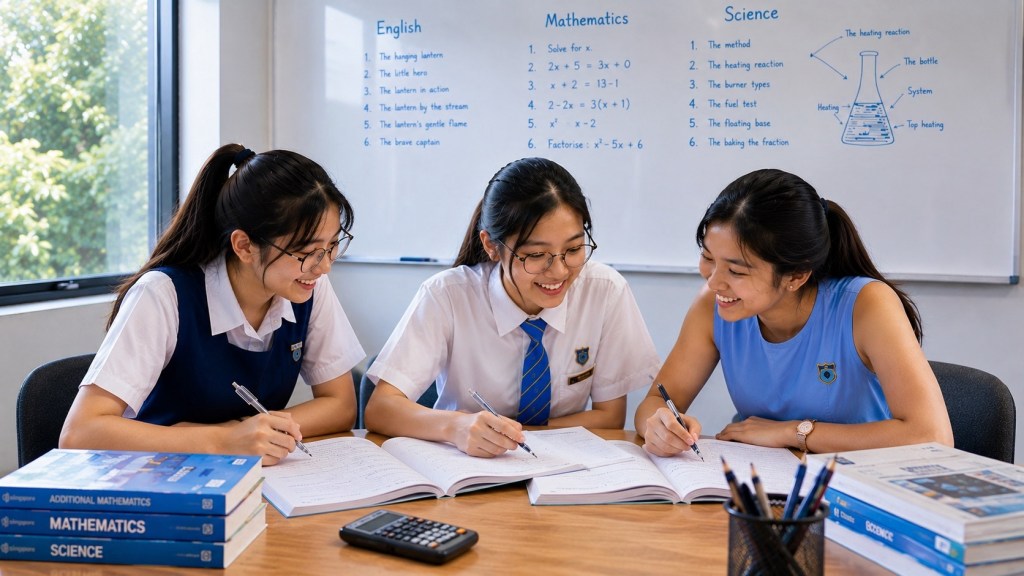
A G3 paper can give you all the information you need and still be difficult if you cannot translate the source into the exact response the question requires. This workshop develops that transfer skill across English, Mathematics and Science.
It follows the subject workshops in Vol 0066, Vol 0067 and Vol 0068, and the evidence discipline in Vol 0065. Use the G3 SEC learner route for the wider sequence.
For 2027 school candidates, use the official K300 English, K310 Mathematics and K326/K327/K328 combined Science syllabuses, plus the SEAB G3 directory, for assessment requirements. Every case below is original teaching material.
The hidden skill is translation
Many examination questions do not ask whether you know a fact in isolation. They give a source—a passage, table, graph, diagram, audio segment, scenario or apparatus—and ask you to turn that source into the right kind of answer. Translation is the bridge between evidence and marks.
Translation begins by naming the source
Before answering, identify what kind of information you have. A passage carries language and viewpoint. A table carries organised quantities. A graph carries relationships across axes. A diagram carries spatial or structural information. Each source has a different first reading move.
Translation ends by naming the output
The same source can support different answers depending on the command. A graph may be described, compared, interpreted or used for calculation. A passage may be summarised, quoted, inferred from or evaluated. The output form is set by the question, not by the source alone.
Use a three-step chain
Ask: what does the source literally provide, what relationship does the question require, and what final response form will communicate that relationship? This keeps the learner from jumping directly from a familiar-looking source to a memorised answer pattern.
English passages: literal before inferential
In Comprehension, first understand what the passage states. Then identify what the question asks you to infer. A strong inference extends the text by one justified step. It should not replace the passage with the learner’s own story.
English passages: preserve viewpoint
If a writer reports someone else’s opinion, the answer should preserve who holds the view. “The residents argued that…” is different from treating the claim as an objective fact. Source attribution can be part of the meaning.
English visual information: label before judgement
When a visual text includes headings, images, layout or numerical information, identify the explicit message and intended audience before deciding the effect. The learner should not assume that a bright design automatically means the creator is enthusiastic.
English listening: audio is temporary evidence
Unlike a printed passage, audio continues moving. The learner must translate in real time: hear the relevant information, compress it into useful notes, and preserve qualifiers or sequence. Overwriting notes can cause the next evidence to be missed.
English Oral: examiner question is the source
In Spoken Interaction, the examiner’s wording is the immediate evidence for what response is required. Listen for scope and qualifiers. A polished answer to a different question is still off-task.
Mathematics text: define the target quantity
A word problem often hides the Mathematics inside a story. Before forming an equation, state what must be found and define variables if useful. Translation fails when the learner calculates a quantity the question never requested.
Mathematics tables: identify row, column and unit
A table is not a bag of numbers. Headings define what each value means. Before comparing or calculating, identify the relevant row, column, unit and whether the values are totals, rates, percentages or averages.
Mathematics graphs: read both axes first
Axis quantity, unit, interval and scale come before interpretation. A learner who sees a rising line and immediately says “increasing quickly” may miss that the horizontal spacing is irregular or that the vertical axis does not begin at zero.
Mathematics diagrams: separate given from appearance
A geometry diagram can help reasoning, but only stated, marked or deduced properties are evidence. Translation from picture to equation requires conditions, not visual guesswork.
Mathematics equations: return to context
A solved equation produces a number, but the number must return to the question. Counts may need integers, lengths need units, probabilities need feasible bounds and model outputs may need contextual interpretation.
Science tables: describe before explaining
If a Science table shows a trend, state what the data show before giving the mechanism. This prevents the learner from writing a memorised explanation that does not fit the evidence.
Science graphs: source and mechanism are separate layers
A graph can establish that one quantity rises as another changes under the tested conditions. The graph alone does not always explain why. Mechanism must come from relevant scientific knowledge or additional information.
Science diagrams: labels can be the decisive evidence
Arrows, scale, connections and component labels may determine the answer. Treat the diagram as data. Do not mentally replace it with a textbook diagram that looks similar.
Science practical instructions: sequence is evidence
In Paper 5, the method tells you what is controlled, measured and repeated. Read the procedure as a logical structure. A later evaluation depends on understanding what the experiment actually did.
Mixed sources: decide which source answers which part
A question may combine text with a table or diagram. One source can provide context while another provides the numerical evidence. Do not force every source into every sentence. Use each where it contributes to the specific task.
Worked EMS case 1: a school transport notice
A fictional notice says a shuttle carried 360 passenger trips over 20 journeys. A survey of 50 respondents says 35 prefer the shuttle to walking. A route map shows the shuttle serves two of four school gates. Three source types are present: operational count, preference survey and spatial coverage.
English translation from the notice
A faithful sentence is: “The shuttle recorded 360 passenger trips, and 35 of 50 survey respondents preferred it to walking.” Do not translate passenger trips into 360 different students or respondents into the entire school.
Mathematics translation from the same notice
Average passenger trips per journey = 360 ÷ 20 = 18. That calculation answers an intensity question, not the number of unique passengers. The denominator defines the meaning.
Spatial translation from the route map
Serving two of four gates does not mean half of all students are served. The map describes coverage points, not population distribution. A numerical fraction of gates should not be translated into a fraction of students without further information.
Decision translation from all three sources
A balanced recommendation might support continuing the trial while examining demand at the unserved gates. The evidence shows use and respondent preference but does not establish whole-school preference or equal gate demand.
Worked English case: source wording matters
A passage says a programme “may reduce queueing during off-peak periods.” The correct paraphrase preserves possibility and condition. “The programme reduces queueing” is not a shorter equivalent; it changes the evidence.
Worked English case: summary scope controls selection
If the summary asks for reasons students found a programme useful, points about cost savings may be irrelevant unless students identified them as useful. Translation begins with scope, not with whichever sentence is easiest to paraphrase.
Worked Listening case: sequence changes the answer
A speaker says, “I planned to cycle, but because it rained I took the train.” Notes that record only cycle and train without the contrast can confuse intention with actual action. Translation must preserve time and status.
Worked Oral case: narrow the response to the question
If the examiner asks whether students should volunteer more often, an answer about whether volunteering is enjoyable is not enough. Translate the question into decision, reason and example. Enjoyment may be evidence, but the response must still address should.
Worked Mathematics case: rate versus total
A fictional machine produces 240 parts in 6 hours. The average rate is 40 parts per hour. If the question asks total output after another 3 hours at the same rate, add 120 to the original total. Do not answer 40 simply because it was the first calculated number.
Worked Mathematics case: percentage-point language
A participation rate rises from 45% to 54%. The increase is 9 percentage points and 20% relative to the original rate. Which expression belongs in the answer depends on what the question asks. Translation includes comparison type.
Worked Mathematics case: graph gradient
If distance is plotted vertically against time horizontally, gradient represents speed. If the axes are reversed, the gradient represents time per distance. Same points, different translation. Always read axes before attaching meaning.
Worked Mathematics case: geometry condition
A diagram appears isosceles, but no equal sides are marked or stated. The learner cannot use base-angle equality merely from appearance. The translation from picture to theorem requires evidence of the condition.
Worked Science case: a rising graph
A graph shows gas volume rising rapidly, then reaching a plateau. Description: volume increases and later becomes constant. Explanation depends on the reaction context. Do not write that the reactant is exhausted unless the task information supports that mechanism.
Worked Science case: control and treatment
A table compares treated and untreated samples under matched conditions. The untreated values provide a reference for what happens without the treatment. Translation into a causal conclusion still requires checking whether other relevant factors were controlled.
Worked Science case: practical anomaly
A measured series is 12.1, 12.3, 20.9 and 12.2 seconds. The table supports saying one value is very different from the others. It does not reveal the cause. Evaluation should distinguish observation from explanation.
Worked Science case: units reveal the model
If a target quantity is joules and the learner’s calculation ends in watts, the translation is incomplete. The unit tells you the result is power, not energy. Units help identify what the arithmetic actually produced.
Source compression is not source destruction
Strong answers often shorten information. A summary compresses a passage, a variable represents a quantity, a graph condenses many pairs, and a scientific model simplifies a system. Compression is useful only when the relationship needed by the question survives.
Translation error 1: copying without selecting
Copying a full sentence from a passage can include irrelevant material. Copying every table value can hide the comparison. Selection is part of translation. Use only the evidence needed for the target.
Translation error 2: calculating before defining
A calculator cannot decide what the denominator should be. If the learner computes an average before deciding whether the relevant unit is per session, per student or per hour, the arithmetic can be correct and the answer wrong.
Translation error 3: explaining before describing
In Science, a memorised mechanism can be correct in general but mismatched to the observed pattern. Describe the actual data first. The mechanism must explain that pattern, not a different one.
Translation error 4: using topic labels instead of relationships
Saying “this is percentage” or “this is forces” is not enough. The learner must identify the relationship: percentage of what, net force in which direction, change relative to which base, evidence for which conclusion.
Translation error 5: losing qualifiers
Only, except, at least, approximately, usually, may and under these conditions can completely change an answer. These words define boundaries. Preserve them through notes, paraphrase and calculation.
Translation error 6: adding a familiar assumption
If a diagram looks like a right triangle, do not assume a right angle. If a passage sounds critical, do not assume hostility. If a science pattern resembles a known experiment, do not invent a controlled variable that the question never states.
A source hierarchy helps under pressure
When sources conflict, start with the direct evidence relevant to the question, then use definitions and models to interpret it. Do not let a remembered general rule override specific conditions printed on the page.
A target hierarchy helps under pressure
When a question has several stages, solve the smallest current target. Do not attempt to answer the final judgement while the intermediate quantity is still undefined. Stepwise translation reduces working-memory load.
Use labels to preserve meaning
Write units, variable definitions, paragraph purposes, speaker identities and graph axes clearly. Labels keep information attached to meaning. They reduce the risk that a later calculation or sentence uses the right number or phrase for the wrong role.
Use arrows to preserve dependency in practice
During preparation, draw arrows from source evidence to conclusion, or from intermediate quantity to final target. This reveals unsupported leaps. In the live paper, clear working and concise planning can perform the same function without elaborate diagrams.
Independent task A: English passage
A source says, “Most of the surveyed volunteers said the new timetable was easier to follow.” Write one faithful sentence and one sentence that incorrectly changes population scope.
Independent task B: Mathematics table
A table shows 420 visits over 14 sessions. Find visits per session and explain why the result is not the number of unique visitors.
Independent task C: Mathematics graph
A line graph plots cost on the vertical axis and quantity on the horizontal axis. State what the gradient means if the model is linear.
Independent task D: Science data
A table shows temperature falls of 12°C, 13°C and 12°C for one container, and 18°C, 17°C and 19°C for another under matched conditions. State the comparison supported by the data before explaining it.
Independent task E: mixed evidence
A survey prefers Option A, but a cost table shows Option B is cheaper. Write a recommendation that names the criterion needed to decide between preference and cost rather than pretending the sources directly contradict.
Independent task F: qualifier control
A listening note says “usually walks, bus when raining”. Write the speaker’s usual behaviour and the condition for the alternative. Then write an inaccurate version that loses the qualifier.
Worked feedback A
Faithful: “Most surveyed volunteers said the new timetable was easier to follow.” Inaccurate: “Most volunteers found it easier” if not all volunteers were surveyed, or “Most students found it easier” if the source concerned volunteers. Population labels matter.
Worked feedback B
420 ÷ 14 = 30 visits per session. The total counts visits, not identified individuals. A person attending several sessions can contribute several visits, so the average cannot be translated into unique people without additional data.
Worked feedback C
For a linear cost-versus-quantity graph, the gradient is the change in cost per unit increase in quantity: a variable cost rate. The intercept may represent a fixed starting cost if the context supports that interpretation.
Worked feedback D
The second container has larger temperature falls across the stated repeats than the first. A mechanism or insulation conclusion comes after this description and depends on the matched conditions being relevant to the question.
Worked feedback E
The sources answer different criteria: preference and cost. A decision needs a rule for how those criteria are weighted. You can say A is preferred and B is cheaper without contradiction. The recommendation should state which criterion is prioritised.
Worked feedback F
Usual behaviour: the speaker usually walks. Alternative condition: the speaker takes the bus when it rains. Inaccurate: “The speaker walks to school” if the sentence is treated as exceptionless and the rain condition matters.
Translation drill: one source, four questions
Take one graph and answer four different prompts: describe the trend, calculate a value, compare two points and explain the pattern. Notice how the source stays the same while the response form changes. The command controls the translation.
Translation drill: one sentence, three scopes
Write one factual sentence about a class, then rewrite it for respondents, the whole school and students generally. Identify which versions require new evidence. This builds scope control across English and data interpretation.
Translation drill: one number, three meanings
Use the number 20 as a total, a rate and a percentage in three different contexts. Add the unit or denominator each time. The exercise demonstrates why bare numbers are not enough evidence.
Translation drill: one diagram, two valid representations
Turn a geometry diagram into an equation and a Science apparatus diagram into a labelled variable list. The goal is not to force the subjects together, but to practise extracting relationships from visual information.
Repair route
If translation is weak, begin by labelling source type, target and answer form before solving. Do not add harder content until the learner can state what information the source actually contains.
Stabilisation route
Mix source types so the learner cannot rely on chapter labels. Use passages, graphs, tables and diagrams in changing order. Ask for the first useful move before the full answer.
Extension route
Combine sources that answer different parts of one decision. Require the learner to state which source supports which claim and where a criterion or assumption is still needed.
What progress should look like
Progress is visible when the learner stops copying irrelevant text, selects correct denominators, preserves qualifiers, reads graph axes before interpreting, uses diagrams as evidence and returns calculated values to the context.
Frequently asked: should I always use every source?
No. Use the source that answers the specific part. If a question provides several sources, some may establish context or support a later subpart. Do not force irrelevant evidence into an answer simply because it is present.
Frequently asked: is translation just comprehension?
No. Comprehension is part of it, but translation also includes forming equations, interpreting units, turning practical observations into conclusions and converting oral or visual information into the required response.
Frequently asked: should I write more working for unfamiliar sources?
Write enough to make the reasoning reliable and checkable. Extra working is useful when it exposes the relationship. It is not useful when it repeats the source without moving toward the target.
Frequently asked: what if two representations disagree?
Check whether they represent the same quantity, units, conditions and data. A mismatch may reveal an error, different scope or different model. Do not average or choose one by appearance.
Final operating rule
Source, relationship, response. First identify what the source literally gives. Then identify the relationship the question asks you to build. Finally express that relationship in the required form—sentence, calculation, comparison, explanation, graph reading or decision.
EMS source-to-answer checklist
- name the source type
- read labels, units and qualifiers
- identify the exact target
- select only relevant evidence
- build the needed relationship
- preserve scope and conditions
- choose the correct response form
- return calculations and explanations to context
Advanced source-to-answer laboratory
Advanced translation: the same percentage can answer different questions
A value of 60% can mean 60% of respondents, a 60% increase relative to a baseline, or 60 percentage points on a scale only if the task defines it that way. Before using the number, reconstruct its denominator and comparison. Percentage without reference is incomplete information.
Advanced translation: totals and rates can move in opposite directions
A total can rise while the rate per session falls. Translate each number into its quantity before calling the sources contradictory. This is the same reasoning developed in the conflicting-evidence workshop, now applied as a routine source-reading habit.
Advanced translation: one graph can support several valid sentences
A line can be increasing overall, increasing at a decreasing rate, or increasing only over part of the domain. The correct sentence depends on the interval and command. Avoid global descriptions when the graph changes behaviour.
Advanced translation: axis reversal changes gradient meaning
If y against x has gradient Δy/Δx, reversing the axes gives Δx/Δy, provided the relationship permits the comparison. The picture may still look linear, but the physical or mathematical meaning changes. Labels determine interpretation.
Advanced translation: a table average can hide distribution
A mean value does not show whether observations are clustered or spread out. If a question asks about consistency, use spread information when available. Do not translate an average into a claim about every individual value.
Advanced translation: a diagram can be schematic
Some diagrams communicate relationships rather than scale. If the paper says not drawn to scale, visual size and angle are not quantitative evidence. Use stated dimensions and marked properties instead.
Advanced translation: a photograph is not automatically a measurement
A Science image may show a qualitative feature, but exact length, temperature or concentration requires appropriate scale or measurement information. Do not extract precision the source does not provide.
Advanced translation: a quotation can be evidence of viewpoint, not truth
If a passage quotes a speaker saying a plan is successful, the quotation proves that the speaker expressed that view. It does not by itself prove the plan succeeded. Preserve the distinction between reported opinion and established fact.
Advanced translation: a worked value can become evidence for a later part
In Mathematics and Science, an intermediate value may feed a later calculation or interpretation. Label it with meaning and unit. A bare number loses its role and increases the chance of using the right value in the wrong place.
Advanced translation: answer spaces do not define required length
A large box does not mean the answer should be long, and a small space does not always mean the reasoning is trivial. Use command, marks and task structure rather than visual answer-space size as the main guide.
Advanced translation: multiple sources may use different time windows
A monthly total and a weekly average cannot be compared directly until the time basis is aligned. Convert or restate the quantities. Many apparent disagreements disappear when time scale is made explicit.
Advanced translation: source order is not evidence order
The first source presented is not automatically the most important. Identify which source directly answers the question. A later table may be decisive while the opening passage provides only context.
Advanced translation: a model output inherits its assumptions
If a formula assumes constant speed, uniform rate or matched conditions, the interpretation should preserve those assumptions. Do not translate a modelled answer into a universal real-world claim that ignores the conditions used to produce it.
Advanced translation: wording can change a mathematical task
Find, estimate, compare, justify and hence are not interchangeable. A learner who calculates when asked to justify may miss the reasoning; a learner who writes a paragraph when asked to find a value may waste time. Command words translate the target.
Advanced translation: wording can change a Science task
Describe asks what the evidence shows; explain asks why; suggest asks for a plausible scientifically grounded response; evaluate asks about quality, limitation or judgement. The same dataset can support all four, but the answer form changes.
Advanced translation: wording can change an English task
Identify, explain, compare, infer, summarise and evaluate require different levels of processing. Do not turn every comprehension question into paraphrase. The task may ask for relationship, effect or judgement.
Mixed-source case: preference versus performance
A survey says most respondents prefer Method A, while a results table shows Method B produced a higher average score in the supplied trial. The sources do not directly contradict: one measures preference, the other measured performance. A recommendation needs a criterion or a way to balance both.
Mixed-source case: cost versus capacity
A Mathematics table shows Option X is cheaper, while a diagram shows it cannot meet the required capacity. Translation requires feasibility before cost optimisation. A cheaper infeasible option is not the solution to the stated decision.
Mixed-source case: graph versus explanation
A Science graph shows a plateau. A passage proposes one possible mechanism. The graph establishes the plateau; the mechanism requires the contextual scientific information. Keep observation and explanation in separate layers before combining them.
Mixed-source case: audio versus printed note
If a Listening task includes printed context and the speaker updates it, distinguish background from new information. The printed note may say the event is planned for Tuesday, while the audio announces a change to Wednesday. The live evidence may update the earlier source.
Response-form switching drill
Take one invented dataset and answer four prompts: calculate the average, describe the trend, explain one possible mechanism, and recommend a next action. Notice that the source stays constant while the response type changes. This is the core of flexible examination transfer.
Denominator drill
For every percentage in a practice paper, say the denominator aloud or write it briefly: of respondents, of total cost, of original value, of trials. If the denominator cannot be named, the percentage is not yet understood well enough to use confidently.
Unit drill
For every number, attach its unit or category until the relationship is secure. Minutes, dollars per item, square metres, respondents and percentage points are not interchangeable. Units and labels prevent silent category errors.
Qualifier drill
Highlight only, except, at least, approximately, usually, may, more than and no more than. Then rewrite the question without those words and explain how the meaning changes. This trains attention to boundaries rather than topic alone.
Representation-check drill
Solve a simple problem algebraically, then check it with a graph, table or reverse substitution where appropriate. Agreement between representations is strong error control because different forms expose different mistakes.
Source-to-answer timing rule
Translation should be fast enough to preserve time but slow enough to prevent category errors. A few seconds spent identifying source, target and response form can save minutes of solving the wrong problem.
Source-to-answer checking rule
During final review, do not only check arithmetic or grammar. Check whether the answer still matches the source and command. A perfect calculation for the wrong denominator and a polished paragraph for the wrong question are both wrong-task errors.
Source-to-answer recovery rule
If stuck, step backward one layer. Ask what the source literally says, what the question asks you to build, and where the translation stopped. This often reveals whether the problem is reading, model choice, calculation or communication.
Source-to-answer independence standard
The learner has mastered this skill when a new source no longer triggers the question “Which chapter is this?” but instead “What information is here, what relationship is needed, and what form should the answer take?”
Final translation rule
Never let the representation choose the answer automatically. A passage, graph, table, diagram or recording is a container for evidence. The question defines the job. Strong G3 performance comes from connecting the two accurately and efficiently.
G3 Learner’s Guide navigation: ← Vol 0068 · Master Hub · Vols 0001–0069 · Worked-reasoning route.
