
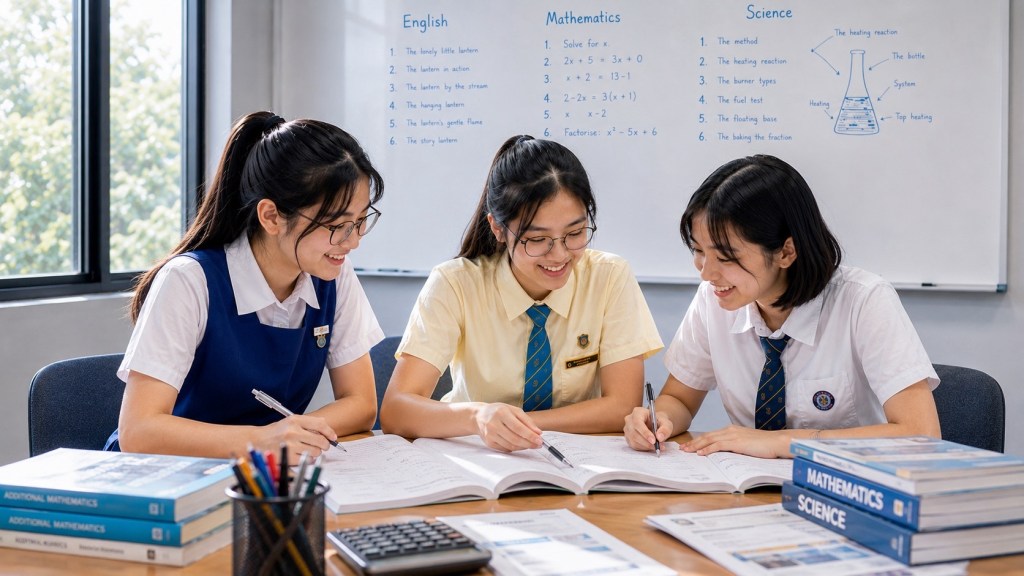
The final sixty minutes before G3 SEC Mathematics are for reducing mathematical noise. The learner should stop broad revision, trust the methods already trained and arrive at Paper 1 or Paper 2 with enough attention to identify relationships, show working and recover from unfamiliar contexts.
This volume follows Vol 0027: Mathematics Final Stretch, Vol 0031: The Last 7 Days, Vol 0035: The Final 24 Hours and the cross-subject final-hour system in Vol 0037.
For 2027 school candidates, the official K310 syllabus sets Paper 1 and Paper 2 at 2 hours 15 minutes and 90 marks each. Use the official timetable for the learner’s year to decide which paper this final-hour guide supports.
The final 60 minutes are not for harder Mathematics
An hour before K310, the learner should stop trying to extend the syllabus. The useful work is operational: confirm equipment, activate one or two familiar relationships, recall the Paper 1 or Paper 2 launch routine, and preserve enough attention to read accurately. The final hour protects Mathematics rather than expands it.
Know whether Paper 1 or Paper 2 is next
The immediate cue depends on the paper. Paper 1 needs fast mixed-topic selection and micro-checks. Paper 2 needs longer-chain planning, modelling and protection of the final real-world problem. Do not rehearse both equally if only one is about to begin.
Minute 60 to 55: close broad revision
Put away large notes, full papers and new problem sets. Keep only the compact error and cue page. The learner should feel the Mathematics system becoming smaller.
Minute 55 to 50: confirm equipment
Check the familiar approved calculator, writing tools and geometrical instruments. Verify calculator mode once. Stop checking after the equipment is clearly ready.
Minute 50 to 45: use one warm-up only if helpful
A simple algebraic manipulation or graph reading can activate thinking. Choose something familiar. The purpose is to feel the process, not prove readiness on a difficult question.
Minute 45 to 40: close Mathematics content
Put away the warm-up and error page. From now on, the learner should not be adding information.
Minute 40 to 35: normal physical reset
Use the bathroom if needed, drink normally and settle belongings. Remove physical distractions.
Minute 35 to 30: stop challenge questions
Do not accept a difficult last-minute problem from another student. The final hour is not a competition.
Minute 30 to 25: recall the launch routine
Target, knowns, representation, method, working, check. This short sequence is enough to orient either paper.
Minute 25 to 20: recall the recovery routine
If blocked: restate the target, write known information, change representation if useful, take one justified step, move if necessary and return later.
Minute 20 to 15: recall the checking hierarchy
Blanks, high-risk method errors, signs, units, copied values, required accuracy and implausible answers. The order should come from personal error history.
Minute 15 to 10: stop all mathematical conversation
Prediction and comparison can consume attention without improving the next decision. Put away the phone and notes as required.
Minute 10 to 5: settle
The learner does not need to rehearse formulas mentally. Let working memory clear.
Minute 5 to 0: listen to instructions
Follow official directions. Once the paper begins, the actual question wording becomes the authority.
Paper 1 final-hour cue
Short questions require method selection, accurate execution and movement. The learner should be ready to switch among Number and Algebra, Geometry and Measurement, and Statistics and Probability.
Paper 1 final-hour pace cue
Do not rush the first page. Establish a sustainable pace. Easy-looking early questions can still contain units or accuracy instructions.
Paper 1 final-hour micro-check cue
Use seconds to check sign, unit, range or substitution after high-risk items. Micro-checking reduces the burden on the final window.
Paper 1 final-hour block cue
If one item becomes a time sink, mark it and move. Paper 1 contains many independent opportunities.
Paper 1 final-hour checking cue
Return to blanks and marked items first. Then check personal risk categories. Do not redo every secure answer.
Paper 2 final-hour cue
Longer questions need mapping. Identify subparts, dependencies, units and likely representations before heavy calculation.
Paper 2 final-hour chain cue
Keep intermediate results labelled. Check major milestones before reusing them. One wrong early value can spread.
Paper 2 final-hour modelling cue
For real-world context: target, relevant data, assumptions, representation, solve, interpret. This sequence is more useful than memorising a scenario template.
Paper 2 final-hour representation cue
Draw, tabulate, define variables or sketch a graph when it exposes structure. Changing representation is a recovery tool.
Paper 2 final-hour checking cue
Check unfinished chains, theorem conditions, units, accuracy and contextual final answers. Protect enough time for the final real-world question.
Do not review every formula
Relevant formulas may be provided, and the learner already has a compact list. The final hour should not become a formula memorisation sprint.
Do not learn a new calculator shortcut
A new key sequence can create entry errors. Use the calculator method already tested.
Do not attempt a new hard proof
Proof skill is built over time. Review theorem conditions and logical chain, not an unfamiliar challenge minutes before entry.
Do not attempt a new difficult probability tree
Keep sample-space logic accessible, but do not create fresh uncertainty with a complicated scenario.
Do not attempt a new long modelling problem
The final hour should preserve modelling attention for the official Paper 2 context.
Do not compare paper counts
Another student may have completed more papers. That does not reveal method selection, error rate or stamina. Use personal evidence.
Do not calculate the mark needed for a grade
Grade arithmetic cannot improve the next Mathematics answer. Focus on available marks.
Algebra cue
Preserve equality, read structure, manage signs, verify solutions. These four habits support many K310 questions.
Geometry cue
Given, target, theorem condition, reason, check. A diagram is evidence only when the property is justified.
Trigonometry cue
Reference angle, known side, required side, ratio, calculator mode, plausibility. The setup matters before the keys.
Functions cue
Input, rule, output, graph meaning. Move among equation, table and graph if one form becomes unclear.
Statistics cue
Variable, centre, spread, graph, context. State mathematical evidence before judgement.
Probability cue
Sample space, event structure, dependence, calculate, bound. Probability should remain between zero and one.
Percentage cue
State the base before calculating. A correct percent operation on the wrong denominator is still wrong.
Rate cue
Write units and identify what changes per what. Compound units reveal the relationship.
Scale cue
Linear, area or volume? The power of the scale factor follows the dimension.
Accuracy cue
Follow the question. Keep precision through working and round at the end. Do not let calculator display decide reporting.
Unit cue
Convert before substitution where necessary. Use units as a check on the model.
If another student offers an obscure formula
Ignore it unless it belongs to the learner’s practised syllabus need. Last-minute novelty is a poor trade for confidence.
If another student says Paper 1 will be easy
Keep the normal pace and checking routine. Easy perception can increase careless errors.
If another student says Paper 2 will be hard
Keep the normal mapping and recovery routine. Difficulty cannot be known until the learner sees the actual paper.
If the learner suddenly forgets a formula
Recall the relationship in words and variables. The paper context or formula sheet may cue the exact form.
If the learner suddenly forgets a theorem
Recall the condition and geometric meaning. Do not panic over exact wording if the reasoning is still available.
If the learner worries about calculator mode
Check it once before entry, then stop. Repeated checking does not add reliability.
If the learner worries about time
Trust the pace markers established in practice. The final hour is not the time to invent a new time budget.
If the learner worries about the final Paper 2 question
Remember that it is still Mathematics. Strip the story to quantities, constraints and relationships. Begin with the target.
If the learner feels the mind is blank
Use recent evidence. Retrieval often returns when the actual question provides cues. Blank feeling before entry is not the same as absent knowledge.
At the venue: close the calculator cover
Once checked, leave it alone until the paper. The learner should not fill the final minutes with random calculations.
At the venue: avoid formula quizzing
Peer quizzing can expose one uncertain detail and make it feel larger than the whole syllabus. The final hour needs perspective.
At the venue: use ordinary conversation or quiet
Both are fine. The learner should avoid turning the corridor into an extension of the revision desk.
When Paper 1 begins
Read each question as a new task. Mixed-topic skill means resetting method selection every time.
When Paper 2 begins
Read enough of the longer question to see structure before calculating. The first minute can save many later minutes.
If the first question is difficult
Do not infer the paper’s total difficulty. Take the first justified step or move as appropriate.
If the first question is easy
Keep the normal reading and check. Early fluency should not become carelessness.
If a calculation gives a strange answer
Check equation, units, calculator entry and order of magnitude. Do not repeat the same entry blindly.
If geometry stalls
Mark givens, target and theorem conditions. Change representation or redraw if needed.
If statistics stalls
Return to the variable, graph and criterion. Mathematical judgement needs a defined basis.
If probability stalls
Make the outcomes visible. A tree or table is often faster than continued mental counting.
Final-hour parent rule
Do not quiz the learner on Mathematics. Help with materials and timing, then allow the trained process to take over.
Final-hour tutor rule
Do not send a difficult last-minute problem. If no urgent specific clarification exists, preserve the learner’s method.
Final-hour device rule
Use the phone only for necessary logistics. Avoid scrolling solution videos, forums or predictions.
Final-hour confidence
Recent error reduction, completed simulations, fewer blanks and stable late-paper accuracy are better readiness indicators than final-minute emotion.
Final-hour independence
The learner should be able to put Mathematics away voluntarily and enter the room knowing what to do first.
Final-60-minute target
The learner starts K310 with familiar equipment, a compact cue system, a clear Paper 1 or Paper 2 routine and enough attention to recognise the Mathematics inside unfamiliar questions.
One final-60-minutes K310 checklist
- close broad Mathematics revision
- confirm familiar calculator and instruments once
- use one compact cue
- avoid hard last-minute questions
- recall launch, recovery and checking routines
- put notes away before entry
- work the actual paper one task at a time
Final-60-minutes Mathematics laboratories
Final-hour Paper 1 rehearsal
Before a mock, use one familiar short question and then stop all Mathematics for forty minutes before entry.
Final-hour Paper 2 rehearsal
Review only the modelling sequence and one long-question outline before a mock, not a full problem.
Calculator-check lab
Check mode and one expression once, then deliberately stop touching the calculator until the mock.
Cue-card lab
Compress K310 to five cues: target, representation, working, accuracy, check.
No-challenge lab
Refuse new hard questions in the final thirty minutes before a school test and compare confidence and attention.
Recovery lab
Begin a practice set with a difficult question and train a controlled move-on decision.
Easy-opening lab
Begin with easy questions and track whether rushing increases avoidable errors.
Paper-entry lab
Put Mathematics notes away ten minutes before a mock and enter with only the launch routine.
Checking lab
State the personal checking hierarchy from memory before a mock and use it at the end.
Real-world cue lab
Without solving, identify target, data, assumptions and representation for three real-world scenarios.
Confidence-evidence lab
List three recent Mathematics behaviours that show readiness: lower error density, fewer blanks or stronger modelling.
Final independence lab
Ask the learner to run the final hour before a school Mathematics assessment without adult prompts.
PSLE-to-SEC continuity
The disciplined question launch from PSLE Mathematics still matters: understand before calculating. The final hour simply strips that habit to its essential form.
Official references
SEAB 2027 K310 G3 Mathematics syllabus · SEAB 2027 G3 school-candidate syllabus directory
Extended Paper 1 and Paper 2 final-hour controls
Paper 1 minute 60 to 50
Close all broad Mathematics revision. Keep only the compact Paper 1 cue page. If a warm-up helps, use one familiar mixed question and stop. The learner should not discover a new weakness in the corridor.
Paper 1 minute 50 to 40
Check calculator mode, geometrical instruments and writing tools once. Confirm materials, then stop handling them. Repeated equipment checking adds no mathematical value.
Paper 1 minute 40 to 30
Recall the short-answer rhythm: read target, choose method, solve, micro-check, move. This should feel procedural, not motivational.
Paper 1 minute 30 to 20
Recall the blocked-item rule. One short question should not consume the time of several others. Mark it, continue and return later.
Paper 1 minute 20 to 10
Recall the checking hierarchy: blanks, signs, units, copied values, accuracy and implausible results. The final check is already planned.
Paper 1 minute 10 to 0
Put notes away and listen to official instructions. The learner no longer needs revision; they need attention.
Paper 1 first five minutes
Establish a clean rhythm. Do not rush simply because the first items look familiar. Early avoidable errors can damage confidence and score.
Paper 1 first topic switch
When the paper moves from algebra to geometry, or from geometry to data, reset. Read the new question as a new mathematical system.
Paper 1 calculator use
Use the calculator for arithmetic after the model is clear. If the output is surprising, check the relationship and entry rather than repeating the same keystrokes.
Paper 1 unit discipline
Write units in contextual questions and convert before substitution when needed. Units are fast error detectors.
Paper 1 accuracy discipline
Read any specified accuracy instruction. Where the syllabus convention applies, round only at the end. Keep greater precision in working.
Paper 1 graph discipline
Read axes, scale and unit before extracting a value. A graph question can be lost before calculation begins if the scale is misread.
Paper 1 geometry discipline
Do not assume from appearance. Use marked or stated properties. Write reasons where reasoning is required.
Paper 1 statistics discipline
State the mathematical feature before the conclusion. A higher median, smaller spread or positive association is evidence; ‘better’ needs a criterion.
Paper 1 probability discipline
Make outcomes visible when the structure is uncertain. A quick tree or table can prevent double counting.
Paper 1 final ten minutes
Find blanks, revisit marked questions, then check personal risk categories. Do not spend the whole window redoing the first page.
Paper 1 answer-change rule
Change an answer only when new reasoning identifies a real problem. Anxiety alone is not evidence.
Paper 1 completion rule
When time is called, release it. Paper 2 still carries equal weighting. Do not carry Paper 1 emotionally into the next paper.
Between Paper 1 and Paper 2: first break
Eat, hydrate and recover normally. A break should restore attention, not become a public answer reconstruction session.
Between Paper 1 and Paper 2: review boundary
Use only the compact Paper 2 page. Avoid another Paper 1 set. The next useful Mathematics is long-chain reasoning and modelling.
Between Paper 1 and Paper 2: algebra maintenance
Use one short algebraic manipulation if the gap is long enough. The purpose is to keep symbolic fluency, not practise a chapter.
Between Paper 1 and Paper 2: modelling cue
Review target, relevant data, assumptions, representation, solve, interpret. This is the final real-world routine.
Paper 2 minute 60 to 50
Stop broad revision. Use one long-question outline at most. The learner should be able to see a chain without solving an entire practice problem.
Paper 2 minute 50 to 40
Check the calculator and instruments once if necessary, then stop. Preserve attention for 2 hours 15 minutes of sustained work.
Paper 2 minute 40 to 30
Recall milestone checking. Important intermediate results should be verified before they feed several later parts.
Paper 2 minute 30 to 20
Recall the final-question protection rule. Earlier questions should not consume all available time. The real-world application deserves deliberate reading and modelling.
Paper 2 minute 20 to 10
Recall the recovery tools: define variables, draw, table, graph, work backward from target. Changing representation can reopen a blocked route.
Paper 2 minute 10 to 0
Put away notes and listen to instructions. The long paper requires a fresh working memory, not one more practice chain.
Paper 2 first five minutes
Establish working layout and pace. A clean start reduces transcription and chain errors later.
Paper 2 long-question reading
Read enough to see dependencies. A later part may rely on an earlier result, or it may be answerable independently even if one part is blocked.
Paper 2 variable definition
Define unknowns clearly in word problems. A variable without meaning can produce a correct-looking equation with the wrong interpretation.
Paper 2 equation formation
Translate relationships before arithmetic. The hardest step may be forming the correct model, not solving it.
Paper 2 intermediate values
Label important intermediate results with units where relevant. This makes the chain inspectable and reduces accidental reuse of the wrong value.
Paper 2 diagrams
Redraw when the provided diagram is crowded. Mark givens, equalities, angles and the target. Representation reduces mental load.
Paper 2 trigonometry
Mark reference angle and sides before choosing a ratio. Check degree mode and plausibility. Setup comes before keys.
Paper 2 functions
Move among equation, table and graph. If algebra is unclear, a sketch or table can reveal the relationship.
Paper 2 data
Use centre, spread, trend or probability according to the task. Interpret in context and avoid unsupported judgement.
Paper 2 modelling first minute
For the extended real-world question, spend the first minute identifying the decision, quantities, constraints and useful information. This is high-value planning.
Paper 2 modelling irrelevant data
Do not use every number simply because it is present. The learner should be able to explain why each used quantity belongs in the model.
Paper 2 modelling assumptions
State assumptions when they affect the model. A mathematically valid result can be practically weak if its assumptions are unreasonable.
Paper 2 modelling calculation
Keep units, working and intermediate values visible. Long contextual calculations are easier to check when the structure remains clear.
Paper 2 modelling interpretation
Return to the real question. A numerical result may require rounding up, choosing a whole number, rejecting a negative value or comparing alternatives.
Paper 2 final fifteen minutes
Prioritise unfinished parts, dependent chains, the real-world problem, units and accuracy. High-mark chains deserve more attention than cosmetic changes to secure work.
If the first Paper 1 question is strange
Do not label the whole paper. Take one justified step or move on. The next item may be routine.
If the first Paper 1 question is easy
Keep the normal reading. Easy-looking items can contain hidden conditions or units.
If the first Paper 2 question is strange
Map the subparts and givens. Do not assume difficulty continues across the paper.
If the first Paper 2 question is easy
Use the opportunity to establish clean working and pace without rushing.
If a sign error appears
Correct it and continue. Do not let one sign mistake create a narrative that the learner is losing control.
If the calculator gives nonsense
Check mode, brackets, units and the formula. Re-enter only after identifying a likely cause.
If geometry feels blank
List known properties from the diagram. The route often emerges after the givens are made explicit.
If probability feels blank
Write the outcomes. Visible sample space reduces mental confusion.
If statistics feels blank
Return to the variable and the question’s criterion. Decide whether the task is calculation, comparison or interpretation.
If modelling feels blank
Ask what decision the real-world situation requires. Define the unknown and identify the quantities directly connected to it.
If time is behind
Protect accessible marks. Shorten over-checking, move from blocks and leave enough time for the final question or checking window.
If time is ahead
Do not rush more. Use the margin to check high-risk working and maintain normal pace.
Final-hour formula boundary
Do not attempt to memorise an entire formula list. Know the relationships and use the provided or learned formulae through meaning.
Final-hour theorem boundary
Do not cram theorem wording without conditions. Geometry marks come from recognising when a property is valid.
Final-hour data boundary
Do not review every statistical formula. Keep interpretation language and graph reading active.
Final-hour probability boundary
Do not tackle a complicated probability puzzle. Keep sample-space discipline and event structure clear.
Final-hour modelling boundary
Do not solve a new extended scenario. Keep the modelling sequence available and preserve cognitive reserve.
Final-hour equipment boundary
Once calculator and instruments are checked, leave them alone. Repeated checking can turn into anxiety.
Final-hour peer boundary
Do not let another learner’s pace, paper count or confidence become evidence about personal readiness.
Final-hour parent boundary
Parents should support logistics and timing, not quiz Mathematics in the corridor or car.
Final-hour tutor boundary
No new technique should be introduced now unless it resolves one specific urgent misunderstanding the learner already recognises.
Final-hour device boundary
Use the phone only for necessary logistics. Solution videos and forum discussions are not final-hour tools.
Final-hour confidence evidence
Use recent facts: fewer blanks, lower error density, cleaner chains, stronger modelling and successful re-tests. These are the real readiness indicators.
Final-hour independence evidence
The learner should be able to say when review is complete, put the materials away and follow the paper process without another prompt.
Final K310 start state
The learner does not need every formula in conscious memory. They need enough attention to read, enough structure to choose a method and enough discipline to check.
Final K310 finish
The final sixty minutes should end with Mathematics feeling quieter: familiar equipment, known risks, clear Paper 1 or Paper 2 routines and no unnecessary new material.
K310 final-entry and paper-release layer
Final Paper 1 entry check
The learner should begin Paper 1 knowing that the first job is accurate classification, not speed. Read the target, identify the mathematical structure and only then calculate. The paper rewards many small correct decisions, so the opening should establish a rhythm that can last.
Final Paper 2 entry check
The learner should begin Paper 2 knowing that long questions are sequences, not single leaps. Map the subgoals, keep intermediate values visible and protect the final real-world problem. A clear chain is easier to recover when one part becomes difficult.
Final K310 checking check
Before entry, the learner should be able to state the checking hierarchy without notes. That means final minutes will be spent finding recoverable marks rather than deciding what to inspect. A checking routine is useful only when it is automatic enough to survive fatigue.
Final K310 recovery check
The learner should also know what to do when blocked: reread, identify knowns, change representation if useful, take one justified step, move if necessary, return later. Recovery is part of Mathematics performance, not a sign that preparation failed.
Final K310 paper-release check
After Paper 1, release it. Paper 2 carries equal weighting and deserves fresh attention. After Paper 2, release Mathematics and move to the next SEC component. The examination period rewards disciplined handoffs as much as disciplined preparation.
Final K310 confidence standard
Confidence should be grounded in evidence: method selection has improved, error density has fallen, blanks have reduced, modelling has become clearer and delayed re-tests have held. These facts matter more than the learner’s emotional state in the corridor.
Final K310 independence standard
The learner should be able to stop revising voluntarily, trust familiar equipment and enter without another worked example. That independence is the final expression of the whole Mathematics learning sequence.
Final K310 conclusion
The last sixty minutes should not make the learner more knowledgeable. They should make the learner more available to the Mathematics already known. Fewer distractions, clearer cues and a stable process are the final advantage.
Enter ready to think clearly, show the method, and protect every available mark.
G3 Learner’s Guide navigation: ← Vol 0038 · Master Hub · Vols 0001–0069 · Vol 0040 → · Mathematics route.
