
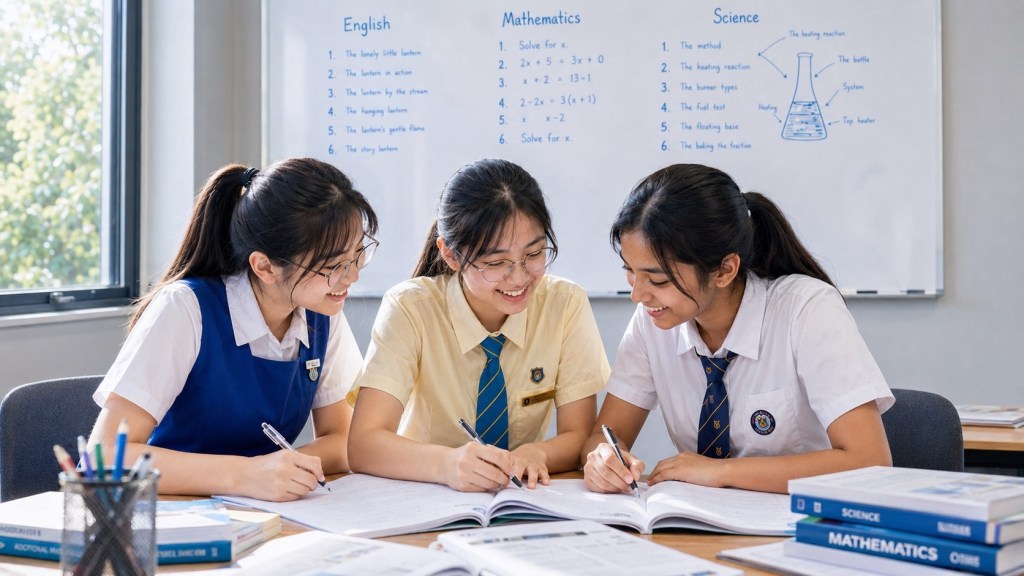
How to perform in the new G2 SEC examinations becomes a practical question when you stop asking whether you have revised enough and start examining what your answers actually show. This G2 SEC mixed-skills checkpoint gives you twelve short tasks across English, Mathematics and Science. Each task reveals a different decision: reading a condition, choosing a method, using evidence, explaining a relationship or recognising the limit of a conclusion.
This is original eduKateSengkang practice, not a SEAB specimen paper, predicted examination paper or validated diagnostic test. Its purpose is narrower: help you choose a sensible next learning priority. The passages, organisations, measurements and situations below are invented for learning. The review criteria are our teaching criteria, not an official mark scheme or a way to predict an SEC grade.
MOE confirms that the SEC begins in 2027, with students taking subjects at their respective levels. That does not make every subject a single common paper. Check your own subject entries and examination year through the MOE SEC announcement and the SEAB G2 syllabus directory.
What this checkpoint adds to the earlier guides
Vol 0033: Exam-Readiness Thresholds explains why a skill should be tested beyond the lesson in which it was taught. Here, you will produce the evidence yourself. Rather than another list of revision habits, this volume provides questions, worked interpretations and a route from each error to a small repair.
The checkpoint is intentionally too small to measure the whole syllabus. It does not assess a full composition, sustained oral interaction, all Mathematics strands or both disciplines of a Science combination. Passing it does not establish complete readiness. Struggling with one task does not establish a general weakness. Treat each response as a sample of thinking worth investigating.
Prepare the page before attempting the questions
Divide a sheet into three areas headed English, Mathematics and Science. Leave space beside each answer for a short note after review. Use ordinary writing materials. A calculator may be used for this activity, but write the relationship you are calculating rather than recording only the display. The official K210 syllabus permits an approved calculator in both Mathematics papers; the equipment used in this informal activity does not determine what is permitted in your actual examination.
Attempt the questions without opening the answers below. A suggested practice window is forty minutes, followed by an untimed review. This timing is a teaching choice, not a national benchmark. Use the arrangements appropriate to your access needs. Do not remove an established accommodation to make the activity seem more demanding. What matters is whether the record accurately represents the conditions under which you worked.
Beside each response, write one of three descriptions: confident, uncertain or unsupported guess. These labels are not marks. They let you compare how an answer felt with how well it was supported. An uncertain correct answer and a confident incorrect answer suggest different next actions. Do not revise the confidence label after seeing the solution; preserve the first record.
English source A: an announcement
Read this invented announcement: “The school resource room will remain open until 6 p.m. on Tuesdays during a four-week trial. Seats must be reserved by noon that day. Students who book but cannot attend should cancel by 2 p.m. so another student can use the place. The trial will continue next term only if attendance shows that the later opening is useful.”
Task E1: A student says, “The room will now open late every day for the rest of the year.” Identify two parts of this statement that the announcement does not support. Task E2: Explain why the cancellation deadline is earlier than the closing time. Use the purpose of cancellation rather than repeating the times.
For both questions, answer the information actually supplied. You do not need to decide whether the trial is a good idea. You do not need to invent staffing difficulties or complaints from parents. Keep policy, condition and purpose separate. A relevant opinion is still the wrong answer when the task asks what a source supports.
English source B: a student response
Read this invented response: “I welcome the later opening because my project group cannot meet before CCA. However, the trial will help us only if booking does not become another race for the same few seats. I would prefer a weekly booking limit so more groups have a chance.”
Task E3: Does the student oppose later opening? State the student’s position and the condition attached to it. Task E4: Write a two-sentence message to the resource-room coordinator. Recommend one change supported by the response, and explain how that change addresses the concern. Do not add a new concern that the student never expressed.
The 2027 K200 English syllabus includes understanding texts and using language appropriately for purpose, audience and context. These short tasks sample those demands; they are not a substitute for the full Writing, Comprehension, Listening and Oral components.
Mathematics tasks: keep the model visible
Task M1: A club pays a fixed delivery fee of $6 plus $2.50 for each folder ordered. Write a formula for total cost C when n folders are ordered, then find the cost of eight folders. Task M2: A jacket costs $72 after a 20% discount. Find the original price and check your answer by applying the discount.
Task M3: A student travels 12 km at 24 km/h and then 12 km at 12 km/h. Find the average speed for the whole journey. Task M4: Thirty-eight participants need seats. Each hired table seats six people and costs $18. The hiring budget is $120. Decide whether the budget can provide enough tables, showing both the required number and total cost.
These are ordinary mathematical situations with an extra demand: each answer must retain its meaning. A formula needs a fixed term when a fee is fixed. A reverse percentage needs the correct base. An average speed needs total distance and total time. A capacity decision needs a whole number of tables. The arithmetic is not the only work.
Science tasks: read the evidence before the conclusion
For S1 and S2, use these invented measurements. Equal volumes of water in otherwise identical containers both begin at 70°C. After ten minutes in the same room, a wrapped container is at 61°C and an unwrapped container is at 54°C. Task S1: Compare their temperature decreases using values. Task S2: Explain why this comparison alone does not establish that the wrapped container will never reach room temperature.
For S3, two groups investigate a treatment that is claimed to improve plant growth. Group A uses the treatment and places its plants beside a bright window. Group B does not use the treatment and places its plants in a darker part of the room. Task S3: Identify the problem with attributing any growth difference only to the treatment, and propose a comparison that addresses it.
For S4, an electronic display is known to read 2°C above the reference temperature on every reading. A student takes five readings of a stable sample and calculates their mean. Task S4: Explain whether averaging alone removes this known offset. These are paper-based reasoning questions; no home experiment is needed. Their shared data and investigation skills are relevant across the Science combinations listed in the official G2 directory.
Stop here before reading the worked review
Finish the twelve responses before checking. If you are blocked, write the first valid statement you can make and move on. Keep unsuccessful working visible. It is useful evidence about where the route changed. Do not use the review to manufacture a clean first attempt. A corrected page is valuable, but it answers a different question from an independent first attempt.
After the attempt, note any interruption, hint or unusual condition. This is not an excuse field. It prevents false interpretation. A response produced after someone supplied the formula cannot be used as evidence of independent method selection. A blank response because the practice window ended cannot automatically be classified as missing knowledge.
Worked review: E1 and the scope of a statement
The student’s statement overstates frequency and duration. The announcement specifies Tuesdays, not every day. It describes a four-week trial, not an unconditional arrangement for the rest of the year. A strong answer names those two contrasts. It does not need a general paragraph about why students should read notices carefully.
A partially successful response might say, “It is only a trial.” This detects the duration problem but leaves the frequency problem unstated. Another might say, “It might not continue.” That identifies uncertainty about continuation but still needs the exact Tuesday restriction. The repair is not more vocabulary. It is counting the requested differences and checking which dimensions the source limits.
For a fresh check, replace the announcement with: “Bookings are available to Secondary 3 students on alternate Thursdays until the end of this term.” Ask whether it supports “all students every Thursday”. The surface has changed, but the reading operation remains scope control. A learner who corrects the first statement yet misses the second has not transferred the distinction fully.
Worked review: E2 and functional explanation
The earlier deadline gives another student time to take and use the released place. The relevant relationship is cancellation followed by reallocation, not the arithmetic difference between 2 p.m. and 6 p.m. “Because cancellation is at 2 p.m.” repeats a fact without explaining its purpose. “Because staff go home early” invents a reason absent from the source.
A useful answer is: “Students must cancel early enough for the vacant place to be offered to someone else before the session ends.” This wording is not compulsory. Any accurate version preserving that relationship is acceptable for this teaching task. Assess the meaning, not whether your sentence matches the model word for word.
To repair a weak response, underline the action and the intended benefit separately. Then connect them with a causal phrase. For example: cancel early, therefore another student can plan to attend. This small exercise is more targeted than rewriting the whole announcement. It turns a general instruction to “explain more” into a visible missing connection.
Worked review: E3 and conditional support
The student supports later opening but is concerned about fair access to limited seats. The word “however” introduces a qualification; it does not erase the earlier welcome. The response should preserve both the positive position and the booking condition. “The student dislikes the trial” is too negative. “The student likes everything about it” ignores the concern.
This is a useful distinction for reading opinions: support for an aim is not identical to support for every implementation detail. Readers who treat any criticism as total opposition will misrepresent moderate viewpoints. In this exercise, the preferred weekly limit is evidence that the student wants the arrangement improved, not abandoned.
Try a contrast sentence: “I support more outdoor lessons, provided there is an indoor alternative during heavy rain.” The position is support; the condition concerns weather contingency. Ask the learner to identify both without judging the proposal. This keeps the task anchored to what the speaker actually said.
Worked review: E4 and a supported recommendation
A suitable response is: “Could the resource room introduce a weekly booking limit for each group? This would give more groups an opportunity to use the limited seats during the trial.” The recommendation comes from the source, the reason addresses access, and the request fits a student writing to a coordinator.
A response suggesting free transport or different furniture may be sensible in another discussion but is not grounded in this student’s concern. Another response might propose the correct limit yet give the reason “so students enjoy themselves”. That reason is too general. The teaching target is alignment between evidence, proposal and intended result.
Do not penalise yourself because your request uses a different polite structure. “I recommend limiting each group to one booking a week” can work if the proposed detail is presented as your suggestion rather than as an existing rule. Distinguish information taken from the source from a reasonable specification you are adding to implement it.
Worked review: M1 and fixed versus variable cost
The model is C = 6 + 2.50n. For eight folders, C = 6 + 20 = $26. The fixed fee appears once because one order is being delivered. Multiplying 8 by 8.50 charges eight delivery fees. Writing C = 2.50n omits the delivery charge. Both mistakes arise before the arithmetic.
A useful check is to compare the costs of eight and nine folders. They should differ by $2.50, not $8.50, because the order has gained one folder but not another delivery. Another check is to explain each term aloud. If you cannot say what the 6 represents, the formula may be a memorised shape rather than an understood model.
For transfer, change the situation to a $12 entry fee plus $3 for each activity. Ask for the cost of four activities, then ask which part changes when a fifth activity is added. The model structure is the same. Do not make the retest harder by adding discounts yet; first check whether fixed and variable quantities remain distinct.
Worked review: M2 and the percentage base
After a 20% discount, the sale price is 80% of the original. Let the original price be P. Then 0.80P = 72, so P = $90. Check: 20% of $90 is $18, and $90 minus $18 is $72. Adding 20% of $72 instead uses the sale price as the base and gives the wrong reconstruction.
The important explanation is not merely “divide instead of multiply”. It is why division is needed here: the known amount represents a reduced fraction of an unknown original. That relationship determines the operation. A learner who chooses division only because the task contains the word “original” may still fail when the wording changes.
A fresh check is a bag costing $68 after a 15% discount. Write the relationship before calculating. The correct original is $80 because 0.85 × 80 = 68. When reviewing, distinguish a wrong multiplier from a correct multiplier entered incorrectly into the calculator. Those are different repair targets.
Worked review: M3 and what is being averaged
The first 12 km takes 12 ÷ 24 = 0.5 hours. The second takes 12 ÷ 12 = 1 hour. The total distance is 24 km and the total time is 1.5 hours, so average speed is 24 ÷ 1.5 = 16 km/h. The simple mean of the two speeds, 18 km/h, is not appropriate because the travelling times are unequal.
The slower speed operates for longer, which explains why the whole-journey average is below 18 km/h. This is a reasonableness check, not a replacement for the calculation. Writing both journey times makes the weighting visible. It also provides a stable route when distances and speeds become less friendly numbers.
The K210 Mathematics syllabus includes selecting appropriate mathematics and interpreting results in context. This exercise samples that selection. For a contrast retest, keep the two speeds but make each stage last half an hour. Then the average is 18 km/h. The changed condition, equal time rather than equal distance, explains the changed method.
Worked review: M4 and feasibility
Thirty-eight divided by six is 6.333… . Six tables provide only 36 seats, so seven are required. Seven tables cost 7 × $18 = $126. The $120 budget is therefore insufficient by $6. A complete decision uses both the capacity condition and the budget condition.
“Six tables because 6.333 rounds to six” applies ordinary rounding where a minimum capacity decision is needed. “Seven tables” solves only the seating part. “Not enough budget” without supporting quantities may be a guess. The teaching criterion is a defensible chain: required capacity, whole-number choice, cost, comparison.
For a fresh check, provide 41 participants, eight seats per table, $16 per table and a $100 budget. Six tables cost $96, so the plan is feasible. A learner should not carry the previous conclusion forward merely because the task looks similar. Preserve the method, then let the new data determine the decision.
Worked review: S1 and comparable change
The wrapped container decreases by 70 − 61 = 9°C. The unwrapped container decreases by 70 − 54 = 16°C. The wrapped container therefore has a temperature decrease 7°C smaller over the ten-minute interval. A statement about final temperatures alone is not wrong, but the task specifically asks for decreases, so calculate the changes.
Do not replace “temperature decrease” with “energy lost” without qualification. The numerical temperature data alone are not numerical measurements of energy transfer. The shared initial condition makes the comparison straightforward, but the physical quantity still needs its correct name. This is a small language choice with a large effect on scientific precision.
For transfer, let two samples begin at different temperatures and ask which had the larger decrease. A learner who compares only their final temperatures will now fail. This helps distinguish genuine change-based reasoning from a shortcut that happened to work because the original starting temperatures were equal.
Worked review: S2 and the boundary of a claim
The observations cover ten minutes. They support a smaller temperature decrease for the wrapped sample during that interval; they do not establish what happens forever. “Never reaches room temperature” is much stronger than the supplied record. A good answer identifies the difference between a measured interval and an unlimited future claim.
This question does not require you to calculate a cooling curve. It asks whether the evidence supports the wording. The G2 Science syllabus includes evaluating information and investigations. Here, the evaluation is the scope of the conclusion, not a criticism of every feature of the experiment.
To retest the same skill, provide a short record showing a material unchanged after two hours. Ask whether it supports “this material never changes”. The learner should identify insufficient time coverage rather than inventing a particular future outcome. Recognising an unsupported conclusion does not require proving its opposite.
Worked review: S3 and an alternative explanation
Treatment and light conditions differ together, so any growth difference cannot confidently be attributed only to the treatment. A better comparison gives treated and untreated plants comparable light conditions while controlling other relevant differences. Use comparable plants, consistent measurement and appropriate replication; changing only the treatment is the intended contrast.
“Repeat the experiment” is incomplete because repetition of the same confounded arrangement preserves the ambiguity. “Put both groups by the window” addresses the named light difference, though a careful plan should also consider whether positions receive comparable light. A repair should target the alternative explanation that the task actually creates.
For transfer, compare two cleaning methods but give one twice as long to work. Ask what the comparison can show. The same reasoning applies without requiring plant knowledge: method and duration changed together. You are testing whether the learner notices a comparison problem across contexts.
Worked review: S4 and a persistent offset
Averaging alone does not remove the known +2°C offset. If every reading includes the same offset, their mean includes it too. Repetition may help describe variation among readings, but it does not cancel a shared bias. Use a properly checked instrument or apply a justified correction based on the stated calibration information.
The reasoning can be seen without advanced statistics. If the reference temperature is 20°C and the display repeatedly shows 22°C, the mean of five 22°C readings is still 22°C. More copies of the same shifted reading do not move the average back to 20°C. The example tests the difference between consistency and correctness.
A fresh check uses a balance that reads 5 g when empty. Ask whether averaging ten readings of the same object removes the zero offset. The relevant structure is unchanged. The learner should not need the temperature example beside them to explain why the bias persists.
Turn the responses into a learning decision
For each task, record whether the first response was supported and complete, partly correct, incorrect or not attempted. Do not add these labels into an SEC grade. Instead, identify the earliest point where the answer stopped working: task reading, evidence selection, model choice, execution or final expression. Choose the smallest repair that addresses that point.
A learner who misses E1 and M4 may be overlooking conditions across subjects. A learner who gets M1’s model right but calculates incorrectly needs a different intervention from one who multiplies the delivery fee by every folder. A learner who writes correct Science observations but unsupported conclusions needs claim checking, not necessarily a new chapter of content.
Preserve uncertainty when the evidence is thin. One error does not prove a repeated pattern. Take the suspected cause into a fresh task. If the same failure returns under slightly different wording, the diagnosis becomes more useful. If it does not, record the first error without building a large programme around it.
A worked example of a seven-day repair plan
Suppose a learner misreads the Tuesday restriction, reverses the percentage base and attributes plant growth only to treatment. Do not respond by assigning a full English paper, a full Mathematics paper and another Science test immediately. The first repair can be small: practise source conditions, represent original and changed quantities, and identify what differs between comparison groups.
On the first day, discuss those three failures and redo the relevant questions without looking at the model answers. On a later day, use the fresh checks supplied above. Towards the end of the week, place one of each inside a short mixed set. Keep the corrected first attempt and the later independent attempt separate so improvement remains visible.
If the new tasks still fail, reduce the difficulty and teach the missing relationship directly. If they succeed, return the skill to ordinary subject practice rather than drilling the identical question indefinitely. The plan is an example, not a guaranteed timetable. Its useful feature is the connection between observed error, teaching action and new evidence.
Use the right learning route after the checkpoint
For English task interpretation and expression, continue through the Secondary English Learning Hub. For a Mathematics concept or technique gap, use the Complete Mathematics Index. For scientific concepts and investigation skills, use the Complete Science Index. The checkpoint selects the next learning job; those routes provide the underlying teaching.
Use Vol 0036: Evidence Strength when the main issue is an overstrong conclusion, and Vol 0035: Constraints and Feasibility when a correct calculation has become an impossible practical answer. Do not replace concept teaching with repeated checkpoint attempts.
The PSLE bridge remains Read Before You Solve. The secondary extension is to preserve conditions, select a model and justify the final claim without a prompt. For full-paper pacing and review, return to Examination Craft. The most useful result of this checkpoint is not a flattering total. It is a precise sentence: this is the next skill I will repair, and this is how I will check whether the repair held.
G2 SEC Learner’s Guide: open the Vol 0001–0131 index · continue to Vol 0132–0175.
G2 SEC Learner’s Guide navigation: Master Index · Cross-subject lane · Examination Craft
