
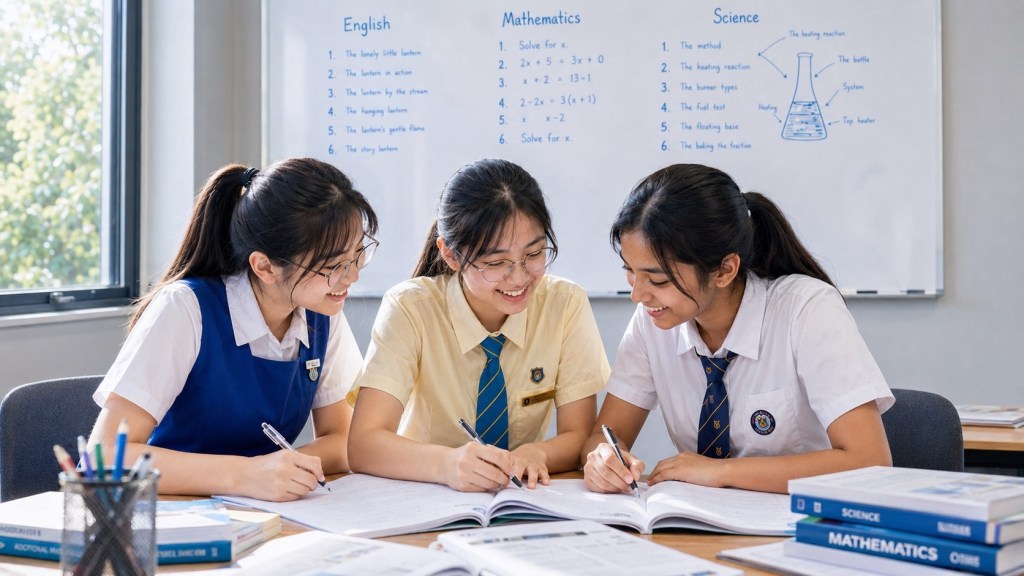
How to perform in the new G2 SEC Science examination when a question looks unfamiliar is to look past the story and recover the scientific structure. For 2027, G2 Science is offered through K223 Science (Physics, Chemistry), K224 Science (Physics, Biology) and K225 Science (Chemistry, Biology). The syllabus explicitly assesses handling information and solving problems, not only recall. That means some questions will place familiar science inside unfamiliar situations.
This sixteenth Learner’s Guide builds on Vol 0012: Calculations, Graphs and Data — From Numbers to Evidence. The earlier guide developed data interpretation. This volume develops transfer: using a known concept when the apparatus, organism, material, setting or wording is new.
Use the official SEAB G2 syllabus page and the current K223, K224 or K225 syllabus for the learner’s actual subject combination. Transfer practice should remain anchored in assessed concepts before extending beyond the syllabus.
Unfamiliar Does Not Mean Unknown
An unfamiliar question often contains one or more familiar scientific relationships hidden inside a new context. The learner’s first job is not to remember seeing the exact question. It is to identify what scientific principle could still explain the situation.
The Transfer Strip
Strip the question down in four passes:
- Context: what is the story or setting?
- Evidence: what observations, values or changes are given?
- Concept: which scientific principle connects the evidence?
- Task: what must be stated, calculated, predicted or explained?
The context can be new while the concept remains familiar.
Translate New Words Into Known Roles
A question may introduce a device, species or material you have never seen. Ask what role it plays rather than whether you recognise its name.
- Is it a source of energy?
- Is it a conductor or insulator?
- Is it a reactant or product?
- Is it a variable being changed?
- Is it an organism carrying out a known process?
- Is it a measuring instrument?
- Is it evidence of a chemical or physical change?
Role recognition prevents unfamiliar nouns from blocking familiar reasoning.
Use the Command Word as an Anchor
When context feels complex, the command word reduces the search space.
- State: give the required fact or conclusion.
- Describe: say what happens or what pattern appears.
- Explain: give the mechanism.
- Predict: use the evidence or principle to state what should happen next.
- Suggest: propose a plausible scientifically supported answer.
- Calculate: use a valid relationship with units.
The command tells you the form of the answer even when the setting is unfamiliar.
Physics Transfer: Follow the Quantities
In Physics, unfamiliar contexts often become manageable when the quantities are identified. A new machine may still involve force, energy, pressure, current, resistance, speed or another familiar relationship.
Write the quantities with units and ask how changing one should affect another. The name of the machine may be irrelevant to the physics being tested.
Chemistry Transfer: Follow the Particles and Evidence
In Chemistry, a strange industrial process or unfamiliar substance may still show known evidence: gas formation, temperature change, mass change, colour change, pH change, precipitation or rate.
Ask what the observations imply and which particle or reaction model can explain them. Do not invent properties for an unfamiliar substance unless the question provides evidence.
Biology Transfer: Follow Structure, Process and Function
A new organism can still use known biological processes. Look for structure, transport, nutrition, respiration, reproduction, coordination or ecological relationships.
The learner does not need to know the organism’s name if the question provides enough evidence to reason from known principles.
The Evidence Boundary
Unfamiliar questions tempt students to guess. The remedy is to mark the evidence boundary: what the question tells you, what the syllabus concept allows you to infer, and what remains unknown.
A strong answer stops at the boundary of justified inference.
Use Comparison to Find the Variable
When two conditions are compared, identify what changed and what stayed similar. This often reveals the tested variable even when the context is unfamiliar.
Then connect the change to the measured outcome.
New Diagram, Same Science
A diagram can look complex because of labels and unfamiliar components. Before interpreting the whole picture, identify the parts that correspond to known scientific roles.
- source;
- pathway;
- barrier;
- sensor;
- input;
- output;
- reactant;
- product;
- organ;
- transport route.
Then reconstruct the system from those roles.
New Graph, Same Relationship
Ignore the story for a moment. Read the axes. Identify the variables. Describe the pattern. Only then reconnect to the context.
This sequence prevents the unfamiliar scenario from overwhelming basic graph-reading skill.
What to Do When You Do Not Know a Term
Do not abandon the question. Use surrounding information.
- Identify the grammatical role of the term.
- Look for a definition, diagram or measurement nearby.
- Infer its functional role.
- Continue with the known scientific relationship.
- Avoid inventing a detailed meaning not supported by the question.
The Transfer Ladder
Level 1 — same concept, familiar context
Use ordinary textbook examples.
Level 2 — same concept, changed numbers or diagram
The surface changes while the structure stays clear.
Level 3 — same concept, unfamiliar real-world setting
The learner must ignore novelty and recover the concept.
Level 4 — several concepts in one setting
The learner chooses which principle applies to each part.
Level 5 — incomplete evidence
The learner must state what can and cannot be concluded.
Train Transfer With ‘Why Is This Still the Same?’
After solving an unfamiliar question, ask the learner to explain why it is still the same science as a familiar classroom example. That comparison makes the deep structure explicit.
The Wrong Transfer Problem
Transfer can fail because the learner applies a familiar concept merely because one word appears. For example, seeing “heat” does not mean every thermal concept applies. Seeing “gas” does not identify the reaction. Seeing “plant” does not tell you which process is being tested.
The concept must fit the evidence, not just a keyword.
The Science Transfer Error Ledger
- blocked by unfamiliar vocabulary;
- focused on story instead of evidence;
- selected concept from keyword only;
- ignored units or variables;
- made an inference beyond the evidence;
- knew the concept but could not connect it to the new context;
- answered from general knowledge instead of the syllabus principle.
A 14-Day Transfer Build
Days 1–3 — strip familiar questions
Practise context → evidence → concept → task on ordinary questions.
Days 4–6 — changed contexts
Use the same concepts inside different everyday or technological settings.
Days 7–9 — unfamiliar diagrams and data
Read roles, variables, axes and units before trying to explain.
Days 10–11 — mixed concepts
Use questions where several principles could appear and require explicit selection.
Days 12–13 — evidence boundaries
Practise stating what can and cannot be concluded from limited data.
Day 14 — timed transfer set
Use unfamiliar contexts under time and review exactly where novelty disrupted reasoning.
Advanced Transfer: Build From Principles, Not Memories
The most robust learner can reconstruct an answer from first principles when the exact question has never been seen. This is the endpoint of transfer: less dependence on surface pattern, more dependence on scientific relationships.
Final Rule
When a Science question looks new, do not ask, “Have I seen this before?” Ask, “What evidence is here, what scientific role does each part play, and which principle can connect them?”
Novel context. Familiar structure. Evidence first. Concept second. Mechanism third. Answer last.
G2 SEC Learner’s Guide: open the Vol 0001–0131 index · continue to Vol 0132–0175.
G2 SEC Learner’s Guide navigation: Master Index · Science lane · Examination Craft
G2 SEC Learner’s Guide navigation: Master Index · Science lane · Examination Craft
