
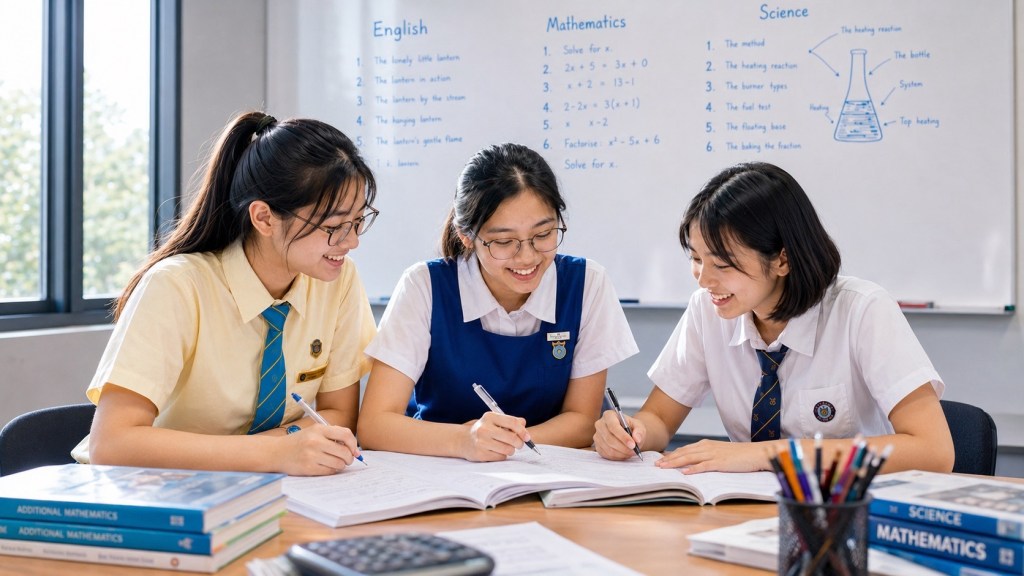
A Mathematics tuition progress review should tell parents more than whether the student is “doing better”. Parents searching for Secondary Mathematics tuition progress reports, tutor feedback, how to know what a Math tutor is teaching, or what parents should expect from Mathematics tuition in Sengkang need information that can support a decision. A useful review describes what the learner can currently do, under what conditions, what support is still needed, what evidence has changed and what should happen next.
Marks matter, but they are only one layer. A student can improve algebraic independence before the next school test reflects it. Another student can receive a higher score because the paper suited familiar strengths while an old transfer problem remains. A progress review should therefore connect school results with observable learning: retrieval, method selection, working, accuracy, time, independence, delayed retention and transfer to changed questions.
At eduKate Sengkang, this Advanced Mathematics Tutorials article owns the reporting job: what a Secondary Mathematics tuition progress review should contain, how parents should read it, and how the report should change teaching decisions. It is distinct from How to Know Whether Mathematics Tuition Is Actually Working, which owns the broader evaluation decision. This page is about the evidence a tutor should surface so that evaluation becomes possible.
Quick answer: what should a Mathematics tuition progress review contain?
State the learner’s current mathematical job, the evidence observed, the support conditions under which performance occurred, the recurring error pattern, what has changed over time, the workload or assessment context, and the next teaching action. Avoid unsupported predictions and vague praise.
- Current priority.
- Recent independent evidence.
- Support used.
- Strengths that are stable.
- Weaknesses that are still active.
- Error categories.
- Retrieval after delay.
- Transfer to changed/mixed questions.
- School assessment evidence.
- Homework independence and duration.
- Next four-week job.
- Conditions for changing, reducing or ending support.
A progress review is not a marketing report
Parents do not need a monthly brochure explaining that the programme is excellent. They need a bounded description of the learner’s current Mathematics. The report should be useful even if the news is mixed.
A review that can only report positive developments may hide the exact information needed to improve teaching.
A progress review is not a psychological profile
Tutors should report educational evidence, not diagnose personality or health. Statements such as “careless child”, “lazy learner” or “not mathematically inclined” are too broad and often unsupported.
Replace them with task evidence: “sign errors recur when negative brackets appear under time,” or “the student starts direct questions independently but still needs a method cue on mixed questions.”
The report should begin with the current learning job
Parents should know what the tuition is currently trying to change. The job might be algebra repair, transition into Secondary 1, Secondary 2 bridge stability, E-Math maintenance during A-Math, paper timing, checking, or enrichment.
Without a current job, progress becomes difficult to interpret because every lesson can appear to be “covering Mathematics” without a clear success condition.
The current job should be small enough to review
- Too broad: improve Mathematics.
- Better: stabilise algebraic manipulation.
- Better still: reduce sign and bracket errors across expansion and equations, then retest inside mixed questions.
- Too broad: prepare for exams.
- Better: improve full-paper completion.
- Better still: reduce time lost on early short-answer questions and preserve 15 minutes for targeted checking.
The report should separate teaching coverage from learner capability
“We covered factorisation, graphs and statistics” describes tutor activity. It does not tell the parent whether the student can use those topics independently.
Coverage can be listed as context, but the central statement should describe capability: “Factorisation is stable in direct questions and survives a one-week delayed retest; mixed selection remains slow.”
The report should identify support conditions
A correct answer after a worked example is different from a correct answer produced closed-book. A correct answer after a tutor names the method is different from independent method selection. A progress review should record enough support context to interpret success honestly.
- Independent.
- Notes open.
- Formula cue available.
- One tutor hint.
- Method named by tutor.
- Guided step-by-step.
- Worked example consulted.
- AI/solver used.
- Peer explanation heard first.
The report should include at least some fresh independent evidence
If every reviewed task was completed with live tutor support, the tutor cannot confidently report independent mastery. A fresh question at the end of the lesson or a delayed retest provides stronger evidence.
The report should distinguish immediate learning from retained learning
Students often appear fluent immediately after explanation. The stronger question is whether the method is still available several days later. Delayed retrieval should appear in progress reporting for important repaired skills.
The report should distinguish familiar success from transfer
A learner can master one worksheet pattern and still fail when wording, representation or context changes. Report whether the capability survives variation.
This is especially important for upper-secondary and examination preparation, where questions rarely reproduce tuition examples exactly.
The report should distinguish accuracy from speed
A student may become more accurate but remain too slow for paper completion. Another may become faster by skipping working and lose accuracy. Progress reporting should show the trade-off rather than collapsing both into one score.
The report should distinguish concept errors from execution errors
Concept error: the relationship is not understood. Execution error: the method is appropriate but algebra, calculation, units or input fail. These require different teaching responses.
The report should identify recurring error families
- Concept.
- Interpretation.
- Method selection.
- Sequence.
- Algebra/calculation.
- Graph/diagram.
- Calculator/input.
- Unit/rounding.
- Working/copying.
- Time allocation.
- Checking.
- Recovery after difficulty.
Parents do not need every error listed. The report should surface the categories that repeat or have high mark cost.
The report should name stable strengths
Progress reporting should not become a weakness inventory. Stable strengths matter because they can be moved to maintenance, reducing workload. They also show parents what no longer needs active tuition attention.
The report should identify what can be removed
A mature progress review asks not only what to add but what to stop: fewer hints, less remedial homework, less note dependence, lower lesson frequency or less parent supervision.
Support reduction is evidence of progress.
The report should include workload context
A student’s performance can change because school workload, A-Math, illness, CCA or several tests collide. This context should not excuse every problem, but it helps parents interpret temporary fluctuations.
The report should connect to school evidence
Recent WA, EOY or prelim papers are valuable because they show unsupported performance under the school’s conditions. A progress review should use them where relevant, while avoiding overgeneralising from one paper.
The report should not promise future grades
A tutor can describe current capability and likely next steps, but exact future grades depend on many variables. Reporting should avoid turning progress review into a prediction exercise.
The report should not compare the student with named peers
Parents can ask about group fit without receiving private information about other learners. Progress should be reported against the student’s target and earlier evidence, not as a ranking inside tuition.
The report should not use “careless” as the final explanation
If the tutor reports careless mistakes, they should identify the mechanism: signs, copying, units, calculator input, rushing, checking or another repeatable category.
The report should not use “needs more practice” without specifying practice
More practice is useful only if the tutor can explain what capability the practice targets and how it will be retested.
The report should not use “needs confidence” without evidence
Confidence can be high and inaccurate or low and accurate. Report confidence alongside independent performance where it materially affects learning.
The seven-part eduKate progress-review frame
- 1. Current job.
- 2. Evidence collected.
- 3. Support conditions.
- 4. Capability state.
- 5. Error/strength pattern.
- 6. Change since last review.
- 7. Next action and release condition.
1. Current job
State the immediate instructional priority in one or two sentences. This creates a reference point for the rest of the report.
2. Evidence collected
Name the source: school test, homework, tuition diagnostic, mixed set, timed section, delayed retest or fresh independent question.
3. Support conditions
Clarify whether the learner worked independently, used notes, received hints or had access to a model.
4. Capability state
Use bounded terms such as blocked, fragile, stable, transfer-ready or examination-ready for the specific task—not as fixed labels for the child.
5. Error and strength pattern
Identify the few patterns that matter most. Avoid cataloguing every slip.
6. Change since last review
Compare like with like where possible. “Now solves changed ratio questions independently; previously needed a model” is stronger than “improved a lot.”
7. Next action and release condition
State what tuition will do next and what evidence would allow that support to reduce or change.
A short weekly update versus a formal progress review
A weekly update can be one or two sentences: lesson focus, one observation and continuation work. A formal review can happen less frequently and synthesise patterns across several weeks.
Parents do not need a full report after every lesson unless the learner is in a special transition or recovery phase.
A monthly review
A monthly review can be useful during active repair, tutor switching or a new class placement. It gives enough time for intervention and retest without waiting a full term.
A termly review
A termly review is useful for stable students. It can connect school results, tuition evidence, workload and the next school phase.
A review after a major assessment
A returned EOY or prelim paper may justify an immediate evidence review because it can change the teaching job substantially.
Secondary 1 progress reporting
Parents should hear about symbolic transition, homework independence, signed-number stability, equations, graphs and working habits. Early marks are useful but should not be the only story.
Secondary 2 progress reporting
Reports should focus on bridge skills: algebraic manipulation, factorisation, proportion, graph interpretation, mixed method selection and upper-secondary readiness.
Secondary 3 progress reporting
Reports should distinguish E-Math from A-Math, describe workload sustainability and show whether E-Math maintenance survives the heavier year.
Secondary 4 progress reporting
Reports should increasingly include paper completion, error categories, timing, checking, prelim evidence and independence in revision decisions.
G1/G2/G3 progress reporting
The report should use the learner’s actual subject route as the target. It should not imply that progress means resembling another level. The relevant question is whether capability is strengthening within the correct syllabus and pathway.
Progress reporting in a three-student group
Each learner should still have an individual evidence trail. Shared lesson content does not justify generic group reports. The tutor can report the shared concept while specifying the student’s own support level, errors and next task.
The privacy boundary in group reporting
Parents should not receive other students’ marks, difficulties or private information. Group fit can be described without identifying peers: “The current class pace remains appropriate,” or “we are reviewing placement because the learning jobs have diverged.”
A progress report should make the next lesson intelligible
After reading the review, a parent should understand why the tutor will spend time on a particular activity. If the next month looks identical regardless of the report, the reporting system may be ceremonial rather than operational.
A progress report should make the end of an intervention intelligible
Parents should know what success looks like. For example: “When factorisation survives two delayed mixed retests, we will move it to maintenance and increase graph transfer.”
What a good progress sentence looks like
“Algebraic rearrangement is now accurate in direct and changed questions; retrieval after one week is stable. Mixed selection remains slow, so the next phase will use short interleaved sets rather than more topical worksheets.”
What a weak progress sentence looks like
“Doing well in algebra. Needs more practice.” This gives neither evidence nor action.
What a good negative progress sentence looks like
“The sign-control intervention has not yet transferred: the same error returned in two fresh mixed questions. We are reducing difficulty, rebuilding the negative-bracket step and retesting before adding further topics.”
What a good plateau sentence looks like
“Accuracy remains high but paper completion has not improved. The bottleneck has shifted from content to time allocation, so the next four weeks will use timed sections and question-triage review.”
What a good strong-student sentence looks like
“Current syllabus work is independently secure and retained after delay. Routine practice has been reduced; the next phase will emphasise unfamiliar transfer, multiple methods and precision.”
What a good release sentence looks like
“The student now carries ordinary school Mathematics independently. We will reduce live homework support and review whether weekly tuition still adds enough distinct value.”
Where this progress-review guide sits in the Mathematics estate
Use How to Know Whether Mathematics Tuition Is Working for the broader evaluation, Mastery Checkpoint for topic-level evidence, and this page for the parent-facing review that turns those observations into a clear teaching decision.
The baseline comes before the progress claim
A tutor cannot describe change responsibly without knowing what the learner could do before the intervention. The baseline does not need to be a formal test; it can be a recent school paper, a fresh diagnostic set, homework independence or a timed section.
The important thing is comparability. If the baseline was a guided question and the later evidence is independent, the review should say so. If the later question is much easier, the apparent improvement may be misleading.
Baseline quality matters
- Use fresh work where possible.
- Record support used.
- Use representative questions.
- Avoid relying on one unusually good or bad day.
- Preserve enough context to compare later.
- Do not turn the baseline into a permanent label.
The report should name the evidence window
“This month” or “since the last WA” is better than blending several terms together. Parents should know whether the review describes four lessons, one assessment cycle or a whole semester.
A short window can show intervention response; a longer window can show whether learning held.
The report should separate observation from interpretation
Observation: “The student needed one method cue on three of six mixed questions.” Interpretation: “Method selection remains fragile.” Both are useful, but keeping them distinct prevents the tutor’s conclusion from sounding like raw fact.
The report should expose uncertainty where it exists
A tutor may suspect that a student is slow because of retrieval, but only have two examples. It is better to say “retrieval appears to be the main bottleneck; we are testing this with closed-book sets next week” than to present the hypothesis as settled.
The report should include change in support dose
Support reduction is one of the strongest indicators of learning. A student who needed a worked example last month and now needs only a question cue has progressed even if the worksheet score looks similar.
- Full model → partial model.
- Method named → open prompt.
- Open prompt → no prompt.
- Notes open → notes closed.
- Immediate feedback → delayed feedback.
- Tutor-planned practice → student-selected practice.
The report should include change in task difficulty
A student can maintain 80% while moving from direct questions to changed mixed questions. That is meaningful progress even though the percentage stayed the same.
Parents should know when the task demand increased so they do not misread stable scores as stagnation.
The report should include change in speed only when speed matters
Not every learning phase should be timed. During first teaching, slower correct reasoning can be desirable. As methods stabilise, speed becomes more relevant, especially in Secondary 4.
Progress reporting should explain why timing is or is not part of the current evidence.
The report should include change in error cost
Not all errors are equal. A student may still make occasional mistakes but stop making the high-cost ones that break entire multi-step questions. That can represent major improvement.
The report should include change in error recurrence
A one-off error is different from a repeated error family. Report whether the same sign, unit, method-selection or calculator problem is becoming less frequent.
The report should include change in recovery
Strong students still get stuck. Progress can mean recovering sooner: recognising an unproductive route, returning to the last secure line, or moving on and returning later.
The report should include change in question-start quality
Many students improve before their final answers improve. They begin questions with a useful representation, define variables correctly or identify the method family without help. These first-move changes matter.
The report should include change in self-correction
A learner who catches their own sign error before feedback is developing self-regulation. This should be reported differently from a learner whose correct final answer depended on tutor correction.
The report should include change in resource dependence
If the student uses notes, formula sheets, worked examples or AI less often, that can be evidence of growing independence. The tutor should not celebrate closed-book performance by pretending those resources were never useful; the progression itself is the learning story.
The report should include change in homework behaviour where relevant
- Starts without prompting.
- Uses notes less often.
- Finishes in a more sustainable time.
- Leaves fewer blank questions.
- Marks uncertainty more precisely.
- Needs less parent help.
- Corrects errors before submission.
- Can explain the method afterwards.
The report should include change in school participation where observable
Parents may report that the student understands lessons more quickly, asks better questions or feels less lost. These observations are useful context, but they should be paired with actual work where possible.
The report should not overclaim from parent impressions
“My child seems more confident” is meaningful but not enough to prove mathematical mastery. Combine it with independent questions, school papers or delayed retrieval.
The report should not overclaim from tutor impressions
A tutor who knows the student well may sense improvement. The report should still show what changed in the work.
The report should not overclaim from effort
Effort matters for teaching decisions, but high effort does not automatically mean capability improved. Report both: “The student is attempting more independently; algebra accuracy is still fragile.”
The report should not overclaim from neatness
Neater working can improve visibility and reduce copying errors, but it is not the same as conceptual understanding. Describe what the working quality changed mathematically.
The report should not overclaim from participation
A talkative student can participate without mastering the work; a quiet student can understand deeply. Participation is useful context, not a mastery score.
The report should not overclaim from homework completion
Completed homework can contain substantial support. The review should distinguish independent completion from guided completion.
The report should not overclaim from one test
One school test is important evidence, especially because it is authentic and unsupported, but its scope may be narrow. Use it with previous tests and tuition evidence.
How to read a rising school mark
Ask what changed. Did concept knowledge improve? Did the paper match strong topics? Was timing better? Did repeated errors reduce? A rising mark is welcome but should still be interpreted.
How to read a flat school mark
A flat mark can hide progress if the paper was broader or harder, if support was reduced, or if the student completed more of the paper independently. It can also represent genuine stagnation. The report should show which.
How to read a falling school mark
A falling mark may reflect a new topic, difficult paper, workload, illness, weak retention or a failed intervention. The tutor should avoid global conclusions before examining the script.
How to read a volatile mark pattern
Large swings can signal topic dependence, confidence issues, timing variability or inconsistent support. Compare error families across papers rather than averaging the scores and calling the learner “inconsistent”.
A progress review after a Weighted Assessment
- Assessment scope.
- Topics attempted independently.
- First major error categories.
- Questions left incomplete.
- Difference from homework performance.
- One repair priority.
- One strength to move to maintenance.
- Retest plan.
A progress review after EOY
EOY evidence is broader. It can reveal old-topic retention, mixed method selection and stamina. The review should distinguish first-semester forgetting from current-topic weakness and plan the next transition accordingly.
A progress review after prelims
Prelim reviews should be highly operational: recoverable marks, recurring high-cost errors, time loss, checking gaps and topics that still require concept repair. The next plan should connect directly to the final examination window.
A progress review during catch-up
When the student is behind, review whether the first weak dependency is becoming usable and whether current school access is improving. “Covered three old chapters” is not enough.
A progress review during enrichment
For strong learners, report transfer, method comparison, modelling, representation flexibility and response to unfamiliar questions. Do not report enrichment only as “did harder questions.”
A progress review during exam control
Report completion, method-selection time, working quality, error recurrence, question triage, checking and stamina. Content scores alone miss the purpose of the phase.
A progress review during a tutor switch
The first review should compare the original switching reason with the new evidence. Has homework dependence fallen? Has pace improved? Is the class fit better? The new tutor should not claim success simply because the student likes the change.
A progress review during a new group placement
Report whether the student can work productively between tutor turns, whether the shared core is useful, and whether differentiation is genuine. Group fit is part of the learning evidence.
Secondary 1 review template
- Transition skill being built.
- Current algebra/signed-number stability.
- Homework independence.
- Working habits.
- Graph/representation understanding.
- Support that has faded.
- Next transition target.
Secondary 2 review template
- Bridge skill stability.
- Expansion/factorisation relationship.
- Formula manipulation.
- Graph/proportion transfer.
- Mixed method selection.
- Upper-secondary readiness.
- Next repair or stretch job.
Secondary 3 review template
- E-Math stability.
- A-Math interaction if applicable.
- Shared algebra dependencies.
- Upper-secondary transfer.
- Homework/workload sustainability.
- Mixed-paper progress.
- Next maintenance/repair decision.
Secondary 4 review template
- Full-syllabus retrieval.
- Paper completion.
- High-cost error categories.
- Timing profile.
- Checking profile.
- Prelim/past-paper evidence.
- Independent revision decisions.
- Final-stage next action.
The report should include the student’s own account
Ask the learner what feels easier, what still feels unpredictable and what support they believe they need. Student perception is not definitive evidence, but it can reveal hidden dependence, anxiety or boredom.
The report should compare student perception with performance
A student may feel weak while solving accurately, or feel confident while making recurring errors. The mismatch is useful for confidence calibration.
The report should include parent observations selectively
Parents can contribute homework time, resistance, sleep or support use at home. The tutor should interpret these alongside task evidence rather than letting home impression dominate the report.
The report should not become surveillance
Families do not need minute-by-minute monitoring or a score for every behaviour. Collect the minimum evidence needed to make teaching decisions.
The report should protect student dignity
Use neutral capability language and avoid publishing or sharing private comparisons. Progress reviews are for learning decisions, not performance theatre.
The report should acknowledge legitimate accommodations
If a student uses an approved or appropriate access arrangement, report performance under those conditions. Independence does not mean removing legitimate support that the learner is entitled to use.
The report should know its professional boundary
Tutors can report educational observations. Clinical, diagnostic, safeguarding, placement and formal accommodation decisions belong to competent professionals or school authorities.
Progress-report frequency should match the volatility of the job
A student in a stable maintenance phase may not need frequent formal reporting. A learner switching tutors, preparing for prelims or recovering from a broad gap may benefit from more frequent reviews.
Too-frequent reporting can distort teaching
If tutors feel compelled to produce new metrics every week, they may choose easily measurable tasks rather than the most useful teaching. Reporting should serve learning, not drive it.
Too-infrequent reporting can preserve a failing intervention
Months of unchanged teaching without review can allow the same error pattern or overload to continue. Set a review interval that gives the intervention time to work but still catches drift.
The report should trigger one of several actions
- Continue current intervention.
- Reduce support.
- Increase challenge.
- Change practice type.
- Change feedback timing.
- Change group placement.
- Change tutor/programme.
- Coordinate with school.
- Move to exam control.
- Move to enrichment.
- Reduce or stop tuition.
A progress review that never changes anything may be informational but not operational.
Continue when the mechanism is improving
If the targeted capability is strengthening and transfer evidence is emerging, stay the course even if one school score remains noisy.
Change when the mechanism is not improving
If the same error persists despite repeated identical practice, change the intervention rather than only increasing volume.
Reduce support when independence increases
Fewer prompts, less note use, shorter homework and reduced parent supervision can justify a lighter programme.
Increase challenge when stability is genuine
When current work survives delay and variation, shift toward mixed transfer, enrichment or more authentic papers.
Switch group when the shared job disappears
If class placement no longer permits useful shared teaching and differentiated next steps, regrouping can be the correct progress action.
Switch tutor when the programme cannot change
A progress review can reveal that the tutor understands the problem but the programme structure cannot address it. The switching guide covers continuity and handover.
Stop tuition when support no longer adds distinct value
A progress review should be allowed to conclude that ordinary school learning and independent study are sufficient. Retaining tuition is not itself the definition of progress.
The parent should receive a decision, not only data
Ten numbers without a teaching decision can be less useful than three precise observations. The report should answer: what does this evidence mean for the next lesson and the next month?
A one-page progress review structure
- Current learning job.
- Evidence window.
- Independent evidence.
- Support still required.
- Stable strengths.
- Active bottlenecks.
- School assessment context.
- Workload/homework context.
- Change since last review.
- Next action.
- Release/change condition.
What parents should ask after reading the review
- What can my child now do independently that they could not do before?
- What still requires support?
- What error is repeating?
- What support has been reduced?
- What will tuition do differently next month?
- What school evidence are we waiting for?
- What would justify changing group, tutor or frequency?
- What would justify stopping tuition?
What students should ask after reading the review
- What am I currently trying to improve?
- What evidence shows I improved?
- What mistake keeps returning?
- What can I now do without help?
- What should I practise independently next?
- What support should I try to stop using?
The tutor should be able to defend every reported claim
If the report says “mastered,” the tutor should be able to point to independent, delayed and changed evidence. If it says “weak,” the tutor should show the task pattern that supports that description. Precision protects both learner and tutor from vague narratives.
The report should become shorter as the system matures
A well-understood learner does not need ever-longer reports. Once the family shares the evidence language, a concise update can carry significant meaning: “Stable after delay; mixed selection still fragile; no extra topical homework; retest in two weeks.”
The ultimate progress metric is increasing learner control
Across Secondary school, the learner should increasingly choose methods, use resources, identify errors, manage practice and plan revision without constant tutor direction.
Marks matter, but a student who scores well only inside a highly controlled support system remains fragile. Progress reporting should make independence visible.
Final reporting principle: describe the learner’s capability, then change the teaching
A Mathematics tuition progress review earns its place when it creates a better next decision. It should help parents understand what is actually improving, help students understand what they are learning to carry alone, and help tutors change support when the evidence changes.
The report is not the product. The learning is. Reporting is useful because it keeps the teaching accountable to that learning.
Worked progress review: Secondary 1 transition
Current job: stabilise signed-number control and equation balance so school algebra can be completed independently.
Evidence: two school worksheets, one closed-book tuition diagnostic and one delayed retest. The student now solves direct one-step equations independently and explains balance correctly. Negative signs remain fragile when brackets appear. Homework now begins without waiting for an adult, but the student still opens notes for multi-step equations.
Next action: reduce direct equation drills, use a short sign-sensitive repair set, then move into changed equations and one mixed Secondary 1 set. Release condition: two delayed mixed retests without a sign prompt.
Why this Secondary 1 review is useful
The review makes progress visible without pretending the transition is complete. It also prevents overpractice of direct equations that are already stable. The next lesson follows the remaining bottleneck rather than the chapter sequence alone.
Worked progress review: Secondary 2 bridge year
Current job: connect expansion, factorisation and graph work so the student can select methods without a chapter label.
Evidence: direct factorisation accuracy is high, but two mixed sets show slow selection. A recent WA lost marks because the student attempted expansion where factorisation was required. Formula manipulation is independently stable.
Next action: reduce topical factorisation volume; use contrast pairs and six-question mixed sets. Release condition: correct method family selected independently across two changed mixed sets.
Worked progress review: Secondary 3 E-Math with A-Math workload
Current job: protect E-Math retrieval while A-Math workload increases.
Evidence: school E-Math homework is accurate but completed late; old graph questions are slower than one month ago. A-Math consumes most home Mathematics time. Algebraic signs are stable in both subjects.
Next action: keep A-Math support separate; add one ten-minute E-Math retrieval block and one mixed E-Math set weekly. Do not add another full E-Math worksheet. Release condition: old-topic retrieval returns to stable pace across three weeks.
Worked progress review: Secondary 4 paper control
Current job: improve full-paper completion without losing accuracy.
Evidence: topical accuracy remains strong. In two timed sections, the student spends too long on early low-mark questions and rushes the final page. Sign and calculator errors rise late in the paper.
Next action: no new content block this week. Use timed sectional practice, question triage and a personal checking budget. Release condition: two realistic sections completed on time with late-section accuracy preserved.
Worked progress review: strong student moving into enrichment
Current job: move from stable syllabus control into transfer and mathematical stretch.
Evidence: current topics are independently accurate, retained after delay and secure in mixed sets. Homework is completed efficiently. The student handles changed representations without tutor prompts.
Next action: reduce routine practice; add unfamiliar contexts, method comparison and problem creation. Release condition: enrichment remains useful only while it produces new reasoning rather than extra volume.
Worked progress review: struggling student after tutor switch
Current job: determine whether the old issue—homework dependence—changes under the new support system.
Evidence: first lesson required frequent method cues; by Week 4 the student starts direct algebra independently and asks more precise questions. Mixed questions still trigger waiting. School homework duration has fallen from unsustainable to manageable but remains support-heavy.
Next action: keep the new tutor but fade live cues during mixed work. Review point: another four weeks of independent-start and delayed-retest evidence.
Worked progress review: three-student group placement
Current job: test whether the learner fits the existing three-student Secondary 3 group.
Evidence: the student follows shared explanations, works independently for 8–12 minutes, and receives appropriate branch tasks. The learner is slower than peers but accurate and does not require extra live attention. Extension/repair balance remains workable.
Decision: keep placement. Pace difference alone is not disrupting the attention cycle.
Worked progress review: group placement no longer fits
Evidence: one learner now needs repeated full reteaching while the other two are in timed-paper work. The tutor spends most branch-practice time on the repair learner; stronger students receive solitary filler.
Decision: regroup or use a temporary individual repair block. The issue is placement, not effort.
How to report “no progress” responsibly
A tutor should be able to say when the intervention has not worked. The report can state: “The same algebraic fraction error has returned in three fresh questions despite two weeks of similar practice. We are changing the intervention rather than increasing the worksheet volume.”
This is more useful than softening the message into “still needs practice.” Honest reporting protects the learner from repeating an ineffective route.
How to report regression responsibly
Regression may be temporary, contextual or genuine. Report what changed: longer delay since practice, heavier workload, new topic, support removed, illness, or a return of an old misconception. Then retest before making a broad claim.
How to report fluctuating performance responsibly
Instead of “inconsistent”, describe the conditions. Perhaps the student is stable in direct work, fragile in mixed work and weak under time. That pattern is consistent once the conditions are visible.
How to report effort without confusing it with mastery
“The student is making more independent attempts and persists longer, but accuracy on changed questions remains fragile.” This recognises useful behaviour while preserving the mathematical standard.
How to report confidence without making it the target
“Confidence is rising alongside independent success on delayed questions” is stronger than “more confident”. If confidence rises while errors remain, the report should say so.
How to report speed without creating rushing
“Average start time on familiar algebra questions has fallen while accuracy remains stable” is useful. “Needs to be faster” is vague and can encourage unsafe shortcuts.
How to report mistakes without creating fear
Focus on error families and prevention rules, not the number of red marks. “Unit errors are now rare after the target-unit routine” turns correction into a system rather than a judgement.
How to report a strong school result
A strong result should trigger a maintenance review. Which capabilities are secure enough to receive less tuition time? Which one or two areas still deserve attention? Progress reporting should prevent success from producing endless redundant practice.
How to report a disappointing school result
Read the paper before changing the whole programme. Report the first failures and whether they match tuition observations. A bad paper can reveal a new issue or confirm an old one.
How to report when school and tuition evidence disagree
If tuition work is strong but school tests are weak, investigate support conditions, mixed selection, timing and anxiety. If school tests are strong but tuition diagnostics expose transfer weakness, avoid dismissing the school result; decide whether the weakness matters for the learner’s next goals.
How to report when parent and tutor impressions disagree
Bring the discussion back to evidence. The parent may see two-hour homework sessions; the tutor may see accurate lesson work. Both can be true. The report should integrate the home condition rather than declare one perspective correct.
How to report when student and tutor impressions disagree
A student may say “I still don’t understand” while solving independently. That can signal low confidence or difficulty articulating understanding. Another may say “I know it” while relying on a model. Compare the statement with fresh work.
The progress review should distinguish input from output
Inputs include lesson attendance, homework completion and practice volume. Outputs include independent retrieval, transfer and assessment performance. Reports should include inputs only insofar as they help explain outputs.
The progress review should distinguish short-term output from durable capability
A high score immediately after tuition is short-term output. The same method retrieved later in a changed question is stronger evidence of durable capability.
The progress review should distinguish capability from opportunity
If a student missed several lessons or never had a chance to practise the relevant content, weak performance should not be interpreted in the same way as failure after adequate teaching and practice.
The progress review should distinguish capability from access conditions
Where legitimate access arrangements affect how the learner demonstrates Mathematics, report performance under the appropriate conditions. Do not remove supports merely to create a false test of independence.
The progress review should distinguish group performance from individual performance
A group lesson can appear successful because discussion is lively. The report should still use individual working and fresh attempts to show what each learner owns.
The progress review should distinguish tutor activity from tutor impact
Many explanations, worksheets and corrections describe activity. Impact appears when the learner’s independent operation changes. Good reporting should keep that distinction visible.
A parent should be able to understand why homework changed
If tuition homework is reduced, the report can explain that school already supplies fluency and the next need is mixed transfer. If homework increases temporarily, the report should identify the bounded repair and exit condition.
A parent should be able to understand why class placement changed
“The shared group job has diverged; your child now needs more full-paper work while the current group remains in topic repair” is more useful than “moving to a stronger group.”
A parent should be able to understand why tuition frequency changed
Increased frequency should have a defined job, such as short-term catch-up. Reduced frequency should be supported by growing independence. The report makes these changes transparent.
A parent should be able to understand why tuition is ending
The best report can conclude that support is no longer necessary. It can state that schoolwork is independently manageable, retrieval and transfer are stable, and the learner can plan revision without routine tutor control.
Progress reporting should not become a negotiation for marks
Parents may understandably ask when marks will rise. Tutors should explain what has changed and what remains, but avoid converting every report into a promised grade timeline.
Progress reporting should not become a defence of fees
The report should be useful even if the family later chooses to reduce or stop tuition. Its purpose is educational accountability, not retention marketing.
Progress reporting should not become administrative theatre
Long PDFs and dashboards can look professional while saying little. A concise report with accurate evidence and a clear next action is often stronger.
A simple verbal review can be enough
Not every family needs formal documentation. A five-minute conversation using the seven-part frame can be sufficient, especially in a small programme where tutor, parent and learner already share context.
When a written review is especially useful
- Switching tutors.
- Changing groups.
- Broad catch-up programmes.
- Secondary 2 to Secondary 3 transition.
- Secondary 3 A-Math workload decisions.
- Secondary 4 prelim recovery.
- Considering reducing/stopping tuition.
- When parent and tutor impressions differ materially.
The student-facing version should be simpler
A student does not need the full parent report. They need a clear current job, evidence of improvement, one remaining risk and the next independent action. This keeps the review actionable rather than evaluative.
The final review should produce a release path
Every active intervention should have a condition for becoming smaller. Formula cards can be removed. Hints can be faded. Topic homework can move to maintenance. Tuition frequency can reduce. Reporting should make that release path visible.
The final parent standard
After a useful Mathematics tuition progress review, a parent should be able to answer four questions: What can my child now do? What still needs support? What evidence proves that? What will change next?
If the review cannot answer those questions, it may contain information without providing educational clarity.
The longitudinal review: what should change over six months?
A six-month progress review should show movement in capability and support, not only a list of completed topics. The learner may have moved from guided work to independent work, from direct questions to mixed transfer, from open notes to closed-book retrieval, or from remedial practice to enrichment. Those shifts describe maturation of the learning system.
If the same support, same homework volume and same error categories remain after six months, the report should confront that lack of change directly.
A six-month review should ask whether the original tuition job still exists
A student may have started tuition because algebra was weak. Six months later algebra may be secure while mixed-paper timing is the real constraint. The programme should change its centre of gravity rather than continue selling the original problem back to the family.
The report should show how priorities moved
- Original priority.
- Evidence that priority improved or did not improve.
- When the priority changed.
- Current priority.
- Why the current priority matters now.
- What support was reduced along the way.
The report should show how learner agency moved
In early support, the tutor may choose most tasks. Later, the student should increasingly identify weak areas, use resources and plan revision. Progress reporting should acknowledge this shift because self-management is part of Secondary-school readiness.
The report should show how parent involvement moved
Parents may initially supervise homework or provide reminders. As the learner stabilises, that involvement should often reduce. A report can make this explicit: “Parent prompting is no longer needed for ordinary Mathematics homework; maintain only timetable oversight.”
The report should show how tutor involvement moved
A learner who once needed line-by-line guidance may now need only weekly diagnosis and feedback. If tutor involvement remains intensive, the report should explain why.
The report should show how material difficulty moved
Progress can occur even when marks on tuition tasks stay similar if the tasks become more varied, mixed or timed. Report the change in demand so parents understand the evidence.
The report should show how error quality moved
A learner may move from conceptual misunderstandings to occasional execution slips. That is progress even though errors still exist. Error type is often more informative than total error count.
The report should show how recovery moved
Early in tuition, one difficult question may stop the student. Later, the learner may identify the block, try another representation, move on and return. This is a major examination capability and should be visible in upper-secondary reviews.
The report should show how workload moved
More learning with less duplicate practice is progress. A tutor should be willing to report that homework volume was reduced because current capability no longer justified the old dose.
Progress review failure mode 1: chapter accounting
“Completed Chapters 1–5” may reassure parents that lessons happened, but it does not show whether learning held. Coverage belongs in the report only as background.
Progress review failure mode 2: praise without mechanism
“Much more confident and focused” is incomplete unless the report shows how that confidence relates to independent Mathematics. Useful praise is anchored: “now begins unfamiliar questions without waiting for a method cue.”
Progress review failure mode 3: negative labels
“Careless”, “lazy”, “weak foundation” and “slow” should be translated into observable mechanisms. Labels that cannot guide an intervention do not belong at the centre of a professional review.
Progress review failure mode 4: too many metrics
A dashboard can contain dozens of scores while hiding the next action. Select the smallest metrics that matter to the current job.
Progress review failure mode 5: reporting only the latest lesson
A formal review should synthesise patterns. The latest lesson may be unusually easy or difficult. Use a window broad enough to see recurrence and change.
Progress review failure mode 6: reporting only grades
Grades are authentic outcome evidence but too compressed to guide teaching alone. A 75% can hide strong concepts and weak time control or the reverse.
Progress review failure mode 7: reporting only attitude
Effort, attention and willingness to attempt matter, but Mathematics tuition must still report Mathematics. Behavioural observations should connect to actual task performance.
Progress review failure mode 8: comparing with peers
“Top of the tuition group” may feel positive but says little about the target capability and can violate peer privacy. Compare the learner with relevant syllabus expectations and their own earlier evidence.
Progress review failure mode 9: hiding support
A student may score 90% in tuition because the tutor provided several method cues. If the support is hidden, parents may misread the result. Support conditions belong in the interpretation.
Progress review failure mode 10: no release condition
If every report ends with “continue tuition” without saying what would allow support to reduce, the reporting system risks becoming self-justifying. Useful support should have an exit logic.
The continue threshold
Continue the current intervention when the targeted mechanism is improving, support can be gradually faded and fresh evidence is moving in the expected direction. Do not change a working route merely because progress is gradual.
The change-intervention threshold
Change the practice or teaching method when the same error persists under similar practice, when transfer remains absent or when the student is performing the drill but not the real school task.
The increase-support threshold
Temporary extra support can be justified after absence, before a bounded assessment or when a high-impact gap is preventing school participation. The report should state the exit condition.
The reduce-support threshold
Reduce prompts, homework or frequency when the learner can independently carry the target capability and maintain it after delay. Reduction should be treated as success, not loss of service.
The regroup threshold
Regroup when the learner’s current job repeatedly diverges from the class to the point that shared teaching or tutor attention becomes inefficient. The progress report provides the evidence for that decision.
The tutor-switch threshold
Consider switching when the programme cannot change despite clear repeated evidence of mismatch, when the group cannot be repaired, or when the required subject route is outside the tutor’s fit. The Switching Mathematics Tutors Mid-Year guide explains the handover.
The stop-tuition threshold
Stop or pause when the learner can manage ordinary school Mathematics independently and tuition no longer adds a distinct high-value job. The report should make that independence visible enough for the family to choose confidently.
The enrichment threshold
Move toward enrichment when current syllabus work is stable, retained after delay, transferable and efficient. The report should show readiness rather than infer it from high marks alone.
The exam-control threshold
Shift from topical teaching toward paper control when enough content is stable and the remaining mark loss is increasingly caused by selection, time, working, checking or stamina.
The school-handoff threshold
Official subject-level, placement, accommodation or curriculum decisions should be handed to the school and relevant professionals. A tutor can provide educational observations but should not convert progress reporting into an authority it does not hold.
A good report before a parent–teacher meeting
A short summary of current strengths, active bottlenecks and support conditions can help parents ask more precise school questions. It should not be used to challenge the teacher with competing diagnoses.
A good report after a parent–teacher meeting
Bring relevant school feedback back into tuition. If the teacher sees slow classwork while tuition sees good untimed accuracy, the next intervention may need speed and classroom access rather than more concept teaching.
A good report before Secondary 3 subject decisions
For Mathematics-related readiness discussions, report algebraic stability, independence, workload and response to unfamiliar problems. Official subject decisions belong to school processes; the tutor’s evidence is one input.
A good report before Secondary 4 examination season
Reduce the report to operational risks: content gaps, paper completion, recurring errors, checking and stamina. The family needs a practical final-stage plan, not a long history of every earlier topic.
Progress reports and testimonials are different artifacts
A testimonial tells a public story about a service. A progress report tells a private educational story about a learner. The latter should not be written as promotional copy or shaped toward a future review.
Progress reports and invoices are different artifacts
Payment information and lesson attendance can be included administratively, but the educational review should remain focused on capability and next action.
Progress reports and lesson notes are different artifacts
Lesson notes can record detail; progress reviews synthesise. Parents should not have to read every lesson log to understand the current job.
Progress reports and diagnostic reports are different artifacts
A diagnostic report focuses on what the evidence currently suggests. A progress review adds change over time and whether the intervention worked.
How a tutor can keep progress reporting lightweight
- Maintain a small set of active bottlenecks.
- Record support level on important tasks.
- Note one delayed retest result.
- Capture school assessment categories.
- Record the next release condition.
- Write the synthesis only at review points.
This prevents evidence capture from consuming live teaching time.
How a parent can keep progress review lightweight
Parents can report only material home changes: homework duration, dependence, unusual stress, assessment schedule and whether the child can explain what tuition is working on. They do not need to monitor every question.
How a student can keep progress review lightweight
The student can answer three questions: What became easier? What still breaks? What can I now do without help? This gives the tutor useful perspective without turning the learner into a data recorder.
The annual view across Secondary 1–4
Over several years, progress reports should show a changing learner. Secondary 1 may contain more tutor modelling and parent routine support. Secondary 2 should show stronger mixed selection. Secondary 3 should show better workload self-management. Secondary 4 should show independent paper analysis and revision decisions.
If the learner reaches Secondary 4 with reports still centred on whether homework was completed, the support system may not have transferred enough responsibility.
A final one-minute tutor review
- Current job: ______
- Independent evidence: ______
- Support still needed: ______
- Recurring risk: ______
- What improved: ______
- Next action: ______
- Release/change condition: ______
A final one-minute parent interpretation
Read the report and ask: Does this describe my child’s actual Mathematics? Is the evidence independent enough to trust? Is the next action different because of what the tutor learned? Is there a condition under which support becomes lighter?
A final one-minute student interpretation
The learner should leave the review knowing one current strength, one current job and one thing they are expected to do more independently.
Final principle: progress reporting should make support accountable to learning
Parents do not need perfect certainty. They need honest evidence, clear boundaries and a next action. Students do not need a permanent scorecard. They need to see that capability can change and that increasing independence changes the support they receive.
A strong Mathematics tuition progress review therefore does three things at once: it describes the learner accurately enough to guide teaching, it shows the family why the next decision is justified, and it creates a visible path toward needing less support when the learning has held.
The end-of-term progress review
An end-of-term review should answer a larger question than the weekly lesson summary: has the learner’s operating system changed? The tutor should look across school assessments, independent tuition work, delayed retests, homework behaviour and workload rather than selecting only the best or worst result.
- What capability was the term trying to change?
- What evidence shows that change?
- Which support was removed?
- Which error category still repeats?
- Which topic moved to maintenance?
- Which new job emerged?
- Is the current group/tutor/frequency still the right fit?
- What should next term stop doing?
A review should say what not to practise next
Parents often receive lists of what to do more. A mature report also identifies what can be removed. If direct equations are stable, stop assigning large direct-equation sets. If notes are no longer needed, stop keeping them open. If a tutor prompt is no longer necessary, fade it.
Removing redundant support protects time for the next high-value job and is one of the clearest ways progress changes the programme.
A review should distinguish “not yet” from “not possible”
When a learner has not yet reached transfer or examination readiness, the report should describe what evidence is missing. It should not turn a current task state into a ceiling on future capability.
A review should distinguish a failed intervention from a failed learner
If two weeks of repeated worksheet practice do not change the error, the conclusion is not “the child cannot do this”. The intervention has not yet produced the required evidence. Change the route, representation, support dose or prerequisite target.
A review should distinguish teaching quality from fit
A tutor can be highly competent and still be the wrong current fit because of group composition, subject route, timetable or the learner’s changing job. Progress reporting can surface that mismatch without turning it into a judgement of the tutor’s overall quality.
A review should distinguish current need from permanent service
Tuition should solve an educational job, not become an automatic part of the family timetable forever. Reviews create natural decision points where continuation, reduction, enrichment, regrouping or release can be considered.
A review after four strong months
If the learner has four months of independent homework, stable retrieval, strong transfer and sustainable assessment performance, the next report should actively consider reducing support. Continuing unchanged should require a new distinct job, not habit.
A review after four weak months
If the same bottleneck, same support and same outcome remain after four months, the report should trigger a route review: diagnosis, material, feedback timing, group fit, workload or tutor fit. More of the same is not a progress plan.
A review during a plateau
Plateaus are not always failure. A student may be consolidating, facing harder tasks or operating with less support. The report should compare task demand and support conditions before calling the plateau stagnation.
A review after support is deliberately removed
Performance may dip when notes, prompts or live correction are reduced. That dip can be useful because it reveals what the student truly owns. Report the independence test and the recovery plan rather than hiding the temporary drop.
A review after enrichment begins
Do not expect enrichment scores to look like routine-work scores. Report whether the learner can persist, model, compare methods, transfer and explain. The task is intentionally less familiar.
A review after tuition frequency is reduced
Check whether capability holds with less tutor contact. If it does, the reduction is positive evidence. If performance collapses, identify whether the learner needs a temporary return or a better independent routine.
A review before tuition stops
- School Mathematics is independently manageable.
- Old topics remain retrievable.
- Changed questions are handled without routine rescue.
- Errors are increasingly self-corrected.
- Revision can be planned by the learner.
- Parent homework involvement is low.
- Tutor input is mainly confirmation rather than necessary teaching.
If these conditions are broadly true, a pause or stop trial can be reasonable. The family can review after a school assessment rather than maintaining tuition solely from fear of regression.
A review after tuition stops
Stopping tuition is itself a useful independence test. After several weeks, examine school participation, homework, retrieval and assessment performance. If the learner remains stable, the release has held. If one area deteriorates, targeted support can return without assuming the entire old programme is needed.
The report should create continuity if the tutor changes
A concise progress review can become a handover document. It tells the next tutor what has already been repaired, what support remains, what evidence is reliable and what should not be unnecessarily restarted.
The report should create continuity if the group changes
When a student moves class, the new tutor should know why the move occurred: pace, shared-core mismatch, exam phase, enrichment readiness or support dose. This prevents regrouping from becoming a reset.
The report should create continuity across Secondary years
At the end of Secondary 1, record which foundations are stable and which need maintenance. At the end of Secondary 2, record upper-secondary readiness. At the end of Secondary 3, record E-Math/A-Math workload and final-year priorities. At the end of Secondary 4, the learner should increasingly carry the record themselves.
The final ten parent questions
- What is the current learning job?
- What independent evidence supports your conclusion?
- What support is my child still using?
- What has become stable enough for maintenance?
- What error keeps returning?
- What changed since the last review?
- What will you change next?
- What would cause regrouping or tutor-switching?
- What would cause tuition frequency to reduce?
- What would cause tuition to stop?
The final ten tutor questions
- Am I reporting capability or only coverage?
- Have I recorded support conditions?
- Do I have fresh independent evidence?
- Am I overinterpreting one score?
- Have I named stable strengths?
- Have I named only the high-value active bottlenecks?
- Did the last report change the teaching?
- Can I state the release condition?
- Am I preserving learner dignity and privacy?
- Would this report still be useful if the family chose to leave tuition?
The final ten student questions
- What can I now do without help?
- What still needs a hint?
- What mistake do I keep repeating?
- What topic can I practise less?
- What topic needs retrieval?
- Can I solve a changed version?
- Can I do it next week?
- Can I do it under time?
- What support am I trying to stop using?
- What is my next useful Mathematics job?
Closing standard: a progress review should make the next decision easier
The quality of a progress report is not measured by length, design or positivity. It is measured by whether the evidence is honest enough to describe the learner’s current capability and precise enough to justify the next educational action.
Parents should finish a review understanding what changed, what still requires support and why the tuition system will now continue, adjust, reduce or release. Students should finish knowing what they can carry independently and what they are learning to carry next. Tutors should finish with a clearer teaching job than they had before the review.
That is what Mathematics tuition progress reporting is for: not proving that tuition happened, but keeping tuition accountable to learning that becomes increasingly durable, transferable and independent.
A final note on trust
Good progress reporting builds trust by being willing to show complexity. A learner can be improving in one dimension and fragile in another. A test score can rise while independence remains weak. Homework can become easier while mixed-paper performance is unchanged. Parents should not need every update simplified into “good” or “bad”.
Trust grows when the tutor can say, “This part is working, this part is not yet working, and here is how we know.” That language protects the family from both unnecessary alarm and unjustified reassurance.
A final note on proportional reporting
The amount of reporting should match the educational stakes. A stable Secondary 1 learner does not need a formal report every week. A Secondary 4 learner changing tutors after prelims may need a sharper, more frequent evidence review. The reporting burden should remain light enough that teaching time is protected.
The durable reporting outcome
Eventually the learner should understand enough of the progress language to participate directly: “I can do this topic without notes, but I still choose the wrong method in mixed questions.” At that point, progress review has helped build metacognition rather than merely informing adults.
That is the mature endpoint. The parent receives clarity, the tutor receives a better teaching decision, and the student increasingly understands their own learning well enough to carry more of the review process independently.
The last reporting test
Before sending any Mathematics progress review, the tutor can ask one final question: if the parent removed the student’s name and read only the report, would the document still describe a real mathematical capability, or would it mostly describe attendance, attitude and chapters covered? A strong report should remain recognisably about Mathematics and about the conditions under which the learner can use it.
It should also remain useful if the family decides to change tutors. The next teacher should be able to understand what has been taught, what has actually held, what still requires support and which interventions have already been tried. That continuity is part of responsible reporting.
When progress review reaches that standard, it stops being a courtesy update. It becomes part of the learning system itself: evidence is interpreted, support changes, strong areas are released, weak areas are retested, and the learner gradually assumes more control. That is the reporting standard parents should expect from serious Secondary Mathematics tuition.
The review is complete when it creates a clearer next action and a clearer release path. Parents should know why the next lesson will look the way it does; students should know what they are learning to carry alone; tutors should know which evidence will make them change course. Reporting that cannot change the programme is documentation. Reporting that changes support in response to evidence is part of teaching.
That is the useful standard: evidence that leads to a decision, and a decision that leads to better independent Mathematics.
Progress reporting should ultimately help the learner need less reporting.
Continue through the Mathematics Learning Hub for routes by concept and level, the Complete Mathematics Index for the wider estate, or Mathematics Tutor Sengkang when the question is specifically about tutoring support.
A progress review belongs to the whole Tutor System
A Mathematics progress review should tell parents what changed, under what support conditions, what remains uncertain and what happens next. Use How to Work With Your Child’s Tutor for the parent-side review framework and The Tutor Handbook for the tutor-side evidence, learning-claim and decision-record gates.
