
Open-book and closed-book Mathematics practice answer different questions. Parents searching for whether students should revise E-Math with notes, how to use formula sheets, closed-book practice or Mathematics tuition in Sengkang often treat one mode as universally better. It is not. Notes are useful while learning and repairing; closed-book work is necessary when testing what the student can retrieve independently.
The problem begins when support remains visible for too long. A student may complete homework accurately with notes, examples or a tutor beside them and still fail school tests because the knowledge never became independently accessible. The opposite problem also exists: forcing closed-book work too early can turn first learning into avoidable guessing.
At eduKate Sengkang, this Advanced Mathematics Tutorials article owns open-book-versus-closed-book practice intent. It complements the Retrieval Practice, worked-example and formula-sheet owners.
Quick answer: when should students use notes?
Use notes to understand and repair; remove them to test retrieval, method selection and independence.
Open-book practice: best during first learning
When a topic is new, notes and examples reduce unnecessary search. The student can focus on understanding the structure and comparing their work with a correct model.
Open-book work is also useful when repairing a known gap because the learner needs accurate information available while rebuilding the method.
Closed-book practice: best for evidence
Once the method has been taught, closing the notes shows whether the student can recall and use it independently. This is closer to ordinary test conditions.
The support-fading sequence
- Full worked example visible.
- Summary notes visible.
- Formula or method cue only.
- Closed notes with one hint allowed.
- Fully closed-book independent question.
- Delayed closed-book retest.
Move through the sequence as quickly as the student’s evidence allows.
Open-book success can hide three weaknesses
- Retrieval weakness: method unavailable without notes.
- Selection weakness: chapter heading or example gives away the method.
- Sequence weakness: student follows visible steps rather than planning.
Closed-book failure does not always mean concept failure
A student may understand the idea but retrieve it too slowly. Another may remember the formula but not recognise when it applies. Diagnose the failure before reteaching the entire topic.
Secondary 1–2: fade notes deliberately
Lower-secondary students often need notes during new algebra and graph learning, but closed-book retrieval should appear early enough that symbolic skills become independent.
Secondary 3–4: closed-book evidence becomes increasingly important
Upper-secondary revision should contain substantial independent work because tests and examinations require students to select and execute methods without nearby examples.
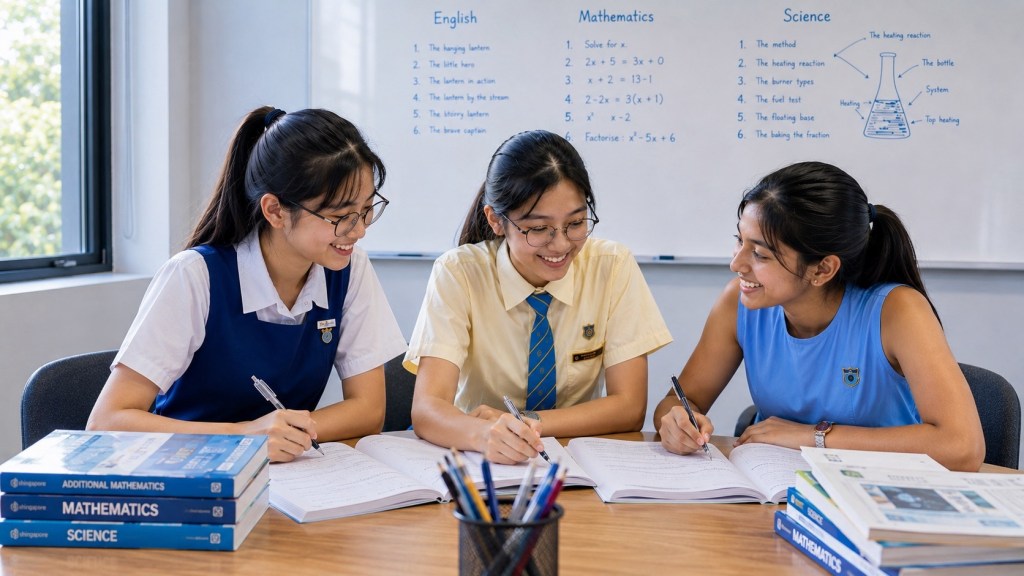
A three-student tutorial can use different support levels
One student may work with a summary sheet, another with a single cue and another fully closed-book. The shared topic remains the same while the support level reflects readiness.
The open/closed diagnostic matrix
- Open correct + closed wrong: support dependence.
- Open wrong + closed wrong: concept or method gap.
- Open correct + closed correct but slow: fluency gap.
- Closed correct + mixed wrong: selection gap.
- Closed correct after delay: durable retrieval emerging.
A weekly pattern
- Learn open-book.
- Practise with reduced notes.
- Retrieve closed-book.
- Mix closed-book.
- Reopen notes only for the part that failed.
- Retest closed-book after delay.
Frequently asked questions
Should homework always be closed-book?
No. Homework can include learning, repair and retrieval. The mode should match the purpose.
Is using notes cheating during revision?
No. Notes are a learning tool. The problem is relying on them when the goal is to test independence.
Where this open/closed practice guide sits in the Mathematics estate
Use the Retrieval Practice guide once the notes are removed and the Confidence Calibration guide to compare perceived readiness with closed-book evidence.
Open-book and closed-book practice should change by Secondary level
Secondary 1: support new notation, then fade quickly
Secondary 1 students may need notes while learning new symbolic conventions, but they should begin short closed-book checks early so the notation becomes usable without a nearby example.
Secondary 2: use notes for repair, not permanent reference
Secondary 2 students should reopen notes when a bridge skill such as factorisation or graph interpretation fails, then close them again for a fresh question.
Secondary 3: increase independent mixed work
Secondary 3 students need more closed-book evidence because topic breadth is increasing. A method that only works with the chapter open will not survive mixed school assessments.
Secondary 4: practise under the support conditions of the actual paper
Final-year revision should increasingly resemble the examination conditions relevant to the student’s route. Independent retrieval and method selection need to be normal rather than exceptional.
The note-use decision tree
- New concept? Use notes and worked examples.
- Known concept but forgotten detail? Retrieve first, then check notes.
- Repeated error? Reopen only the failing section.
- Preparing for a test? Use closed-book mixed work.
- Checking a correction? Close the solution before the parallel retest.
The two-pass practice method
Pass 1 is open-book learning: use the notes to understand the relationship and complete one or two guided examples. Pass 2 is closed-book evidence: remove the support and solve a fresh question that requires the same structure.
If Pass 2 fails, return only to the missing piece rather than rereading everything.
Support dependence can hide inside perfect homework
A student may submit accurate homework because the chapter example, notes or online solution remained visible throughout. One short closed-book retest reveals whether the method is independently available.
Parent checklist for note use
- Does my child attempt before opening the notes?
- Are notes being used to learn or simply to copy the next step?
- Is support reduced across the week?
- Can a fresh question be solved without the source page?
- Does the student know which part to reopen when something fails?
Continue through the Mathematics Learning Hub for routes by concept and level, the Complete Mathematics Index for the wider estate, or Mathematics Tutor Sengkang when the question is specifically about tutoring support.
