
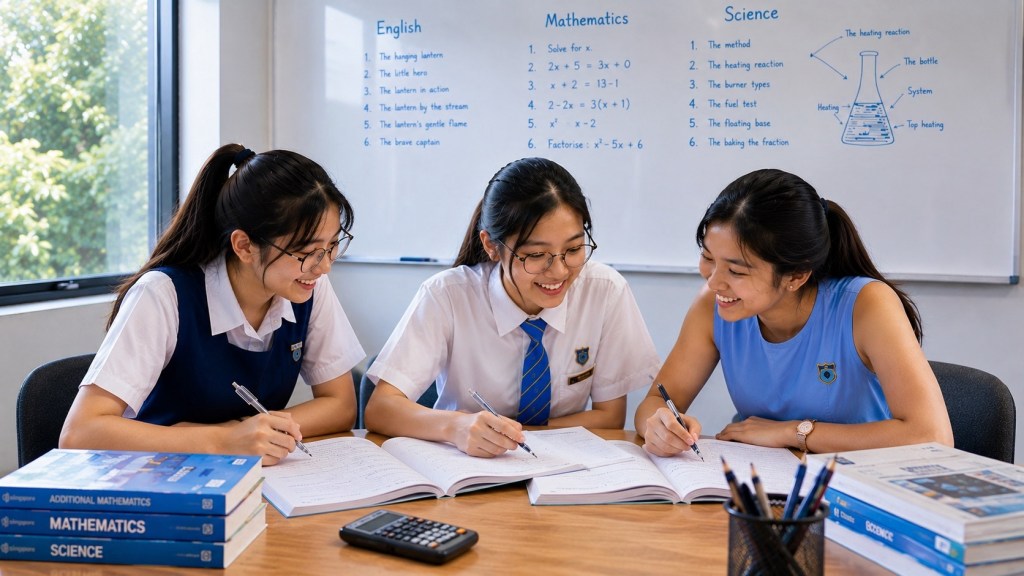
Secondary Mathematics resources do different jobs, and students lose time when they use the wrong resource for the wrong stage of learning. Parents searching for the best E-Math assessment book, Secondary Mathematics textbook, school notes, revision book, past papers or Mathematics tuition in Sengkang are usually not short of material. The problem is resource selection.
School notes are usually strongest for alignment with the teacher’s sequence. Textbooks are useful for explanations, worked examples and structured progression. Assessment books offer volume and variation. Past papers test integration, method selection and examination control. None of these resources is automatically “best” in isolation. The right choice depends on whether the student is learning, repairing, practising, revising or testing transfer.
At eduKate Sengkang, this Advanced Mathematics Tutorials article owns the resource-selection intent. It complements the Secondary Mathematics revision guide, the past-paper guide and the Complete Mathematics Index. The question here is simple: which resource should the student use for which learning problem?
Quick answer: match the resource to the job
School notes align. Textbooks explain. Assessment books vary practice. Past papers integrate. Error logs diagnose. The best resource is the one that solves the student’s current bottleneck.
- Use school notes to stay aligned with the teacher’s definitions, methods and current sequence.
- Use the textbook when an explanation or worked example needs to be rebuilt from first principles.
- Use an assessment book for focused practice and controlled variation.
- Use mixed revision books when method selection needs practice across topics.
- Use past papers for integration, timing and examination control.
- Use an error log to decide what the next resource should target.
- Use the official syllabus as the boundary of what must be known for the student’s current route.
- Use fewer resources more deliberately rather than collecting many partially used books.
School notes: best for alignment, not always enough for repair
School notes tell students how their school is organising the topic. They often reflect the teacher’s terminology, examples and expected working style.
That makes them valuable before tests and for keeping tuition connected to school. However, notes can be concise. If the learner missed the underlying idea, rereading the same summary may not repair it.
Use notes to identify the expected route, then switch to a fuller explanation or targeted practice when the student cannot explain why the method works.
Textbooks: best for structured explanations and worked examples
A good textbook offers sequence. It develops a concept through examples, exercises and increasing difficulty rather than presenting disconnected questions.
Textbooks are especially useful during catch-up because they can restore the chain between earlier ideas and the current chapter.
The limitation is that textbook practice may remain too predictable once the student understands the method. That is when another resource should introduce variation.
Assessment books: best when practice needs volume and variation
Assessment books can be useful for fluency, topical reinforcement and exposure to different question forms. They are less useful when the student is practising a misconception or choosing questions at random.
Parents should not judge a book only by thickness or difficulty. Ask whether the questions are organised in a way that supports the student’s current stage: basic control, standard application, mixed transfer or examination challenge.
One well-chosen book completed with proper correction can outperform several books used superficially.
Past papers: best for integration, not first learning
Past papers place topics together and remove chapter labels. They are excellent for method selection, time management and examination recovery.
They are weaker as first-teaching material because a paper does not explain why the student is wrong. If a concept gap appears, leave the paper, repair the gap with a more suitable resource, then return to a parallel question.
The value of a past paper comes from the correction loop, not simply from completion.
Revision guides and formula books: best for compression
Compact guides can help students retrieve formulas, definitions and method cues quickly. They are useful close to assessments when the student already understands the underlying Mathematics.
A compressed guide is dangerous when it becomes the first encounter with a concept. Short notes can hide the reasoning that makes a method transferable.
Use compressed resources after understanding, not instead of understanding.
Online videos and digital practice: best when used with a clear question
Video explanations can be useful when a student needs to see a different explanation or worked method. Digital question banks can provide immediate practice and feedback.
The risk is passive consumption. Watching several explanations can feel productive without producing independent Mathematics.
After any video or digital lesson, close the resource and solve a fresh question without guidance. Independent transfer is the test.
How to choose between two assessment books
- Check whether the level matches the student’s actual school route.
- Look at question sequencing, not only the hardest page.
- Check whether worked solutions explain reasoning or only provide answers.
- Prefer a resource that allows progression from standard to mixed application.
- Avoid buying a second book that duplicates the same question style unless more fluency is specifically needed.
- Use sample pages to see whether the layout supports readable working.
- Choose a resource that the student is likely to complete and correct properly.
The “too many resources” problem
Students can become collectors. They own school notes, three assessment books, downloaded papers, videos and tuition worksheets, but no single correction system.
Too many resources create switching costs. The learner repeatedly starts new material without revisiting errors from the previous source.
A better system has one primary resource for current learning, one secondary resource for targeted practice and a paper bank for later integration.
Build a resource ladder
Stage 1: learn
Use school notes, teacher examples and textbook explanations.
Stage 2: stabilise
Use focused topical practice with enough repetition to make the method reliable.
Stage 3: vary
Use assessment-book questions with changed surface features and mixed difficulty.
Stage 4: mix
Use mixed-topic revision sets where the method is not announced.
Stage 5: perform
Use timed sections and past papers.
Stage 6: repair
Return to the appropriate lower rung whenever the paper exposes a genuine gap.
How a three-student tutorial should use resources
The tutor should not assign the same resource simply because all three students share a class. One learner may need textbook-level reconstruction, another assessment-book variation and another past-paper transfer.
A shared lesson can still use the same topic, but the resource should match the learner’s error profile and readiness.
This is one practical advantage of a very small group: resource choice can follow diagnosis instead of class average.
A weekly resource plan
- School notes for the current topic.
- One focused practice source for the week’s priority weakness.
- One short mixed set from older topics.
- One error-log retest.
- One paper section when examination integration is appropriate.
- No new resource unless the existing one fails to meet a clear learning need.
Frequently asked questions
Do students need an assessment book if school homework is already heavy?
Not automatically. Add an assessment book only when school work does not provide the practice or variation the student needs.
Are past-year school papers better than assessment books?
They do different jobs. Papers test integration and exam control; assessment books are often better for targeted topical practice.
Should parents buy the hardest available book?
No. A resource should be hard enough to create useful thinking but accessible enough that the student can learn from correction.
Can a student revise only from school notes?
Possibly for some topics, but most students also need independent practice and mixed application to test whether the knowledge transfers.
What is the best resource for a weak student?
The one that addresses the first unstable dependency. That may be a textbook explanation, a simple practice set or a tutor-created repair sequence rather than an advanced exam book.
Where this resource guide sits in the Mathematics estate
Use the relevant Secondary 1–4 Mathematics Tuition Sengkang owner for level-specific teaching, the revision guide for planning and the past-paper guide for examination use.
This article owns resource-selection intent: choosing school notes, textbooks, assessment books and papers according to the student’s actual learning job.
