
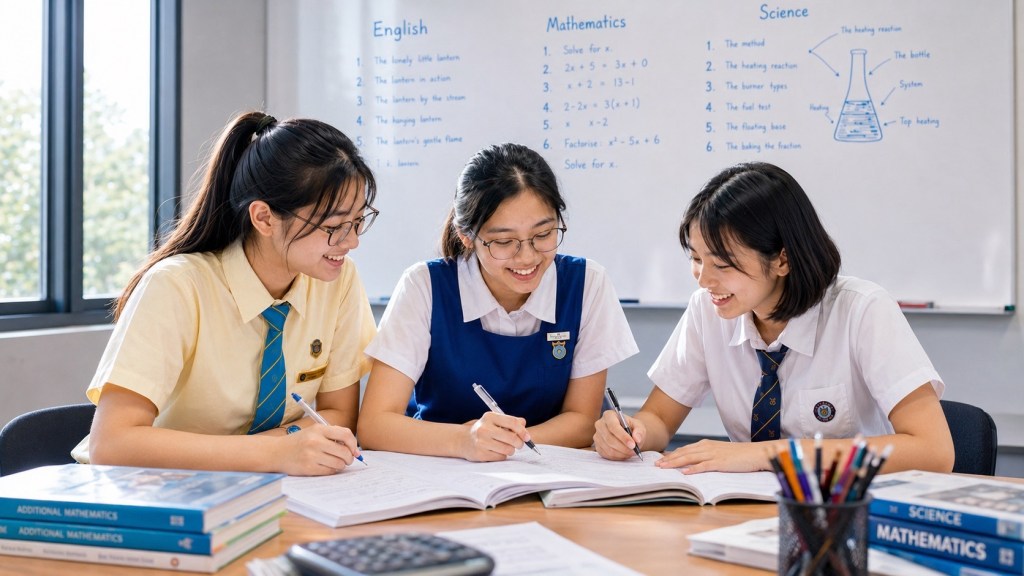
Secondary Mathematics holiday revision should not begin with the question “How far ahead can we go?” It should begin with “What will make the next school term easier to learn?” Parents searching for holiday Mathematics tuition, June or year-end E-Math revision, Secondary Math head-start classes or Mathematics tuition in Sengkang often have two competing goals: repair weak foundations and preview future content.
Both can be useful, but the order matters. A student who is carrying unstable algebra, fractions, graphs or geometry into the holiday usually gains more from repairing those dependencies before accelerating. A student whose current level is secure can use part of the break to preview the next term so the first school encounter feels familiar rather than overwhelming.
At eduKate Sengkang, this Advanced Mathematics Tutorials article owns the holiday-revision decision intent. It supports the catch-up guide, the weekly study schedule and the existing Secondary Mathematics tuition owners. The goal is to decide whether a holiday should repair, consolidate or extend.
Quick answer: repair first, head start second
Use the holiday to remove the biggest learning friction. If foundations are unstable, repair them. If the current level is secure, consolidate and preview selectively rather than racing through the next syllabus.
- Repair repeated algebra, sign, fraction, graph or geometry weaknesses first.
- Consolidate topics that were recently learned but are not yet durable.
- Use retrieval after several days to confirm that learning survived.
- Preview only the next high-value topics, not an entire future year.
- Keep mixed practice so old topics remain available.
- Use one or two timed sections near the end of the holiday if the learner is assessment-ready.
- Protect rest; a holiday programme should improve readiness, not create exhaustion.
- Return to school with a short list of repaired skills and previewed concepts.
The repair case: when the holiday should go backwards first
Repair is the priority when the student ended the term with repeated failures that will affect later work. Weak algebraic manipulation, fraction control, equation balance, graph reading or diagram interpretation can compound quickly if ignored.
The holiday creates something the school term often does not: enough space to slow down without immediately chasing the next chapter.
A focused repair route should identify the first unstable dependency, use simple examples until meaning is clear, then reconnect the skill to current-level questions.
The consolidation case: when the student mostly understands but is not yet stable
Some students do not need deep remediation or acceleration. They need consolidation. They understood the term’s lessons but retrieval is slow, mixed questions are inconsistent or working remains error-prone.
For these students, holiday revision should use spaced retrieval, mixed practice and error correction. The objective is to make existing knowledge easier to access when school resumes.
This kind of consolidation can be more valuable than previewing new content because it reduces the cognitive load of the next term.
The head-start case: when preview is genuinely useful
Preview works best when the student’s current foundations are secure. A first exposure to future algebra, graphs, trigonometry or another school topic can reduce surprise and make classroom learning more efficient.
The purpose is familiarity, not mastery. Students should understand the vocabulary, central relationship and one or two basic examples.
Rushing too far ahead can create shallow procedures that later have to be unlearned or retaught.
How much of the holiday should be Mathematics?
There is no universal number of hours. The correct amount depends on the student’s gaps, school level, other subjects and whether the break follows a heavy examination period.
Several shorter sessions across the week usually support retrieval better than one very long block. A stable student may need only maintenance and preview; a student in recovery may need a more structured sequence.
The programme should remain sustainable enough that the learner returns to school rested.
A two-week holiday repair plan
Days 1–2: diagnose
Use recent tests and a short mixed set to identify the two highest-cost dependencies.
Days 3–6: repair
Teach one dependency at a time and use focused practice.
Days 7–9: reconnect
Place the repaired skills back into mixed current-level questions.
Days 10–12: retrieve after delay
Return to earlier repaired work without notes or immediate prompts.
Days 13–14: transition
Use one school-like mixed set and preview the next term only if the repaired base is stable.
A four-week year-end holiday plan
- Week 1: error map and high-cost repairs.
- Week 2: consolidate current-year algebra, graphs, geometry and key quantitative relationships.
- Week 3: mixed transfer and independent correction.
- Week 4: selective preview of next-year Mathematics plus a handover plan for school reopening.
The year-end break is long enough to do both repair and preview, but repair should still earn priority when the learner has visible gaps.
Holiday revision for Secondary 1
Secondary 1 students often benefit from strengthening negative numbers, fractions, algebra vocabulary, expansion, equations and graph basics. A holiday after the first secondary term can prevent small symbolic errors from becoming normal habits.
Preview should focus on the next school sequence rather than upper-secondary content for its own sake.
Holiday revision for Secondary 2
Secondary 2 is an important bridge into upper-secondary Mathematics. Algebra, factorisation, equations, graphs, inequalities, proportion and geometry should become more reliable before Secondary 3.
A secure student can preview selected Secondary 3 demands, but the main holiday value is often making algebra infrastructure strong enough to carry the next year.
Holiday revision for Secondary 3
Secondary 3 students may need to balance E-Math and A-Math. The holiday should protect E-Math mixed practice while repairing any shared algebra weakness that affects both subjects.
Students not taking A-Math can use the extra bandwidth for mixed upper-secondary Mathematics and examination-control habits.
Holiday revision for Secondary 4
Secondary 4 holidays are increasingly examination-oriented. Revision should move toward mixed papers, timing, error logs and targeted repair.
However, full-paper volume is still not useful if a known concept gap is simply being repeated. Repair and performance practice should remain connected.
What a three-student holiday tutorial can do
A three-student class can run a shared revision theme while giving each learner a different repair or preview target. One student may revisit algebra, another may consolidate graphs and a third may preview the next topic.
The tutor can also decide whether a student is genuinely ready to accelerate rather than assuming all holiday tuition should teach ahead.
This keeps the break diagnostic rather than promotional.
What parents should bring to a holiday consultation
- The latest school test or examination.
- Marked homework with visible working.
- The school topic sequence if available.
- Teacher comments about repeated weaknesses.
- Upcoming assessment dates.
- The student’s own view of which topics feel slow or confusing.
- Information about other holiday commitments so the plan remains realistic.
Frequently asked questions
Should holiday tuition always teach ahead?
No. Preview is useful only when current foundations are sufficiently stable. Repair and consolidation often create a better next-term advantage.
Can a weak student improve significantly during one holiday?
Yes when the gaps are identifiable and the plan is focused. Broad multi-year gaps may need longer, but even one holiday can remove important bottlenecks.
Should students do full papers during holidays?
Use full papers when the learner has enough syllabus coverage and the goal is integration or exam control. Earlier stages may benefit more from mixed sections and targeted repair.
How do we know the holiday plan worked?
The learner should return to school with faster retrieval, fewer repeated error categories and greater independence on the repaired topics.
Where this holiday revision guide sits in the Mathematics estate
Use the relevant Secondary Mathematics Tuition Sengkang year owner for ongoing support, the catch-up guide for deeper repair and the weekly schedule for the return to term time.
This article owns holiday-decision intent: repair, consolidate or preview based on the student’s actual Mathematics condition.
