
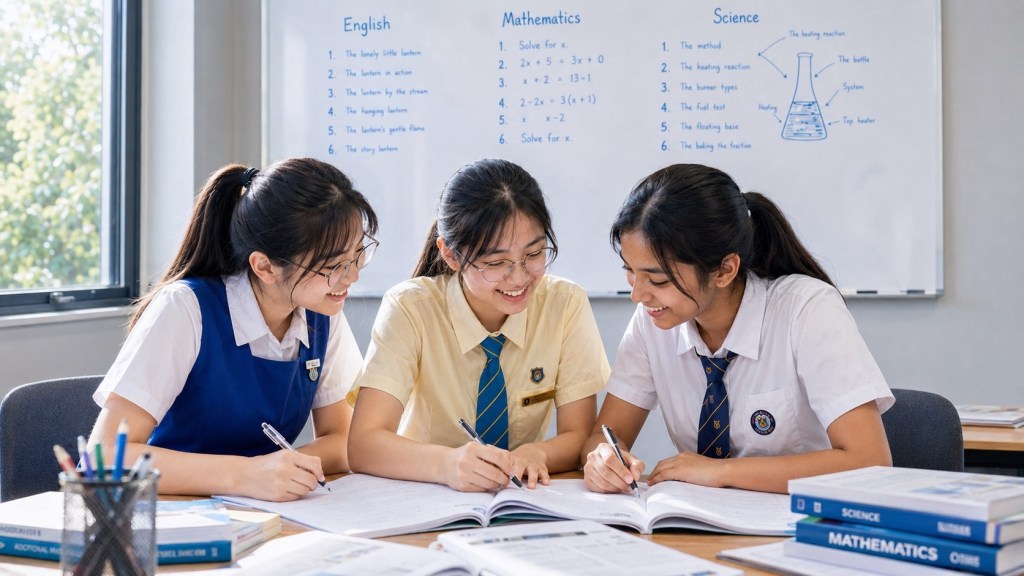
Online Mathematics tuition and face-to-face Mathematics tuition can both work, but they place different demands on the learner. Parents comparing online maths tuition, home tuition, tuition centres in Sengkang, PSLE Mathematics tuition and Secondary Mathematics tuition should therefore focus less on the platform and more on what the teaching format allows the tutor and student to do.
The key Mathematics tasks are diagnostic: seeing working, hearing explanations, identifying the first wrong step, comparing methods, giving a useful hint and checking whether the learner can solve a fresh problem independently. A good format protects these tasks. A weak format hides them.
For Sengkang and nearby Punggol families, convenience matters because travel time and fatigue affect learning. But convenience should not remove mathematical visibility. The best choice is the format in which the student can sustain attention, show authentic working and receive timely feedback.
The correct answer is therefore not ‘online is better’ or ‘face-to-face is better’. The question is which environment gives this learner the best combination of access, visibility, independence and consistency.
Quick comparison
- Online tuition: convenient, no travel, easy access to digital resources and screen sharing.
- Face-to-face tuition: easier physical observation of written working, attention and use of materials.
- Either format can work: when the tutor can see thinking, not just hear final answers.
- Either format can fail: when the learner becomes passive, distracted or dependent on hidden support.
What Mathematics teaching needs from the format
A tutor needs to know more than whether the final answer is correct. The sequence of working matters.
In Primary Mathematics, the tutor may need to see bar models, number lines, fraction diagrams or written algorithms. In Secondary Mathematics, algebraic lines, graphs and geometry annotations become important.
The format should make these visible quickly enough for feedback to change the next attempt.
Online strength: convenience
Online lessons remove travel time and can fit more easily around school schedules.
This can protect sleep and reduce the total burden on a student, especially when travel would otherwise consume a large part of the evening.
Convenience becomes educational value when it improves consistency and attention.
Online strength: digital annotation and resources
Screen sharing can make graphs, digital whiteboards and worked examples easy to access.
For some Secondary Mathematics topics, digital graphing tools can support visualisation when used as a learning aid rather than as a replacement for algebra.
Saved digital notes can also make later review easier.
Online risk: invisible working
If the camera only shows the student’s face, the tutor may miss the exact line where the Mathematics goes wrong.
A student can also type a final answer without exposing the route.
Good online tuition therefore needs a reliable way to share handwritten or digital working.
Online risk: hidden help
Notes, calculators, solution apps or another browser tab may remain outside the tutor’s view.
This can make supported performance look independent.
Fresh questions and explanation prompts help test what the learner actually knows.
Face-to-face strength: richer observation
In person, the tutor can often see how the learner reads the page, where the pencil pauses, how diagrams are annotated and whether the student is copying a nearby example.
These small behaviours can reveal the difference between concept difficulty and uncertainty.
That makes diagnosis efficient.
Face-to-face strength: manipulation and shared paper
For younger Primary learners, physical objects, paper models and quick sketches can be easier to use in person.
The tutor can also compare two students’ written methods side by side.
This is especially useful in a small group.
Face-to-face risk: travel fatigue
A strong face-to-face lesson can still be poor value if the child arrives exhausted after a long commute.
Travel time also competes with school homework, dinner and sleep.
Local Sengkang or Punggol access can therefore matter.
Attention is individual
Some learners focus better online because the environment is familiar and quiet. Others become distracted by screens and need the physical structure of a classroom.
The right format should be judged by observed behaviour rather than assumptions about age alone.
A trial period can reveal the difference.
Primary 1–2
Younger learners often benefit from face-to-face visibility, concrete materials and quick redirection of attention.
Online learning can still work with strong parental setup, an appropriate camera angle and short focused tasks.
The child should still handle quantities and draw, not only click answers.
Primary 3–4
Both formats can work when multiplication, fractions, decimals and word-problem models are visible.
The tutor should be able to inspect the model before giving the next hint.
Screen-shared final answers alone are not enough.
Primary 5–6 and PSLE
Online tuition becomes more feasible because learners can manage materials more independently.
But PSLE preparation still requires written working, Paper 1 non-calculator control, Paper 2 calculator discipline and timed paper behaviour.
Face-to-face tuition can make paper-level observation easier; online tuition can still work if the workflow captures working clearly.
Secondary Mathematics
Secondary learners may be particularly comfortable with digital resources and screen sharing.
However, algebraic manipulation and geometry still need visible line-by-line working.
The tutor should not mistake a shared final equation for secure reasoning.
What a three-student online group would need
- Each learner’s working must be visible.
- Students should solve independently before discussion.
- The tutor should be able to switch attention rapidly between learners.
- Digital tools should support, not obscure, reasoning.
- Fresh questions should test independence.
What a three-student face-to-face group should do
At eduKate Sengkang, the intended value of three students is close visibility plus useful comparison between methods.
One learner can explain a bar model, another an equation and another a table, while the tutor verifies each student’s independent understanding.
The format is valuable only when individual working stays visible.
A parent decision checklist
- Can the tutor see the child’s working clearly?
- Can the learner sustain attention for the full lesson?
- Can the format support current school materials?
- Can the tutor test independence without hidden help?
- Does travel time damage the rest of the evening?
- Does the learner actually prefer the format enough to engage consistently?
- Can the tutor provide timely feedback and retesting?
Frequently asked questions
Is online Mathematics tuition cheaper?
Sometimes, but not always. Price depends on tutor, class size and programme. Compare instructional value rather than assuming a format automatically costs less.
Is face-to-face always better for Primary students?
Not automatically. It often offers easier observation, but online can work when the learning setup preserves attention and visible working.
Can PSLE Mathematics be prepared online?
Yes, if the programme deliberately trains written working, current Paper 1/Paper 2 conditions, mixed problem solving and realistic timed practice.
Which format builds more independence?
Either can, if support is faded and fresh questions are used. Either can create dependence if the tutor rescues too quickly.
Continue the parent comparison route
Use Private Tutor vs Small-Group Mathematics Tuition, Choosing Primary Mathematics Tuition in Sengkang and the Mathematics Hub.
Delivery mode is one variable inside the tutoring system
Online and face-to-face Mathematics tuition differ in interface, observation, tools and friction, but neither mode defines the quality of the tutoring by itself. Use The Tutor System to evaluate delivery mode alongside tutor function, learner condition, practice, evidence and independence.
