
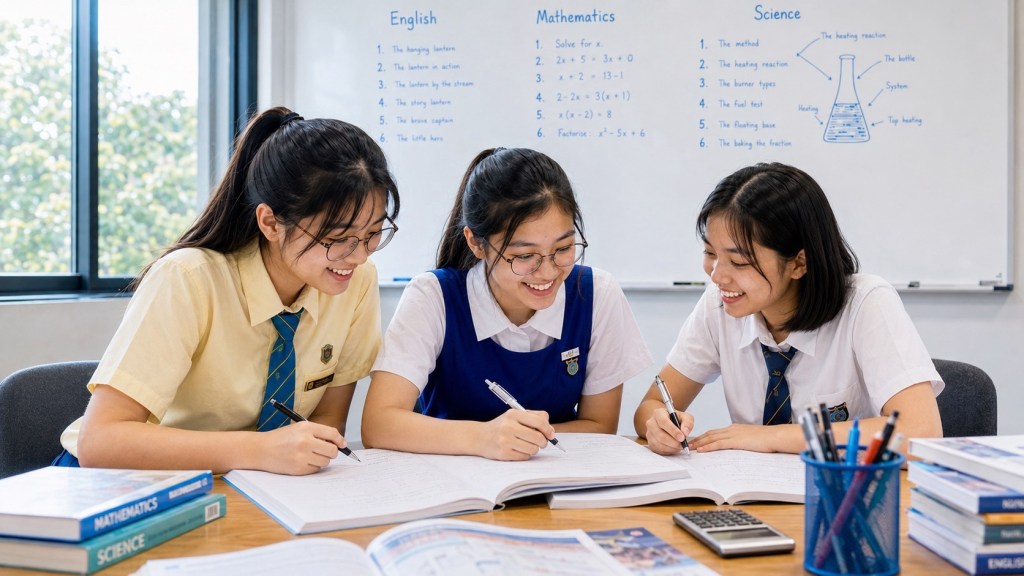
How to compare and contrast two texts, viewpoints and sources is an important English skill because students increasingly need to read more than one text and explain meaningful similarities, differences and relationships. A Primary 4 learner may compare two stories or informational texts. A Primary 6 student may compare viewpoints or source details. At Secondary G1, G2 and G3, students can be asked to compare arguments, evidence, perspective, tone and source reliability without flattening the differences between them.
For parents in Sengkang and Punggol, the weak version of comparison is easy to recognise: “Text A is about X and Text B is about Y.” That is description, not comparison. Strong compare-and-contrast work chooses a shared criterion, places both texts against that criterion and explains why the similarity or difference matters. Purdue OWL’s compare-and-contrast guidance similarly emphasises setting up clear points of comparison rather than listing random details from each subject.
This Advanced English Tutorials guide builds a Primary-to-SEC comparison system: establish the basis of comparison, select comparable evidence, organise by point or by source, preserve differences in viewpoint and evidence strength, and finish with a synthesis that explains the larger significance. It sits above the existing year-specific comparing-texts pages and the research/synthesis owner rather than replacing them.
Quick Read
One-sentence answer: compare texts well by choosing a shared criterion, selecting evidence from both texts that truly addresses that criterion, explaining the similarity or difference and then stating what the comparison reveals.
- Primary 3–4: compare characters, settings, events and informational texts.
- Primary 5–6: compare purpose, evidence, viewpoint, tone and source details.
- Secondary G1/G2/G3: compare arguments, framing, evidence quality, structure, writer’s craft and source reliability.
- Use one criterion at a time so the comparison remains fair.
- A good comparison explains significance; it does not merely place two summaries side by side.
1. Comparison Needs a Shared Basis
Two things can be compared only when the writer identifies the feature being compared.
Cost, purpose, tone, evidence and structure are different criteria and should not be mixed casually.
2. Primary 3: Similarities and Differences
Students can begin with simple shared categories such as character, setting or event.
The comparison should use the same category for both texts.
3. Primary 4: Comparing Two Texts
Primary 4 students can compare purpose, information and evidence.
The existing Primary 4 comparing-texts page remains the year-specific route.
4. Primary 5: Compare Viewpoints
Students can identify how two writers or speakers see the same issue differently.
Viewpoint should be supported with language or selection evidence.
5. Primary 6: Compare Source Use
Upper-primary learners can compare how two texts support claims or present information.
This prepares for multimodal and source-based work.
6. Secondary 1: Compare Arguments
Secondary students can compare claim, reason and evidence.
Do not call two arguments similar merely because they share a topic.
7. Secondary 2: Compare Writer’s Craft
Tone, structure, repetition and imagery can be compared when the criterion is meaningful.
Use the writer’s-craft tutorial for deeper feature analysis.
8. Secondary 3: Compare Evidence Quality
Upper-secondary comparison can ask which source provides stronger support and why.
Criteria should include relevance, source quality, scope and method.
9. Secondary 4 and SEC
By Secondary 4, students should compare efficiently under time.
A compact comparison grid can protect structure.
10. G1, G2 and G3
The same comparison system applies across subject levels while abstraction increases.
Practice should match the learner’s actual course.
11. Choose the Criterion
Ask exactly what is being compared.
A clear criterion prevents topic drift.
12. Text A and Text B Must Be Comparable
Evidence should address the same feature in both texts.
Comparing Text A’s tone with Text B’s statistics creates an unstable comparison.
13. Point-by-Point Structure
Discuss one criterion across both texts before moving to the next.
This often creates strong analytical comparison.
14. Block Structure
Discuss Text A, then Text B, then synthesise.
This can work for longer texts if the final comparison remains explicit.
15. Similarity Language
Both, similarly, likewise and in the same way signal similarity.
The sentence still needs to explain the shared feature precisely.
16. Difference Language
However, whereas, unlike and in contrast can signal difference.
Choose a connector that matches the relationship.
17. Degree of Similarity
Two texts may be partly similar but differ in emphasis.
Use language such as largely, partly or more strongly where evidence supports it.
18. Compare Purpose
Two texts may inform, persuade, entertain or advocate differently.
Purpose can shape evidence and tone.
19. Compare Audience
Writers adapt detail and vocabulary to audience.
Different audience assumptions can explain structural differences.
20. Compare Evidence
One source may use statistics while another uses anecdotes.
Do not assume one is stronger without considering the claim.
21. Compare Tone
Tone comparison needs evidence from both texts.
Choose tone labels after analysing language.
22. Compare Structure
One text may move cause-to-effect while another uses problem-solution.
Explain how the structure shapes understanding.
23. Compare Viewpoint
Writers can agree on facts while interpreting them differently.
Keep factual agreement separate from evaluative difference.
24. Compare Framing
Selection and emphasis can make the same event appear different.
Describe the concrete framing choices.
25. Compare Reliability
Date, source, method and evidence all affect confidence.
Use the research tutorial when source evaluation becomes central.
26. Compare Visual and Written Sources
A graph and paragraph can be compared by what each contributes.
Do not force identical criteria when the source modes differ; use a shared information question instead.
27. Compare Stories
Characters can face similar problems but make different choices.
The significance may lie in consequence or theme.
28. Compare Themes
Two texts can explore the same theme differently.
Theme should be stated as an idea, not one word.
29. Compare Characters
Compare goal, motive, response and change using the same framework.
Avoid listing traits with no common basis.
30. Compare Explanations
Two sources may explain the same phenomenon differently.
Identify whether they disagree on cause, evidence or scope.
31. Compare Conclusions
Writers may use the same evidence but reach different conclusions.
Ask which assumptions or criteria create the difference.
32. Synthesis
After comparing, state what the relationship reveals.
Synthesis moves beyond “A is different from B” toward a larger insight.
33. Comparison Tables
A simple grid can make criteria and evidence visible.
Use one row per criterion and one column per text.
34. Venn Diagrams
Venn diagrams help younger learners separate shared and unique features.
Older students should move beyond the diagram into explanation.
35. Common Mistake: Two Separate Summaries
Writing one paragraph on A and one on B without linking them is not enough.
Add explicit criterion-based comparison.
36. Common Mistake: Random Similarities
Shared nouns or topics may be superficial.
Choose features that matter to the task.
37. Common Mistake: Unequal Evidence
A comparison becomes unfair when one text receives detailed evidence and the other a vague reference.
Balance support where possible.
38. Planning
List two or three criteria before drafting.
Avoid discovering the comparison structure halfway through the essay.
39. Revision
Check that every comparative sentence names both sides clearly.
Remove paragraphs that only summarise.
40. Small-Group Practice
Three students can compare the same two texts using different criteria.
This reveals which comparisons are more informative.
41. When Tuition Adds Value
Tuition may help when students summarise accurately but cannot synthesise or compare significance.
Use the year-specific comparing-texts and research/synthesis routes for deeper support.
42. What Progress Looks Like
Progress appears when comparisons become criterion-based, balanced and evidence-led.
The learner should explain why similarities and differences matter.
43. Final Transfer Test
Give two unfamiliar short texts and three possible criteria.
If the learner can choose the strongest criterion, select balanced evidence and synthesise the result, the skill is transferring.
Frequently Asked Questions
What is the best way to compare two texts?
Choose one shared criterion at a time, gather evidence from both texts and explain the significance of the similarity or difference.
Should students use a Venn diagram?
It can help plan simple comparisons, but the final writing still needs analytical sentences and evidence.
What is the difference between comparison and synthesis?
Comparison identifies relationships; synthesis explains what those relationships reveal when the sources are considered together.
How do students compare viewpoints?
Identify what each writer believes or emphasises, then support the difference with language, selection or evidence.
Why do compare-and-contrast essays feel repetitive?
Students may be listing similarities and differences without a clear criterion or larger analytical purpose.
Where to Go Next
Use the research and synthesis tutorial, the writer’s-craft tutorial and the year-specific comparing-texts guides in the English Learning Hubs.
External reference: Purdue OWL | Essays for Exams.
Advanced Compare-and-Contrast Diagnostic Lab
Comparison errors should be classified. One student may choose weak criteria, another may use unequal evidence, another may summarise both texts separately and never connect them, and another may notice differences but fail to explain significance.
Take one completed comparison and label every sentence A-only, B-only or comparative. If very few sentences truly relate the two texts, the response is probably parallel summary rather than analysis.
Criteria Must Be Stable
A fair comparison uses the same criterion on both sides. If Text A is judged by evidence quality and Text B by emotional tone, the writer is comparing different things.
Write the criterion as a question: How does each source support its main claim? What attitude does each writer create? The same question should be answerable for both texts.
Choose High-Value Criteria
Not every difference deserves paragraph space. Two texts may differ in length, colour, examples, tone and evidence, but the task may care mainly about purpose or viewpoint.
Rank possible criteria by relevance to the question. A small number of strong analytical comparisons usually produces more depth than a long list of obvious differences.
Point-by-Point Planning
A point-by-point plan places one criterion across both texts before moving to the next. This structure makes comparison visible and reduces the risk that one source receives all the analysis.
For each paragraph, write criterion, Text A evidence, Text B evidence and significance. That four-part plan can become a reliable exam scaffold.
Block Structure With Synthesis
Block structure discusses one text and then the other. It can be useful when each text is complex, but the writer must build explicit bridges and a final synthesis.
Without those bridges, the reader receives two mini-essays. The student should note after each block what will later be compared so important relationships are not forgotten.
Compare Purpose and Audience Together
Purpose and audience often interact. A public-information poster and an academic article may discuss the same issue but select different vocabulary, detail and evidence because they serve different readers.
A strong comparison explains the connection: the poster simplifies and foregrounds action because it addresses a broad audience, while the article includes method and qualification for readers who need deeper evidence.
Compare Evidence Types
One text may use statistics, another expert testimony and another personal anecdote. Students should identify not only the evidence type but what claim the evidence can legitimately support.
Anecdote may illuminate lived experience, while a large dataset may better support frequency. Comparison should therefore consider fit, not assume one evidence type is universally superior.
Compare Tone With Evidence
Tone comparison should use exact wording from both texts. “A is more negative than B” is incomplete until the student shows how diction, sentence structure or selection produces that difference.
Use paired evidence: one phrase from A and one from B, then explain the contrast in attitude. This keeps the comparison balanced and text-based.
Compare Structure
Writers may organise the same topic differently. One source might begin with a problem and then present solutions; another might start with data and end with a warning.
Explain how the structural choice changes emphasis or reader understanding. Structure comparison is useful when the order reflects purpose, not simply because the paragraphs differ.
Compare Viewpoint and Assumptions
Two writers can agree on basic facts while disagreeing about what matters most. One may prioritise cost, another fairness or long-term impact.
Identify the underlying criterion or assumption. This creates deeper comparison than saying the writers “have different opinions”.
Compare Source Reliability
Reliability comparison should match the claim. An official agency may be strongest for current rules; a research study for original data; a firsthand account for personal experience.
Students should avoid universal source rankings. Ask which source is best positioned to support this specific statement and why.
Compare Multimodal Sources
A chart and an article cannot always be compared feature-for-feature. Use a shared information question instead: what does each source contribute about the issue?
The chart may quantify a pattern while the article explains causes or limitations. Their difference can be complementary rather than contradictory.
Worked Example: Two Articles on the Same Issue
Suppose two articles discuss homework. Text A argues that moderate homework supports practice, while Text B argues that excessive homework reduces rest and family time. A weak comparison says one is positive and one is negative. A stronger comparison uses a shared criterion: each writer defines the problem differently.
Text A treats insufficient practice as the central risk; Text B treats excessive workload as the central risk. The comparison reveals that disagreement partly comes from different assumptions about what counts as the main educational problem.
Worked Example: Story Characters
Two characters may both face pressure from friends but respond differently. One complies to avoid conflict; the other refuses and accepts social discomfort. The shared criterion is response to social pressure.
The comparison can then explain how motive, action and consequence reveal different values. This is stronger than listing personality adjectives separately for each character.
Worked Example: Two Visual Sources
A line graph shows declining participation over three years, while a poster urges students to join a programme. The graph provides trend evidence; the poster provides persuasive framing.
The comparison should not ask which has “better imagery”. Instead ask how each source represents participation and what kind of information each provides. The modes perform different communicative jobs.
Worked Example: Two Explanations
One source explains lower test performance mainly through sleep, while another emphasises study strategy. Students should compare evidence, scope and whether the explanations exclude or complement each other.
The synthesis may conclude that the sources focus on different contributing mechanisms rather than directly contradict each other. Good comparison avoids manufacturing conflict where sources are complementary.
Significance Sentences
After every comparison, add a significance sentence mentally: “This matters because…” The sentence might reveal a difference in audience, evidence quality, interpretation or consequence.
If the writer cannot explain why the difference matters, the criterion may be too superficial to deserve a paragraph.
Comparison and Synthesis
Synthesis reorganises source information around ideas rather than source order. A synthesis paragraph may state one shared finding, then explain how the sources differ in explanation or emphasis.
This is especially useful in Secondary research and discursive writing. The reader sees a conversation between sources rather than a sequence of summaries.
Agreement With Different Reasons
Two writers can reach the same conclusion for different reasons. Students should not stop at “both agree”.
Compare the reasoning chain. One may support a policy because it saves money; another because it improves access. The shared conclusion hides a meaningful difference in values or evidence.
Disagreement With Shared Evidence
Two writers can use the same evidence but interpret it differently. This often occurs when they apply different criteria or assumptions.
The student should identify the common evidence, then explain where the reasoning diverges. This creates more precise source comparison than simply reporting opposite views.
Comparing Reliability Under Time
In exams, use a compact checklist: source, date, evidence, scope and purpose. Do not attempt a full research audit.
The strongest comparison selects the two or three factors that materially affect confidence in the claim being evaluated.
Comparison Conclusions
A conclusion should not merely repeat the list of similarities and differences. It should state the most important relationship revealed by the comparison.
For example, the texts may share a goal but differ because they address different audiences, or they may use similar evidence but apply different criteria. The conclusion should capture that larger pattern.
A Four-Week Comparison Cycle
Week one practises criteria and balanced evidence. Week two adds purpose, tone and structure. Week three compares viewpoint, source quality and multimodal material. Week four uses unfamiliar paired texts under time and requires a short synthesis.
The same planning grid should be used across weeks so students build a general comparison process rather than separate tricks.
Final Comparison Transfer Standard
A strong learner can meet two unfamiliar texts, choose a meaningful shared criterion, select balanced evidence, describe similarity or difference precisely and explain significance.
The student can also recognise when sources complement rather than contradict each other and can synthesise the relationship without erasing important differences.
Comparison Case Study: Same Evidence, Different Framing
Two texts may use the same statistic but frame it differently. One writer may present a 10 per cent decline as evidence of serious deterioration; another may describe the same change as modest within a longer stable trend.
Students should compare not only the number but the wording around it, the time range selected and any omitted baseline. The evidence is shared, while framing changes interpretation.
Comparison Case Study: Different Audiences
A public-health poster and a research article may both discuss sleep. The poster uses direct advice, simple visuals and short claims; the research article explains method, limitations and uncertainty.
The comparison should explain that audience and purpose account for much of the difference. One source is not automatically “simplistic” and the other “better”; they are designed for different communicative jobs.
Comparison Case Study: Two Narratives
Two stories may explore responsibility through different characters. One character accepts blame immediately; another hides a mistake and changes only after consequences grow.
The shared theme creates the comparison, while motive, choice and change provide evidence. The significance may lie in how each text represents responsibility as immediate principle versus learned insight.
Comparison Case Study: Two Explanatory Texts
One explanatory text may organise by cause–effect, while another uses problem–solution. If both address the same issue, students can compare how structure changes what the reader notices first.
The cause–effect text may foreground mechanism; the problem–solution text may foreground action. Structural comparison becomes meaningful because it changes reader emphasis.
Comparison Case Study: Reliable but Different Sources
An official report and a community interview can both be credible for different claims. The report may provide broad statistics, while the interview gives detailed lived experience.
Students should compare source fit rather than rank one universally above the other. The best evidence depends on whether the question is about frequency, policy, process or personal experience.
Comparative Thesis Statements
A strong comparative thesis names the relationship and the criteria that matter. “Both texts are similar and different” says almost nothing.
A better thesis might state that both sources support the same policy but differ in audience and evidence: one persuades through personal examples, while the other builds a case through data and qualification.
Balanced Evidence
Comparative paragraphs should avoid quoting or analysing one text in detail and then giving only a brief reference to the other. This imbalance often occurs when the writer is more comfortable with one source.
Plan paired evidence before drafting. One strong item from each text is often better than three examples from A and one vague statement about B.
Comparison Language Without Repetition
Students sometimes begin every sentence with “Text A… Text B…”. Variety can come from criterion-led sentences: “In their treatment of evidence, the texts differ…” or “Both writers frame responsibility as…, but…”
The goal is not stylistic decoration. Criterion-led syntax keeps the analysis comparative and reduces mechanical alternation.
Qualifying Similarity
Two sources may appear to agree broadly but differ in scope. One may claim an effect occurs often; another says it occurs only under certain conditions.
Students should avoid “both agree” when the degree of agreement is partial. Words such as broadly, partly, under similar conditions or with different emphasis create more accurate comparison.
Qualifying Difference
Likewise, texts can differ without being opposites. One may emphasise cost while another focuses on access. These priorities are different but not necessarily contradictory.
The writer should distinguish contrast in emphasis from direct disagreement. This is a key step toward mature synthesis.
Comparison Under Time
Under examination conditions, use a rapid four-column plan: criterion, A evidence, B evidence, significance. Two or three rows are usually enough for a focused response.
The plan keeps the essay comparative from the first paragraph and prevents the common drift into separate summaries when time pressure rises.
Revision for Comparative Control
After drafting, underline every sentence that explicitly relates the two texts. If long sections discuss only one source, add the comparative relationship or decide whether the section is unnecessary.
Then check whether each paragraph ends with significance. The reader should know not only what differs, but what that difference reveals.
Parent Practice With Everyday Sources
Families can compare two product descriptions, two news reports on the same event or two school notices for different audiences. Ask which information appears in both, which differs and why the source might have made those choices.
Real-world comparison helps students see that viewpoint, purpose and evidence selection exist beyond examination passages.
Final Comparative Independence Standard
A strong learner can choose a meaningful basis of comparison without being given one, gather balanced evidence and explain whether the sources agree, differ, complement or qualify each other.
The final synthesis preserves differences rather than blending everything into one vague conclusion. That is the point where comparison becomes analytical reading rather than a list of similarities and differences.
Comparison Practice: Criteria Before Content
A useful final exercise is to give students two short texts and forbid them from writing immediately. First they must propose three possible comparison criteria, then rank the criteria by usefulness to the question. This forces the learner to decide what kind of relationship matters before collecting quotations or details.
For example, two articles about school transport might be compared by purpose, evidence and audience. A criterion such as paragraph length may be observable but analytically weak unless structure itself is relevant to the task. The ranking exercise helps students distinguish a real comparison from a superficial difference.
Comparison Practice: Build the Significance Sentence
After each similarity or difference, require one sentence that explains why the relationship matters. “Both writers use statistics” can become “Both writers use statistics, but one uses national data to establish scale while the other uses a small local survey to illustrate experience.” The second version identifies both similarity and difference inside the same analytical frame.
This significance step prevents compare-and-contrast writing from becoming a checklist. The reader learns what the comparison reveals about purpose, evidence, viewpoint or reliability.
Comparison and Independent Judgement
Older students should be able to decide which difference is most important and justify that decision. The criterion may depend on the task: evidence quality for a research question, tone for writer’s craft, or audience for situational communication.
When students can select the comparison criterion, balance evidence and explain significance without being told exactly what to compare, the skill has become independent rather than worksheet-bound.
A final comparison habit is to check whether the conclusion preserves the most important differences instead of blending the sources into one vague message. If Text A is more cautious, Text B more certain, or one source uses broader evidence, that distinction should survive the synthesis. Strong comparison does not reward false balance or artificial opposition; it represents the relationship as accurately as possible. When students can decide whether sources agree, differ, complement or qualify one another and support that judgement with balanced evidence, compare-and-contrast work has moved beyond school formula into genuine analytical reading.
The final check is criterion integrity: every paragraph should compare the same kind of feature across both sources and end with a clear statement of significance. If the comparison remains balanced, evidence-led and faithful to each source’s actual position, the analysis is ready to stand independently.
Strong comparison keeps both sources visible, balanced and accurately represented from beginning to conclusion.
Continue through the English Learning Hub for the wider language map, or use the Complete English Index to find related guides and tutorials.
