
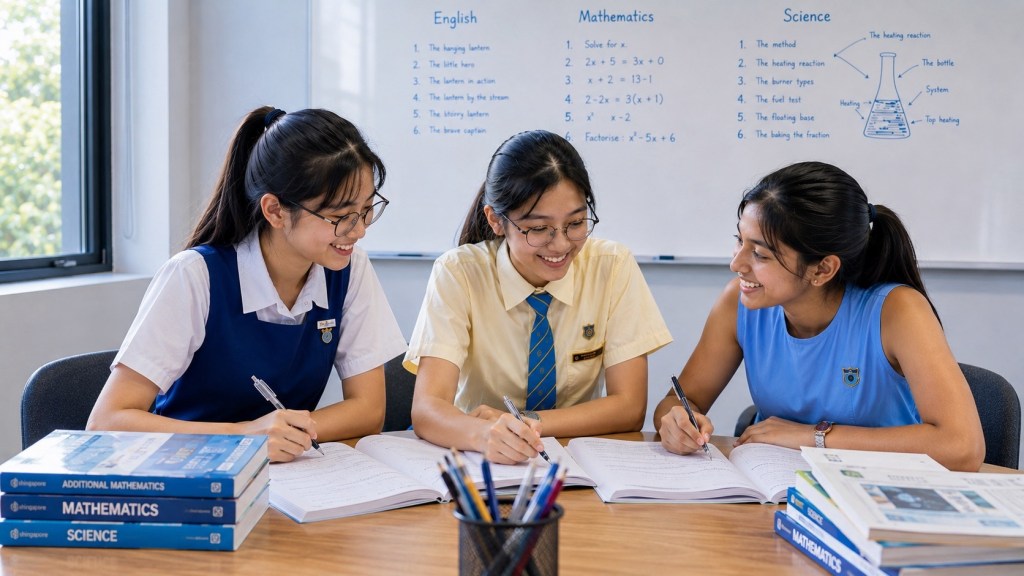
Alicia finishes a mathematics paper with twelve minutes left. She has been taught that careful students check their work, so she returns to Question 1 and begins solving everything again in the same order. Eight minutes later she reaches Question 7. The arithmetic looks familiar because she is reproducing the same route. The question she actually misread is Question 14, which she never reaches.
Tricia checks differently. She rereads every sentence until it feels safe. Kai Kai changes correct answers whenever a second possibility enters his mind. All three are trying to protect marks. The problem is not that checking is bad. The problem is that checking has become an unpriced activity: every answer receives attention regardless of risk, and every additional minute is treated as automatically valuable.
Alicia, Tricia and Kai Kai are fictional learners. Their examples are original teaching illustrations rather than measured case studies. Examination rules and marking conventions vary. The educational question here is narrower: how can a learner use limited review time to detect meaningful errors without turning the end of an examination into a second complete sitting?
1. Check risk before checking order
When review time begins, do not automatically restart at Question 1. First identify unanswered items, incomplete responses, questions marked uncertain, high-value multi-step work, suspicious units or signs, and places where the answer conflicts with an estimate or the wording. These are higher-information targets than a familiar answer already produced confidently and coherently.
Use a different verification route where possible. If the first solution substituted into a formula, check dimensions, estimate the scale, substitute the result back, or use an alternative representation. Repeating the identical sequence can reproduce the identical error. A useful check should have some chance of seeing what the original route could not.
Then stop when the next check is unlikely to be worth more than unfinished or weak work elsewhere. This is not a universal timing formula. It is a decision principle: review time has an opportunity cost.
2. Checking has several different jobs
Students often use one word—check—for several operations. One check asks whether the question was interpreted correctly. Another verifies calculation. Another checks whether the final answer has the required form, units or precision. Another looks for omitted subparts. Another evaluates whether a conclusion is supported by evidence. These jobs require different actions.
If Alicia’s main risk is misreading the requested quantity, recalculating from the same interpretation will not help. She needs to reread the command and compare the noun attached to the answer with the noun requested. If Kai Kai’s risk is changing answers without evidence, his review needs a threshold for reopening a decision. If Tricia omits parts, she needs a completion sweep before deep verification.
3. Start with missing work
Before polishing completed answers, scan for blanks, skipped pages, unfinished subparts and responses that stopped before the requested conclusion. An answer that was never reached deserves attention before a secure one is solved for a third time.
A blank can have several causes. The learner may not know the content, may have skipped deliberately, may have run out of time, or may have overlooked the item. The review phase is not the place to diagnose the entire history. It is the place to notice the missing response and decide whether useful work can still be produced.
4. Check the question beside the final answer
A powerful short check is to read the request and the submitted answer together while temporarily ignoring most of the working. Does the answer object match the request? If the question asks for a difference, has the student reported the difference rather than one original value? If it asks for coordinates, are both coordinates present? If it asks for an explanation, has the relationship been stated?
This complements Why Correct Working Still Loses the Final Mark. The point is not to make every answer longer. It is to verify that the work has reached the requested destination.
5. Repeating arithmetic is not independent verification
Suppose Tricia calculates 17 × 24 and writes 388. If she repeats the identical algorithm with the same mistaken intermediate value, she may reproduce 388 and feel reassured. She could instead decompose 24 × 10 + 24 × 7 = 240 + 168 = 408. The alternative route reveals the discrepancy.
Not every answer needs two full methods. Alternative verification is most useful where the cost and risk justify it. A short inverse operation, substitution, dimensional check, graph interpretation or estimate can provide independent evidence at lower cost than complete re-solving.
6. Use plausibility as a filter
An estimate can reveal orders of magnitude, impossible signs and unreasonable proportions. If a classroom length calculation produces 48,000 metres, investigate. If a probability is reported as 1.7 under a convention where probabilities lie between 0 and 1, investigate. These checks use structure rather than memory of the previous calculation.
But an estimate cannot confirm every precise answer. Values of 4.72 and 4.27 may both look plausible. Estimation is triage, not proof.
7. Units, signs and boundaries are high-information checks
If distance divided by time ends in metres rather than metres per second, the response may have lost the meaning of the quotient. If an area calculation ends in centimetres rather than square centimetres, inspect the operation and conversion. A negative sign may represent direction, change, gradient or an algebraic solution; when a result crosses a meaningful boundary, it deserves attention.
Do not mechanically add units or circle every minus sign. The check should ask whether the unit, sign or range makes sense for the quantity and model.
8. In science, check evidence against conclusion
A science response can contain correct facts and still overstate what the data show. During review, compare the conclusion with the evidence supplied. Did the learner describe a trend when the question asks for a mechanism? Did they claim more certainty than the comparison supports? Did they omit a relevant condition?
A useful short question is: “What in the data lets me say this?” If the answer cannot be located, the conclusion may need revision. The reverse check also matters: relevant evidence may be present while the conclusion is missing.
9. In writing, check relevance before polishing
When time is limited, the highest-value review of an extended response may not be correcting every minor surface feature. First ask whether the paragraph answers the question, whether the evidence is relevant, and whether the reasoning connects evidence to claim. A beautifully edited paragraph that answers the wrong question remains a serious problem.
Then inspect recurrent language risks the learner actually has. “Check your English” is too broad. A useful review names the likely failure: sentence boundary, reference, tense, omitted task requirement, unsupported inference or loss of meaning.
10. Do not let checking create new errors
Review can damage a correct answer when the learner changes it without stronger evidence, overwrites readable working, introduces a transcription error, or replaces a complete response with a rushed alternative. The goal is not maximal change. It is error detection followed by justified correction.
Use an evidence threshold. Reopen an answer when you can identify a contradiction, an unmet instruction, a calculation discrepancy, a missing condition or a stronger reason. “This suddenly feels wrong” can justify inspection, but not necessarily replacement. The earlier guide on changing multiple-choice answers develops this distinction.
11. Build the review order during practice
After each practice paper, classify errors by what a realistic check could have caught. Some errors were invisible without new knowledge. Some were detectable from units, a contradiction, an unanswered part or a mismatch with the command. This separates “I should have known this” from “my review process could reasonably have caught this.”
Then rehearse the review under bounded time. The student should learn which signals deserve attention and how long a check takes. A review system that works only with unlimited time is not yet an examination system.
12. Measure what checking changes
Keep the original answer visible during practice. Record whether review preserved it, corrected it or damaged it. Over several papers, ask whether the checking routine is finding meaningful errors without consuming time needed for unfinished questions. This is ordinary teaching evidence, not a controlled experiment, but it is better than assuming more checking is always better.
If the student repeatedly spends five minutes confirming secure early items while leaving later work incomplete, change the order. If review repeatedly catches sign or answer-form errors, preserve those checks. If a ritual never changes a decision, consider removing it.
13. The stop rule matters
Checking can expand indefinitely because absolute certainty is unavailable. A learner can always reread once more. The stop rule is therefore part of the skill: when the answer fits the question, the route is coherent, no contradiction appears and higher-priority work remains, move on.
For a high-value uncertain question, a deeper check may be justified. For a one-step answer already verified by an inverse operation, a third identical calculation may add little. The student should allocate review by expected usefulness rather than by anxiety.
14. The aim is a better submitted paper
Alicia’s new routine begins with blanks and flagged uncertainty, then checks answer-to-question fit and high-risk calculations using an alternative route. Tricia limits rereading to specific purposes. Kai Kai changes an answer only when he can name the evidence that justifies reopening it.
These are illustrative routes, not guaranteed outcomes. Their shared principle is that checking is a decision system, not a virtue measured by minutes. Good review directs scarce time towards errors that can still be detected and repaired.
Students should finish an examination with neither blind trust nor endless suspicion. They need a practical middle: complete the paper, identify risk, verify independently where useful, correct with evidence, and stop when the next minute belongs somewhere else.
Further routes
Continue through the Complete Examination Craft Index for paper-performance guidance or the Learning Runtime Hub when the underlying learning state remains unclear.
