
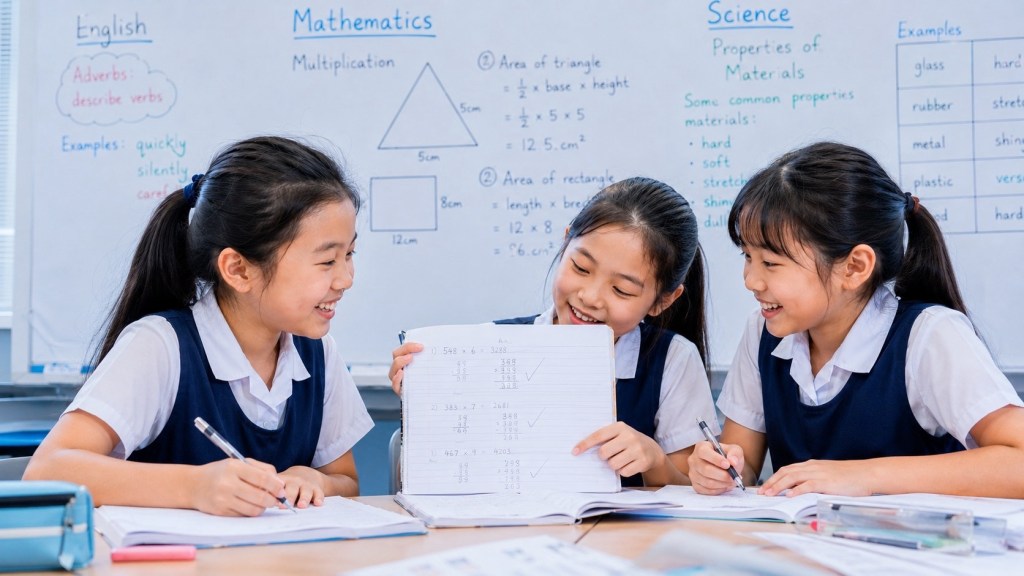
Wait, What? Your everyday experience can be useful in Science—and still lead you to the wrong answer.
You have seen wet clothes dry, shadows move, objects slow down, plants grow towards light and metal spoons become warm. Those experiences give you useful starting ideas. But PSLE Science does not ask you to choose the answer that feels most familiar. It asks you to reason from the exact object, condition, evidence and scientific relationship in the question.
The strongest learner does not throw intuition away. The strongest learner treats intuition as a prediction to test, not as proof.
Quick Answer
Use everyday experience in this order: NOTICE THE INTUITION → NAME WHAT YOU EXPECT → CHECK THE QUESTION CONDITIONS → READ THE GIVEN EVIDENCE → SELECT THE RELEVANT SCIENCE → REVISE THE INTUITION IF NECESSARY → STATE ONLY WHAT THE EVIDENCE SUPPORTS.
If your common-sense expectation agrees with the evidence and mechanism, it can help you reason quickly. If it conflicts with the evidence, the evidence wins. If the evidence is incomplete, keep the intuition provisional rather than turning it into a fact.
The PSLE Science Learning Job This Guide Owns
This guide owns one job: how a Primary 5/6 learner uses prior everyday experience as a starting hypothesis without letting familiarity override the scientific evidence in a PSLE Science question. It does not own the underlying concepts of heat, forces, plants, light, electricity or materials. Those remain scientific concept owners.
For examination from 2026, PSLE Science assesses attainment in the 2023 Primary Science syllabus. SEAB’s current syllabus states that candidates apply scientific facts, concepts and principles and scientific inquiry, including prediction or hypothesis, interpretation and analysis, evaluation of observations, information and methods, and communication of explanations and reasoning. That official frame explains why “it usually happens like this” is not enough.
Why Intuition Is So Powerful
Everyday experience is fast. Your brain compresses many previous encounters into expectations: rough surfaces slow sliding objects; warm things cool; larger containers look as if they should hold more; plants near windows seem to grow differently from plants in darker places.
This is useful because Science does not begin with an empty mind. Prior knowledge helps you notice patterns and generate predictions. The difficulty is that everyday situations often contain several changing conditions at once. A real kitchen, playground or garden is not automatically a fair test. What felt like one cause may have been several causes acting together.
Everyday Experience Is a Starting Model, Not a Verdict
Suppose you think, “Dark-coloured objects always become hotter.” That may come from real experiences, but a PSLE Science question can change the material, light source, duration, starting temperature, distance or measurement point. The scientific job is not to repeat the remembered rule. The job is to ask whether the exact conditions in the question make that rule relevant and whether the evidence supports the expected outcome.
INTUITION SAYS WHAT YOU EXPECT. EVIDENCE SAYS WHAT HAPPENED. SCIENTIFIC REASONING CONNECTS THE TWO.
Worked Example 1: The Bigger Object “Should” Fall Faster
A learner sees two objects of different size and immediately predicts that the larger one must reach the ground first. The learner has imported an everyday expectation before reading the rest of the question.
A stronger route is: READ GIVEN INFORMATION. What are the objects? What differs? What conditions are stated? DISTINGUISH OBSERVATION FROM INFERENCE. “Object A is larger” may be an observation. “It will fall faster” is a prediction. SELECT THE RELEVANT CONCEPT. Use only the Primary Science idea appropriate to the question. CONNECT TO CONDITIONS. Do not add unmentioned factors such as wind or material unless the question supports them. CHECK AGAINST EVIDENCE. If measurements are given, they outrank the first guess.
Worked Example 2: A Metal Spoon Feels Colder, So It Must Have a Lower Temperature
Two objects have been in the same room for a long time. One feels colder to the touch. A learner concludes that the colder-feeling object must have a lower measured temperature.
The everyday sensation is real, but the inference needs checking. A scientific question may give thermometer readings, material information or another condition that changes how the observation should be explained. The learner should not replace measured evidence with touch sensation simply because the sensation is familiar.
The lesson is broader than this example: your senses provide observations, but they do not automatically provide the complete scientific explanation.
Worked Example 3: “More” Must Always Produce “More”
Many learners expect a simple rule: more light means more output, more force means more movement, more water means more growth. Sometimes a relationship does increase across the tested range. Sometimes another condition becomes limiting, a threshold is reached, or the question is measuring a different outcome.
Do not turn an everyday “more → more” expectation into a universal law. Read the range actually tested. Identify the measured quantity. Check whether the data continue the relationship. If the pattern changes, update the explanation instead of forcing the old rule to survive.
Worked Example 4: Familiar Story, Different Scientific Job
A question mentions a plant near a window. The learner recognises a familiar plant-and-light story and begins writing about photosynthesis. But the actual question asks which side of the plant shows greater growth over time, or which variable should be controlled, or what evidence would support a claim.
The familiar story may help identify relevant background knowledge, but it does not decide the question type. Always recover the exact job before using the concept.
The Intuition–Evidence Protocol
- Catch the first thought. What answer feels obvious before you analyse it?
- Turn it into a prediction. Say, “I expect X because…” rather than “X is definitely true.”
- Read all conditions. What object, time, setup, variable or range does the question actually give?
- Find direct evidence. What was observed, measured, labelled or compared?
- Select the scientific concept. Which concept genuinely applies under these conditions?
- Explain the mechanism. Why should the condition lead to the outcome?
- Compare intuition with evidence. Confirm, revise or reject the first thought.
- Limit the conclusion. Do not make the rule bigger than the evidence.
Failure Signatures
- Choosing an MCQ option because “that normally happens”.
- Ignoring a graph because it conflicts with a remembered everyday rule.
- Adding an unmentioned cause from real life to make an answer feel sensible.
- Using a personal experience as evidence for every object of the same type.
- Assuming a familiar word means the familiar mechanism is automatically relevant.
- Changing the given conditions in your head so they resemble a memorised example.
- Refusing to revise a first answer even after contradictory evidence appears.
Earliest Weak-Link Diagnosis
When a learner gives a confidently wrong answer, do not immediately reteach the whole science topic. Ask:
- What did you expect before reading the data?
- Which exact sentence, label or measurement supports your answer?
- Which condition in the question is different from the everyday example you remembered?
- If the evidence changed, would you change your explanation?
If the learner cannot point to evidence, the weak link is evidence discipline. If the learner reads the evidence correctly but applies the wrong concept, the weak link is conceptual. If the concept is correct but an unstated everyday condition has been imported, repair condition tracking.
Misconception Repair
“Common sense is the opposite of Science.” No. Everyday experience can generate useful hypotheses. Science adds controlled comparison, measurement, mechanism and evidence limits.
“If I have seen it happen before, it will happen here.” Only if the relevant conditions are sufficiently similar and the scientific relationship applies.
“If data disagree with my expectation, the data must be wrong.” Unexpected data should be checked, not automatically erased. The measurement, method, condition or original expectation may need revision.
“Scientific answers should never use everyday examples.” Everyday examples can help explain a mechanism, but they must remain examples rather than substitutes for the question evidence.
Prediction Before Evidence: A Powerful Practice Routine
When practising, pause before revealing the result. Write a prediction and one reason. Then inspect the data. If the result disagrees, do not simply copy the correct answer. Write what changed in your reasoning: wrong condition, wrong concept, wrong mechanism, hidden assumption or overgeneralised everyday rule.
This turns surprise into learning. Research on conceptual change in Science shows that learners often carry robust prior ideas into formal learning, and that structured conflict between prediction and evidence can help revision when it is paired with explanation rather than simple correction.
Retrieval and Transfer Sequence
- Round 1: take five everyday Science statements and label each as observation, intuition, prediction or established scientific relationship.
- Round 2: add one condition that would make each statement fail or need qualification.
- Round 3: use a table or graph that contradicts one first prediction and explain why the evidence changes the answer.
- Round 4: switch topic—from heat to plants, forces, materials or electricity—so the skill is not tied to one chapter.
- Delayed return: several days later, solve a new question and write your first intuition separately from your final evidence-based answer.
Unfamiliar Transfer Challenge
A learner says, “A heavier object will always make the spring extend more because heavier things pull harder.” A question then gives two objects, different springs and measured extensions. What should happen first?
Do not start with the everyday rule. First check whether the springs are comparable, what quantity differs, what is measured and whether the question provides a fair comparison. Only then apply the relevant force-and-spring concept. The everyday expectation may be useful, but the investigation design decides whether the evidence can test it.
Answer-Checking Receipt
- I can name my first intuition without treating it as evidence.
- I have read all relevant conditions before deciding.
- I can point to the exact observation or data my answer uses.
- I have selected a concept that fits these conditions.
- I can explain the mechanism rather than rely on familiarity.
- I changed my first idea if the evidence required it.
- I have not imported an unstated everyday condition into the question.
- My conclusion is no stronger than the evidence.
Parent and Tutor Teaching Guide
When a child says, “But I know this because I saw it before,” do not dismiss the experience. Ask, “What was the same about your experience, and what is different in this question?” That turns prior knowledge into a comparison rather than a fight.
A useful teaching move is prediction before reveal. Let the child commit to a prediction, then show the result or data. If it disagrees, ask which assumption failed. The aim is not to embarrass the learner. The aim is to make the hidden model visible enough to repair.
Do not train children to distrust intuition completely. Experts also use intuition—but expert intuition is repeatedly checked against evidence, conditions and mechanism.
Useful Internal Routes
- PSLE Science Learning Guide
- How to Use a Scientific Model Without Mistaking the Model for Reality
- How to Test an Explanation by Asking What Evidence Would Count Against It
- How to Learn a Concept With Examples and Non-Examples
- How to Learn From a Question You Got Right for the Wrong Reason
Authoritative and Research References
- MOE — Science Teaching & Learning Syllabus, Primary Three to Six, updated May 2024
- SEAB — PSLE Science syllabus, examination from 2026
- Pacaci et al. — meta-analysis of conceptual change strategies in Science education
- Theobald & Brod — prediction, surprise and revision of children’s scientific misconceptions
Quiet Return
Your first thought is allowed to be wrong. In fact, a wrong prediction can become excellent Science if you know how to test it. Bring your experience into the question—but let the evidence, conditions and mechanism decide whether that experience survives.
PSLE Science route: Evidence and clear scientific explanations · PSLE Science Learning Guide · Primary 6 Science Learning Hub
