
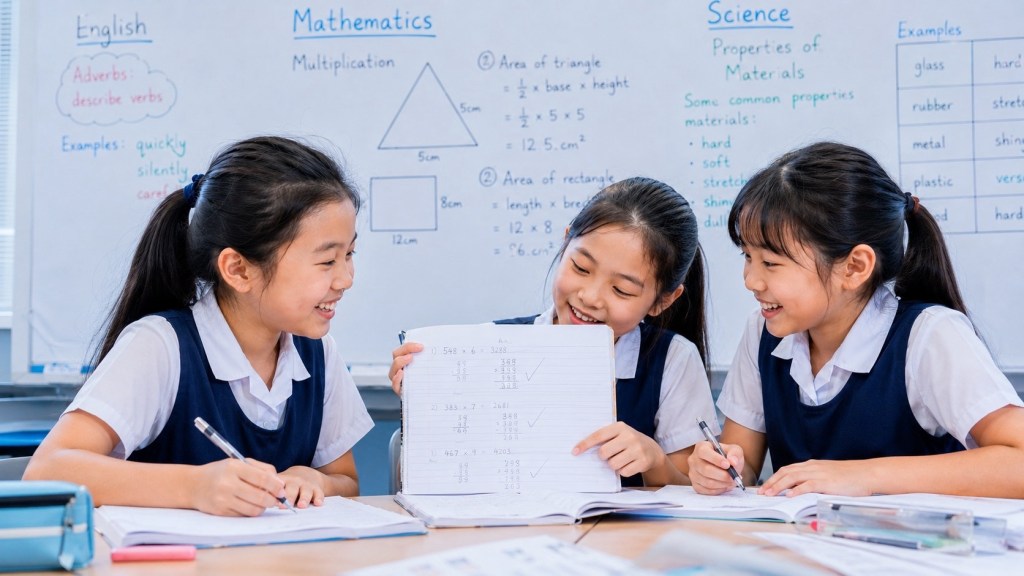
Wait, What? A PSLE Science question can describe what actually happened and then ask you to imagine something that did not happen. If you mix those two worlds together, your Science may be correct but your answer can still collapse.
Suppose an original investigation shows two containers under stated conditions and gives their measured results. A later part then says, “If the cover were removed…” or “Suppose the temperature were lower…”. That new condition is hypothetical. It is a condition you must reason from. It is not a result that was observed in the original investigation.
The central skill is therefore not merely predicting. It is keeping two evidence states separate: what the question says actually occurred and what the question asks you to reason would occur under a changed condition.
Quick Answer
When a question introduces an imagined change, use this route:
READ THE ACTUAL EVIDENCE → MARK THE HYPOTHETICAL CHANGE → KEEP THE ORIGINAL RESULTS UNCHANGED → IDENTIFY THE SCIENTIFIC OBJECT OR RELATIONSHIP → SELECT THE RELEVANT CONCEPT → TRACE THE MECHANISM UNDER THE NEW CONDITION → PREDICT THE OUTCOME → CHECK THAT YOU DID NOT PRETEND THE PREDICTION WAS OBSERVED.
A hypothetical condition changes the reasoning task. It does not rewrite the history of the experiment.
The Owned PSLE Science Learning Job
This guide owns one learner job: separating hypothetical conditions from actual observations and results in PSLE Science reasoning.
It does not replace the wider guides on prediction and hypothesis, changed-condition reasoning, question reading, evidence extraction or experimental design. Those pages remain the owners of those broader jobs. Here, the focus is narrower: when the question moves from “what happened” to “what would happen if…”, can you preserve the boundary?
Why Learners Mix the Two Worlds
The failure is understandable. A long Science question may present a diagram, several conditions, a results table and then a new sentence beginning with words such as if, suppose, imagine, instead, were changed to or would. The learner is holding many facts at once. The newest sentence feels vivid, so it can silently overwrite the earlier evidence.
That creates several common errors:
- writing the imagined condition as though it had been measured;
- changing an earlier table value to fit the prediction;
- using the original conclusion unchanged even though a relevant condition has changed;
- claiming the hypothetical outcome is “shown by the data” when the data came from the original condition;
- forgetting which parts of the original set-up still remain the same;
- inventing extra changes that the hypothetical sentence never stated.
Actual Evidence, Hypothetical Condition, Predicted Outcome
| Information type | What it means | What you may do with it |
|---|---|---|
| Actual observation or measurement | The question says this was observed, recorded or measured. | Use it as evidence, within the limits of the method. |
| Actual stated condition | The condition belongs to the original set-up or process. | Use it to interpret the actual evidence. |
| Hypothetical condition | The question asks you to imagine a changed condition. | Use it to rebuild the reasoning for the imagined case. |
| Predicted outcome | The outcome you infer under the hypothetical condition. | State it as a prediction or reasoned consequence, not as an observed result. |
This distinction is powerful because it preserves scientific provenance: where each statement came from.
Worked Example 1 — A Changed Cover
Imagine an original investigation with two identical containers of warm water. Both start at the same measured temperature. One container is covered and the other is uncovered. After the same time, the question supplies their temperatures.
A later part says: Suppose the cover on the first container were removed at the start instead.
The original temperatures remain the original temperatures. You do not erase them. The new task is to reason about a different imagined condition.
- Actual evidence: keep the recorded temperatures attached to the original covered/uncovered conditions.
- Hypothetical change: the first container is now imagined without its cover from the start.
- Object: the same container of warm water is being reasoned about under a changed condition.
- Relevant concept: select the appropriate Primary Science relationship about the condition and energy transfer.
- Mechanism: explain how the changed condition affects the process.
- Outcome: predict the direction of the resulting temperature difference that the mechanism supports.
- Evidence check: label that outcome as a prediction. Do not say the original data measured it.
Notice what this guide is teaching: not the heat concept itself, but the discipline of keeping an imagined branch separate from the evidence branch.
Worked Example 2 — A Plant Under a New Condition
An original question describes a plant kept under a particular set of conditions and gives an observation after several days. A later part asks what would happen if one stated condition were changed.
A weak answer may say, “The plant was observed to…” and then state the imagined outcome. That turns a prediction into evidence.
A stronger answer preserves the grammar of the Science: “If the condition were changed, then…” followed by the relevant mechanism and predicted outcome. The condition is hypothetical; the reasoning can be scientific; the outcome is still not an observation unless the question later says the changed case was actually tested.
Worked Example 3 — A Graph Followed by an Imagined Change
A graph gives measured values over time for one condition. A later part asks what the graph might look like if a different condition had applied.
Do not redraw the original graph in your mind as though the new line had been measured. First identify the relationship actually shown. Then ask whether the scientific mechanism supports a higher, lower, faster, slower, earlier or later response under the new condition. Your imagined line must remain a prediction constrained by the original evidence and Primary Science knowledge.
The Three-Column Scratch Method
For difficult practice questions, make a tiny scratch table:
| ACTUAL | CHANGED IN THE HYPOTHETICAL | NOT CHANGED |
|---|---|---|
| observations, measurements, original conditions | only the condition the new part changes | every relevant feature the question leaves unchanged |
This prevents a common hidden failure: changing five things when the question changed one.
Observable Failure Signatures
- using “the results show” for a result that was never measured;
- copying an old conclusion after the condition changes;
- altering a table or graph value because you think the imagined case “should” be different;
- forgetting the original evidence once a new scenario is introduced;
- treating “if” as proof rather than as a reasoning instruction;
- adding extra imagined conditions to make a preferred answer work.
Find the Earliest Weak Link
- Reading failure: you did not notice that the question entered a hypothetical case.
- Scope failure: you changed more conditions than the question changed.
- Evidence failure: you treated a predicted value as observed evidence.
- Concept failure: you noticed the hypothetical change but selected the wrong scientific relationship.
- Mechanism failure: you knew the concept name but could not trace why the outcome should change.
- Checking failure: you never returned to ask whether every statement was actual, given, inferred or predicted.
Misconception Repair
“If the Science is correct, I can call it evidence.”
No. Scientific knowledge can justify a prediction, but a prediction is not transformed into an observation merely because the reasoning is sound.
“A hypothetical question means forget the original data.”
No. The original evidence may still reveal the relationship you need. Keep it as evidence about the original condition while reasoning cautiously about the changed case.
“Everything changes in an imagined scenario.”
No. Unless stated otherwise, preserve the relevant features that the question leaves unchanged. One changed condition should not become permission to redesign the entire experiment.
Question-Reading Protocol for Hypothetical Parts
- Box the word or phrase that opens the hypothetical case.
- Name the exact scientific object or set-up being changed.
- Write the one changed condition in a few words.
- List the important original conditions that still remain.
- Separate original observations from your later prediction.
- Choose the concept that connects the changed condition to the process.
- Explain the mechanism before stating the outcome.
- Check that your answer uses language appropriate to a prediction rather than an observation.
Retrieval and Practice Sequence
- Take a simple original scenario and underline only the actual evidence.
- Add one hypothetical condition and mark it in a different notation on scratch paper.
- Predict the outcome without changing any other condition.
- Explain which original evidence still matters and which cannot directly prove the new outcome.
- Change the hypothetical condition again and rebuild the mechanism.
- Use a new topic or representation—a diagram, table or graph—to test the same boundary skill.
- Return after several days and do the process without the scratch table.
Unfamiliar Transfer Test
A real transfer test changes the surface. If you practised with temperature, move to a plant, force, material or electrical-system context. If you practised with prose, use a graph or diagram. The target is not memory for one example. The target is the invariant job.
ACTUAL EVIDENCE STAYS ACTUAL. HYPOTHETICAL CONDITIONS STAY HYPOTHETICAL. PREDICTIONS MUST BE REASONED, NOT RETROACTIVELY OBSERVED.
Delayed Independent Return Test
Three to seven days later, give yourself a new question containing actual data followed by one imagined change. Without notes, mark what was actually observed, what condition is hypothetical, what stays unchanged, what concept applies, what outcome is predicted, and which sentence in your answer is evidence rather than reasoning.
Answer-Checking Receipt
- Did I identify the exact word or sentence that introduces the hypothetical case?
- Did I keep the original observations and measurements unchanged?
- Did I change only the condition the question changed?
- Did I distinguish observation from inference and prediction?
- Did I select the relevant concept rather than a familiar keyword?
- Did I explain the causal mechanism?
- Did I connect the mechanism to the hypothetical condition?
- Did I state an outcome at the correct strength?
- Did I avoid saying the prediction was “shown” by data that never measured it?
Parent and Tutor Teaching Guide
When a learner mixes actual and hypothetical information, do not immediately supply the Science answer. Ask two questions first: “Which part actually happened?” and “Which part are you being asked to imagine?”
Then ask the child to point to the evidence for each claim. If there is no measured evidence for the hypothetical result, that is not a problem; the learner may still be able to predict it using scientific knowledge. The important repair is to label the job correctly.
Fade the prompts quickly. The goal is a child who notices the switch independently, preserves the original evidence, rebuilds the mechanism and checks the final claim without being carried through every step.
Useful Internal Routes
- PSLE Science Learning Guide
- How to Identify What Evidence a PSLE Science Question Actually Gives You
- How to Answer PSLE Science Prediction and Hypothesis Questions
- How to Rebuild a PSLE Science Explanation When One Condition Changes
- Previous guide: anomalous results and evidence integrity
- Next guide: sort given information by scientific job
Authoritative References
- Singapore Examinations and Assessment Board: PSLE Science syllabus for examination from 2026
- SEAB: PSLE formats examined in 2026
- Ministry of Education Singapore: Primary Science Teaching & Learning Syllabus 2023
- Education Endowment Foundation: Improving Primary Science
The 2026 PSLE Science syllabus states that the paper assesses attainment in the 2023 Primary Science syllabus and includes application of scientific facts, concepts and principles together with scientific inquiry, including prediction or hypothesis, interpretation and analysis, evaluation, and communication of explanations and reasoning. This guide uses that official frame without claiming a compulsory answer template or marking phrase.
The Quiet Return
Science reasoning becomes more reliable when every statement keeps its origin. An observation is what was observed. A condition is what applied. A hypothetical change is what you are asked to imagine. A prediction is what your scientific reasoning says should follow. Keep those jobs separate, and unfamiliar questions become much easier to control.
PSLE Science route: Evidence and clear scientific explanations · PSLE Science Learning Guide · Primary 6 Science Learning Hub
