
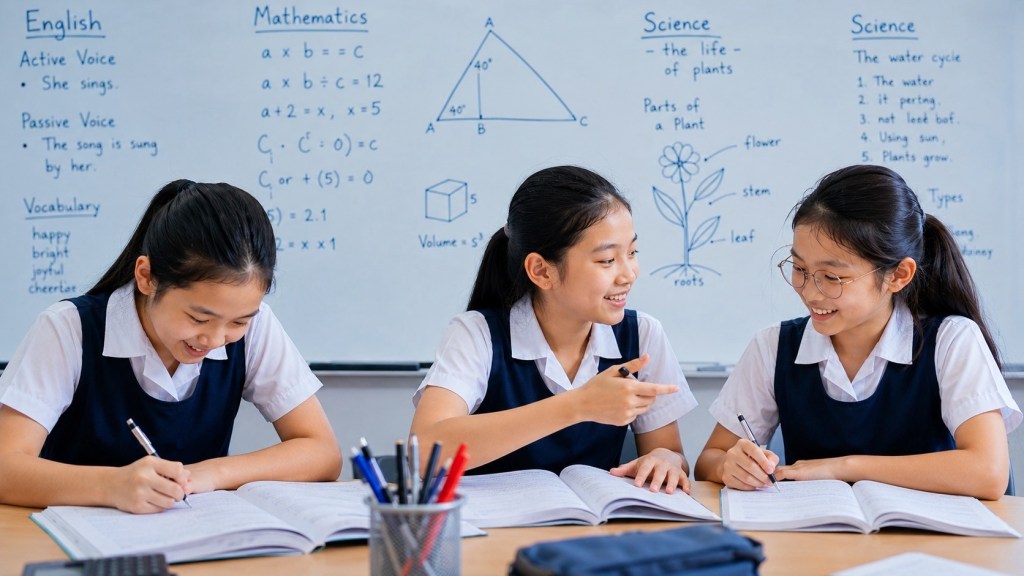
Wait, What? A Wrong Prediction Can Become Better Science Than a Lucky Correct One
You predict that Set-up A will show the larger change. The experiment finishes. Set-up B changes more.
There is a very tempting escape: quietly adjust the prediction in your head until it sounds as though you expected B all along.
That protects the feeling of being right, but it destroys the most useful evidence in the exercise. A prediction is valuable because it records what your scientific model expected before the result could influence you.
The result is not there to reward your prediction. It is there to test it.
When prediction and result disagree, the important question is not “How do I make my prediction look less wrong?” It is “Which part of my reasoning must now be checked?”
Quick Answer
Write or state the prediction and its scientific reason before seeing the result. When the data arrive, keep the original prediction unchanged. Compare the predicted outcome with the actual observation or measurement, decide whether the result supports, contradicts or does not fully test the prediction, then diagnose the first weak link: evidence reading, concept choice, mechanism, condition, measurement or assumption. Update the explanation after that comparison.
The learning chain is:
PREDICT → GIVE SCIENTIFIC REASON → OBSERVE / READ RESULT → COMPARE → EXPLAIN THE MATCH OR MISMATCH → REVISE THE MODEL IF NEEDED → TEST AGAIN.
Owned PSLE Science Learning Job
This guide owns one specific Primary 5/6 job: using the difference between a prior scientific prediction and a later result as evidence for learning.
It does not replace the existing guide on making predictions and hypotheses, which owns how a prediction is formed. It also does not replace reasoning from unexpected results, which owns what to do when an experimental result itself needs investigation. Here the dominant job is the comparison between what you expected beforehand and what the evidence later showed.
Why This Belongs in the Current PSLE Science Frame
For examination from 2026, SEAB states that PSLE Science assesses the 2023 Primary Science syllabus. The assessment objectives include applying scientific inquiry through making predictions and hypotheses, interpreting and analysing information, evaluating observations, information and methods, and communicating explanations and reasoning.
That makes prediction more than a guess before the “real” work starts. Prediction exposes the learner’s current model so later evidence has something definite to test.
The official specification is available from the Singapore Examinations and Assessment Board. The wider 2023 Primary Science syllabus remains the curriculum frame; this page does not invent a marking formula or a required school sentence pattern.
A Prediction Has Three Parts, Not One
A useful scientific prediction contains more than an outcome. It normally carries three linked pieces:
- Condition: what is different or what situation is being considered?
- Expected outcome: what do you think will happen?
- Scientific reason: what concept or mechanism makes you expect that outcome?
For example: “If the same mass of water is exposed over a larger surface area under otherwise comparable conditions, more water will evaporate over the same time because more liquid surface is exposed for water molecules to escape into the air.”
If the later result disagrees, these parts give you places to inspect. Perhaps the condition was not actually controlled. Perhaps the mechanism was misapplied. Perhaps the measurement did not capture evaporation well. A bare sentence such as “A will be greater” gives much less diagnostic information.
Prediction Is Not the Same as Observation
| Statement | Scientific role | When it is made |
|---|---|---|
| “I expect P to lose more water.” | Prediction | Before the result is known |
| “P lost 14 g and Q lost 8 g.” | Observation / measured result | After measurement |
| “The result supports the prediction that P would lose more water.” | Comparison / evaluation | After result and prediction are both available |
| “The larger exposed surface contributed to the greater loss under these conditions.” | Scientific explanation | After linking evidence to mechanism |
If you rewrite the prediction after reading the result, prediction and observation collapse into the same thing. You can no longer tell whether your model successfully anticipated the outcome.
The Four Possible Comparison Outcomes
Do not reduce every prediction-result comparison to “right” or “wrong”. There are at least four useful outcomes at Primary Science level.
1. The Result Supports the Prediction
The observed direction or pattern matches what was predicted under the tested conditions. This strengthens the prediction in that context, but one successful result does not prove a universal law.
2. The Result Contradicts the Prediction
The observation goes in the opposite direction or otherwise conflicts with the expected outcome. Now inspect the reasoning and the method instead of changing the old prediction.
3. The Result Is Too Weak to Decide
The measurement may be missing, too limited, inconsistent or unable to distinguish the predicted outcomes. “Not confirmed” is not automatically “disproved”.
4. The Result Tests a Different Question
The method may have drifted. If the prediction concerns temperature but the investigation changes both temperature and amount of water, the result may not cleanly test the prediction you thought you made.
Worked Example 1 — Prediction Supported, But Do Not Overclaim
Two identical wet cloths begin with the same mass. Cloth P is spread flat. Cloth Q is folded into a compact square. Both are left side by side for 20 minutes. The surrounding conditions are kept comparable.
Prediction before the test: P will lose more water because a larger area of wet cloth is exposed to the surrounding air.
| Cloth | Starting mass | Mass after 20 min | Mass lost |
|---|---|---|---|
| P | 120 g | 112 g | 8 g |
| Q | 120 g | 116 g | 4 g |
Comparison: P lost more mass than Q, matching the predicted direction.
What the result supports: under these tested conditions, the spread-out cloth lost more water over the same interval.
What it does not prove: it does not prove that surface exposure is the only factor affecting evaporation in every situation, or that P lost water faster during every single second of the 20 minutes.
A correct prediction still needs an evidence boundary.
Worked Example 2 — Prediction Contradicted for a Useful Reason
A learner tests two toy cars on different ramps. Car A is released from a higher point but runs onto a rough mat. Car B is released from a lower point and runs onto a smooth surface.
The learner predicts A will travel farther because it starts higher. The result shows B travels farther.
Do not instantly conclude that “starting higher does not matter”. The test changed more than one relevant condition. Surface roughness also differs. The result contradicts the simple prediction about what would happen in these two set-ups, but the investigation does not isolate the effect of release height.
The useful repair is therefore not merely “predict B next time”. It is: identify the competing changed condition, redesign the comparison, and test the relationship again.
This is the difference between learning from evidence and memorising the last outcome.
Worked Example 3 — Your Concept Was Right but the Condition Was Wrong
A pupil knows that plants need light for photosynthesis. She predicts that a plant placed in brighter light will always grow taller than another plant.
The actual result from a short investigation shows little measurable difference in height.
Several possibilities remain. The observation period may be too short for a height difference to become detectable. Light may not be the limiting condition in the tested range. Height may not be the most sensitive outcome for the question. The plants may differ naturally. A correct fact about photosynthesis does not guarantee a particular visible growth result over every short interval.
The weak link was not necessarily the fact “plants need light”. It may have been the jump from that fact to an over-strong prediction about height under unspecified conditions.
Worked Example 4 — The Measurement Could Not Test the Prediction
A learner predicts that one set-up will cool more quickly than another. The only measurement taken is the final temperature after 30 minutes.
Set-up P ends at 28°C and Q ends at 30°C. Does this prove P cooled faster throughout the test?
Not necessarily. To compare cooling rate reliably, the starting temperatures and the change over time matter. If the starting temperatures differed, or if the curves crossed, one final value cannot reconstruct the whole cooling process.
The prediction may be sensible, but the available evidence may not be sufficient to test the exact claim.
The No-Hindsight Rule
Use a simple rule in practice:
Once the result is visible, the original prediction becomes evidence about your earlier thinking. Do not edit it. Add a new explanation below it.
You may cross out a spelling error if needed, but do not change “A will be greater” into “B will be greater” after seeing B. Instead write:
- My prediction was A.
- The result was B.
- The mismatch may have occurred because…
- The next test I would use is…
This creates a visible learning trail.
Find the Earliest Weak Link
| Failure signature | Likely weak link | Repair |
|---|---|---|
| You predicted from the picture rather than the data. | Evidence reading | List the given conditions before selecting a concept. |
| You used a correct chapter fact but predicted the wrong direction. | Concept application | Explain the mechanism under this exact condition. |
| Your prediction ignored a second changed variable. | Fair-test reasoning | Identify all material differences between set-ups. |
| The result surprised you because you assumed “more” always means “faster”. | Quantity meaning | Name the measured quantity and its unit before comparing. |
| Your prediction and result seem different only because you compared different time points. | Comparison alignment | Match the same elapsed time or scientific stage. |
| You cannot tell whether the result supports the prediction. | Evidence-to-claim link | Write exactly what observation would count as support. |
| You rewrite the prediction after checking the answer. | Learning receipt | Freeze the original prediction; add the revision separately. |
Misconception Repair — “Wrong Prediction” Does Not Mean “Wrong Science Everywhere”
Suppose you predict that a larger bulb will be brighter in a given circuit and the result does not match. It would be a mistake to jump from one failed prediction to “everything I learned about circuits is wrong”.
A prediction can fail because the scientific model was wrong, the model was incomplete, a condition was misread, the method did not isolate the relationship, a measurement was unsuitable, or the result itself is variable. Diagnosis comes before replacement.
The opposite is also true. One successful prediction does not prove that your whole explanation is correct. Different mechanisms can sometimes produce the same observed outcome.
Prediction Accuracy and Explanation Quality Are Different Receipts
Imagine two learners both predict the correct outcome.
Learner A writes: “P will be greater because P looks bigger.”
Learner B writes: “P will be greater because the changed condition increases the relevant process, so the measured outcome should increase.”
Both may have the same prediction result, but the quality of their reasoning is different. A correct guess and a correct mechanism should not be treated as identical learning.
After the experiment, ask two questions: Was the predicted outcome supported? and Was the scientific reason supported?
Build a Prediction–Result Table
For investigation practice, use a compact table rather than a paragraph of self-judgement.
| Before result | After result |
|---|---|
| Prediction | Actual observation / measurement |
| Scientific reason | Supported / contradicted / insufficient |
| Critical condition | Did the method preserve that condition? |
| Expected evidence | Was that evidence actually collected? |
| Confidence | What changed in my model? |
This table is a learning scaffold, not an official PSLE answer format. Its job is to make invisible scientific thinking inspectable during practice.
Use a Counter-Prediction to Test Whether You Understand the Mechanism
After explaining the result, change one condition and predict again.
If exposed surface area was the important relationship, what should happen if the containers now have equal exposed surface area but different starting volumes? If circuit completeness was the relationship, what happens if the switch is moved to another location while the path remains complete?
A mechanism that survives a changed context is stronger learning than a sentence copied from the first result.
Common Traps
- Hindsight rewrite: editing the prediction after seeing the data.
- Outcome-only checking: judging only whether the direction was right and ignoring the reason.
- One-result certainty: treating one matching result as universal proof.
- Concept panic: abandoning a correct concept because the method was weak.
- Method blindness: blaming your Science before checking whether the investigation actually tested the prediction.
- Answer-key copying: replacing your old prediction with the model answer and losing the evidence of what went wrong.
- Prediction as prophecy: believing a scientific prediction should always come true if it is “good”.
Retrieval and Practice Sequence
Round 1: Read a short investigation description. Cover the results. Write the prediction, reason and expected evidence.
Round 2: Reveal the results. Classify the comparison as support, contradiction or insufficient evidence. Point to the decisive observation.
Round 3: If there is a mismatch, find the earliest weak link. Do not simply write the “correct answer”.
Round 4: Change one condition and make a fresh prediction. This tests whether the repaired mechanism travels.
Round 5: Return several days later without the previous answer visible. Reconstruct the reasoning from the conditions and evidence.
Unfamiliar Transfer Challenge
A fictional material changes its electrical resistance when compressed. A question tells you that greater compression normally increases resistance within the tested range. You predict that Sample P, which is compressed more, will show the higher measured resistance.
The result instead shows Q is higher. You later notice that P and Q were measured at different temperatures, and the question gives information that temperature also affects resistance.
A strong response is not “The given rule was wrong”. It is: the result did not isolate compression because another relevant condition differed, so the prediction cannot be judged cleanly from this comparison.
The object is unfamiliar. The inquiry logic is not.
Delayed Independent Return Test
Three days later, take an investigation you have not seen. Before revealing the result, write:
- the predicted outcome;
- the mechanism;
- the condition that must remain controlled;
- the observation that would support the prediction;
- one result that would contradict it;
- one result that would be too weak to decide.
Then reveal the data and compare. If you can preserve the old prediction, diagnose the mismatch and build a new test without a hint, the learner job is becoming independent.
Answer-Checking Receipt
- Did I write the prediction before seeing the result?
- Did I attach a scientific reason rather than a familiar phrase?
- Did I keep the original prediction unchanged afterward?
- Did I read the actual measurement or observation correctly?
- Did I compare the same object, quantity, unit and time?
- Did the method really test the condition in my prediction?
- Did I distinguish contradiction from insufficient evidence?
- Did I update the explanation only after the comparison?
- Can the repaired explanation survive a changed example?
Parent and Tutor Teaching Guide
Ask the learner to predict before showing the answer or result. If the prediction is wrong, resist the urge to correct it immediately. Ask: “What did you expect to observe if your idea were right?” Then reveal the evidence.
When the result disagrees, use neutral diagnostic prompts: “Was the concept wrong, or did another condition change?” “Did we measure the thing your prediction was about?” “What evidence would separate those possibilities?”
Preserve the learner’s original reasoning on the page. A visible wrong prediction followed by a strong scientific repair is evidence of learning. A perfectly rewritten page can hide the entire change.
Do not turn every mismatch into “carelessness”. A repeated mismatch may reveal a concept boundary, a quantity confusion, an inquiry weakness or a representation problem. Name the earliest repairable link.
Useful Internal Routes
- How to Answer PSLE Science Prediction and Hypothesis Questions
- How to Reason From Unexpected Experimental Results in PSLE Science
- How to Tell What Must Be True From What Could Be True in PSLE Science
- How to Test a PSLE Science Explanation by Asking What Evidence Would Count Against It
Authoritative and Research References
- Singapore Examinations and Assessment Board — PSLE Science, for examination from 2026
- Singapore Ministry of Education — Primary Science Teaching and Learning Syllabus 2023
- Education Endowment Foundation — Improving Primary Science
- Education Endowment Foundation — systematic review of approaches to primary science teaching
The official Singapore sources define curriculum and assessment. The education evidence informs teaching and learning approaches. Neither source type implies a universal fixed answer template, and this guide’s prediction–result table is a teaching scaffold rather than an official requirement.
The Quiet Return
A prediction is a promise to your future self: this is what I currently think the Science implies.
Then reality answers.
If the answer matches, ask how far the evidence really travels. If it does not, protect the mismatch long enough to learn from it. Do not erase the old model. Use the result to build a better one.
