
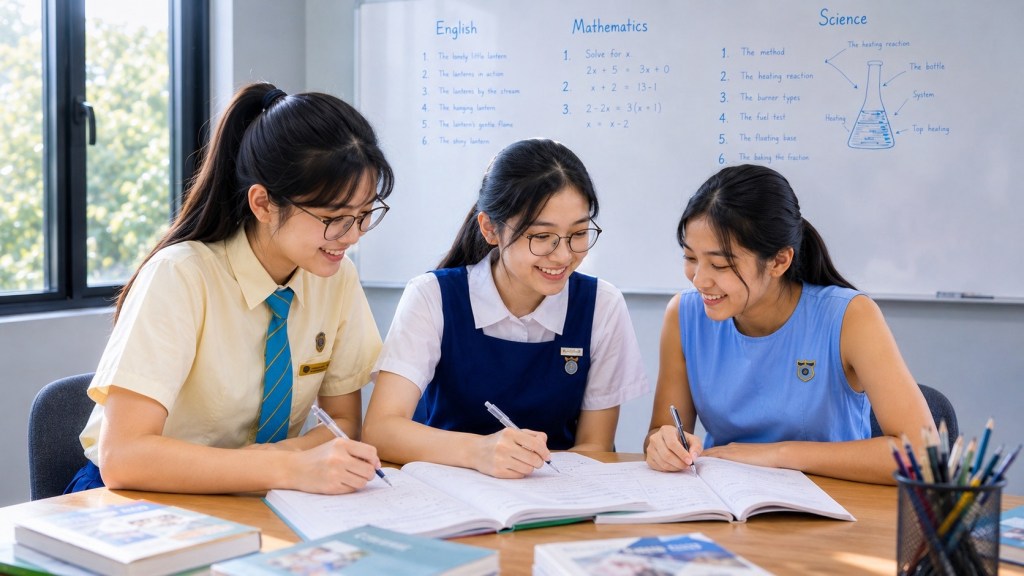
HOW TO LEARN PSLE SCIENCE — Student Guide
Wait, What? A Question Can Be About Two Topics Without Needing Two Separate Answers
A plant is placed under a transparent cover. The temperature inside rises. Water droplets later appear on the inner surface.
What topic is this?
Heat? Water cycle? Plant systems? Changes of state?
The strongest answer may need more than one scientific idea. But that does not mean you should dump every related keyword onto the page.
Mixed PSLE Science questions are not solved by naming more topics. They are solved by giving each concept one precise job, then connecting those jobs through the evidence.
Quick Answer
When a PSLE Science question needs two concepts, use this sequence:
- Read the evidence first.
- Find the first scientific relationship that explains the first change.
- Find the second scientific relationship that explains what happens next.
- Keep the two jobs separate so one concept does not replace the other.
- Join them with a causal bridge: because A happens, B changes; because B changes, C happens.
- Return to the exact outcome asked.
- Check that every concept is necessary.
The goal is not “two keywords”. The goal is one connected model of what happened.
The Exact PSLE Science Learning Job This Guide Owns
This guide owns one student job: how a Primary 5/6 learner recognises and connects two distinct scientific concepts inside one PSLE Science question without confusing, duplicating or merely listing them.
It does not replace canonical pages on heat, photosynthesis, forces, circuits, water, reproduction, ecosystems or other Science concepts. Those pages teach the concepts themselves. This page teaches the combination job: how to use two already-learned concepts together when a new question crosses topic boundaries.
Why This Matters in the Current PSLE Science Frame
The 2026 Standard PSLE Science examination assesses the 2023 Primary Science syllabus. The official assessment objectives include knowledge with understanding, applying scientific facts, concepts and principles, and scientific inquiry skills such as interpreting information, analysing evidence, evaluating observations or methods, and communicating explanations and reasoning.
The 2023 Primary Science syllabus also organises learning through five themes — Diversity, Cycles, Systems, Energy and Interactions — while treating scientific ideas as connected rather than sealed inside isolated chapters.
That matters because real phenomena do not respect textbook chapter boundaries. A seedling can involve systems, interactions and energy. A condensation setup can involve energy transfer and a cycle of water. A food web can involve diversity, systems, interactions and energy flow.
The examination can change the surface story while preserving the scientific relationships underneath it.
The Biggest Mistake: Topic Matching
A learner sees a leaf and thinks: Photosynthesis.
A learner sees a lamp and thinks: Electricity.
A learner sees water droplets and thinks: Condensation.
Those associations can help, but they are not enough. A picture can contain many concepts. The question chooses which relationships matter.
So replace:
“What chapter does this look like?”
with:
“What changed first, what changed next, and which scientific relationship explains each change?”
The Two-Concept Map
A useful mixed-concept explanation often looks like this:
Given condition → Concept 1 explains Change A → Change A creates a new condition → Concept 2 explains Change B → requested outcome
This is not an official marking formula. It is a learning model for finding the logic inside a question.
Worked Example 1 — Heat Transfer + Evaporation
Original situation: Two identical shallow dishes contain equal masses of water. Dish A is placed under a warm lamp. Dish B is placed farther away. After one hour, A contains less water.
A weak answer might say:
“There is heat and evaporation.”
Two keywords, no connection.
A connected explanation asks:
- Concept 1 — Energy/heat: Which dish receives more energy from the warmer radiation source under the stated arrangement?
- Bridge: How can that affect the water’s temperature or the energy available to water molecules?
- Concept 2 — Evaporation: How can the changed thermal condition affect the rate at which water escapes into the air?
- Outcome: Which dish therefore loses more water over the same time?
Notice the jobs are different. Heat transfer explains the changed thermal condition. Evaporation explains water leaving the liquid. One does not replace the other.
Worked Example 2 — Circuits + Energy Conversion
Original situation: A cell, switch and buzzer are connected in a simple circuit. The switch is initially open and then closed.
If the question asks why sound is produced only after the switch is closed, you may need two connected ideas:
- Closing the switch completes the conducting path, allowing electric current to flow in the working circuit.
- The buzzer uses electrical energy and produces sound through vibration.
If you mention only “sound energy”, you have not explained why closing the switch matters. If you mention only “closed circuit”, you may not yet have explained the requested sound outcome.
Worked Example 3 — Plant Systems + Water Movement
Original situation: A leafy shoot stands in coloured water. After time, colour appears in certain parts of the stem and leaf.
A mixed explanation could require:
- a system idea: particular plant structures carry water;
- a transport relationship: water taken up by the shoot moves through those structures;
- possibly, depending on the exact question, a relationship involving water loss at leaves and continued movement of water.
The phrase depending on the exact question matters. Do not add a second concept unless the evidence or target needs it.
Worked Example 4 — Food Web + Energy
Original situation: An insect population falls sharply. A bird species that feeds mainly on that insect later decreases.
The first idea is a feeding relationship in a system. The second can be an energy/food-availability consequence. The reasoning is not simply “food web + energy”. It is:
Fewer insects → less food available to the bird population → less chemical energy/resources available through that feeding route → the population may be less well supported under the stated conditions.
Be cautious with ecological questions: a food web shows possible feeding relationships, but a simple diagram may not prove that one change has only one cause. State only what the evidence supports.
How to Know Whether You Really Need Two Concepts
Use the necessity test.
- Try to explain the entire evidence-to-outcome chain with one concept.
- Ask whether there is a missing transition.
- If a second relationship is required to explain that transition, the second concept earns its place.
- If removing the second concept changes nothing, it may be decoration.
Strong answers are complete, not crowded.
The Bridge Sentence Test
If two concepts are needed, you should be able to write a bridge between them.
Useful bridge structures include:
- “Because ___ increased, ___ then…”
- “This caused ___, which meant that…”
- “The first process changed ___; under this new condition, the second process…”
- “As a result of ___, the amount/rate/temperature/force available for ___ changed…”
The bridge should describe a scientific relationship, not just join two vocabulary words.
Observation, Inference and Concept Must Not Collapse Into One Thing
| Layer | Example | What it is not |
|---|---|---|
| Observation | The thermometer reading rose from 25°C to 34°C. | Not yet the explanation |
| Inference | The water gained thermal energy under the setup. | Not directly identical to the reading itself |
| Concept | Energy can be transferred from a warmer source/environment to a cooler object. | Not a description of the individual data point |
| Second concept | A changed temperature can affect the rate of evaporation. | Not automatically needed unless water loss is part of the question |
Mixed questions become much easier when you keep these layers visible.
Failure Signature 1 — The “And Also” Answer
Example:
“The bulb lights because the circuit is closed and also there is electrical energy and also energy changes to light.”
The ideas may be relevant, but the structure does not show which relationship causes which outcome.
Repair it by turning the list into a chain.
Failure Signature 2 — One Concept Swallows the Other
A learner learns one powerful chapter well and tries to use it everywhere.
For example, every plant question becomes photosynthesis. Every temperature question becomes heat transfer. Every movement question becomes force.
That is over-generalisation. The question may need a second relationship: transport, evaporation, reproduction, friction, circuit continuity, food availability, or another concept.
Failure Signature 3 — Two Concepts Are Named but Their Order Is Reversed
Suppose increased heating causes faster evaporation. Writing “more evaporation caused the lamp to transfer more heat” reverses the experimental relationship unless the setup specifically supports that feedback.
Mixed-topic questions demand causal direction.
Failure Signature 4 — The Student Uses the Right Concepts but the Wrong Object
A question may include a plant, a plastic bag, water droplets and light. The learner may correctly explain condensation — but on the wrong surface, or from the wrong source of water, or under an unstated condition.
Always bind each concept to the object it describes.
Earliest Weak-Link Diagnosis
| What you observe in your work | Likely weak link | Repair |
|---|---|---|
| You recognise both topics but cannot connect them | Missing causal bridge | Write A → B → C before writing sentences |
| You use many concepts | No necessity filter | Remove one concept and see whether explanation breaks |
| You use one familiar concept for every mixed question | Weak concept discrimination | Ask what relationship the evidence actually requires |
| Your answer works only for the textbook example | Surface-feature dependence | Practise the same relationship with new objects |
| You reverse cause and effect | Weak directional model | Use arrows and label cause/effect |
| You cannot tell which evidence supports which concept | Evidence-concept binding | Underline evidence in two colours and pair each with its job |
A Four-Box Method for Mixed Questions
On rough paper, make four tiny boxes:
- Evidence: what did I observe/read?
- Concept 1: what explains the first change?
- Concept 2: what explains the next change?
- Outcome: what does the question ask me to state?
Then draw arrows. If there is no scientific relationship between two boxes, your concepts may not belong together.
How Diagrams Can Hide the Concept Boundary
A diagram may show one physical setup even though the reasoning crosses two ideas.
Example: a black container and a shiny container under a radiant source can involve absorption of radiation and subsequent temperature change. If the question then asks about evaporation of water inside, a second process enters.
Do not let one picture trick you into assuming there is only one concept.
How Tables and Graphs Can Reveal the Concept Boundary
Sometimes the first concept explains the independent-variable effect, while the second explains the measured outcome.
Suppose a graph shows lamp distance versus rate of gas-bubble production from an aquatic plant. The graph itself gives a pattern. To interpret it, you may need to reason about light availability and the plant process that uses light. The graph is evidence; the scientific concepts explain why the pattern might occur under the controlled conditions.
What If Three Concepts Seem Relevant?
Do not panic. Use hierarchy.
- Which relationship directly explains the measured change?
- Which relationship explains the condition that produced that change?
- Is the third concept necessary for the requested outcome, or merely background?
A scientifically complete answer can still be short. Depth comes from correct relationships, not from maximum word count in the examination.
Mixed Questions Across the Five Primary Science Themes
The official syllabus themes can connect in many legitimate ways. Here are learner-facing examples of connections, not fixed exam templates:
| Connection | Possible reasoning job |
|---|---|
| Diversity + Systems | How differences in structures relate to different functional roles |
| Cycles + Energy | How energy conditions change rates within a repeating material process |
| Systems + Interactions | How one part affects another through a force, signal, resource or pathway |
| Energy + Interactions | How forces, heating, electrical effects or light change an object’s state or behaviour |
| Diversity + Interactions | How different organisms or materials respond differently under the same condition |
The table is a map for thinking. It is not a list of guaranteed examination combinations.
How to Practise Without Memorising Mixed Questions
Use a sequence that changes the surface while keeping the underlying relationships.
- Learn each concept separately until you can explain it.
- Practise identifying the concept from unfamiliar evidence.
- Combine two concepts in one causal chain.
- Change the object but keep the same relationship.
- Change one condition and rebuild the chain.
- Return days later and solve a new version without hints.
This matters because transfer means recognising a relationship when the surface example changes.
Retrieval Practice for Mixed Concepts
Do not only reread concept notes side by side. Close the notes and ask:
- What causes this change?
- What new condition does that create?
- Which second concept now becomes relevant?
- What evidence would show I chose the wrong second concept?
Retrieval practice has strong evidence across classroom learning, but mixed-topic application requires more than recall: the learner must also discriminate and connect. Evidence on interleaving and concept learning suggests that comparing and alternating related categories can support discrimination, although effects depend on task, age, prior knowledge and implementation. Do not treat “interleaving” as a magic timetable rule.
Unfamiliar Transfer Challenge
Original situation: A sealed clear bottle contains a small amount of water and air. It is placed in sunlight for some time and later moved into a cooler room. Droplets appear on the upper inside wall.
Without writing a full answer, identify:
- What changed first?
- Which energy relationship helps explain that?
- What happened to some liquid water?
- What changed when the bottle moved to the cooler room?
- Which second change-of-state relationship can explain droplets forming?
- Which details are observations and which are inferences?
If you can build the causal chain without relying on the chapter title, your mixed-concept reasoning is becoming more flexible.
Delayed Independent Return Test
Three or more days later, take four unfamiliar Science questions from different themes. For each one, do not ask “which chapter?” Ask:
- What relationship explains the first change?
- Is there a second unexplained transition?
- If yes, what concept owns it?
- Can I remove either concept without breaking the explanation?
If you can do this without a hint sheet, you are testing independent transfer rather than immediate imitation.
How to Check the Final Mixed-Concept Answer
Use the companion guide How to Check a PSLE Science Answer Without Re-doing the Whole Question, then add two mixed-question checks:
- Necessity: does each concept do a job the other cannot do?
- Bridge: is there a scientific connection between Concept 1 and Concept 2?
Common Traps
- Writing every keyword you remember.
- Assuming every mixed-looking diagram needs two concepts.
- Using two true facts without connecting them.
- Choosing concepts because of familiar objects rather than evidence.
- Ignoring the order of events.
- Changing the causal direction.
- Forgetting which object each concept applies to.
- Using a concept-page explanation so broadly that it no longer answers the question.
- Treating theme names as if they were mechanisms.
How Do We Know This Learning Approach Is Reasonable?
It follows the official Singapore Science frame: learners are expected not only to recall knowledge but also to apply concepts, interpret information and communicate scientific reasoning. The MOE syllabus explicitly presents the themes as connected and emphasises scientific practices such as using evidence and models.
More broadly, science-education frameworks use crosscutting ideas such as systems, cause and effect, energy and matter, patterns and structure–function to help learners connect knowledge across contexts. These frameworks are not PSLE marking rubrics, but they illustrate a durable principle: coherent science learning depends on seeing relationships that recur across different phenomena.
Research on interleaving and retrieval suggests that learners can benefit when they must discriminate between related categories and retrieve ideas rather than merely reread them. However, much of that research spans different ages and subjects. For a Primary learner, the safest conclusion is modest: varied practice can be useful when concepts are already understood and when feedback helps repair confusion.
Model Limits
- Not every PSLE Science question is a two-concept question.
- Some questions require one concept applied carefully rather than two concepts combined.
- Some phenomena can be explained at several scientific levels; use the level supported by the syllabus and question.
- A causal chain is a learning tool, not an official compulsory answer format.
- Ecological and investigation questions may contain uncertainty or alternative explanations that a simple chain should not hide.
- Two keywords are not evidence that two mechanisms are needed.
Parent and Tutor Teaching Guide
If a child struggles with mixed questions, do not begin by assigning more mixed papers. First find the weak link.
- Can the child explain Concept 1 independently?
- Can the child explain Concept 2 independently?
- Can the child identify which evidence triggers each concept?
- Can the child state the bridge between them?
- Can the child solve the same relationship using a different object?
If either concept is weak, repair it first. If both concepts are secure but the child cannot connect them, practise arrow chains and bridge sentences. If the child connects them only in familiar worksheets, change the surface context and test transfer.
A useful tutoring question is:
“What does the first concept explain that the second concept does not?”
If the learner cannot answer, the concepts may still be labels rather than working models.
Student Mastery Checklist
- I can identify the evidence before naming a topic.
- I can tell whether one concept is enough.
- I can give each concept a separate job.
- I can connect the concepts with a causal bridge.
- I can remove unnecessary keywords.
- I can keep observation separate from inference.
- I can track which object each concept applies to.
- I can solve a changed surface example using the same relationships.
- I can return days later and rebuild the chain without hints.
Authoritative References and Further Learning
- Singapore Examinations and Assessment Board — PSLE Science syllabus, examination from 2026.
- Singapore Ministry of Education — 2023 Primary Science Teaching and Learning Syllabus.
- National Science Teaching Association — Crosscutting Concepts overview, useful as a broader science-education connection rather than a Singapore examination rubric.
- Firth, J., Rivers, I. & Boyle, J. (2021). Systematic review of interleaving as a concept-learning strategy.
- Sana, F. & Yan, V. X. (2022). Research on interleaved retrieval practice and science learning.
The Quiet Ending
The beginner sees two topics and tries to remember two model answers.
The improving learner recognises two concepts.
The strong PSLE Science learner asks something better:
What does each concept explain, what evidence activates it, and how does the first scientific change create the condition for the second?
That is how mixed questions stop being mixed. They become one connected piece of Science.
