
MindOS · Collaborative-Inhibition State · Individual Baseline → Collaborate → Track Unique Recall → Compare With Nominal Pool → Reconstruct Alone → Delay → Transfer
Wait, What? Three Students Remembering Together Can Produce Less Than the Same Three Students Remembering Separately
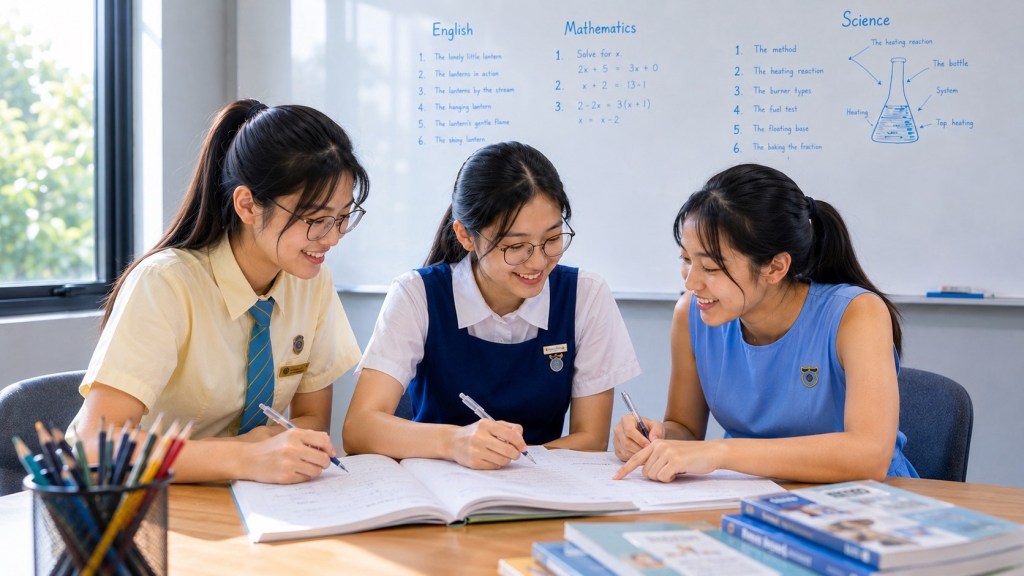
A group sits around one table and tries to remember everything from a lesson.
They prompt one another. They correct one another. They hear ideas they had forgotten. The discussion feels richer than studying alone.
Yet experimental memory research has repeatedly found a surprising comparison: an interacting group can recall fewer unique items than the same number of people would recall if they worked separately and their nonredundant answers were later pooled.
This is called collaborative inhibition.
Quick Answer
Owned learner job: during group retrieval, separate the value of social interaction from the cost of disrupted individual retrieval, then design the sequence so each learner preserves and expands their own accessible knowledge after the group dissolves.
The RFE is not “group work is bad.” It is:
Use collaboration when it adds explanation, correction, re-exposure and perspective—but protect each learner’s retrieval route and verify individual capability afterwards.
The Critical Comparison: Real Group Versus Nominal Group
Collaborative inhibition cannot be understood by comparing a group with one person.
Three people will usually remember more total information than one person simply because there are three memory systems contributing.
The informative comparison is a nominal group:
- three people recall separately;
- their answers are pooled;
- duplicates are removed;
- that unique total is compared with what three interacting people recalled together.
When the interacting group produces fewer unique items than the nominal pool, collaborative inhibition is present.
This Is a Narrow Child of Social Learning State
Social Learning State owns the broad conversion of peer interaction into individual learning: attempt, explain, challenge, feedback, reconstruct and transfer.
Collaborative-Inhibition State owns one specific memory phenomenon inside that wider territory: joint retrieval can disrupt the amount of unique information a group produces relative to pooled individual recall.
It therefore needs a different discrimination test: compare interacting recall with independent-first recall, not merely inspect the quality of the group product.
Why Might Collaborating Reduce Immediate Group Recall?
The strongest established explanation is retrieval-strategy disruption.
People organise memory idiosyncratically. One learner may remember a Science topic by diagram location. Another may move through causal order. Another may retrieve examples first and definitions second.
When partners begin producing items in a different order, each person’s private search route can be interrupted. Instead of following their own sequence, they must repeatedly process what others say, check whether it is new, inhibit repetitions and restart their search.
Other mechanisms may also contribute, including retrieval inhibition or social-process effects. But the 2016 meta-analysis by Marion and Thorley found strong support for retrieval-strategy disruption as a general explanation across the literature.
The Paradox: Collaboration Can Hurt Immediate Group Recall and Help Later Individual Recall
Collaborative inhibition is only half the story.
When people collaborate, they are also re-exposed to information from partners. They can hear correct items they failed to retrieve, receive new cues, detect errors and reorganise memory.
The same 2016 meta-analysis found that collaborative remembering generally benefited later individual retrieval. A 2024 meta-analysis focused specifically on postcollaborative memory likewise found a moderate facilitating effect of collaboration on subsequent individual retrieval across 64 studies and 101 effect sizes.
This creates a crucial educational distinction:
- Immediate group productivity: how much unique material the group produces together.
- Later individual learning: what each learner can retrieve after hearing and processing the group discussion.
A group can be weaker on the first and stronger on the second.
Observable Learner Signatures
- A learner produces many items alone but becomes quieter after peers start recalling in a different order.
- Group discussion repeatedly interrupts a learner just as they are following a private retrieval sequence.
- The same few highly accessible answers dominate discussion while less obvious items disappear.
- After the group, learners say, “I remembered more when I was writing alone first.”
- Individual post-tests improve after collaboration even though the group’s unique recall total was not impressive.
- Larger groups become increasingly difficult to coordinate during free recall.
- Unstructured “shout out anything you remember” sessions produce more disruption than organised turn-taking or category-based retrieval.
These are hypotheses, not diagnoses. Social anxiety, dominance, status, language differences, weak knowledge and task design can create similar patterns. MindOS therefore changes the retrieval structure and observes what changes.
Discrimination Test 1: Individual First, Group Second
Give each learner two or three minutes to retrieve independently before discussion begins. Save each private list.
Then collaborate. Compare:
- the group’s joint list;
- the pooled nonredundant private lists;
- each learner’s later individual recall.
This is far more informative than looking at the group answer alone.
Discrimination Test 2: Free-Flowing Versus Structured Recall
On one session, allow unrestricted recall. On another, use categories, rounds or temporary silent periods.
If structured recall preserves more unique contributions, disruption rather than lack of knowledge becomes a stronger explanation.
Discrimination Test 3: Group Size
The 2016 meta-analysis found collaborative inhibition was enhanced in larger groups. In ordinary study, compare pairs with groups of four on similar retrieval tasks.
If the larger group increases interruption while individual post-learning does not improve, reduce the collaboration footprint.
Discrimination Test 4: Recall or Explanation?
Collaborative inhibition is a recall phenomenon. A group task whose main job is explanation, argument, critique or joint problem solving should not be judged only by number of unique recalled items.
Name the job before measuring it.
The MindOS Collaborative-Inhibition Protocol
Step 1 — Protect an Individual Retrieval Window
Before anyone speaks, each learner retrieves independently. This preserves the private search route and exposes the actual starting state.
Step 2 — Pool Without Erasing Provenance
Combine unique ideas, but note which items were independently available to whom. A beautifully complete shared list should not be mistaken for equal individual memory.
Step 3 — Use Collaboration for Value-Adding Operations
Do not spend the whole session shouting remembered facts. Use the group for things interaction can add:
- explain why an item matters;
- correct inaccuracies;
- connect two contributions;
- challenge an assumption;
- supply a missing example;
- compare retrieval structures.
Step 4 — Create Short Silent Resets
After a burst of discussion, stop. Give each learner thirty to sixty seconds to resume their own search without new inputs.
This can reduce continuous strategy disruption while preserving social re-exposure.
Step 5 — Reconstruct Alone
Close the shared notes. Every learner now reproduces the knowledge independently. This is the critical handoff from social support to personal capability.
Step 6 — Test a Changed Task
Do not ask for the same list in the same order. Use a new question, new example or new retrieval cue so the learner must own the structure rather than replay the group conversation.
Step 7 — Return After Delay
Several days later, test individually before any peer contact. This shows whether collaboration produced durable learner change rather than temporary access to other people’s memories.
Worked Example: Science Revision
Three students revise factors affecting enzyme activity. Each first writes everything they can recall independently. They then pool the lists and discover that one student remembered pH, another enzyme concentration, and another denaturation conditions.
Instead of stopping at a complete shared list, they explain the mechanism behind each factor, challenge weak statements, then close the notes and each reconstructs a causal explanation independently.
The group has been used as a re-exposure and correction engine, not as the final memory store.
Worked Example: Mathematics
A group tries to recall all cues that distinguish several differentiation techniques. Free-flowing recall becomes repetitive because the most confident student keeps naming the same familiar conditions.
The repair is not “talk less.” Each student first writes their own method-selection cues, then the group compares conflicts, then each receives a different mixed problem set individually.
The examination receipt is whether each learner selects the correct technique when nobody else is present.
Worked Example: English
Students are recalling evidence for a literature essay. One student’s first quotation changes everyone else’s search direction. The group becomes excellent at discussing that quotation but retrieves fewer alternative scenes.
Use silent individual retrieval first, then pool evidence, then assign each learner a different claim and require independent evidence selection. This preserves breadth before collaboration narrows the retrieval space.
How Do We Know?
Marion and Thorley’s 2016 Psychological Bulletin meta-analysis synthesised 75 effect sizes from 64 studies. Collaborative inhibition was robust, and the effect was larger in larger groups, with uncategorised material, under free-flowing/free-order recall, and when group members did not know one another. The pattern broadly supported retrieval-strategy disruption as a general explanation.
The same review separately examined postcollaborative individual memory and found that collaboration generally benefited later individual retrieval.
A 2024 meta-analysis of postcollaborative benefits included 64 studies, 101 effect sizes and 13,398 participants from 11 countries. It found a moderate facilitating effect of collaboration on subsequent individual retrieval. Another 2024 meta-analysis continued to support collaborative inhibition while examining moderators including group membership, culture and memory monitoring.
- Marion & Thorley (2016), meta-analysis of collaborative inhibition and postcollaborative memory
- Post-collaborative benefits: meta-analysis of subsequent individual retrieval (2024)
- Meta-analysis of collaborative inhibition moderators (2024)
Evidence Boundary
- Collaborative inhibition refers to a specific comparison with nominal pooled individual recall; it does not mean groups remember less than single individuals.
- The phenomenon is strongest in memory-retrieval tasks and should not be casually generalised to all collaborative learning.
- Group discussion can improve later individual memory through re-exposure and other mechanisms.
- Retrieval-strategy disruption is well supported but not necessarily the only contributing mechanism.
- Educational groups add social dynamics, expertise differences and task goals that laboratory paradigms may not fully capture.
- A quiet learner in a group should not be labelled as cognitively inhibited without evidence; social and contextual explanations must remain open.
AI Boundary: A Shared AI Answer Can Become a Synthetic Group Memory
In group study, one student may ask an AI tool and paste a complete list into the shared document. The group artifact instantly becomes comprehensive.
But the crucial measurement has vanished: what could each learner retrieve, and what did collaboration add?
A safer sequence is individual recall first, group pool second, AI verification third, then individual reconstruction after the AI output is closed. The tool may improve factual checking; it should not erase the distinction between shared access and personal memory.
Staged Practice
- Private baseline: every learner retrieves alone.
- Nominal pool: combine unique private answers.
- Collaborative recall: retrieve together and observe disruption or additions.
- Value-add discussion: explain, correct, connect and challenge.
- Silent reset: let private retrieval resume.
- Individual reconstruction: close the shared material.
- Changed task: solve or explain individually.
- Delayed return: test before the next collaboration begins.
Scaffold Fade
At first, a tutor enforces private-first recall and explicit turn-taking. Later, learners learn to protect their own retrieval window, notice when discussion is narrowing the search, and call for a short silent reset themselves.
Mature group study should not require an adult to keep saying “now do it alone.” The learners should understand why individual reconstruction is the receipt.
Examination Craft
Most school examinations remove the group. A collaborative revision method therefore fails its purpose if the learner can recognise a peer’s reasoning but cannot independently retrieve and execute it under time pressure.
Finish collaborative sessions with individual exam-style prompts. Separate the learners before the answer is produced.
Transfer Test
Move to a different subject or task. Do not prescribe the collaboration structure. Observe whether learners independently choose to retrieve first, collaborate for value-add operations, and reconstruct afterwards.
Transfer is present when the sequence becomes a self-regulated group-learning habit rather than a teacher-managed ritual.
Delayed Return Test
Several days later, test each learner individually before they see the group notes. Compare the result with the original private baseline. The key question is not whether the group once produced a complete answer, but whether each learner’s accessible capability changed.
Parent and Tutor Teaching Guide
When students revise together, avoid judging the session by how lively the discussion sounds. Ask:
- “What did each of you remember before anyone spoke?”
- “Which new idea did you gain from someone else?”
- “Did another person’s answer interrupt something you were trying to retrieve?”
- “Take one minute silently. What else comes back?”
- “Now close the group notes. Can each of you reconstruct the topic?”
- “Tomorrow, can you do it before the group meets?”
This preserves the social advantages while keeping the learner, not the group artifact, as the final receiver.
MindOS Direction Graph
Individual recall → nominal pool → collaborative recall → compare unique output → discussion adds explanation/correction → silent reset → individual reconstruction → changed task → delayed individual return → future self-regulation.
If the group product is strong but individual capability is unclear, return to Social Learning State. If one learner dominates and others copy, use role rotation and individual post-testing. If retrieval itself is weak even alone, route to Retrieval State. If early group outputs crowd later recall within the same session, inspect Output-Interference State.
MindOS rule: collaboration is not measured by how complete the shared memory sounds. Its educational value is proven when interaction adds something useful and each learner can still retrieve, explain and perform after the group is gone.
