
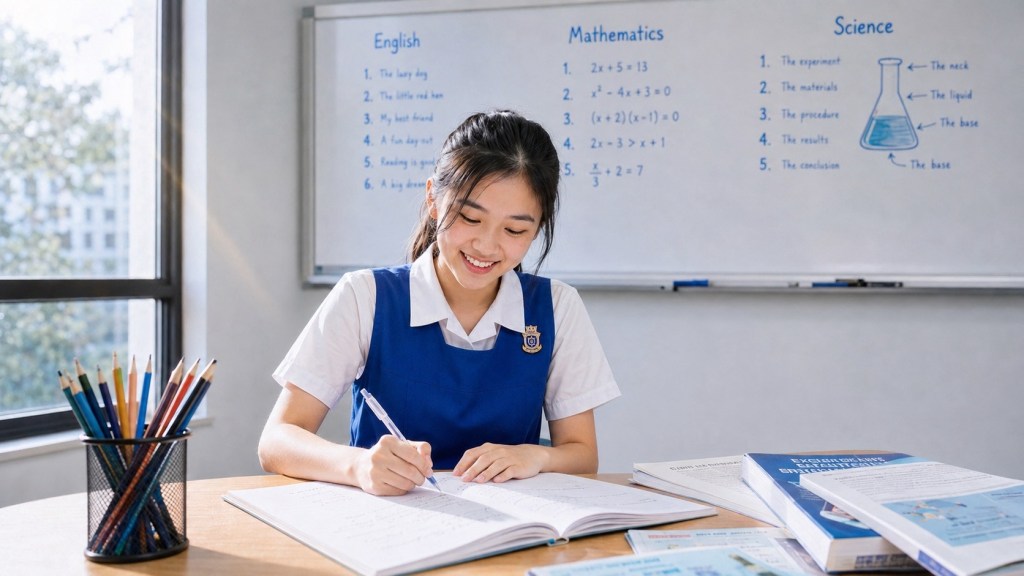
The Problem We Have in Singapore
I have been thinking about this for a long time.
Not really about tuition.
About the problem that creates tuition.
Because if we start with tuition, we are already halfway into the story.
We see the child struggling with Mathematics.
We see the English composition that came back with a disappointing mark.
We see Science answers that seem almost correct, but somehow keep losing marks.
We see the examination coming.
And then the natural response is:
Find tuition.
But I think there is a question before that.
What problem are we actually trying to solve?
That sounds simple.
I don’t think it is.
Singapore Has a Large, Structured Education System
Let me start there.
I don’t think the problem is that Singapore does not know how to educate children.
Quite the opposite.
We have schools.
Teachers.
Curriculum.
Textbooks.
Assessment.
Infrastructure.
Technology.
Libraries.
Programmes.
Examinations.
Pathways.
A system that can take a child entering Primary 1 and move that child through increasingly sophisticated knowledge over many years.
That is an enormous civilisational achievement.
Sometimes we forget how much coordination sits behind that national effort because it appears every morning when children put on their uniforms and go to school.
But building a national education system is one problem.
Teaching this particular child, sitting in front of us today, is another.
That difference is where I think things become interesting.
The Syllabus Has a Position
Every year has somewhere it needs to go.
Primary 1 has its work.
Primary 2 has its work.
Primary 3 moves farther.
Then Primary 4.
Primary 5.
Primary 6.
PSLE.
Secondary school.
And so on.
The curriculum has a direction.
It has to.
There are thousands of students moving through it.
We cannot design a completely different national syllabus for every individual child every Monday morning.
So there is necessarily a timetable.
A sequence.
A pace.
A destination.
But the learner has a position too.
And those two positions are not always the same.
That, to me, is one of the fundamental problems in education.
WHERE THE CURRICULUM IS ≠WHERE THE LEARNER IS
Sometimes they align beautifully.
The teacher teaches something new.
The child has the foundations.
The explanation connects.
Practice strengthens it.
The class moves on.
Everything works.
But sometimes the syllabus moves and the learner does not move with it.
Or not completely.
And education becomes much more complicated from there.
The Child Is Still Carrying Yesterday
Suppose a Primary 5 child is having trouble with fractions.
We can say:
The child is weak in Primary 5 Mathematics.
But what does that actually mean?
Perhaps fractions are genuinely the problem.
Or perhaps multiplication facts were never sufficiently stable.
Perhaps division is weak.
Perhaps part-whole relationships are unclear.
Perhaps the child can calculate but cannot understand the language of the word problem.
Perhaps the child understands the problem but cannot represent it.
Perhaps the child knows everything but works so quickly that checking disappears.
Perhaps several of those things are happening together.
The visible failure happens today.
The cause may have started two years ago.
This is one of the difficult things about education.
Children accumulate.
They don’t reset in January.
Primary 4 does not disappear when Primary 5 begins.
Every new topic arrives on top of whatever survived from before.
So a child can enter a classroom carrying small gaps that nobody can easily see.
At first, the gaps may not matter very much.
Then later work starts depending on them.
Suddenly they matter enormously.
A Small Problem Can Travel
This is something I have seen again and again.
A small weakness doesn’t necessarily remain small.
Imagine a child whose multiplication is slightly slow.
Nothing catastrophic.
Give the child enough time and the answers are usually correct.
Then Mathematics becomes more complicated.
Now multiplication is not the question.
It is only one tiny operation inside a larger question.
The child has to:
read,
understand,
choose a method,
hold information,
calculate,
compare,
decide,
check.
That slightly unstable multiplication suddenly consumes attention that another child can use somewhere else.
So the visible problem may eventually appear to be:
“My child doesn’t understand word problems.”
But perhaps the word problem isn’t the first problem.
This is why diagnosis matters.
And it is also why simply doing more questions can sometimes produce surprisingly little improvement.
If we keep repairing the visible difficulty instead of the underlying one, the learner may remain unreliable when the task changes.
But We Usually See the Mark First
Parents don’t normally receive a diagnostic map.
They receive:
63.
Or:
Band / AL / grade.
Or a teacher’s comment.
And understandably, the mark becomes the problem.
Why did you get 63?
Then:
How do we get this to 75?
Then:
How do we get this to AL2?
This isn’t unreasonable.
Examinations matter.
Grades have consequences.
Children themselves care about the results.
But the number is an output.
It is not necessarily an explanation.
A 63 can come from many different causes.
63↓weak knowledge?63↓careless execution?63↓reading problem?63↓poor retrieval?63↓wrong representation?63↓time pressure?63↓several small problems acting together?
Same mark.
Different child.
Different repair.
That is where I think education becomes deeply personal.
And Classrooms Have a Difficult Job
A schoolteacher may have many students.
All sitting in the same room.
All officially learning the same topic.
But they are not actually the same learner.
One already understands and needs challenge.
One understands but is slow.
One can execute procedures but does not understand why they work.
One has forgotten something from last year.
One is anxious.
One is distracted.
One misunderstood the question.
One simply needs two more examples.
The class has one hour.
The syllabus still has to move.
There is no villain here.
This is a scale-and-attention problem.
Mass education has to solve one problem:
How do we educate many children reasonably well?
Individual teaching has to solve another:
What does this learner need next?
Those problems overlap.
But they are not identical.
I Think This Is Where Tuition Should Begin
Not with:
More worksheets.
Not with:
Get ahead three chapters.
Not even with:
Small classes are better.
The first question should be:
Where is the learner actually standing?
Because until we know that, we don’t really know what to teach.
Perhaps the student needs to move forward.
Perhaps they need to go backwards briefly.
Perhaps they need practice.
Perhaps explanation.
Perhaps a different representation.
Perhaps the knowledge is already there and the problem is execution.
Perhaps the child needs to connect two things that were learned separately.
Tuition becomes useful when it can make those distinctions.
Otherwise tuition can become school repeated after school.
The same curriculum.
Another worksheet.
Another explanation.
More hours.
But no better diagnosis.
That is not the kind of tuition I find interesting.
Why Three Students?
This is also why I keep coming back to three.
Not because three is a magical number.
And not because I think every larger class is automatically bad.
The reason is much more practical.
If I want to teach a child properly, I need to be able to see what the child is doing.
Not just whether the final answer is right or wrong.
I want to see:
Where did the hesitation happen?
What did they assume?
Which method did they choose?
What did they forget?
Did they understand the question?
Can they explain their reasoning?
Does the mistake repeat?
Does the correction survive twenty minutes later?
Can they use the idea when I change the question?
Those signals matter.
With three students, there is enough room for interaction between students but still enough visibility for the tutor to keep watching the learning.
So for me:
3-PAXis not the philosophy.3-PAXis the delivery mechanism.
The real idea underneath it is:
See the learner clearly enough to teach the learner who is actually there.
There Is Another Singapore Problem
We are very good at moving.
There is always another examination.
Another level.
Another chapter.
Another worksheet.
Another milestone.
Our education system is built to keep moving forward.
That forward movement serves an important purpose.
But forward momentum creates a danger too.
Sometimes the answer to difficulty becomes:
Move faster.
The child is weak?
More tuition.
More worksheets.
Start next year’s syllabus earlier.
More practice papers.
More hours.
Sometimes that works.
Sometimes the child simply needed sufficient practice.
But acceleration is not the same thing as repair.
If a bridge behind you is damaged, running faster toward the next bridge does not repair it.
And eventually the route becomes unstable.
This is why I think good education sometimes needs the confidence to stop.
Look.
Diagnose.
Repair something small.
Then move again.
Calm Matters More Than It Sounds
This is also why I use the word calm quite deliberately.
Calm learning does not mean easy learning.
It doesn’t mean lowering standards.
It does not mean children should never struggle.
Some of the most valuable learning is difficult.
Calm means we are not creating unnecessary chaos around the difficulty.
If something is wrong, find it.
If something is missing, build it.
If the child needs repetition, repeat.
If the child is ready, stretch.
There is no need to make every learning problem an emergency.
Because panic creates another problem.
When children begin believing:
“I am bad at Mathematics.”
or:
“I cannot do Science.”
a temporary capability gap starts becoming an identity.
I would much rather say:
Something here is not working yet. Let’s find it.
That is a repairable problem.
Education Is a Voyage Because the Learner Keeps Changing
This is where our Voyage Series eventually came from.
I kept looking at children across years and thinking:
This isn’t a collection of chapters.
It is a developing person.
The Primary 1 learner and the Secondary 4 learner are connected.
English develops.
Mathematics develops.
Science develops.
But underneath those subjects, the learner is also learning how to:
observe,
read,
represent,
compare,
reason,
explain,
test,
correct,
transfer,
judge.
The syllabus changes.
But the learner is travelling through all of it.
So perhaps the deeper educational question is not simply:
“What should a Primary 5 student know?”
It is:
“What kind of learner is being built here, and what does this learner need next?”
That question is much harder.
But I think it is the right one.
So Why Tuition?
I don’t think tuition should exist simply because school is insufficient.
That is too crude.
School and tuition can solve different problems.
School provides the great common structure.
The curriculum.
The progression.
The classroom.
The national standard.
The shared educational journey.
Good tuition can provide something narrower:
resolution.
A closer look.
A smaller feedback loop.
A place where the learner’s actual state can temporarily become more important than the position of the whole cohort.
SEE↓DIAGNOSE↓REPAIR↓PRACTISE↓CONNECT↓RETEST↓MOVE
Then send the learner back into the larger journey stronger than before.
That, to me, is a defensible reason for tuition to exist.
Not to replace school.
Not to create an endless second school day.
Not merely to race ahead.
But to catch what a large, moving curriculum cannot always pause long enough to see.
The Problem Is Not That Children Are Different
Children being different is normal.
The problem appears when we behave as though difference does not matter.
Different foundations.
Different speeds.
Different strengths.
Different gaps.
Different ways of misunderstanding.
Different moments when something finally connects.
Education has to create common destinations.
But teaching still happens one learner at a time.
Somewhere between those two truths sits the problem.
And perhaps that is also where good tuition can be useful.
Not as an answer to everything.
Just as a smaller place where we can ask a very important question more carefully:
Where is this learner actually standing today?
Once we know that, we have a much better chance of deciding where to go next.
