
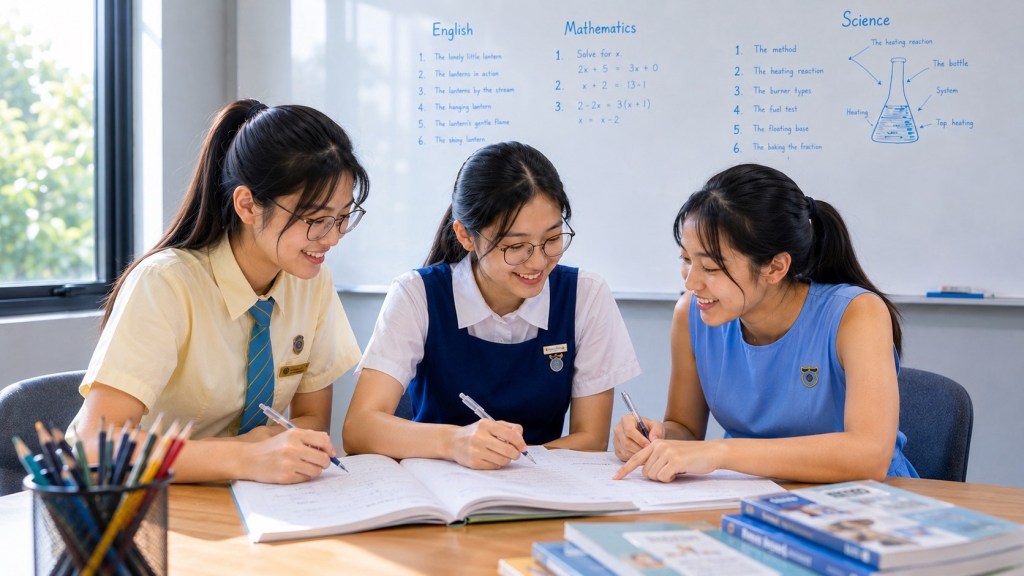
I have been thinking about something that happens quite often during tuition.
A student gives me a very short answer.
Sometimes one word.
Sometimes:
“I don’t know.”
Sometimes:
“Maybe because of this?”
Sometimes they say something that is completely wrong.
And strangely, those moments can tell me much more than a long polished answer.
Because when a student starts talking, even badly, I can begin to see what is happening inside.
Not everything.
But enough to start probing.
And when we probe carefully around a topic, something interesting happens.
The empty spaces begin to appear.
I Don’t Always Want The Correct Answer First
This may sound strange for a teacher.
Obviously, I want the student to eventually reach the correct answer.
But when I am trying to understand what a student knows, the correct answer is not always the most useful first thing.
Suppose I ask:
Why does evaporation happen faster on a hot day?
The student gives the perfect textbook answer.
Good.
But now I don’t know very much yet.
Perhaps they understand it.
Perhaps they memorised it.
Perhaps they recognised the question.
Perhaps they heard the exact wording yesterday.
So I might go around it.
What if the water is in the shade?
What if there is wind?
What if the temperature stays the same?
Why would moving air matter?
Where does the water go?
Can evaporation happen when it is cold?
Now the interesting part starts.
The student has to move.
And once they move, I can see where the road ends.
Probe Around The Idea
I think of this almost like walking around an object in the dark.
One torch beam does not tell you its full shape.
So you move.
Shine from another direction.
Then another.
The object begins to appear.
Learning can be like that.
Ask directly:
What is a fraction?
The student gives a definition.
Fine.
Now:
Is 3/3 a fraction?
Is 5/4 a fraction?
Which is larger, 2/3 or 3/5?
Why?
Can you draw it?
Can you show it another way?
Where would it sit on a number line?
Now I am no longer testing one memorised sentence.
I am probing the structure around it.
And eventually:
the void appears.
The Void Is Useful
This is something I think teachers sometimes fear.
We ask a question.
The child cannot answer.
Silence.
It feels like the lesson has failed.
But perhaps the silence is exactly what we needed to find.
Because now we know:
something is missing here.
That is useful information.
Before the probe, the gap was hidden.
After the probe, it has a location.
KNOWNKNOWNKNOWN?KNOWN
That question mark matters.
We can work with a question mark.
What is harder to work with is a learner who looks as though everything is fine while the gap remains invisible.
So I don’t think every wrong answer is bad news.
Sometimes the wrong answer is the first accurate signal we have received.
A Student Who Is Wrong Can Still Be Very Active
This is another distinction I care about.
Suppose I ask:
Why do you think this happens?
The student thinks.
Then says:
I think it’s because the heavier thing falls faster.
Wrong.
But something important just happened.
The student formed a model.
They selected an explanation.
They committed to it.
Now we have something to inspect.
I can ask:
Why do you think heavier means faster?
What would happen if I dropped these two objects?
What if their shapes were different?
What evidence would change your mind?
Now the student’s thinking is active.
The answer may be wrong.
But the switch is on.
QUESTION↓STUDENT THINKS↓STUDENT COMMITS↓MODEL BECOMES VISIBLE↓TEST↓CORRECT
That is a beautiful teaching situation.
Because wrong thinking that is visible can be repaired.
Wrong Is Not The Same As Passive
I think we sometimes mix these up.
A wrong student answer looks bad because the output is incorrect.
A silent student may look safer because nothing incorrect was said.
But from a teaching perspective, I may prefer the wrong answer.
At least I have a signal.
The student who says:
“I think it is because…”
has opened the door.
The student who says nothing may still be thinking.
Of course.
Silence is not automatically passivity.
Some children need time.
Some are shy.
Some think internally.
We should not punish that.
But if lesson after lesson the student only receives, copies, nods and waits, then I become more concerned.
Because now I cannot easily tell what is happening inside.
Passive Learning Is Harder To Read
Imagine this:
I explain.
The student nods.
I do an example.
The student copies.
I do another example.
The student copies.
Then I say:
Understand?
The student says:
Yes.
This can feel like a very smooth lesson.
No resistance.
No wrong answers.
No awkward silences.
Everything moves quickly.
But perhaps I have learned almost nothing about the student.
The lesson may have been:
TUTOR THINKS↓TUTOR EXPLAINS↓STUDENT RECEIVES
What I really need eventually is:
STUDENT RECEIVES↓STUDENT RECONSTRUCTS↓STUDENT EXPLAINS↓STUDENT TESTS↓STUDENT CORRECTS
Until the learner starts producing something, I cannot be very sure what has actually been built.
This Is Why I Ask Around The Topic
Sometimes students probably wonder why I keep asking strange neighbouring questions.
They got the answer correct.
Why am I still asking?
Because I am not always checking the answer.
I am checking the shape of the knowledge.
Does it connect here?
And here?
What happens if I turn the problem around?
What happens if I remove one clue?
What happens if I change the words?
What happens if I ask for an example?
What happens if I ask for a counterexample?
Every probe gives me another coordinate.
Eventually a rough map appears.
         understands
             |
can explain — IDEA — can apply
             |
          can compare

but...

cannot transfer here
             X
Now we have something much more useful than:
“Student knows Chapter 4.”
The Student Can Say Very Little And Reveal A Lot
This is why I like the title.
Students say more when they say less.
A hesitation can say something.
A strange word choice can say something.
A half-finished explanation can say something.
The point where the sentence breaks can say something.
For example:
“The answer is bigger because… because the denominator…”
Stop.
That unfinished sentence may tell me more than a memorised definition of fractions.
The learner has reached the edge of their model.
That edge is useful.
It tells me where to probe next.
The Short Answer Can Contain The Whole Problem
Suppose I ask:
Why did you choose this method?
The student says:
“Because that’s the formula.”
That is a small sentence.
But it may reveal a lot.
Perhaps the learner sees Mathematics as:
see question↓find matching formula↓insert numbers
That is a very different mental model from:
understand relationship↓represent it↓choose a useful method↓calculate↓check
One short answer has opened a much larger educational question.
So sometimes I listen less for correctness and more for structure.
What model is hiding inside the sentence?
Students Need To Externalise Something
We cannot directly see another person’s understanding.
That is one of the fundamental difficulties in teaching.
I cannot open a student’s head and inspect:
fraction concept: 72% installed.
So the learner has to externalise something.
Speak.
Write.
Draw.
Calculate.
Explain.
Choose.
Compare.
Predict.
Those outputs are probes into an invisible state.
They are imperfect.
But they are what we have.
This means student participation is not just about making lessons lively.
It is diagnostic.
When the student produces, the invisible becomes slightly more visible.
Active Does Not Mean Noisy
I should be careful here.
An active learner is not necessarily the student talking the most.
A student can speak constantly and think very little.
Another can sit quietly for thirty seconds, then produce a careful answer.
Active, to me, means the learner is doing something internally and then taking ownership of an output.
They are:
retrieving,
connecting,
predicting,
constructing,
testing,
choosing,
explaining.
The important thing is that the learner’s machinery is running.
Not only mine.
Wrong Answers Are Cheap When We Catch Them Early
This is one of the advantages of a small teaching environment.
A student says something wrong.
Good.
We found it.
Now we can inspect it before the wrong model becomes stable.
I would much rather hear:
“I think area and perimeter are basically the same.”
in tuition today than discover that belief during an examination three months later.
The wrong answer is not the disaster.
The hidden wrong answer is more dangerous.
WRONG + VISIBLE↓probe↓correct↓retestWRONG + HIDDEN↓repeat↓stabilise↓surface later
So I want students to risk being wrong.
That is part of learning.
The Classroom Has To Make Wrong Answers Safe Enough To Reveal
This connects to the invisible education I wrote about earlier.
If every wrong answer produces embarrassment, students learn very quickly:
Don’t expose your thinking.
Then the teacher loses the signal.
The class may become quieter.
More orderly.
Perhaps even more efficient-looking.
But now students are hiding the very thing we need to inspect.
So the environment matters.
I want the student to know:
You are allowed to give me your current model.
Even if it is wrong.
We are going to examine it, not prosecute it.
That does not mean accuracy stops mattering.
Accuracy matters enormously.
But correction requires access.
Passive Students Create A Different Risk
This is the part I think we need to be more careful about.
When a learner participates actively, their thinking returns to us.
We can see something.
The loop closes.
TEACH↓STUDENT THINKS↓STUDENT OUTPUT↓WE OBSERVE↓CORRECT
But in passive learning:
TEACH↓TEACH↓TEACH↓?
We don’t know what happened.
And this is where I start thinking about installation.
What exactly did the learner install from the lesson?
The intended concept?
A shortcut?
A misunderstanding?
A phrase without meaning?
A rule that only works for one question type?
A fear of asking questions?
We may not know.
The teacher transmitted.
But transmission is not the same as reconstruction.
We Can Install The Wrong Thing Very Efficiently
This worries me.
A polished explanation can be so smooth that the student never has to construct anything.
They simply follow.
Then perhaps what gets installed is:
When I see this pattern, perform these four steps.
That may work.
Until the pattern changes.
Or perhaps the student copies an explanation they do not understand.
It looks correct on paper.
But the meaning never arrived.
This is why I don’t trust fluency during the explanation itself.
I trust what happens after I step away.
Remove The Tutor And See What Remains
This may be one of the simplest probes.
Explain.
Practise together.
Then remove some support.
Ask:
Now you do it.
Then later:
Explain why.
Then change the problem.
Then return next week.
The capability that remains after assistance is removed is more interesting than the capability that only exists while I am speaking.
That is when we start finding out what belongs to the student.
The Probe Is Not An Interrogation
I should say this too.
If every conversation becomes a test, students can shut down.
Probing should feel like curiosity.
What made you think that?
Show me.
What happens if we change this?
Is there another way?
Which part are you least sure about?
What would convince you that your answer is wrong?
These questions invite the learner outward.
The purpose is not to catch them.
The purpose is to see them.
That difference matters.
Sometimes The Best Probe Is “Why?”
But even “why” can be too large.
A student says:
“I don’t know.”
So instead:
Which part do you know?
Or:
What was the first thing you noticed?
Or:
Which answer definitely cannot be correct?
Or:
Can you draw what you think is happening?
The route into the student’s thinking may need to be smaller.
Again, meet the learner where the learner is.
The Void Is Not Empty Forever
Once we find the gap, we can build into it.
That is the whole point.
The probe shows:
nothing stable here yet.
Then:
VOID↓example↓representation↓student attempts↓correction↓another probe
Eventually the answer changes.
More importantly, the structure changes.
The student has something there that did not exist before.
That is learning we can observe indirectly.
And Then We Probe Again
Because one correct answer still isn’t enough.
Did the learner remember the explanation?
Or construct the idea?
Change the question.
Ask again.
Come back later.
Use another representation.
If the capability survives, confidence increases.
Not emotional confidence alone.
Evidence-based confidence.
The student knows:
I can actually do this.
That is much stronger.
Maybe Conversation Is One Of The Best Diagnostic Tools We Have
We use worksheets.
Tests.
Examinations.
All useful.
But sometimes five minutes of careful conversation tells me something the worksheet did not.
Not because conversation is magical.
Because I can adapt in real time.
The student answers.
I change the next question.
They hesitate.
I move sideways.
They reveal a gap.
I go down one level.
Something connects.
I go back up.
That is hard to do with a fixed worksheet.
The probe follows the learner.
This Is Another Reason Three Students Changes The Lesson
With three, I can ask.
Listen.
Follow.
Return.
A student can explain an idea.
Another can disagree.
A third may expose a different misconception.
Suddenly one topic produces three different maps.
That is valuable.
The group gives us variation.
The size still allows us to follow the signals.
At least, that is what I am trying to preserve.
Teaching Should Produce A Return Signal
I think this may be the simplest way to compress the whole idea.
Teaching cannot only go outward.
TUTOR↓STUDENT
Something has to come back.
TUTOR↓STUDENT↓ANSWERQUESTIONHESITATIONEXPLANATIONERRORDRAWINGCHOICE↓TUTOR
That return tells us what to do next.
Without it, we are teaching partly blind.
The Student Who Says “I Think…”
I like hearing those words.
“I think…”
Not because what follows will necessarily be correct.
But because something has switched on.
The learner is no longer merely receiving.
They are constructing a claim.
Now we can work.
Why?
Show me.
Let’s test it.
What if this changes?
Does your idea still work?
Sometimes they will be wrong.
Fine.
Correct it.
Sometimes I will be wrong.
Then we correct me.
The important thing is that the lesson has become a thinking environment rather than a transmission line.
The Quiet Danger Is Not Wrongness
The quiet danger may be unobserved installation.
The student sits.
Receives.
Copies.
Nods.
Leaves.
And we assume the lesson entered exactly as intended.
Maybe it did.
Maybe it didn’t.
That uncertainty should make us humble.
Because teaching is not complete when information leaves the teacher.
Something has to happen on the other side.
So Let Them Say Less
A short answer is enough.
A half-answer.
A guess.
A diagram.
A question.
Even:
“I don’t know, but I think this part matters.”
Now we have a place to begin.
Probe around it.
Find what is solid.
Find what is missing.
Find the void.
Build carefully.
Then probe again.
Maybe that is one of the simplest versions of teaching I know.
Not:
How much can I tell the student?
But:
How little do I need to ask before the student begins showing me how they think?
Because once the learner starts showing us that, the lesson changes.
We are no longer teaching an imagined student.
We are teaching the one who is actually there.
 eduKate Sengkang