
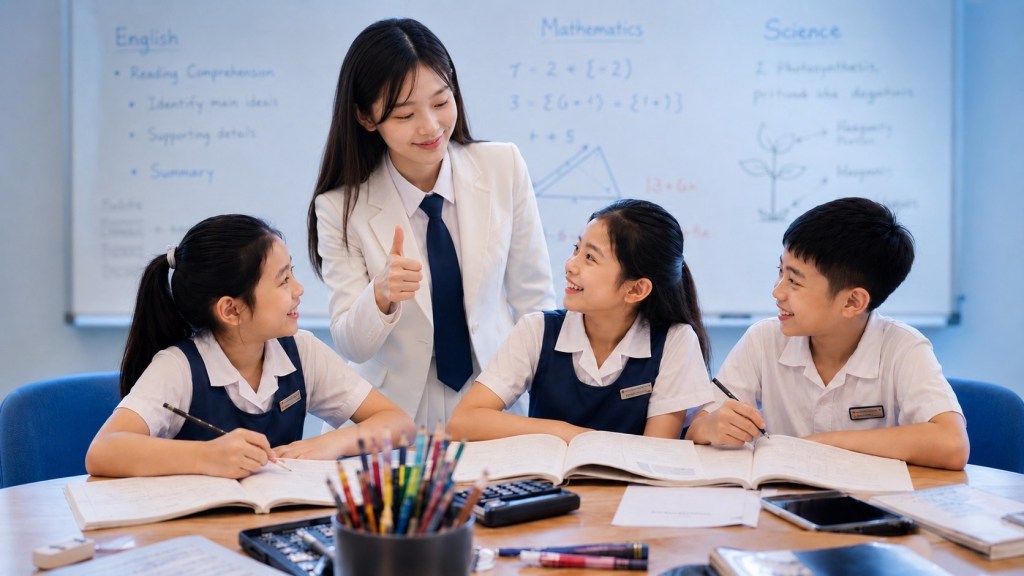
Punggol Primary 2 English Tuition | Strengthen Early Foundations with eduKate
Punggol Primary 2 English Tuition by eduKate helps young learners strengthen reading, grammar, vocabulary, comprehension, sentence writing, oral confidence and early English foundations.
Primary 2 English is where early reading, grammar, vocabulary, sentence writing and comprehension habits begin to settle. eduKate Punggol helps young learners strengthen English foundations calmly and confidently before upper primary pressure arrives.
Summary
Primary 2 English is one of the most important quiet years in a child’s education.
It may not feel like a national examination year. It may not carry the visible pressure of Primary 5 or Primary 6. But Primary 2 is where many English habits begin to form permanently: how a child reads, how a child answers questions, how a child writes sentences, how a child speaks, how a child handles vocabulary, and how a child feels about the English language.
At eduKate Punggol, our Primary 2 English Tuition focuses on strengthening early foundations before small weaknesses become larger problems in Primary 3, Primary 4, Primary 5 and PSLE preparation.
The aim is simple.
Help the child read better.
Help the child understand better.
Help the child write better.
Help the child speak with more confidence.
Help the child enjoy English instead of fearing it.
Primary 2 English tuition should not be about rushing children into examination panic. It should be about building the language engine early, calmly and properly.
When a child’s foundations are strong, the future becomes easier to build.
Why Primary 2 English Matters More Than Parents Think
Primary 2 looks gentle from the outside.
The child is still young.
The worksheets may look manageable.
The stories may look simple.
The spelling lists may not seem frightening.
The compositions are short.
The comprehension passages are not yet too long.
So it is easy to think:
“It is only Primary 2. There is still time.”
There is time.
But Primary 2 is also where language habits begin to settle.
A child who reads carefully in Primary 2 will usually cope better when passages become longer later. A child who writes complete sentences in Primary 2 will have a smoother journey into composition writing. A child who learns grammar properly in Primary 2 will make fewer basic errors in upper primary. A child who learns to explain answers clearly will not panic when comprehension questions become more demanding.
The reverse is also true.
If a child begins to guess words, avoid reading, write incomplete sentences, use very simple vocabulary, or answer questions without evidence, these habits may quietly follow the child into Primary 3 and Primary 4.
By the time parents notice the problem, the child may already have built a weak language system.
That is why Primary 2 matters.
It is not only about this year’s marks.
It is about the child’s future English foundation.
Primary 2 Is the Year of Language Control
Primary 1 introduces children to school English.
Primary 2 begins to stabilise it.
By Primary 2, children are expected to read more independently, understand instructions, write more complete answers, use basic grammar correctly, build vocabulary and speak with clearer expression.
This is the year where English moves from “I know the word” into “I can use the word.”
That is a big difference.
A child may know many words but not know how to use them in a sentence. A child may understand a story when someone reads it aloud but struggle to read the same passage alone. A child may be able to speak naturally but write very short, broken sentences. A child may memorise spelling but still make grammar mistakes when writing.
Primary 2 English Tuition at eduKate Punggol helps children close these gaps.
We do not treat English as one single skill.
English is a system.
It has reading, grammar, vocabulary, spelling, sentence writing, comprehension, oral expression and story thinking. These parts must work together. When one part is weak, the whole system becomes less stable.
That is why we strengthen early foundations carefully.
The Real Problem Is Not Always “Weak English”
When a Primary 2 child struggles with English, parents may say:
“My child is weak in English.”
But that sentence is often too broad.
The child may not be weak in everything.
The real problem may be more specific.
The child may be able to speak well but write poorly.
The child may know the answer but cannot form a sentence.
The child may read the passage but miss key details.
The child may understand the story but not the question.
The child may know spelling words but forget them in writing.
The child may have ideas but cannot organise them.
The child may answer too quickly without checking.
The child may avoid difficult words because confidence is low.
So the first job of good Primary 2 English tuition is not to label the child.
The first job is to find the exact weakness.
At eduKate Punggol, we look for the small leaks.
Is the child reading word by word without understanding the full sentence?
Is the child guessing from pictures?
Is the child skipping punctuation?
Is the child using “and then, and then, and then” in writing?
Is the child writing fragments instead of complete sentences?
Is the child confused by past tense, present tense, singular and plural?
Is the child answering comprehension questions without using clues from the passage?
Is the child afraid to speak because mistakes feel embarrassing?
Once the weakness is named, it can be repaired.
This is how children improve.
Not through panic.
Through clarity.
Reading: The First Big Foundation
Reading is the heart of Primary 2 English.
When a child reads well, many other English skills become easier.
Reading gives the child vocabulary.
Reading shows sentence patterns.
Reading builds grammar awareness.
Reading improves spelling memory.
Reading helps composition ideas.
Reading strengthens comprehension.
Reading gives the child rhythm, tone and expression.
But reading must be active.
Some children can pronounce words but do not understand what they are reading. Some children read quickly but miss details. Some children read too slowly and lose the meaning of the sentence. Some children do not notice punctuation, so every sentence sounds the same. Some children avoid longer words and guess instead.
Good reading is not only saying the words aloud.
Good reading means the child understands the sentence, follows the story, notices the details and can explain what happened.
In our Primary 2 English Tuition, we help students read with attention.
We teach them to slow down at punctuation. We help them notice who is doing the action. We ask them what happened first, next and after that. We guide them to look for feelings, actions, reasons and clues.
This matters because comprehension begins with reading control.
A child who cannot read carefully will struggle to answer carefully.
Comprehension: Teaching Children to Find the Answer, Not Guess It
Primary 2 comprehension is where many parents begin to see strange mistakes.
The child reads the passage.
Then gives an answer that sounds possible.
But it is not in the passage.
This is one of the biggest early comprehension habits to correct.
Young children often answer from memory, imagination or general knowledge. If the passage says, “Tom was upset because he lost his toy,” the child may answer, “He was angry because his friend took it.” The child has created a possible story, but not the correct answer.
At Primary 2, children must begin learning that comprehension answers come from clues.
The answer is not random.
The answer is not guessed.
The answer is not always what the child feels.
The answer must fit the passage.
We teach students to ask:
Where is the clue?
Who is the sentence about?
What happened before this?
What happened after this?
Which word tells me the feeling?
Which sentence tells me the reason?
Does my answer match the question?
This is the beginning of evidence-based answering.
It may sound simple, but it is powerful.
By the time students reach upper primary, comprehension becomes much more demanding. If they already know how to look for clues in Primary 2, they will be better prepared for longer passages and more difficult questions later.
Grammar: Building Correct English Before Errors Become Habits
Grammar is not only about rules.
Grammar is how a sentence holds itself together.
In Primary 2, children need to become more confident with basic sentence control. They need to understand nouns, verbs, adjectives, pronouns, prepositions, conjunctions, tenses, singular and plural forms, subject-verb agreement and punctuation.
These may look small.
But small grammar errors become big writing problems later.
A child who writes “He go to school” in Primary 2 may continue making subject-verb agreement mistakes in Primary 3 and Primary 4. A child who confuses “is” and “are” may later struggle with longer sentences. A child who does not understand past tense may write compositions with mixed timing. A child who cannot use punctuation properly may write confusing sentences.
At eduKate Punggol, we teach grammar as usable English.
Not only as worksheets.
The child must know how to use grammar in sentences, comprehension answers, oral responses and writing. Grammar must move from the exercise book into real language.
For example, it is not enough to know that “ran” is past tense.
The child must be able to write:
“The boy ran across the field because he was late.”
It is not enough to know that adjectives describe nouns.
The child must be able to write:
“The frightened puppy hid under the wooden bench.”
This is how grammar becomes writing power.
Vocabulary: Giving the Child More Words to Think With
Vocabulary is not decoration.
Vocabulary is thinking power.
A child with limited vocabulary often writes the same kinds of sentences again and again:
The boy was happy.
The girl was sad.
The dog was big.
The food was nice.
The place was beautiful.
There is nothing wrong with simple words at the beginning.
But if the child only has simple words, the child can only express simple meanings.
Primary 2 is a good time to build vocabulary gently and steadily.
Children should learn words connected to feelings, actions, places, people, weather, movement, behaviour and everyday situations. They should learn not only what a word means, but how to use it properly.
For example, instead of only “happy”, a child can learn:
glad
excited
delighted
cheerful
proud
relieved
Instead of only “sad”, a child can learn:
upset
disappointed
lonely
miserable
heartbroken
gloomy
Instead of only “walked”, a child can learn:
strolled
hurried
marched
crept
wandered
limped
But vocabulary must be age-appropriate.
We do not force Primary 2 children to memorise difficult words just to sound impressive. The goal is not to make the child write unnaturally. The goal is to give the child useful words that fit the story and improve expression.
Good vocabulary helps the child read better, write better and speak better.
It gives the child more tools.
Sentence Writing: The Bridge to Composition
Primary 2 composition writing begins with sentence control.
Before a child can write a good story, the child must write good sentences.
This sounds obvious, but many students are rushed into story writing before their sentence foundation is ready. They may have ideas, but their sentences are incomplete, repetitive or unclear.
A strong Primary 2 sentence should usually have:
Who or what the sentence is about.
What happened.
Where or when it happened.
A clear ending.
Correct punctuation.
For example:
Weak sentence:
The boy happy.
Better sentence:
The boy was happy because he found his missing wallet.
Stronger sentence:
The boy was relieved when he found his missing wallet under the table.
This is the growth we want.
Not from short fragments into complicated writing too quickly.
But from unclear sentence to clear sentence.
From clear sentence to better sentence.
From better sentence to expressive sentence.
At eduKate Punggol, we train students to build sentences carefully. We help them add details, use better verbs, include feelings, explain reasons and avoid careless grammar mistakes.
Once the sentence improves, composition becomes much easier.
Composition: Teaching Children to Tell a Simple Story Clearly
Primary 2 compositions do not need to be dramatic novels.
They need to be clear stories.
A good Primary 2 composition should show what happened, who was involved, where it happened, what the problem was, how the problem was solved and how the character felt.
Many children struggle because they jump from one event to another without structure.
They may write:
One day, I went to the park. I saw a dog. The dog ran. I was scared. My mother came. We went home.
The story is understandable, but it is thin.
The child needs to learn how to expand.
What kind of park?
What was the child doing there?
What did the dog look like?
Why did the dog run?
How did the child feel?
What did the mother say?
What happened at the end?
At Primary 2, composition tuition should teach children to build story thinking.
We help students understand beginning, middle and ending.
Beginning:
Who is there?
Where are they?
What are they doing?
Middle:
What problem happens?
How does the character react?
What makes the situation interesting?
Ending:
How is the problem solved?
What does the character learn or feel?
This gives children a simple story map.
When children know the map, they feel less lost.
Oral English: Helping Children Speak Clearly and Confidently
Primary 2 English is not only written English.
Children also need to speak.
Some children speak naturally at home but become quiet in class. Some know the answer but are afraid of making mistakes. Some use very short answers. Some speak too softly. Some do not explain their thoughts clearly.
Oral confidence is built slowly.
The child needs a safe environment to practise. The child needs encouragement, correction and repeated chances to speak.
At eduKate Punggol, we help Primary 2 students speak in fuller sentences. We guide them to describe pictures, answer questions, explain opinions and use better vocabulary when speaking.
For example, instead of:
“I like it.”
The child can learn to say:
“I like this picture because the children are helping one another.”
Instead of:
“He is bad.”
The child can learn to say:
“He was unkind because he snatched the toy from his friend.”
Oral practice strengthens thinking.
When children can say their ideas clearly, they often write better too.
Confidence: The Hidden Foundation of English Learning
A child who feels weak in English may begin to avoid the subject.
This can happen quietly.
The child reads less.
The child writes shorter answers.
The child guesses quickly.
The child says, “I don’t know.”
The child avoids speaking.
The child becomes careless because trying feels uncomfortable.
This is why confidence matters.
But confidence is not built by empty praise.
Confidence is built when the child experiences real improvement.
When a child learns how to read a sentence properly, confidence grows.
When a child answers a comprehension question correctly, confidence grows.
When a child writes a complete sentence, confidence grows.
When a child uses a new word well, confidence grows.
When a child speaks clearly and is understood, confidence grows.
Small wins matter.
Primary 2 students are still young. They need correction, but they also need to feel that English is not an enemy. The tuition environment should be calm, encouraging and structured.
We want students to think:
“I can learn this.”
“I know what to do.”
“I can try again.”
“I am getting better.”
That is how English confidence is built.
Why Early Foundation Tuition Helps Before Upper Primary Pressure Arrives
Parents often wait until Primary 4, Primary 5 or Primary 6 before seeking English tuition.
That is understandable.
The pressure becomes more visible then.
But by upper primary, English problems are usually more layered. A Primary 5 child struggling with composition may not only have a composition problem. The child may have weak sentence control, limited vocabulary, poor reading habits, grammar gaps and low confidence from years earlier.
The visible problem appears in Primary 5.
The root may have started in Primary 2.
This is why early foundation tuition can be powerful.
At Primary 2, the child is still flexible. Habits are still forming. Confidence can still be protected. Reading can still become enjoyable. Grammar can still be corrected before errors harden. Writing can still be shaped gently.
Early tuition is not about rushing children into advanced work.
It is about preventing avoidable struggle later.
When foundations are strong, the child climbs more easily.
What eduKate Punggol Primary 2 English Tuition Focuses On
Our Primary 2 English Tuition focuses on building the core language system.
1. Reading Accuracy
Students learn to read with attention, expression and understanding. We help them notice punctuation, sentence meaning, sequence, characters, feelings and clues.
2. Grammar Foundation
Students practise basic grammar in a way that connects to real writing and answering. We focus on sentence correctness, tense awareness, subject-verb agreement, punctuation and word forms.
3. Vocabulary Growth
Students learn useful words for emotions, actions, descriptions, settings and story situations. Vocabulary is taught for use, not merely memorisation.
4. Sentence Writing
Students learn to write complete, clear and expressive sentences. This becomes the foundation for better composition writing.
5. Comprehension Skills
Students learn to locate clues, understand questions and answer accurately. We train them not to guess, but to read and think.
6. Composition Readiness
Students learn simple story structure, sequencing, character action, feelings and endings. They begin to understand how stories are built.
7. Oral Confidence
Students practise speaking in fuller sentences, explaining ideas and using appropriate vocabulary.
8. Learning Habits
Students learn to check their work, listen carefully, correct mistakes and take pride in improvement.
This is not random English practice.
It is foundation-building.
The Parent’s Role at Primary 2
Parents do not need to become English teachers at home.
But parents can help by building the right environment.
Read with your child.
Ask simple questions about the story.
Encourage full-sentence answers.
Praise careful effort.
Correct gently.
Let your child explain what happened in the day.
Build a small reading habit.
Avoid making English feel like punishment.
At Primary 2, the emotional relationship with English matters.
If the child feels that English only means scolding, red marks and stress, the child may pull away from the subject. But if English is connected to stories, expression, confidence and small improvements, the child is more likely to keep trying.
Tuition and home support should work together.
The tutor builds the skill system.
The parent protects the learning environment.
Together, the child grows better.
Common Signs Your Primary 2 Child May Need English Support
Parents may consider Primary 2 English tuition if the child:
Reads slowly and loses meaning.
Guesses words instead of decoding them.
Avoids reading aloud.
Writes incomplete sentences.
Uses very simple vocabulary repeatedly.
Makes frequent grammar errors.
Confuses tenses.
Struggles with spelling.
Cannot answer comprehension questions accurately.
Gives answers that are not from the passage.
Writes very short compositions.
Has ideas but cannot express them.
Speaks too softly or gives one-word answers.
Loses confidence easily.
Says English is too hard.
These signs do not mean the child has failed.
They mean the child needs support.
And at Primary 2, support can still be gentle, early and highly effective.
Why Small-Group Tuition Works Well for Primary 2
Primary 2 children need attention.
They need someone to see how they read, how they write, how they answer and how they think.
In a small-group environment, the tutor can observe more closely. The child also gets the benefit of learning with peers, listening to other answers, speaking up gradually and becoming more comfortable.
Small-group tuition allows correction without overwhelming the child.
The tutor can notice when a student is guessing.
The tutor can correct a sentence immediately.
The tutor can help a student try again.
The tutor can encourage the quiet child to speak.
The tutor can stretch the stronger child with better vocabulary.
The tutor can slow down when the foundation is weak.
For Primary 2, this balance matters.
Children should not feel lost in a large class.
They should also not feel isolated.
A well-run small group gives structure, attention and confidence.
The eduKate Approach: Catch Up, Keep Up, Move Ahead
At eduKate Punggol, we believe good tuition should help students catch up, keep up and move ahead.
Catch up means repairing what the child has not fully understood yet.
This may be grammar, reading, spelling, sentence writing or comprehension.
Keep up means helping the child follow school expectations with more confidence.
The child becomes better prepared for classwork, homework, assessments and classroom participation.
Move ahead means building stronger habits for the next level.
The child begins to write better sentences, read with more understanding, use better vocabulary and speak more clearly.
This is how early English tuition should work.
Not pressure first.
Foundation first.
Then confidence.
Then growth.
Primary 2 English Is the Beginning of a Longer Road
Primary 2 is not the end goal.
It is the beginning of a longer English journey.
In Primary 3, students will face more demanding comprehension and writing. In Primary 4, language expectations rise again. In Primary 5, PSLE preparation becomes more visible. In Primary 6, students must perform under national examination pressure.
The child who enters upper primary with strong reading, grammar, vocabulary and sentence habits will have a better chance of coping calmly.
The child who enters upper primary with weak foundations may feel that English suddenly became difficult.
But English rarely becomes difficult overnight.
It becomes difficult when small gaps accumulate.
That is why we build early.
Primary 2 is the right time to make English clear, friendly and structured.
A Better Future Begins with Strong Language
English is more than a school subject.
It is the language of explanation, reading, writing, thinking, speaking, learning and confidence. A child who becomes stronger in English can understand more, express more and participate more fully in school life.
When a child can read a story and understand it, a door opens.
When a child can write a clear sentence, another door opens.
When a child can explain an answer, another door opens.
When a child can speak with confidence, another door opens.
Education is built through many small doors.
Primary 2 English is where we begin opening them properly.
At eduKate Punggol, we want children to feel that English is something they can learn, improve and enjoy. We want them to build the foundations that will support Primary 3, Primary 4, Primary 5, Primary 6 and beyond.
Properly taught kids shine a bright light into the future.
And for Primary 2 English, that light begins with strong foundations.
Conclusion: Strengthen Early, Grow Steadily
Punggol Primary 2 English Tuition with eduKate is about strengthening the child before pressure becomes heavy.
It is about reading carefully, answering clearly, writing complete sentences, using better vocabulary, speaking with confidence and building grammar correctly.
It is about helping parents see the small leaks early.
It is about helping children realise that English is not something to fear.
It is something they can grow into.
Primary 2 may look like a small year.
But small years build big futures.
With the right guidance, a Primary 2 child can become a more confident reader, a clearer writer, a better speaker and a stronger learner.
That is the purpose of early foundation English tuition.
Not to rush childhood.
But to protect the child’s learning journey, one clear sentence at a time.
FAQ
Is Primary 2 too early for English tuition?
Primary 2 is not too early if the child has weak reading habits, grammar errors, poor sentence writing, limited vocabulary or low confidence. Early support helps repair small gaps before they become larger upper primary problems.
What should Primary 2 English tuition focus on?
Primary 2 English tuition should focus on reading accuracy, grammar, vocabulary, spelling, sentence writing, comprehension, simple composition structure and oral confidence.
Why does my child understand stories but still answer comprehension questions wrongly?
Your child may understand the general story but may not be locating the exact clue needed for the question. Comprehension requires children to connect the question to evidence in the passage.
How can tuition help Primary 2 composition writing?
Tuition helps by strengthening sentence writing first, then teaching children how to build a simple story with a beginning, middle, problem, solution and ending.
What are common Primary 2 English weaknesses?
Common weaknesses include guessing words, weak grammar, incomplete sentences, poor punctuation, limited vocabulary, short answers, careless comprehension and low oral confidence.
Does Primary 2 English tuition prepare for PSLE?
It does not prepare through pressure. It prepares through foundations. Strong Primary 2 reading, grammar, vocabulary and writing habits make the later PSLE journey easier.
How can parents support Primary 2 English at home?
Parents can read with the child, ask simple story questions, encourage full-sentence answers, build vocabulary naturally and make English feel encouraging rather than frightening.
Why choose eduKate Punggol for Primary 2 English Tuition?
eduKate Punggol focuses on strengthening early foundations through reading, grammar, vocabulary, comprehension, sentence writing, oral confidence and careful correction so children can catch up, keep up and move ahead.
Why Primary 2 English Is Crucial
Primary 2 builds on the basics from Primary 1 and sets the stage for independent reading, writing, and speaking. According to the MOE Primary English Language Syllabus, students at this stage should:
- Read simple passages fluently and accurately.
- Write short compositions of 100–120 words with clear sentences.
- Use basic grammar and vocabulary correctly in context.
- Express themselves confidently in oral activities and listen with understanding.
If weaknesses in grammar, reading, or vocabulary remain unaddressed in P2, these will carry forward into P3, where demands rise sharply.
At eduKate Punggol, our Primary 2 English Tuition (3 students per class) builds strong foundations early, ensuring your child gains confidence in reading, writing, and speaking before moving up.
What Primary 2 Students Learn
Reading & Comprehension
- Decode and read fluently with expression.
- Answer simple comprehension questions (literal and basic inference).
- Expand vocabulary through graded readers and short passages.
Writing
- Compose short recounts (personal experiences, daily events).
- Use proper paragraphing (intro, body, conclusion).
- Begin descriptive writing with simple adjectives and verbs.
Grammar & Vocabulary
- Tenses (present, past, continuous forms).
- Subject-verb agreement and pronouns.
- Vocabulary banks on everyday themes (family, school, nature).
Oral & Listening
- Reading Aloud: pronunciation, pacing, and clarity.
- Picture Discussion: describe and talk about details confidently.
- Listening: understand and answer questions from simple recordings.
How eduKate Punggol Teaches Primary 2 English
1) Small-Group Advantage (3-pax)
- Focused guidance in reading fluency.
- Encouragement for shy children to participate.
- Tailored lesson pacing for each student.
2) Reading Development
- Phonics reinforcement where needed.
- Guided reading with comprehension Q\&A.
- Vocabulary journals with thematic words.
3) Writing Confidence
- Sentence-building activities.
- Short paragraph writing, moving into compositions.
- Use of story starters and pictures to inspire ideas.
4) Grammar & Vocabulary Growth
- Weekly grammar drills with correction logs.
- Thematic word lists integrated into compositions.
- Fun activities (games, flashcards, oral quizzes).
5) Oral Practice
- Role-play activities (school, family, community situations).
- Stimulus-based prompts to encourage expression.
- Teacher feedback on pronunciation and fluency.
Term-by-Term Roadmap
- Term 1: Diagnostic assessment; phonics/grammar review; vocabulary building.
- Term 2: Short compositions; comprehension strategies; oral practice.
- Term 3: Longer compositions; listening comprehension; grammar mastery.
- Term 4: Exam-style practice papers; oral exam drills; revision of weaker areas.
This ensures students leave P2 with a solid foundation for P3, where the syllabus intensifies.
Parent Checklist: Does My Child Need Primary 2 English Tuition?
| Signs of Struggle | eduKate Solution |
|---|---|
| Reads slowly or skips words | Guided reading with fluency coaching |
| Short, incomplete sentences in writing | Structured writing scaffolds |
| Frequent grammar mistakes | Weekly drills + correction logs |
| Weak vocabulary use | Thematic word banks & vocab journals |
| Shy during oral activities | Role-play & small-group oral practice |
Why Parents Choose eduKate Punggol
- MOE-Aligned Lessons: Directly mapped to Primary 2 outcomes.
- Experienced Tutors: 20+ years guiding young learners.
- 3-Student Groups: Encourages participation and confidence.
- Holistic Skills Coverage: Reading, writing, grammar, vocabulary, oral, and listening.
- Regular Parent Updates: Weekly WhatsApp reports and monthly reviews.
- Local Convenience: Near Punggol MRT & Waterway Point, accessible for families in Punggol and Sengkang.
Home Resources for Parents
- MOE Primary English Syllabus – outlines learning goals from P1–P6.
- British Council – Learn English – activities for reading and vocabulary.
- National Library Board – children’s reading lists and programmes.
- Twinkl Singapore – printable worksheets and phonics resources.
FAQs (Schema-Ready Content)
Q: What is the focus of Primary 2 English tuition?
A: Strengthening reading fluency, building grammar accuracy, and developing early composition skills.
Q: Do you prepare students for oral exams?
A: Yes. We provide reading aloud practice, picture discussion training, and conversational role-play.
Q: How many students per class?
A: Maximum of 3 students per class for personal attention.
Q: How do you keep P2 students engaged?
A: Interactive activities, games, and guided discussions make learning fun while covering syllabus outcomes.
Q: How do parents track progress?
A: Weekly WhatsApp updates and monthly feedback ensure parents stay involved.
Enrol in Primary 2 English Tuition at Punggol
A strong foundation in Primary 2 English ensures your child enters Primary 3 ready for more advanced comprehension and writing. Early intervention builds confidence, accuracy, and love for learning.
📍 eduKate Punggol – near Waterway Point & Punggol MRT
📞 Contact us today: eduKate Homepage
🌐 Connect with us on Facebook eduKate Punggol
Authoritative References
- MOE Primary English Language Syllabus
- British Council Singapore – English at Home
- National Library Board – Literacy Resources
- Twinkl Singapore
 eduKate Sengkang