
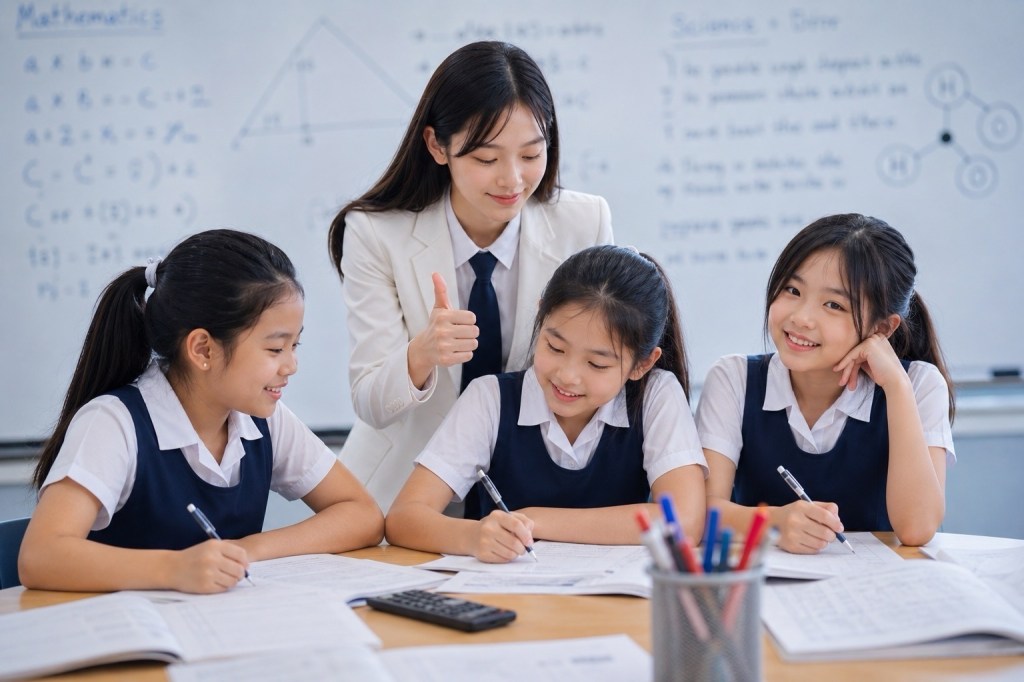
PSLE Syllabus Mathematics Tuition Singapore, eduKate Tampines and Punggol
PSLE Mathematics is not just a school subject.
It is one of the first serious thinking systems a Singapore child meets.
At Primary School level, Mathematics teaches a child how to count, measure, compare, estimate, calculate, organise information, solve problems and explain reasoning. But beneath the surface, something bigger is happening.
The child is learning how to think when the answer is not immediately visible.
That is the real power of PSLE Mathematics.
It trains patience.
It trains accuracy.
It trains logical movement.
It trains the courage to stay with a problem long enough for structure to appear.
This is why PSLE Mathematics matters.
Not because every child must grow up to become a mathematician.
But because every child will grow up into a world that requires clearer thinking.
Singapore is a small country that survives by human capability. We do not have the luxury of wasting potential. Every child who learns how to think better becomes part of the country’s future strength.
At eduKate Tampines and Punggol, our PSLE Mathematics Tuition helps students understand the MOE syllabus, strengthen weak foundations, improve problem-solving, and prepare for the PSLE with calm, structured guidance.
We help students catch up, keep up, and move ahead.
The PSLE Mathematics Syllabus Is a Thinking Map
Many parents see the PSLE Mathematics syllabus as a list of topics.
Whole numbers.
Fractions.
Decimals.
Percentages.
Ratio.
Rate.
Geometry.
Measurement.
Area.
Volume.
Angles.
Data.
Problem sums.
That is the visible layer.
But the syllabus is more than a checklist.
It is a thinking map.
Each topic builds a different part of mathematical intelligence.
Whole numbers teach quantity and place value.
Fractions teach part-whole relationships.
Decimals teach precision.
Percentages teach comparison.
Ratio teaches proportional thinking.
Geometry teaches spatial reasoning.
Measurement teaches the discipline of units.
Data teaches interpretation.
Problem sums teach translation from language into structure.
When a child struggles in Mathematics, the problem is often not that they “cannot do Maths.”
The problem is that one part of this thinking map is weak.
A child may be able to calculate but not understand the question.
A child may know the formula but not know when to use it.
A child may be fast in Paper 1 but collapse in Paper 2.
A child may understand class examples but freeze when a question is slightly changed.
That is why good PSLE Mathematics Tuition must do more than give worksheets.
It must diagnose the child’s thinking system.
Where is the gap?
Where is the confusion?
Where does the child lose marks?
Where does the method break?
Where does confidence disappear?
Once the problem becomes visible, it can be repaired.
PSLE Mathematics Is Not About More Practice Alone
Practice matters.
But practice without understanding can become noise.
A child may complete many worksheets and still repeat the same mistakes. They may memorise model answers but fail to solve unfamiliar questions. They may know the steps for one version of a problem but cannot transfer the method to another.
That is not improvement.
That is repetition without control.
At eduKate Tampines and Punggol, we believe Mathematics Tuition should help students practise with purpose.
Every question should teach something.
A careless mistake teaches checking.
A wrong method teaches topic recognition.
A misunderstood question teaches reading precision.
A long problem sum teaches structure.
A difficult Paper 2 question teaches endurance.
The goal is not simply to finish more questions.
The goal is to become a stronger problem-solver.
This is an important difference.
In PSLE Mathematics, a student does not only need speed.
The student needs judgement.
They must know when to draw a model.
When to form an equation.
When to work backwards.
When to compare units.
When to use ratio.
When to simplify.
When to pause and reread.
When to check whether the answer makes sense.
These decisions separate mechanical practice from real mathematical maturity.
The Three Levels of PSLE Mathematics Thinking
A strong PSLE Mathematics student needs three levels of thinking.
The first level is accuracy.
This is the foundation.
The child must know basic operations, number facts, multiplication tables, fractions, decimals, percentages, units and calculation methods. Without this, every question becomes unstable.
Accuracy is not glamorous.
But it is powerful.
A child who calculates accurately has more mental space to think.
The second level is application.
This is where students learn to use concepts in different situations.
They must understand how a topic appears in real questions. They must recognise that a problem about sweets, money, distance, time, water, boxes or pupils may be testing the same underlying structure.
Application is where many students begin to struggle.
They may know the topic in isolation but fail to connect it to a word problem.
The third level is reasoning.
This is the highest level.
Reasoning is the ability to analyse information, infer hidden relationships, choose a strategy and move through a multi-step problem.
This is where PSLE Mathematics becomes a training ground for higher intelligence.
The child learns that not every problem announces its solution immediately.
Some problems must be unpacked.
Some problems must be drawn.
Some problems must be translated.
Some problems must be attacked from another direction.
This is the kind of thinking we want children to develop.
Not panic.
Not guessing.
Not blind memorisation.
Structured reasoning.
Why Paper 2 Feels So Difficult
Many parents tell us the same thing.
“My child can do the simpler questions, but the problem sums are difficult.”
This is common.
Paper 2 is where Mathematical understanding is tested more deeply.
The questions may require multiple steps.
The wording may be heavier.
The student must select the correct method.
There may be more information to organise.
There may be hidden relationships in the problem.
This is why some children perform well in routine practice but lose marks in the examination.
They are not failing because they do not care.
They are failing because the question is asking for a higher level of thinking.
In Paper 2, the student must hold many things together at once.
Reading.
Understanding.
Choosing.
Calculating.
Checking.
Explaining.
Time control.
If any one of these breaks, marks leak.
That is why our PSLE Mathematics Tuition focuses on more than topic revision.
We teach students how to approach the problem.
First, read carefully.
Then identify what is given.
Then identify what is asked.
Then decide what relationship connects the information.
Then choose a method.
Then solve cleanly.
Then check whether the answer is reasonable.
This sounds simple.
But for a child under examination pressure, it must be trained until it becomes a habit.
Tuition as a Repair-and-Growth System
At eduKate Tampines and Punggol, we see Mathematics Tuition as a repair-and-growth system.
Some students come to us because they are falling behind.
For them, tuition must repair foundations.
We may need to go backwards before going forwards. If fractions are weak, percentages will suffer. If multiplication is unstable, ratio becomes harder. If units are misunderstood, measurement questions become dangerous.
A weak foundation cannot be ignored.
It must be fixed.
Other students come because they are average but inconsistent.
For them, tuition must stabilise performance.
They may understand the topic but lose marks through careless mistakes, poor working, weak checking, or panic when a question looks unfamiliar.
These students need better habits.
Some students come because they are already strong but want AL1.
For them, tuition must sharpen precision and stretch thinking.
They need exposure to challenging questions, faster recognition, cleaner working and stronger exam strategy.
This is why tuition should never be one-size-fits-all.
A child who needs repair should not be thrown into endless advanced questions.
A child who needs stretch should not be trapped in slow repetition.
A good tutor must know the difference.
The Problem Is Often Not the Child
When a child struggles in Mathematics, it is easy for everyone to become emotional.
The child feels stupid.
The parent feels worried.
The school moves on.
The homework piles up.
The examination feels closer.
But the problem is often not the child.
The problem is the system around the child.
Maybe the concept was taught too quickly.
Maybe the child missed one important lesson.
Maybe the class moved on before the foundation settled.
Maybe the child memorised without understanding.
Maybe the student developed bad habits early.
Maybe nobody caught the exact point where the mistakes started.
Once we see it this way, the situation becomes more hopeful.
Because systems can be repaired.
At eduKate Tampines and Punggol, we help make the learning problem visible.
We find the missing concepts.
We correct the weak methods.
We guide the student through difficult question types.
We teach them how to think step by step.
We help them rebuild confidence.
This matters because a child who has struggled for a long time often carries emotional weight into the subject.
They may say, “I hate Maths.”
But sometimes what they really mean is:
“I hate feeling lost.”
When understanding returns, confidence can return too.
PSLE Mathematics and the Future Child
The PSLE is important.
But the child is more important.
A good PSLE Mathematics programme should prepare the student for the examination while also preparing the child for the next stage of learning.
Secondary Mathematics will not become easier if Primary foundations are weak.
Algebra, equations, functions, graphs, geometry, data handling and later Additional Mathematics all depend on the child’s earlier number sense and problem-solving habits.
A child who learns PSLE Mathematics properly enters Secondary School with better control.
They know how to show working.
They know how to handle multi-step questions.
They know how to read carefully.
They know how to check.
They know how to keep calm when the question looks different.
This is why Primary Mathematics is not small.
It is the foundation of future academic confidence.
At eduKate, we take this seriously.
Every clear explanation matters.
Every corrected mistake matters.
Every good habit matters.
Every lesson is part of a larger future.
Tampines and Punggol: Tuition Close to the Community
Education works best when it is close enough to become consistent.
For families in Tampines and Punggol, PSLE Mathematics Tuition should not feel like an extra burden added onto an already busy week.
It should be a support structure.
A place where the child can ask questions.
A place where confusion is corrected.
A place where mistakes are explained properly.
A place where the student learns that difficult questions can be solved.
Tampines and Punggol are both family-centred towns with many school-going children. Parents are busy. Children are tired. School demands are real.
Good tuition must respect this reality.
It must be clear.
It must be purposeful.
It must be supportive.
It must help the child improve without adding unnecessary panic.
At eduKate Tampines and Punggol, our Mathematics Tuition is built around patient teaching, syllabus awareness, exam preparation and steady academic growth.
We do not want students to merely survive PSLE Mathematics.
We want them to become stronger thinkers.
What We Teach in PSLE Mathematics Tuition
Our PSLE Mathematics Tuition focuses on the core areas students need for school and examination readiness.
We help students strengthen number sense, fractions, decimals, percentages, ratio, geometry, measurement, area, volume, angles, data interpretation and problem-solving.
We teach students how to handle word problems, identify question types, draw models when useful, organise information and avoid common traps.
We help students improve Paper 1 accuracy and Paper 2 reasoning.
We train careful working.
We correct repeated errors.
We build examination habits.
We help students understand why a method works, not just how to copy it.
This is important because PSLE Mathematics rewards students who can think flexibly.
The examination does not only ask, “Do you remember?”
It also asks, “Can you apply?”
And for the stronger questions, it asks, “Can you reason?”
That is where tuition can make a real difference.
From Fear to Structure
A child who fears Mathematics often sees every question as a threat.
A trained student sees a question as a structure.
That is the transformation we want.
When the child learns how to break a problem down, the fear reduces.
When the child learns how to identify the topic, the confusion reduces.
When the child learns how to show working, the mistakes reduce.
When the child learns how to check, the marks become more stable.
When the child experiences improvement, confidence grows.
This is how Mathematics Tuition should work.
Not by shouting.
Not by overloading.
Not by making the child feel small.
But by teaching clearly, correcting carefully and building the child up.
Education should not crush children.
Education should sharpen them.
The Civilisation Value of Teaching Mathematics Properly
A civilisation becomes better when its children are properly taught.
This is not just a beautiful idea.
It is practical.
A child who learns Mathematics properly becomes more capable of handling information, money, time, measurement, planning, technology, data and decisions.
A child who learns to reason mathematically becomes less afraid of complexity.
That child grows into a teenager who can handle harder subjects.
Then into an adult who can think more clearly.
That is how education compounds.
The benefit does not end at the PSLE.
The benefit continues into Secondary School, future examinations, career choices, family decisions and citizenship.
Singapore’s future depends on children who can think.
Not only children who can memorise.
Not only children who can rush.
But children who can reason, build, repair, calculate, question and solve.
This is why we teach.
This is why we care.
This is why PSLE Mathematics Tuition must be done properly.
Come to eduKate Tampines and Punggol If Mathematics Is Becoming Difficult
If your child is struggling with PSLE Mathematics, do not wait until confidence collapses.
The earlier the problem is made visible, the easier it is to repair.
If your child is careless, we can train checking habits.
If your child is weak in foundations, we can rebuild them.
If your child struggles with problem sums, we can teach structure.
If your child panics in examinations, we can build familiarity and strategy.
If your child is aiming higher, we can stretch reasoning and precision.
The goal is simple.
We help students move from confusion to clarity.
From weak foundations to stronger control.
From fear to confidence.
From random practice to purposeful preparation.
At eduKate Tampines and Punggol, our PSLE Mathematics Tuition follows the spirit of the MOE syllabus and prepares students for the demands of the PSLE with clear instruction, careful correction and patient guidance.
Because every child deserves the chance to learn properly.
And every properly taught child becomes one more bright light for the future.
PSLE Syllabus Mathematics Tuition Singapore
PSLE Mathematics is not only about getting the answer.
It is about learning how to think.
At eduKate Tampines and Punggol, we help students understand the syllabus, master essential concepts, improve problem-solving, and build the confidence needed for the PSLE.
If Mathematics is becoming confusing, we are here to help.
Let us find the gaps.
Let us rebuild the foundations.
Let us prepare your child properly.
Clear teaching. Stronger habits. Better thinking.
That is how children move ahead.

Our course includes:
- PSLE Mathematics Tuition Preparatory Course
- PSLE Intensive Tuition Mathematics Course
- MOE Syllabus Primary 1-6 Mathematics Course


 eduKate Sengkang