
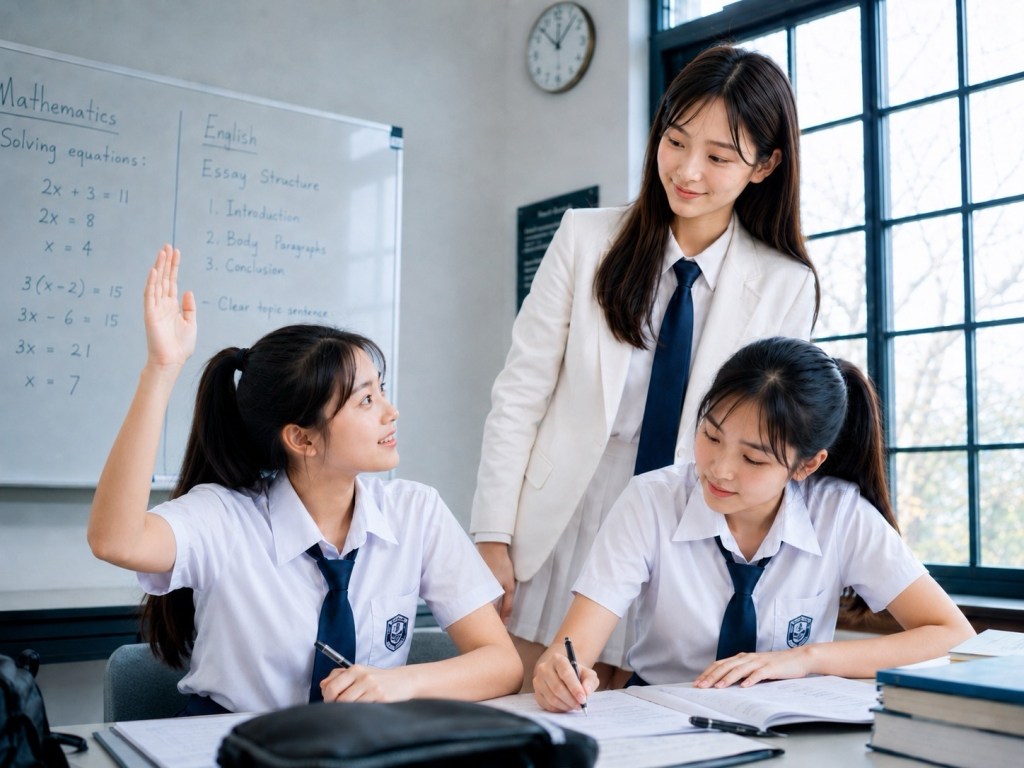
1-to-1 Science Home Tuition Sengkang
And a child who grows in confidence begins to see Science not as a subject to fear, but as a way to understand the world.
1-to-1 Science Home Tuition in Sengkang for Primary, PSLE and Secondary students. Build Science understanding, open-ended answering skills, exam confidence and clear concept explanation with personalised home tuition.
1-to-1 Science Home Tuition in Sengkang helps students move beyond memorising facts into clear scientific explanation. With personalised guidance, students can repair weak concepts, improve open-ended answers, strengthen exam confidence and learn how to think through Science questions with clarity.
Personal Science Tuition for Students Who Need Clarity, Confidence and Better Answers
Science is not just memory.
Science is explanation.
Many students in Singapore begin Science thinking that the subject is about remembering facts, keywords, definitions, diagrams and model answers. At first, that may seem to work. They memorise the digestive system. They memorise the life cycle. They memorise conductors and insulators. They memorise forces, heat, light, electricity, cells, systems, interactions and energy.
Then the questions change.
The exam does not simply ask, “What is this?”
It asks, “Why?”
It asks, “What happens next?”
It asks, “Explain using evidence.”
It asks, “Compare.”
It asks, “Predict.”
It asks, “Give a reason.”
It asks the student to think like a scientist, not recite like a machine.
This is where many students struggle.
They may know the topic, but cannot explain it clearly. They may remember the keyword, but cannot use it in the correct sentence. They may understand during tuition or school lessons, but lose marks in open-ended questions. They may know the concept, but write too generally. They may write a long answer, but miss the scientific point.
For parents looking for 1-to-1 Science Home Tuition in Sengkang, this is usually the real problem.
The child is not always lazy.
The child may not yet know how Science answers work.
Why Science Feels Hard Even When the Topic Looks Familiar
Science can be deceptive.
A student may look at a chapter and think, “I know this already.”
Plants.
Animals.
Magnets.
Electricity.
Matter.
Heat.
Light.
Forces.
Human body systems.
Energy.
Interactions.
Cycles.
The words are familiar.
But Science examinations do not reward familiarity alone. They reward accurate explanation.
A child may know that plants need sunlight. But can the child explain how sunlight is related to food-making?
A child may know that metal is a good conductor. But can the child explain why heat flows faster through metal than plastic?
A child may know that a shadow forms when light is blocked. But can the child explain how the size of the shadow changes when the object moves nearer to the light source?
A child may know that friction slows objects down. But can the child explain how friction acts in the opposite direction of motion?
Science is not just a list of facts.
Science is a thinking system.
When students cannot connect fact, concept, evidence and explanation, their answers become weak. They may write something that sounds scientific but does not answer the question. They may give the correct keyword but place it in the wrong logic. They may know the concept but fail to link cause and effect.
This is why 1-to-1 Science Home Tuition in Sengkang can help.
The tutor does not only teach the chapter.
The tutor studies the child’s thinking.
The Real Problem: The Child Cannot See the Question’s Hidden Demand
Many Science mistakes happen because the student answers the topic, not the question.
The question may be about heat transfer, but the student writes everything remembered about heat.
The question may be about adaptation, but the student writes a general answer about survival.
The question may be about fair testing, but the student explains the experiment wrongly.
The question may be about forces, but the student forgets direction.
The question may be about electricity, but the student does not track the circuit properly.
This is the hidden demand problem.
Every Science question has a demand.
Some questions want a cause.
Some want an effect.
Some want a comparison.
Some want evidence from a table.
Some want a prediction.
Some want a relationship.
Some want a conclusion.
Some want a reason using a specific concept.
Some want the student to use data, not memory.
When students do not see the demand, they write from memory.
That is when marks disappear.
A good 1-to-1 Science tutor helps the student slow down and ask:
What is this question really testing?
What concept is hidden here?
What evidence is given?
What must I compare?
What keyword is needed?
What cause leads to what effect?
What scientific sentence will protect the mark?
This is how Science becomes clearer.
Why 1-to-1 Home Tuition Works for Science
Science is highly personal.
Two students can get the same answer wrong for different reasons.
One student does not understand the concept.
Another understands the concept but cannot write clearly.
One student knows the keyword but does not link it properly.
Another student rushes and misses the question demand.
One student is weak in diagrams.
Another student is weak in data tables.
One student panics in open-ended questions.
Another student loses marks because of vague wording.
In a large class, these problems can hide.
In 1-to-1 home tuition, they become visible.
The tutor can look directly at the child’s work and see the pattern. The tutor can ask the child to explain aloud. The tutor can detect whether the weakness is content, language, logic, memory, confidence, attention or examination technique.
This matters because Science improvement is not only about doing more worksheets.
It is about correcting the right weakness.
If the child lacks content, teach the concept.
If the child lacks keywords, build vocabulary.
If the child lacks explanation, train cause-and-effect sentences.
If the child lacks question reading, teach annotation.
If the child lacks confidence, rebuild through small wins.
If the child lacks exam discipline, train timing and answer structure.
That is the advantage of 1-to-1 Science Home Tuition in Sengkang.
The lesson can move directly to the student’s real problem.
Sengkang Parents: Why Home Tuition Can Be Useful
Sengkang families are busy.
School, CCA, homework, spelling, tests, enrichment, travel time, meals, rest and revision all compete for space in the child’s week.
For some students, home tuition is not only about convenience.
It is about reducing friction.
The child learns in a familiar environment. There is less travel time. The parent can observe the learning rhythm. The tutor can focus fully on the student. Lessons can be shaped around upcoming tests, school topics, weak chapters, PSLE preparation, lower secondary Science or examination revision.
For students who are shy, quiet or easily overwhelmed, 1-to-1 home tuition can also create a safer learning space.
Some children do not ask questions in class.
They are afraid of sounding weak.
They are afraid others already know.
They are afraid the teacher will move on.
They are afraid their question is “too simple”.
But Science collapses when small doubts are left untouched.
If the child does not understand why evaporation causes cooling, later questions on heat become weaker. If the child does not understand energy conversion, electricity and systems become harder. If the child does not understand variables, experiments become confusing. If the child does not understand how to answer “explain”, open-ended questions become frightening.
1-to-1 tuition gives the child permission to ask.
That can change everything.
Primary Science: From Curiosity to Examination Control
Primary Science begins as curiosity.
Why do plants grow?
Why do magnets attract?
Why does ice melt?
Why do shadows change?
Why do animals adapt?
Why do objects float or sink?
Why does electricity flow?
Why does the body need different systems?
At the beginning, Science should feel alive. It should make the child look at the world differently. A good Science tutor should not kill curiosity by turning every lesson into memorisation.
But as students move towards upper primary and PSLE, curiosity must become control.
The child must learn to answer accurately.
This is where many Primary 5 and Primary 6 students struggle. They may enjoy Science. They may even know quite a lot. But exams require disciplined answering.
A PSLE Science answer must often do three things:
It must use the correct concept.
It must use the correct evidence.
It must explain the correct relationship.
For example, a child cannot simply write:
“The plant grows better because it has sunlight.”
That may be too vague.
The answer may need to explain that the plant can make more food when it receives more light, and this supports better growth.
Science rewards the exact link.
This is why Primary Science tuition must train explanation, not just memory.
The Open-Ended Question Problem
Many parents say the same thing:
“My child is okay with MCQ, but loses marks in open-ended.”
That is common.
MCQ allows recognition.
Open-ended requires production.
In MCQ, the answer may be visible among the options. The student can eliminate, compare and guess intelligently.
In open-ended questions, the student must build the answer from scratch.
This requires:
Scientific vocabulary.
Clear sentence structure.
Cause-and-effect logic.
Accurate concept use.
Relevant evidence.
No unnecessary storytelling.
No vague wording.
No missing link.
The open-ended section exposes whether the student truly understands.
A student may know the answer in the head but fail to write it in a mark-worthy way.
That is why 1-to-1 Science Home Tuition should include answer crafting.
The tutor should not only say, “This is wrong.”
The tutor should show the student how to rebuild the answer.
What word is missing?
What link is broken?
What concept should be named?
What data should be used?
What comparison must be made?
What sentence will earn the mark?
Over time, the child learns that Science answering is not random.
It has structure.
Secondary Science: A New Level of Abstraction
Secondary Science becomes more demanding because the subject becomes more abstract.
At primary level, students often study Science through observable situations.
At secondary level, Science becomes more layered.
Students may study cells, particles, forces, energy transfer, chemical changes, ecosystems, reproduction, electricity, waves, pressure, atomic structure, acids and alkalis, and other topics that require stronger conceptual thinking.
The student must now move between the visible and the invisible.
They may see a candle burning, but must explain chemical change.
They may see a bulb light up, but must understand current and circuit behaviour.
They may see a plant growing, but must understand cells, transport and systems.
They may see a hot object cool down, but must explain heat transfer and energy loss.
This is why lower secondary Science can surprise students.
It is not only more content.
It is deeper explanation.
Under Full Subject-Based Banding, students may also offer subjects at different levels as they progress through secondary school. This means Science confidence and subject readiness matter. Students who build strong lower secondary Science foundations are better positioned for upper secondary Science pathways.
A good 1-to-1 Science tutor helps students build that foundation before the subject becomes too heavy.
Science Is a Language Subject Too
This is important.
Science is not English, but Science uses language.
Many students lose marks because their language is too vague.
They write:
“The object changes.”
“The plant is affected.”
“The animal adapts.”
“The heat moves.”
“The circuit works better.”
“The force is stronger.”
These answers may show partial understanding, but they are not precise enough.
Science needs sharper language.
What changed?
How did it change?
Why did it change?
What caused it?
What evidence supports it?
Which object gained heat?
Which object lost heat?
Which direction did the force act?
Which variable was changed?
Which variable was measured?
Which condition was kept the same?
A Science answer must be controlled.
That is why Science tuition must train students to write in a scientific manner.
Not flowery.
Not long.
Not vague.
Clear.
Accurate.
Connected.
The Science Answer Formula: Concept + Evidence + Link
A useful way to help students improve is to train them to build answers in three parts.
Concept.
Evidence.
Link.
The concept tells us which Science idea is being tested.
The evidence tells us what information from the question supports the answer.
The link explains how the concept and evidence answer the question.
For example:
Concept: More light allows the plant to make more food.
Evidence: Plant A received more light than Plant B.
Link: Therefore, Plant A grew taller because it could make more food for growth.
This is simple, but powerful.
Many weak answers fail because one part is missing.
Some students give concept without evidence.
Some give evidence without concept.
Some give both but fail to link them to the question.
1-to-1 tuition allows the tutor to train this repeatedly until the child internalises the pattern.
Science becomes less frightening when the student knows how to construct an answer.
Common Science Problems We See
Students usually do not fail Science because of one big problem.
They leak marks through many small openings.
They memorise keywords without understanding.
They write answers that are too general.
They do not use data from the question.
They skip comparison words such as more, less, faster, slower, higher and lower.
They confuse cause and effect.
They describe instead of explain.
They do not know how to answer “why”.
They copy phrases from notes without adapting them.
They misunderstand experiment variables.
They rush through diagrams.
They make careless MCQ mistakes.
They cannot transfer knowledge to unfamiliar questions.
They panic when the question looks different from the worksheet.
These are not permanent weaknesses.
They are trainable.
But they must be corrected properly.
What Good 1-to-1 Science Home Tuition Should Do
Good Science tuition should not simply make the student do more questions.
More questions can help only when the student is learning from them.
If the child repeats the same thinking mistake across ten worksheets, the child is not improving. The child is rehearsing the mistake.
A good tutor should slow down the mistake.
The tutor should ask:
Why did you choose this answer?
What did you think the question was asking?
Which word in the question matters?
Where is the evidence?
What concept are you using?
Can you explain this in one clear scientific sentence?
Can you draw the process?
Can you compare the two situations?
Can you identify the variable?
Can you predict what happens if the condition changes?
This is how tuition becomes repair.
Not just marking.
Not just drilling.
Repair.
The student learns to see the thinking behind the answer.
1-to-1 Tuition for Different Types of Science Students
Not every child needs the same kind of Science tuition.
Some students need rescue.
They are lost, tired, demoralised or failing. They may feel Science is too much to remember. For these students, the tutor must rebuild confidence first. Start with core concepts. Use simple explanations. Create small wins. Teach the child that Science can make sense again.
Some students need stability.
They are passing but inconsistent. They may understand familiar questions but struggle with open-ended answers or unfamiliar applications. For these students, the tutor must build answer structure, question reading and concept transfer.
Some students need growth.
They are doing reasonably well but want stronger marks. They need sharper explanations, more advanced question exposure, better data interpretation and cleaner exam technique.
Some students need distinction.
They already know the topics but want higher precision. They need harder application questions, faster recognition, stronger reasoning and fewer careless losses.
1-to-1 Science Home Tuition works best when the tutor knows which student is sitting in front of them.
A rescue student should not be taught like a distinction student.
A distinction student should not be slowed down unnecessarily.
A quiet student may need confidence.
A careless student may need discipline.
A memorising student may need understanding.
A strong student may need stretch.
The lesson must fit the child.
How Home Tuition Can Repair Science Confidence
Confidence in Science does not come from praise alone.
It comes from proof.
The child must experience:
“I understand this.”
“I can explain this.”
“I can answer this.”
“I can correct my mistake.”
“I can handle a new question.”
“I can improve.”
That is how confidence returns.
Many students lose confidence because Science feels unpredictable. One week they score well. The next week they lose marks. They cannot tell what went wrong. They feel they studied, but the result does not show it.
A good tutor makes the subject predictable again.
The tutor shows the child that mistakes have categories.
Content mistake.
Keyword mistake.
Evidence mistake.
Linking mistake.
Comparison mistake.
Variable mistake.
Careless mistake.
Exam timing mistake.
Once the child can name the mistake, the child can repair it.
That is a powerful shift.
The student no longer feels attacked by Science.
The student begins to understand the system.
Building a Science Mistake Ledger
One of the best ways to improve Science is to keep a mistake ledger.
Not a pile of wrong answers.
A ledger.
Every mistake is recorded by type.
Did the student misunderstand the concept?
Did the student fail to use the data?
Did the student answer too vaguely?
Did the student miss the comparison?
Did the student use the wrong keyword?
Did the student forget the direction of heat, light, force or current?
Did the student confuse the changed variable with the measured variable?
Did the student describe when the question asked for explanation?
Did the student write too much but say too little?
When mistakes are tracked properly, patterns appear.
The child may realise that the real issue is not Science content.
It may be question reading.
Or answer structure.
Or weak vocabulary.
Or poor comparison language.
Or rushing.
This changes revision.
Instead of saying, “Study harder,” the tutor can say, “This week, we repair comparison answers.”
That is much more useful.
What Parents Should Watch For
Parents do not need to know every Science topic to know when help is needed.
Watch the pattern.
If your child says, “I know it, but I don’t know how to write,” the issue may be answer structure.
If your child scores well in MCQ but poorly in open-ended, the issue may be explanation.
If your child memorises but still loses marks, the issue may be concept transfer.
If your child takes too long to revise, the issue may be weak organisation.
If your child avoids Science, the issue may be confidence.
If your child keeps saying, “Careless mistake,” the issue may be deeper than carelessness.
If your child depends heavily on answer keys, the issue may be independence.
If your child cannot explain the lesson aloud, the concept may not be stable.
These are signs that tuition should not merely add more work.
It should repair the learning system.
Sengkang Science Home Tuition: What the Lesson Can Look Like
A strong 1-to-1 Science lesson should be calm, focused and diagnostic.
First, the tutor checks what the student is learning in school.
Then the tutor identifies the weak link.
Is the child weak in concept?
Is the child weak in keywords?
Is the child weak in open-ended answers?
Is the child weak in diagrams?
Is the child weak in experiments?
Is the child weak in application?
Next, the tutor teaches the concept clearly.
Not too fast.
Not too abstract.
Not only from notes.
The tutor should help the child see the process.
Then the tutor moves into questions.
Not random questions.
Purposeful questions.
A good lesson may include:
Concept explanation.
Diagram analysis.
Keyword training.
MCQ elimination.
Open-ended answer crafting.
Experiment variable practice.
Data interpretation.
Correction of past mistakes.
School worksheet review.
Test preparation.
Exam strategy.
The goal is not to finish pages.
The goal is to strengthen thinking.
Why Science Needs Both Understanding and Practice
Some parents ask whether Science is about understanding or practice.
It is both.
Understanding without practice becomes fragile.
Practice without understanding becomes mechanical.
The student needs concept clarity first, then repeated application.
For example, it is not enough to know that heat travels from a hotter object to a cooler object. The student must apply this idea to metal spoons, ice cubes, insulation, body temperature, cooking, evaporation and experimental setups.
It is not enough to know that plants need light. The student must apply this to photosynthesis, growth, food-making, leaf structure, experimental variables and data comparison.
It is not enough to know that electricity flows in a closed circuit. The student must apply this to bulbs, switches, batteries, conductors, arrangements and changes in brightness.
Science becomes strong when knowledge can move.
That is transfer.
Good Science tuition trains transfer.
The Parent’s Role at Home
Parents do not have to become Science teachers.
But parents can help by creating the right environment.
Ask your child to explain one concept in simple words.
Ask, “Why?” after an answer.
Ask, “What evidence tells you that?”
Ask, “What changed in this experiment?”
Ask, “What stayed the same?”
Ask, “Can you compare these two?”
Ask, “What did you learn from the mistake?”
These small questions teach the child that Science is not just memorising.
It is reasoning.
Parents can also help by not treating every mistake as failure.
A mistake is information.
If the mistake is used properly, it becomes a repair point.
That is how students grow.
Why 1-to-1 Science Home Tuition Is Not for Everyone
1-to-1 tuition is powerful, but it must be used properly.
Some students do better in small groups because they enjoy peer energy.
Some students need competition.
Some students learn well from discussion.
Some students benefit from hearing other students’ questions.
But 1-to-1 home tuition is especially useful when the child has specific weaknesses, low confidence, heavy gaps, school test pressure, irregular understanding, or a need for close correction.
It is also useful when parents want a lesson shaped closely around the student’s school pace, upcoming tests, homework issues and examination timeline.
The key is not whether tuition is 1-to-1 or group.
The key is whether the tuition solves the child’s actual Science problem.
Science Is a Future Skill
Science is not only for examinations.
Science trains a way of thinking.
It teaches students to observe carefully.
It teaches them to ask questions.
It teaches them to compare evidence.
It teaches them to test ideas.
It teaches them to explain cause and effect.
It teaches them to think about systems.
It teaches them to stay curious about the world.
In a future shaped by technology, medicine, engineering, climate issues, artificial intelligence, data, materials, energy and environmental change, Science thinking matters.
Not every child will become a scientist.
But every child benefits from learning how to reason clearly.
That is why Science tuition should not reduce the subject into memorised answers only.
It should help the child become a stronger thinker.
The Aim: Catch Up, Keep Up, Move Ahead
For students who are behind, 1-to-1 Science Home Tuition in Sengkang should help them catch up.
Repair the weak chapters.
Rebuild the missing concepts.
Make Science less frightening.
Help the child answer again.
For students who are coping, tuition should help them keep up.
Stay aligned with school.
Strengthen open-ended answers.
Prepare for tests.
Correct mistakes early.
For students who are ready, tuition should help them move ahead.
Attempt harder questions.
Improve precision.
Build exam confidence.
Train for AL1, strong grades and future Science readiness.
The pathway is simple.
Catch up.
Keep up.
Move ahead.
But the work must be done properly.
Closing Thought: Science Becomes Easier When It Becomes Clear
Science is difficult when it feels like a mountain of facts.
Science becomes easier when the student sees the system.
Facts connect to concepts.
Concepts connect to questions.
Questions connect to evidence.
Evidence connects to explanation.
Explanation earns marks.
That is the route.
For parents searching for 1-to-1 Science Home Tuition in Sengkang, the goal should not be more panic, more worksheets or more memorisation without meaning.
The goal should be clarity.
A child who understands Science can explain.
A child who can explain can answer.
A child who can answer can grow in confidence.
FAQ
Is 1-to-1 Science Home Tuition suitable for weak students?
Yes. 1-to-1 Science Home Tuition can be especially helpful for students who are weak, quiet, confused or low in confidence because the tutor can slow down, identify the exact weakness and rebuild the student’s understanding step by step.
Can 1-to-1 Science tuition help with PSLE Science?
Yes. PSLE Science requires strong concept understanding, accurate keywords, clear open-ended answers, data interpretation and exam discipline. 1-to-1 tuition can target the student’s specific weak areas before the examination.
Why does my child understand Science but still lose marks?
Many students understand the topic but cannot express the answer in a scientific way. They may miss keywords, evidence, comparison language or cause-and-effect links. Science tuition helps students convert understanding into mark-worthy answers.
Is Science mainly about memorising keywords?
No. Keywords are important, but memorising them is not enough. Students must know when to use each keyword, how to link it to the question, and how to explain the concept accurately.
What is the difference between Science group tuition and 1-to-1 home tuition?
Group tuition gives students peer learning and class energy. 1-to-1 home tuition gives more direct attention, personalised pacing and immediate correction. The better option depends on the child’s personality, confidence and learning needs.
Can Secondary Science students benefit from home tuition?
Yes. Secondary Science becomes more abstract and requires stronger explanation, concept transfer, data interpretation and experimental reasoning. 1-to-1 tuition can help students build these skills before upper secondary Science becomes more demanding.
How often should a student attend Science tuition?
Many students benefit from weekly Science tuition, especially when preparing for PSLE, school exams or lower secondary assessments. Students with larger gaps may need more consistent support until the foundation becomes stable.
What should good Science tuition focus on?
Good Science tuition should focus on concept clarity, question analysis, open-ended answering, experiment skills, data interpretation, keyword accuracy, mistake correction and exam confidence.
One-to-One Science Tuition in Sengkang provides a highly personalized learning experience where a dedicated tutor works directly with a single student, focusing entirely on that student’s specific academic needs and goals. Here’s how it stands out and why it can be particularly beneficial:
1. Tailored Instruction to Address Individual Needs
- In a one-to-one Science home tuition setting, the tutor assesses the student’s strengths, weaknesses, and preferred learning styles, then tailors lessons accordingly. This customized approach allows the tutor to target specific areas of difficulty, whether it’s foundational gaps in biology, complex physics principles, or advanced chemistry equations, giving the student a much more efficient and effective learning experience.
2. Focused Attention and Immediate Feedback
- Unlike group classes, one-to-one tuition offers the student the undivided attention of the tutor, enabling immediate feedback and clarification on concepts. This direct interaction ensures that misunderstandings are promptly addressed, reducing the likelihood of knowledge gaps and increasing the student’s confidence in the subject.
3. Flexible Learning Pace
- One-to-one tuition adapts to the student’s pace, allowing for accelerated learning in stronger areas and a more gradual approach in challenging topics. This flexibility is especially beneficial for students preparing for PSLE or GCE O-Levels, as it helps them build a strong foundation while ensuring they’re fully prepared for exam requirements.
4. Enhanced Exam Preparation and Strategy Development
- With an individual focus, the tutor can go beyond just teaching content and focus on developing exam-specific skills like time management, answering techniques, and understanding the MOE SEAB syllabus requirements in detail. Mock tests and timed exercises allow the student to practice under exam conditions, honing strategies that maximize their performance.
5. Building a Supportive Mentor-Student Relationship
- One-to-one tuition fosters a strong, supportive relationship between the tutor and student, making it easier for the tutor to motivate the student, address anxieties, and boost their self-confidence. This mentoring aspect can be invaluable, especially for students who feel anxious or less motivated in group settings.
6. Efficient Use of Time and Resources
- In a private, focused setting, there is no time spent waiting for others or adjusting to the varied pace of a group. Every session is concentrated on the student’s individual progress, making one-to-one tuition a highly efficient use of time, especially beneficial for students with busy schedules or those needing to improve quickly.
In Sengkang, 1-to-1 Science Home Tuition Sengkang provides students with a tailored and focused approach to mastering science, helping them build confidence, achieve higher grades, and ultimately develop a deep and lasting understanding of the subject. This intensive support can make a marked difference in academic performance, particularly for students aiming to excel in key exams.
eduKate Parent’s Review
Parent Review:
“Ever been lost in the maze of finding quality science tuition in Sengkang? That was me, chasing my tail while my son’s grades slid south. Then, out of the blue, a colleague mentioned eduKate’s Sengkang Science Tuition. We didn’t waste a second—got him enrolled early. And guess what? His grades didn’t just improve; they skyrocketed by three levels! It’s like he found his mojo. If you’re in the same boat, don’t hesitate.”
Parent Review:
“Science and my daughter? Like oil and water—they just didn’t mix. We tried everything, but nothing clicked. Scouring Sengkang for a decent science tuition was no picnic. Then a flyer for eduKate’s Sengkang Science Tuition landed in our mailbox. Figured we’d give it a whirl. Starting early turned out to be the golden ticket. Two grades up, and she’s actually enjoying science now! Who would’ve thought?”
Parent Review:
“Picture this: my son, frustrated, textbooks everywhere, science grades plummeting. I was tearing my hair out. Then, during a casual chat at the market, someone dropped the name eduKate’s Sengkang Science Tuition. Skeptical but desperate, we jumped on it early. Lo and behold, he leaped ahead by one whole grade! The turnaround was nothing short of amazing. If you’re grappling with similar woes, eduKate might just be your answer.”
PRIMARY SCIENCE TUITION IN SENGKANG
Primary Science Tuition in Sengkang: Building a Strong Foundation for PSLE Success
Primary Science is an essential subject that fosters curiosity, critical thinking, and a deeper understanding of the world around us. At eduKate Singapore in Sengkang, our Primary Science Tuition program is designed to help students develop a solid foundation in science concepts, learn scientific inquiry skills, and prepare effectively for the PSLE. Through engaging lessons, hands-on activities, and targeted exam preparation, we equip students with the knowledge and skills they need to excel in Science.
Why a Strong Science Foundation is Essential for PSLE Success
A thorough understanding of science concepts and inquiry skills is essential for success in school assessments and the PSLE. Our Primary Science Tuition program covers all key topics in the MOE Primary Science syllabus while emphasizing critical thinking, problem-solving, and application.
1. Comprehensive MOE-Aligned Curriculum Covering Key Topics
Our Primary Science Tuition program follows the MOE syllabus, ensuring students master all the essential topics required for PSLE. The curriculum includes:
- Diversity of Living and Non-Living Things: Understanding various forms of life and non-living matter.
- Cycles: Exploring life cycles, water cycles, and cycles in matter.
- Systems: Learning about different systems, such as the digestive and respiratory systems.
- Energy: Gaining insight into energy forms, sources, and conservation.
- Interactions: Studying interactions within ecosystems, between materials, and understanding forces.
By aligning with the MOE syllabus, our program provides a structured approach that prepares students for school assessments and the PSLE.
2. Scientific Inquiry and Thinking Skills
Science is not just about facts and formulas; it’s about inquiry and discovery. Our program encourages students to think critically and approach problems scientifically by teaching them the skills of scientific inquiry:
- Formulating Hypotheses: Encouraging students to ask questions and make predictions.
- Experimentation and Observation: Teaching students to design experiments, observe results, and analyze data.
- Drawing Conclusions: Helping students use evidence to form logical conclusions, enhancing their understanding of scientific concepts.
Through scientific inquiry, students develop an appreciation for the subject and gain the skills to tackle science questions confidently.
3. Hands-On Activities to Enhance Understanding
To make science engaging and relevant, our tutors incorporate hands-on activities and experiments that allow students to explore concepts practically. Through these activities, students:
- Apply Concepts in Real Life: Relating science topics to everyday experiences, such as plant growth or water conservation.
- Engage Actively in Learning: Participating in experiments that demonstrate scientific principles, making learning fun and memorable.
- Strengthen Retention: Hands-on learning reinforces concepts and improves long-term retention, especially helpful for PSLE preparation.
4. Exam-Focused Preparation for the PSLE
Our Primary Science Tuition program includes a strong focus on PSLE preparation, equipping students with the skills, strategies, and confidence needed to excel in the exam. Key areas of exam preparation include:
- Understanding Question Types: Teaching students how to tackle multiple-choice, structured, and open-ended questions effectively.
- Answering Techniques: Guiding students in presenting clear and logical answers, using scientific terms and diagrams where applicable.
- Time Management Skills: Practicing under timed conditions to help students manage their time during exams.
These strategies ensure that students are fully prepared for the PSLE Science paper and can approach the exam with confidence.
Tuition Rates and Packages
At eduKate Singapore, we provide competitive tuition rates, giving families options that meet their needs.
Here’s an overview of Singapore Primary Science tuition rates by tutor category:
| Tutor Type | Primary 1 | Primary 2 | Primary 3 | Primary 4 | Primary 5 | Primary 6 |
|---|---|---|---|---|---|---|
| Part-Time Tutors | $25-$35/h | $25-$35/h | $25-$35/h | $31-$44/h | $30-$40/h | $30-$40/h |
| Full-Time Tutors | $35-$45/h | $35-$45/h | $35-$45/h | $44-$56/h | $40-$50/h | $40-$50/h |
| Ex/Current MOE Teachers | $50-$70/h | $50-$70/h | $50-$70/h | $63-$88/h | $60-$80/h | $60-$80/h |
| Professional Tutors | $80-$100/h | $80-$100/h | $90-$100/h | $92-$110/h | $100-$140/h | $100-$190/h |
Our Primary Science Tuition program combines affordability with quality instruction, ensuring students receive the support they need to su
A 1-to-1 Home Tuition Sengkang Science Enrichment course for Sengkang students offers unique advantages, especially as students face increasingly complex topics in the MOE SEAB Science curriculum. Here’s why such a course is invaluable:
1. Bridging Knowledge Gaps and Reinforcing Core Concepts
- Many students struggle with challenging science concepts like physics and chemistry, which are essential for PSLE and secondary-level exams. A Science Enrichment course offers additional, focused instruction on these fundamental areas, building a strong conceptual base that helps prevent future academic struggles.
2. Enhanced Problem-Solving Skills
- Science enrichment goes beyond rote learning by emphasizing practical problem-solving. Students engage in activities that involve critical thinking, experiments, and hands-on learning, which build real-world applications of classroom knowledge. This not only deepens their understanding but also equips them with strategies to tackle diverse question types in exams.
3. Advanced Exposure and Curiosity Building
- A key benefit of enrichment courses is the opportunity to explore science topics beyond the standard curriculum, like environmental science, technology, or basic genetics. By exposing students to a broader range of scientific ideas, these programs cultivate curiosity, inspiring students to engage more enthusiastically with the subject.
4. Focused Exam Preparation and Stress Management
- Enrichment courses often provide targeted exam preparation, with practice tests and feedback that address specific exam requirements in Sengkang’s MOE SEAB Science syllabus. Additionally, they offer stress-management techniques, teaching students to handle exam pressure effectively and approach exams with confidence.
5. Small Group Interaction and Collaborative Learning
- In smaller, enrichment-focused classes, students benefit from closer interaction with their tutors and peers. This allows for a more customized learning experience where students can ask questions freely, share ideas, and work on projects together, making learning more dynamic and enjoyable.
6. Early Preparation for Higher-Level Science
- Enrichment courses that start early lay the groundwork for future success, especially for students aiming for top results in PSLE, GCE O-Levels, and beyond. With an early focus on science, students can approach advanced topics with greater ease and a solid foundational understanding, helping them maintain an academic edge.
A 1-to-1 Science Home Tuition Sengkang Enrichment course for students doesn’t just aim to improve grades; it fosters a genuine interest in science, develops critical skills, and supports a holistic learning journey that extends well beyond exams.
How to Get Started
Consultation
If you’re interested in helping your child excel in Primary 3 Science, we offer a consultation to assess their current Science proficiency and learning needs. During this consultation, we develop a personalized learning plan to ensure your child gets the support they need to succeed.
Trial Lessons (Available Upon Request)
Due to our 3-pax-per-class limit, trial lessons are available depending on availability. Please inquire during your consultation to see if a trial lesson is open in our Primary 3 Science tuition classes.
For more information or to schedule a consultation, visit EduKate Singapore or contact us on Facebook.
Contact Us Today
Give your child the advantage they need for PSLE Science success. Contact us now to learn more about our tuition programs or to schedule a consultation:
- Phone: +65 82226327
- Email: admin@edukatesg.com
Visit our website at edukatesingapore.com to explore how our Sengkang Primary Science tuition can help your child excel.
At eduKate Singapore, we believe in nurturing bright minds and preparing them for a successful future. Let us help your child achieve their full potential in PSLE Science and beyond.
 eduKate Sengkang